
One short, human-sounding sentence that adds perspective, not facts, beats any paragraph of executive praise. That matters because about 28% of journalists use release quotes regularly while 13% never touch them at all, and half say the language simply doesn’t sound natural. A public relations firm may spend years placing clients on television, radio, and in print, and the quotes that survive a reporter’s edit are almost always the shortest ones in the draft.
TL;DR:
- Quotes should be a single, natural-sounding sentence that states a specific fact, outcome, or opinion relevant to the announcement.
- They must come from the most credible, authoritative person available for that particular claim and be prepared with rehearsed, concise language.
- Quotes are most effective when placed at the beginning, middle, or end of the release to add emotion, context, or a memorable closing line.
- Follow AP style: use double quotation marks, place punctuation inside quotes, and attribute quotes after the first sentence of a multi-sentence quote.
- Focus on clarity, brevity, and authenticity by writing quotes in plain speech, avoiding corporate jargon, and removing unnecessary words or clichés.
Table of Contents
- When Should You Include a Quote in a Press Release?
- How Do You Write an Effective Press Release Quote?
- Getting the Format Right: AP Style, Attribution, and Pull Quotes
- Strong vs. Weak Quotes: Side-by-Side Examples
- What Goldman McCormick PR Tells Clients Before a Draft Goes Out
- Why Most PR Teams Overthink the Quote and Underthink the Speaker
- Get Professional Help Writing Quotes That Get Picked Up
- Sources
When Should You Include a Quote in a Press Release?
A quote earns its place only when it does something the facts around it can’t. If a sentence just restates the headline in a different font, cut it. If it adds emotion, a reaction, or a point of view no other line in the release carries, keep it.
That’s the filter Media Helping Media’s newsroom guidance uses too: reserve quotes for feelings or opinions, and let straight facts stay in paraphrase. A launch date is a fact. “This changes how our patients get same-day care” is an opinion worth quoting.
Placement depends on the job the quote needs to do:
- In the lead or right after it: use a quote to hook a skeptical reporter with a bold, specific claim they can’t find anywhere else in the wire copy.
- In the middle: use a quote to add context, interpretation, or a reaction that helps a journalist understand why the news matters.
- At the close: use a quote to leave a memorable, forward-looking line, something a broadcast producer might read on air as the final beat of the story.
Most releases need one to two speakers, not more. A single executive quote handles most product or company news. Bring in a second voice, a customer, a partner, a board member, only when that person adds a genuinely different angle rather than echoing the spokesperson.
Journalism itself leans on a broader convention sometimes called the three quote guideline, the idea that a well-sourced story pulls perspective from at least three credible voices. That’s a newsroom habit, not a PR rule. Chasing three quotes in a press release usually just dilutes the one strong line you actually have.
How Do You Write an Effective Press Release Quote?
Write one sentence. Not two, not a paragraph with a semicolon holding it together. One.
That target isn’t arbitrary. Analysis cited by PRsay found average quoted length in sampled news running 19 to 20 words, with the single most common length landing around seven words. Reporters lift short lines because short lines fit into a paragraph, a chyron, or a radio read without trimming. A quote that runs three sentences gets paraphrased or cut outright.
Length is only half the job. The sentence also has to sound like a person said it out loud, not like it passed through a legal review. Journalists complain about this constantly: 34% say release quotes lack substance, and 50% say the language just doesn’t sound natural. That complaint traces back to one habit: writers default to corporate throat clearing instead of a real reaction.
Here’s a working process for drafting a quote that survives the edit:
- Write down what the spokesperson would actually say in a hallway conversation. Skip the press release voice entirely on the first pass.
- Cut it to one sentence. If two ideas fight for space, keep the sharper one and drop the other.
- Remove every word that could appear in any company’s release. “Excited,” “thrilled,” “proud to announce,” and “state of the art” all fail this test.
- Add one concrete, forward-looking, or human detail. A number, a specific outcome, a plain statement of what changes for the customer.
- Confirm the attribution names the most authoritative person available for that topic. Journalism style guides recommend attributing to whichever source carries the most authority on the specific claim, not necessarily the highest title on the org chart.
- Read it aloud. If you stumble over it, a reporter will cut it.
Pro Tip: Draft three versions of the same quote at three different lengths, one full sentence, one clipped to under ten words, one expanded with a specific number, and let the release’s tone decide which survives. Wire editors often prefer the shortest of the three.
A few corporate-to-human swaps make the pattern obvious:
| Corporate version | Human version |
|---|---|
| “We are thrilled to announce this exciting new partnership.” | “This partnership gets patients into treatment three weeks faster.” |
| “Our team is committed to excellence and innovation.” | “We built this because the old process was wasting people’s time.” |
| “This milestone represents a significant achievement for our organization.” | “Ten years ago, this office had two employees. Today it has sixty.” |
Notice the human versions all do one thing the corporate versions don’t: they tell the reader something specific enough to picture. That’s the entire craft in a sentence.
Break up any spokesperson statement longer than two sentences into separate quotes placed in different paragraphs. A CEO who talks for four sentences straight rarely gets quoted in full, but two of those sentences, split apart and each doing distinct work, might both make it into print.
Getting the Format Right: AP Style, Attribution, and Pull Quotes
Style errors are the fastest way to make a good quote look amateur to a copy desk. The mechanics are simple, but they trip up drafts constantly.
- Use double quotation marks for direct speech, never single marks, except for a quote nested inside another quote.
- Place the comma or period inside the closing quotation mark, always.
- Put attribution after the first sentence of a multi-sentence quote, not before it and not buried at the end. “This is the biggest shift we’ve made in five years,” said the CEO. “It changes how every client interacts with our team.”
- Capitalize the first word of a quoted sentence even mid-paragraph, since it’s a full sentence in its own right.
- Identify the speaker clearly with full name and exact title on first mention, matching standard newsroom sourcing practice.
Block quotes rarely belong in a press release. Wire services and news desks work in short paragraphs, and a large indented block reads as filler rather than substance. If a spokesperson’s statement runs long, split it into two attributed quotes separated by a sentence of context instead of stacking it into one dense block.
Pull quotes, the visually isolated lines used in multimedia releases or on a landing page, work differently. They exist to catch a scanning eye, so they should be the single sharpest line in the release, PR Newswire’s formatting guidance treats them as a distinct element from the body quote, not a repeat of it. Reusing the same line in the body and as a pull quote wastes the opportunity to say two different things.
The most common fixable errors: mismatched quotation marks around a paraphrase, attribution dropped in front of a long statement instead of after the first sentence, and titles that don’t match the person’s actual role. Copy desks catch these fast, and they cost you credibility before the story ever runs.
Strong vs. Weak Quotes: Side-by-Side Examples
Seeing the edit happen is more useful than reading a rule about it. Here’s how the same announcement type improves once you apply the cuts above.
- Product launch. Weak: “We are incredibly excited to bring this innovative new product to market and believe it will change the industry.” Strong: “Doctors have asked for this for a decade. Now they finally have it.” The strong version drops the adjectives and states a concrete origin for the product instead.
- Partnership announcement. Weak: “This strategic partnership represents a significant milestone in our ongoing commitment to innovation.” Strong: “Our clients get access to twice the caseload capacity starting Monday.” A partner announcement should quote a number or a date, not a mission statement.
- New hire. Weak: “We are thrilled to welcome such a talented and experienced professional to our growing team.” Strong: “She spent eight years prosecuting cases like this. Now she’s building our defense strategy from the other side.” The hiring manager or a peer works better here than a generic HR line.
- Fundraising round. Weak: “This funding will allow us to continue our mission of delivering exceptional value to our customers.” Strong: “We’re hiring twenty engineers by June and shipping the feature customers have wanted since 2023.” Investors and founders both work as speakers, but only the founder should name the specific plan.
- Rebrand. Weak: “Our new brand identity reflects our evolution as a company and our vision for the future.” Strong: “The old name described what we were in 2016. It doesn’t describe what we do now.” A founder or long-tenured executive carries more weight than a marketing lead here.
- Crisis or correction statement. Weak: “We take this matter very seriously and are committed to addressing any concerns.” Strong: “We got this wrong, and here’s exactly what we’re changing so it doesn’t happen again.” In a crisis release, the highest-ranking available executive should be the one speaking, not a spokesperson lower in the chain.
Every strong version runs one sentence, names something specific, and avoids a word that could apply to any company on any day. That pattern repeats across every release type.
What Goldman McCormick PR Tells Clients Before a Draft Goes Out
Every quote sent to a client for approval should pass through the same five checks: does it say one thing clearly, does it avoid a corporate cliché, does it name the right speaker for the story, does it match AP style punctuation, and would a producer read it on air without editing it first.
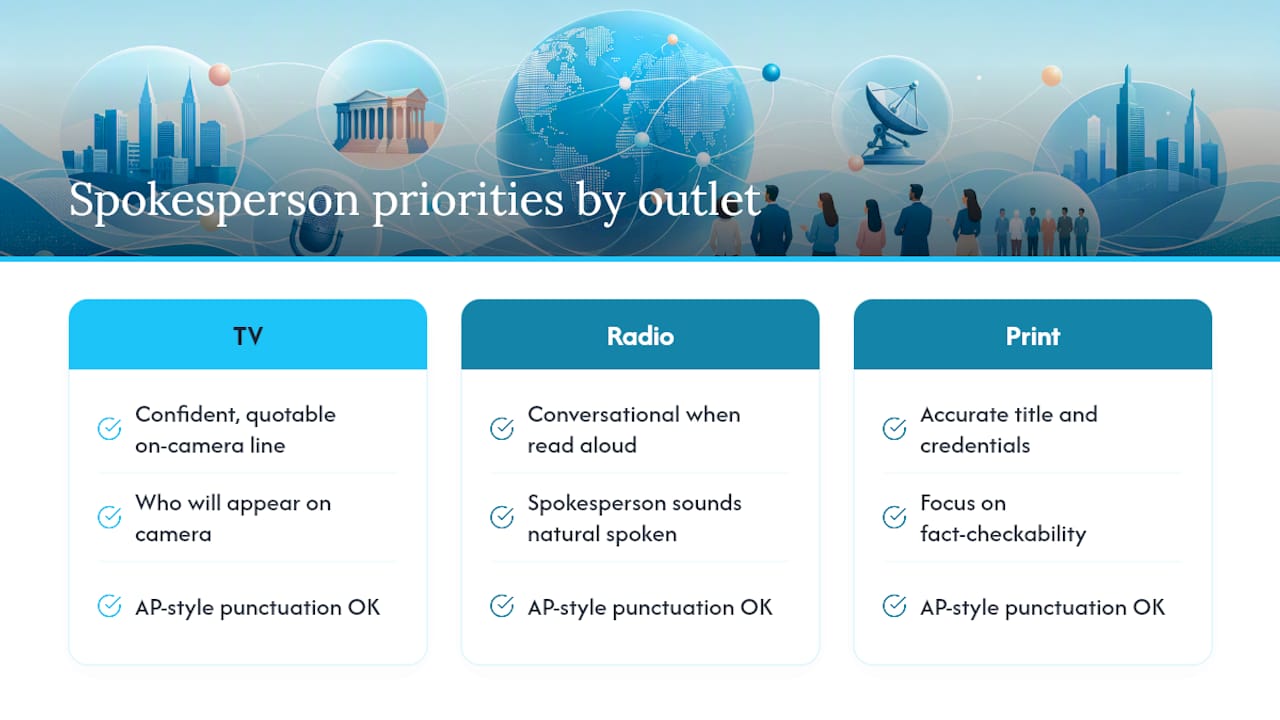
Speaker selection changes by outlet. Television producers want a confident, quotable line from whoever will actually appear on camera. Radio hosts want a spokesperson who sounds conversational when read aloud, not stiff. Print reporters care less about delivery and more about whether the title and credentials hold up under a fact check.
Awards and recognitions from outlets such as Forbes, Bulldog Reporter, and the New York Observer reflect years of getting exactly this kind of language right before it reaches a reporter’s inbox. Those recognitions reflect years of getting exactly this kind of language right before it reaches a reporter’s inbox.
Why Most PR Teams Overthink the Quote and Underthink the Speaker
The habit worth building isn’t a better sentence template. It’s a better editing sequence: draft the quote in plain speech first, cut it to one line, then check whether the speaker attached to it is actually the most credible person available for that specific claim. Most releases get the sentence roughly right and the speaker wrong, quoting a marketing lead on a clinical claim, or a founder on a detail an operations manager actually owns.
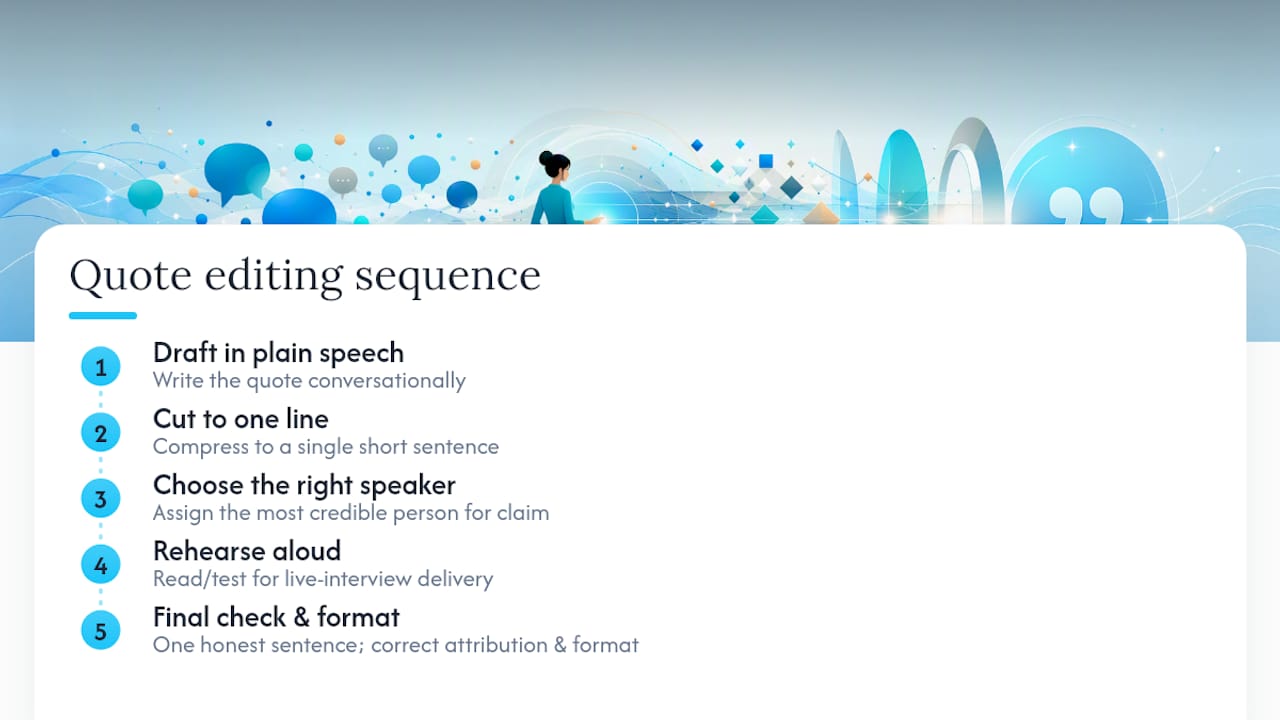
Rehearse the line with the spokesperson before it goes out. A quote that reads well on paper sometimes falls apart the moment someone tries to say it in a live interview, and a producer will notice the gap between the press release and the person answering questions.
None of this changes the verdict from the top: one short, honest sentence, attributed to the right person, formatted the way a copy desk expects it. Everything else is refinement.
— Ryan McCormick
Get Professional Help Writing Quotes That Get Picked Up
Writing a quote that survives a copy desk is one skill. Getting that release in front of the right TV producer, radio host, or newspaper editor is a different one entirely, and it’s the part most in-house teams struggle with once the draft is done. Some public relations firms handle both press release writing, media outreach, and direct placement on television, radio, and in newspapers, built around journalist-first editing standards covered above.
If your last three releases went out and generated silence, the quote probably wasn’t the only problem. Getting the right reporter to open the email matters just as much as what’s inside it. A few ways to start:
- Request a quick review of your next draft quote before it goes out to a distribution list.
- Ask for a sample edit on a past release to see how the language changes.
- Book a consultation to map out a distribution plan for your next announcement.
Visit the Goldman McCormick PR team to start that conversation, or explore how other PR and communications best practices shape the kind of coverage-ready copy reporters actually pick up.