
Prepare a focused, evidence-led nomination: one-paragraph case summary, two to three measurable metrics, and client sign-off, then submit before the deadline. Judges evaluating dozens of entries reward the challenge, action, impact narrative over adjective-heavy prose, so build your submission around evidence, not enthusiasm. Assign one owner to the nomination, calendar the deadline immediately, and gather your client approvals in parallel with drafting rather than after.
TL;DR:
- Choosing niche categories with clear judging criteria and verified past winners increases chances of success and reduces competition.
- Start submissions at least six weeks before the deadline, allowing ample time for drafting, approvals, formatting, and internal quality checks.
- Focus on concrete metrics, third-party validation, and strong storytelling that answer the specific award questions directly.
- Avoid generic language, exceeding word limits, or submitting in the wrong category, as these are common reasons for disqualification.
- Reuse a prepared awards template and coordinate multiple contributors with clear ownership to streamline the process and improve outcomes.
Table of Contents
- How to Submit for Legal Awards Step by Step
- Which Legal Awards Are Worth Entering?
- What Makes a Winning Legal Award Narrative?
- How Far in Advance Should You Start a Submission?
- How to Turn a Legal Award Win Into Business Development
- What Goldman McCormick PR Brings to Awards Season
- What Does a Legal Awards Submission Actually Cost?
- What Mistakes Sink Otherwise Strong Legal Award Entries?
- How Should You Tailor Entries for Regional vs. National Awards?
- What Do Judges and Past Winners Say Separates Winning Entries?
- How Do You Manage Multiple Contributors on One Submission?
- Three Unexpected Fixes That Change Submission Outcomes
- How Goldman McCormick PR Supports Award Season
- Sources
How to Submit for Legal Awards Step by Step
Most legal award nominations fail for the same reason: the team starts drafting before mapping the actual questions the application asks. Fix that order first.
- Read the category criteria line by line and match each judging question to a specific piece of evidence you already have or can get quickly.
- Choose the category that fits your actual work, not the one with the most prestigious name. A niche practice-area category often has less competition and a better evidence fit than a broad “Firm of the Year” entry.
- Draft a one-paragraph case summary that states the challenge, what your team did, and the result. This becomes your anchor text for the rest of the form.
- Write the expanded narrative, answering each award question directly using the summary as scaffolding.
- Collect metrics, client approvals, and supporting documents, redacting anything confidential before it goes anywhere near a submission portal.
- Format attachments exactly as instructed, since award pages such as the New York Legal Awards publish specific rules on file types, word counts, and required fields.
Before you submit, run a short quality check:
- Confirm word counts on every open text field.
- Verify file formats match the portal’s accepted types (PDF versus Word trips up more entries than you’d expect).
- Check naming conventions on attachments so reviewers can tell what they’re opening.
- Proofread for the firm’s correct legal name and practice group titles.
- Submit well before the deadline, save the confirmation screen or email, and follow up directly if the portal gives no automatic receipt.
Pro Tip: Build a submission “shell” once (mission statement, firm bio, boilerplate metrics) and reuse it across every category you enter that year. It cuts drafting time by more than half on your second and third submissions.
Which Legal Awards Are Worth Entering?
Not every award deserves your partners’ time. Legal marketing experts increasingly recommend a prioritization framework before committing resources to any program, because scattershot entry wastes billable hours chasing recognition nobody outside the firm notices.
Before you commit to any legal excellence award, check for these credibility markers:
- A named, identifiable judging panel rather than “our editorial team.”
- A public list of past winners you can verify independently.
- Editorial reach that means something to your actual clients and referral sources.
- Clear criteria published before you pay any fee.
Rank each candidate award against strategic fit, likely audience impact, cost and staff time required, and program credibility. A regional award with modest fees but strong local referral-source visibility often beats a pricier national program with vague judging standards.
Watch for red flags: any organizer that pressures you to pre-purchase a “winner’s package,” charges steep fees before naming finalists, or won’t explain how judging works. Industry commentary on award strategy consistently warns against mass submissions to unverified programs.
Pro Tip: If an award’s website is heavier on “nominate now” buttons than on judge bios or past winners, treat that as a warning sign, not an opportunity.
What Makes a Winning Legal Award Narrative?
Judges reading fifty similar submissions remember structure. Use a simple arc: challenge, action, result. Open with the problem your client or firm faced, describe specifically what your team did, and close with what changed.
Try sentence starters like: “When [client/situation] faced [specific challenge]…” followed by “Our team responded by…” and closing with “As a result, [measurable outcome].”
Metrics carry more weight than adjectives. Outcomes like case value recovered, percentage reduction in litigation time, or client retention rates convince judges faster than phrases like “exceptional service.” When figures are confidential, describe scale in relative terms, such as a percentage improvement instead of a dollar figure, or use client-approved ranges.
Third-party validation strengthens every claim:
- Press clippings covering the matter or campaign.
- Client testimonials, quoted with permission.
- Referee contacts judges can call directly.
- Public court records or filings, where applicable.
One coherent finding across guides on winning submissions is that judges prefer tangible proof over marketing language almost every time. Format your evidence so it’s scannable: bolded outcome lines, short bullet callouts under each narrative section, and clearly labeled attachments (a reviewer skimming ten entries in an hour will reward whatever they can find fastest). The same storytelling discipline that wins brand engagement in content marketing applies directly here.
Pro Tip: Bold your single best metric within the narrative text itself. Judges skimming under time pressure often remember only what’s visually distinct.
How Far in Advance Should You Start a Submission?
Work backward from the deadline, not forward from today. A reasonable internal timeline looks like this:
- Six weeks out: Research categories, confirm criteria, assign an owner.
- Four weeks out: Draft the case summary and expanded narrative.
- Three weeks out: Send to the client for approval and gather metrics.
- Two weeks out: Incorporate partner and compliance review.
- One week out: Final QA pass and formatting check.
- Three days out: Submit and archive the confirmation.
Stakeholder sign-off needs a real checklist, not a hallway conversation:
- Client approval on any quoted results or testimonials.
- Compliance or ethics review where bar rules govern self-promotion claims.
- Partner-in-charge review of the practice group’s factual accuracy.
The most common administrative errors are missed word counts, forgetting to redact confidential figures, uploading the wrong file version, and misreading eligibility windows. A short internal QA checklist catches nearly all of them before submission, which matters since official category pages rarely offer grace periods for correction.
How to Turn a Legal Award Win Into Business Development
A shortlist or win is a marketing asset with a short shelf life. Act on it within days, not weeks.
- Issue a press release and pitch it directly to relevant legal trade press.
- Update your firm’s website with a dedicated awards page and structured data markup for search visibility.
- Refresh attorney bios and LinkedIn profiles to reference the recognition.
- Pitch the win into existing client and referral-source newsletters.
The same awards-as-channel thinking that recommends year-round evidence collection also applies to promotion: treat each result as reusable material for pitches, RFP responses, and lateral recruiting conversations. A well-optimized awards page with clear headlines and metadata compounds SEO value over time, and recruiters searching for firms with recent recognition will find it.
Pro Tip: Draft your press release language before you know the outcome. Having a template ready means you can publish within hours of the announcement instead of days.
What Goldman McCormick PR Brings to Awards Season
Goldman McCormick PR was named one of “America’s Best PR Firms For 2021” by Forbes Magazine, and the New York Observer previously cited the agency as one of the top five PR firms specializing in legal PR. That legal-sector focus matters when a submission needs both persuasive writing and media instincts.
A PR partner handling award submissions typically manages:
- Category selection and prioritization against your firm’s actual strengths.
- Narrative drafting and evidence structuring for maximum judge impact.
- Approvals coordination between attorneys, clients, and compliance.
- Post-win amplification through media pitching and press placement.
What Does a Legal Awards Submission Actually Cost?
Entry fees for legal industry awards vary widely, and firms consistently underestimate the total spend because they budget only for the fee itself.
Direct costs include the submission fee, which can range from modest sums for regional practice-specific awards to larger amounts for national programs with heavy media reach. Many programs charge separately for each category entered, so a firm submitting the same case study to three categories pays three fees, not one.
Incidental costs add up faster than firms expect. Attorney and marketing staff time drafting and reviewing a strong narrative often runs several hours across multiple people. If the program requires a gala ticket, table, or attendance fee for finalists, that’s a separate line item, sometimes larger than the entry fee itself. Design costs for a polished PDF submission, professional headshots if required, or a short video component (increasingly requested by national programs) all belong in the budget.
Build a simple cost worksheet before committing to any given award: entry fee, expected staff hours multiplied by a reasonable rate, any required attendance costs, and a small buffer for last-minute formatting help. Compare that total against the strategic value the award actually delivers, using the same prioritization thinking that governs category selection. A firm that tracks this honestly usually finds that a handful of well-chosen regional and practice-specific awards deliver better return than one expensive national gala entry.
What Mistakes Sink Otherwise Strong Legal Award Entries?
The most common failure isn’t weak work, it’s weak presentation of strong work. Firms with genuinely excellent results routinely lose to competitors with better-organized submissions.
Missing the deadline window entirely, or submitting so close to the cutoff that a portal error becomes fatal, remains the single most preventable error. Build in a buffer of at least 48 hours.
Generic language kills otherwise strong entries. Phrases like “client-focused” and “innovative approach” with no supporting evidence read as filler to judges scanning dozens of similar entries. Every claim needs a metric, an example, or a third-party validation point attached to it.
Ignoring word limits or required fields is a fast disqualification path. Some portals reject submissions automatically for exceeding character counts; others simply cut off text, leaving your strongest closing point unread.
Skipping client approval creates real risk. Publishing a client’s results or quote without sign-off can trigger a withdrawal request after judging has already begun, wasting the entire effort.
Reusing last year’s submission without updating metrics is another quiet killer. Judges on multi-year panels sometimes recognize recycled language, and stale numbers signal a firm that hasn’t grown.
Finally, entering the wrong category dilutes strong work. A genuinely excellent practice-group achievement often loses in a broad “Firm of the Year” category against louder competitors, when it would have stood out clearly in a specific practice-area category instead.
How Should You Tailor Entries for Regional vs. National Awards?
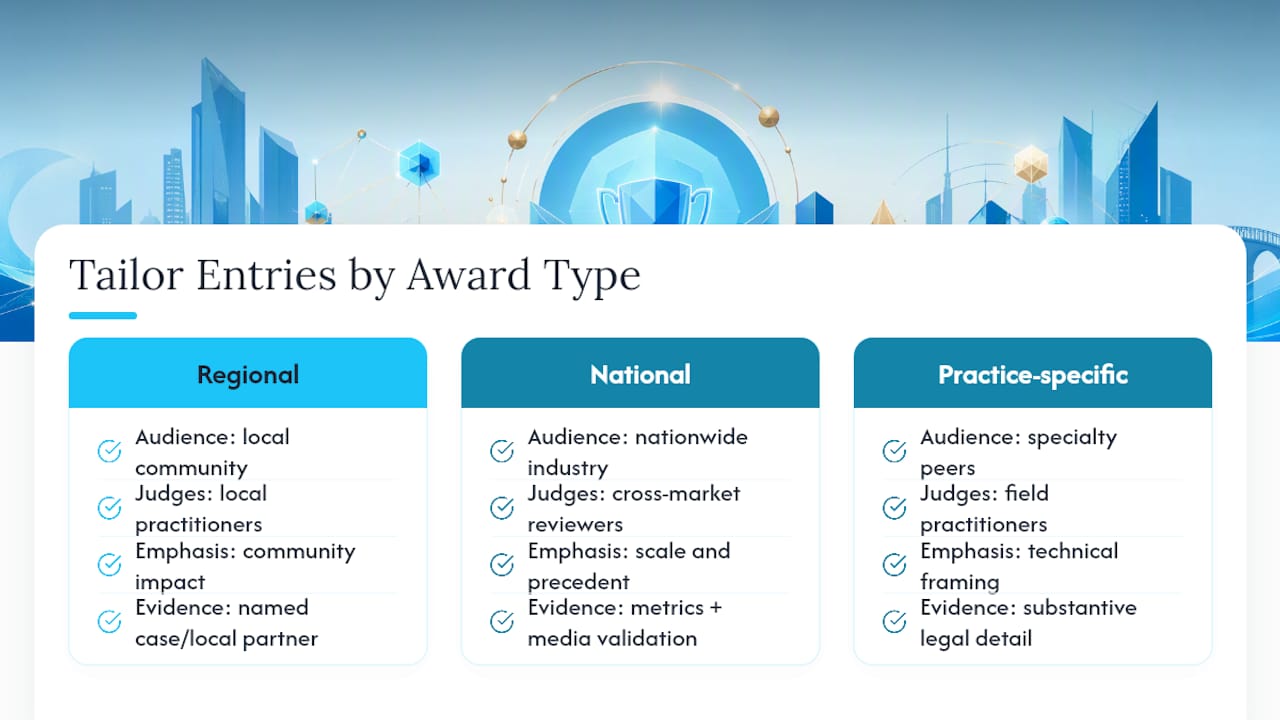
A regional or state bar association award and a national industry program are not the same audience, and treating them identically weakens both entries.
Regional awards typically reward community impact, local reputation, and relationships with local courts, clients, or bar leadership. Judges are often local practitioners themselves, so specific, verifiable local detail (a named case, a local nonprofit partnership, a regional client) carries real weight. Keep the narrative grounded in geography and community context rather than broad industry claims.
National awards demand a different register. Judges reviewing entries from across the country care less about local color and more about scale, precedent-setting impact, or measurable business results that translate across markets. A national submission should lean harder on quantifiable metrics and third-party media validation, since judges have no local context to fill in gaps.
Practice-specific awards, such as those focused on litigation, intellectual property, or corporate transactions, require narrower technical framing. Judges in these categories are often practitioners in that exact field, so oversimplifying the legal complexity can actually hurt you. Include enough substantive detail to demonstrate real expertise, while still keeping the narrative accessible to a judge who may specialize in a related but distinct area.
The practical takeaway: never submit the identical narrative to a regional bar award and a national industry program. Rewrite the opening and evidence emphasis for each audience, even when the underlying case is the same.
What Do Judges and Past Winners Say Separates Winning Entries?
Ask anyone who has judged a legal industry award what separates a shortlisted entry from a discarded one, and the answer rarely involves the underlying legal work itself. It’s almost always about how clearly that work gets communicated.
Judges consistently reward specificity over scale. A submission claiming “significant results for our client” loses to one stating a concrete percentage or dollar figure, even when the underlying achievement is comparable. Vague superlatives read as filler; specific numbers read as proof.
Past entrants who’ve succeeded repeatedly tend to treat the case summary as the most important paragraph in the entire document, not an afterthought written last. Reviewers skimming dozens of applications often decide within the first few sentences whether an entry deserves a full read.
Judging panels also notice when a submission answers the actual question asked rather than a related question the firm prefers to answer. It sounds obvious, but marketing teams under deadline pressure frequently repurpose old bio language that drifts from what the category criteria actually require.
One pattern that shows up across expert commentary on award narratives is that entries built around a single, well-told matter or initiative consistently outperform entries that try to summarize an entire year of firm activity. Depth on one strong story beats breadth across five mediocre ones.
How Do You Manage Multiple Contributors on One Submission?
Legal award nominations rarely come from one person. A partner has the case knowledge, a marketing coordinator has the writing skill, and a client contact needs to approve the final language. Coordinating all three without losing weeks requires a clear structure from day one.
Assign a single owner for the submission, even when several people contribute content. That person tracks the deadline, chases approvals, and has final say on what gets submitted. Without one clear owner, submissions drift between people until nobody is sure who’s responsible for the final version.
Separate content creation from approval clearly. Ask the attorney for facts and metrics first, in rough form, rather than polished prose. Let the marketing writer shape that raw material into the narrative structure, then route the draft back to the attorney and client for factual and tone approval, not for a rewrite.
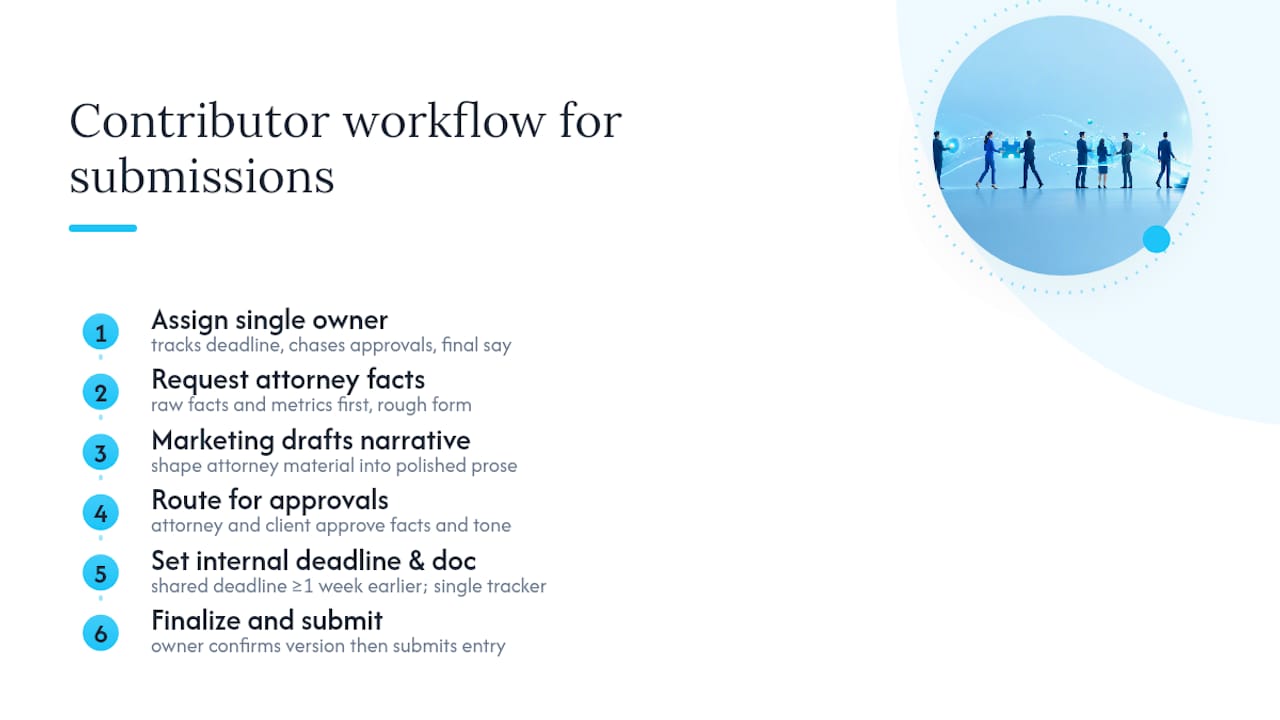
Set a shared internal deadline that sits at least a week before the actual submission deadline. This buffer absorbs the inevitable delay when a partner is in trial or a client is slow to respond to an approval request.
Use a single shared document or tracker rather than email threads with multiple attachment versions. Version confusion, someone editing an outdated draft, is one of the most common reasons submissions go out with factual errors or missing approvals.
Three Unexpected Fixes That Change Submission Outcomes
The teams that win consistently aren’t the ones with the best cases. They’re the ones who start six weeks early, cut every unsupported adjective before submitting, and calendar next year’s awards the week after this year’s results arrive. One firm we’ve seen repeatedly lose out simply reused stale bio language instead of writing to the actual category question. Build awards into your annual marketing calendar now, not next deadline season.
— Ryan McCormick
How Goldman McCormick PR Supports Award Season
Preparing a genuinely competitive nomination takes attorney time, marketing bandwidth, and someone who knows how judges actually read these entries. Goldman McCormick PR handles that work directly: category strategy, narrative drafting, client and compliance approvals, and amplification once results come in.
The agency’s legal PR focus, recognized by the New York Observer as among the top firms specializing in legal media work, means submissions get built by people who understand both legal accuracy and what earns media pickup afterward. That combination matters more than most firms realize until a win goes unpublicized because nobody had a press release ready.
If your firm is weighing which categories to enter this season, or needs a team to draft, coordinate approvals, and manage the calendar end to end, reach out to Goldman McCormick PR to scope your submission strategy before the next deadline closes.