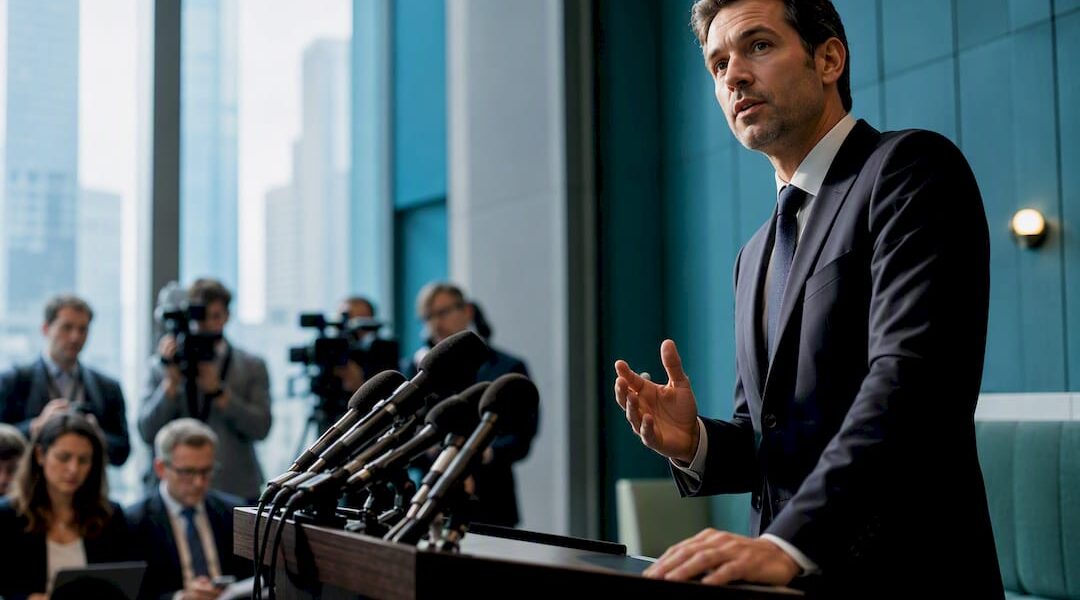
Hold a press conference only when the story is genuinely newsworthy enough to warrant television coverage and the client’s posture can withstand public scrutiny; otherwise, pitching individual reporters directly is more efficient and far less risky. If those two conditions hold, your next move is a quick huddle between the client, defense counsel, and your PR lead to lock messaging before anything gets scheduled.
TL;DR:
- Conduct a press conference only if the case has significant newsworthiness and public interest, and if the client can withstand public scrutiny.
- Ensure approval from the client, check ethical boundaries, and assess risks before booking a venue and scheduling the event.
- Design the space carefully with branding, camera angles, and security in mind, scheduling between 10 a.m. and 11 a.m. for optimal TV coverage.
- Limit spokespeople to one or two, prepare clear messages, and anticipate difficult questions with mock sessions to maintain message control.
- Coordinate closely with legal counsel to avoid discussing sealed or privileged information, and follow up promptly with edited footage and coverage monitoring.
Table of Contents
- Law Firm Press Conference Checklist: What to Confirm Before You Book a Room
- Is a Press Conference the Right Move for This Case?
- Setting Up the Room: Logistics That Look Right on Camera
- Crafting Your Message and Choosing Who Speaks
- Getting Reporters in the Room: Outreach and Distribution
- Live Streaming and Digital Amplification
- Legal and Ethical Guardrails Before You Speak Publicly
- After the Cameras Leave: Follow-Up and Measurement
- How Goldman McCormick PR Runs a Law Firm Press Conference
- Crisis Communication Strategies Specific to Law Firms
- Handling Difficult or Sensitive Questions at the Podium
- Coordinating With Clients and Managing Their Expectations
- Public Relations Professionals vs. In-House Legal Staff: Who Runs What
- What Actually Breaks a Press Conference
- Ready to Put a Press Conference on the Calendar?
- Sources
Law Firm Press Conference Checklist: What to Confirm Before You Book a Room
Before you touch a venue calendar, run the decision safeguards: written client consent, an ethics check against your state bar rules, and a plain-language risk assessment of what public exposure could do to the case. Skip any of these and you’re improvising in front of cameras.
Once you’re cleared to proceed, the logistics list looks like this:
- Timing and venue: confirm date, room capacity, parking, and building security clearance
- AV and staging: microphones, backdrop with firm signage, seating for press, riser for cameras
- Personnel: designated spokespeople, a media liaison separate from the speakers, a photographer or videographer
- Materials: printed press kits, a Q&A prep sheet, written bios, holding statements for unresolved questions, and a plan for delivering B-roll after the event
Miss the materials step and reporters leave with nothing to build a segment around, which kills your coverage before it starts.
Is a Press Conference the Right Move for This Case?
Ask five questions before you commit to a live event:
- Will the coverage reflect favorably on the client and the firm?
- Is there genuine public interest, and does the story have visual elements worth filming?
- Could the exposure create legal or reputational risk that outweighs the benefit?
- Have reporters already shown independent interest in the story?
- Is the timing right, given where the case stands procedurally?
If the answers lean negative, you have alternatives: an embargoed release timed to a specific outlet, one-on-one briefings with reporters who already cover the beat, or targeted pitches to a single TV or radio producer. A careful weighing of pros and cons matters here because publicity can cut both ways. It can support a client’s narrative or hand opposing counsel language to use in court.
Pro Tip: If even one of the five questions gives you pause, default to a one-on-one briefing with your top target reporter instead of a full press conference. You control the message better and cut your exposure risk in half.
Setting Up the Room: Logistics That Look Right on Camera
Every visual detail in the room ends up in the broadcast. Backdrop, signage, and speaker arrangement will appear in wide shots, so design the space with that framing in mind, not just for the people standing in it.
Run through this before the doors open:
- Backdrop with firm branding positioned for wide-angle and close-up shots alike
- Podium height and microphone placement tested with your actual spokespeople
- Seating arranged so photographers have a clean sightline to the podium
- Overflow plan if more press shows up than RSVPed
- Building security briefed on media credentials and access points
- Weather contingency if any portion happens outdoors
On timing, scheduling between 10 a.m. and 11 a.m. gives TV crews enough runway to edit footage for the evening news, which is the single biggest lever you control over whether your event actually airs that night.
Assign clear roles on-site: a media liaison to greet press and manage sign-in, a designated staffer to run the Q&A microphone, and security posted at entry points if the case carries any volatility.
Crafting Your Message and Choosing Who Speaks
Before you write a single line for the podium, build an elevator pitch and three supporting messages your spokesperson can repeat without sounding scripted. A structure that works well for legal audiences: acknowledge the difficulty of the situation (Pity), affirm the client’s character or position (Praise), then state what happens next (Promise). It’s plainspoken, and it reads as sincere rather than rehearsed.
Keep the stage tight. Cap on-camera spokespeople at one or two, and route logistics and follow-up questions through a separate media liaison who never speaks on record. Too many voices at the podium dilutes the message and multiplies your risk of someone going off script.
- Keep opening remarks under one minute
- Prepare a written Q&A document with anticipated questions and approved answers
- Draft holding statements for anything still under investigation or sealed
- Run at least one mock Q&A session before the real thing
Opening statements should stay brief, with the bulk of the time reserved for questions. A firm looking to sharpen its narrative arc before the event can borrow structure from outside disciplines. Story development techniques used in commercial production apply just as well to a two-minute opening statement as they do to a thirty-second ad.
Pro Tip: Write your holding statement for the worst question you can imagine getting, then have your spokesperson say it out loud five times before the event. If it still sounds stiff on the fifth try, rewrite it.
Getting Reporters in the Room: Outreach and Distribution
A press conference with no press defeats the purpose. Build your invitation list around the outlets most likely to actually show up and file a story.
- Build a targeted media list: local TV assignment desks, courthouse and legal-beat reporters, and relevant trade press
- Send a formal media advisory 24 to 48 hours ahead, but pitch your top two or three target reporters earlier and individually
- Consider offering a short exclusive or embargoed detail to your highest-priority outlet in exchange for guaranteed coverage
- Follow up by phone the morning of the event, not just by email
- Supplement the live event with a written press release distributed the same day, so outlets that couldn’t attend still get the story
Reporters who cover courts and legal news get pitched constantly. Treating them as a resource rather than a target and following up with useful, accurate information after the event builds the kind of relationship that gets your next pitch answered.
Live Streaming and Digital Amplification
A room full of reporters is no longer the ceiling on your reach. Live streaming or recording the event for later distribution extends coverage well past whoever physically showed up.
- Pick a streaming platform ahead of time and assign a technical producer to run it
- Run a full stream test the day before, including audio levels and camera angles
- Capture B-roll, still photography, and short pull-quote clips suited for social posts
- Send reporters a download link to edited B-roll and high-resolution stills within hours, not days
- Confirm you have release forms and usage rights for anyone appearing in recorded footage
Skipping the rights confirmation is the most common oversight here, and it’s the one that comes back to bite firms months later when footage resurfaces somewhere unexpected.
Legal and Ethical Guardrails Before You Speak Publicly
Every word said at the podium is a word your firm may need to explain later, sometimes in front of a judge. Keep statements factual and steer clear of anything that could prejudice a jury pool, consistent with the spirit of ABA Model Rules 1.6 (confidentiality) and 3.6 (trial publicity).
- Get written, informed client consent before scheduling anything
- Coordinate every talking point with litigation counsel, not just the PR team
- Use a holding statement for facts that are still unconfirmed or under seal
- Delay public comment entirely if premature statements could jeopardize trial fairness
Pro Tip: When in doubt about whether a statement crosses an ethical line, ask defense counsel to redline the exact language you plan to say out loud. A verbal approval isn’t the same as a written one when something goes sideways later.
After the Cameras Leave: Follow-Up and Measurement
The event ending doesn’t mean the work is done. Momentum dies fast if you don’t move quickly.
- Send a digital press kit and edited B-roll to attending and invited reporters within hours
- Monitor coverage across TV, print, and online for accuracy, and request corrections on factual errors immediately
- Log every placement: outlet, reporter, tone, and reach
- Compare results against your original objectives, not just raw mention counts
- Use strong coverage as a springboard to pitch a follow-up interview or a bylined op-ed
A press conference that generates three accurate, sympathetic segments is a bigger win than one that generates ten mentions with the facts garbled. Measure for quality of message, not just volume of clips.
How Goldman McCormick PR Runs a Law Firm Press Conference
The workflow a specialist firm follows looks like this: assess newsworthiness and risk, build messaging, handle production and staging, run targeted media outreach, then amplify coverage after the event closes. Goldman McCormick PR has executed this playbook for attorneys, particularly in the New York criminal defense space, since 2010. Forbes named the firm one of America’s best PR firms for 2021, Bulldog Reporter awarded it a Gold Award for Best Cause/Advocacy Campaign in 2016, and the New York Observer listed it among the top five legal PR agencies in 2014. Clients typically receive a press kit, a media list, spokesperson coaching, and a post-event coverage report. Bring in a specialist when the stakes or the media list exceed what your in-house team handles regularly.
Crisis Communication Strategies Specific to Law Firms
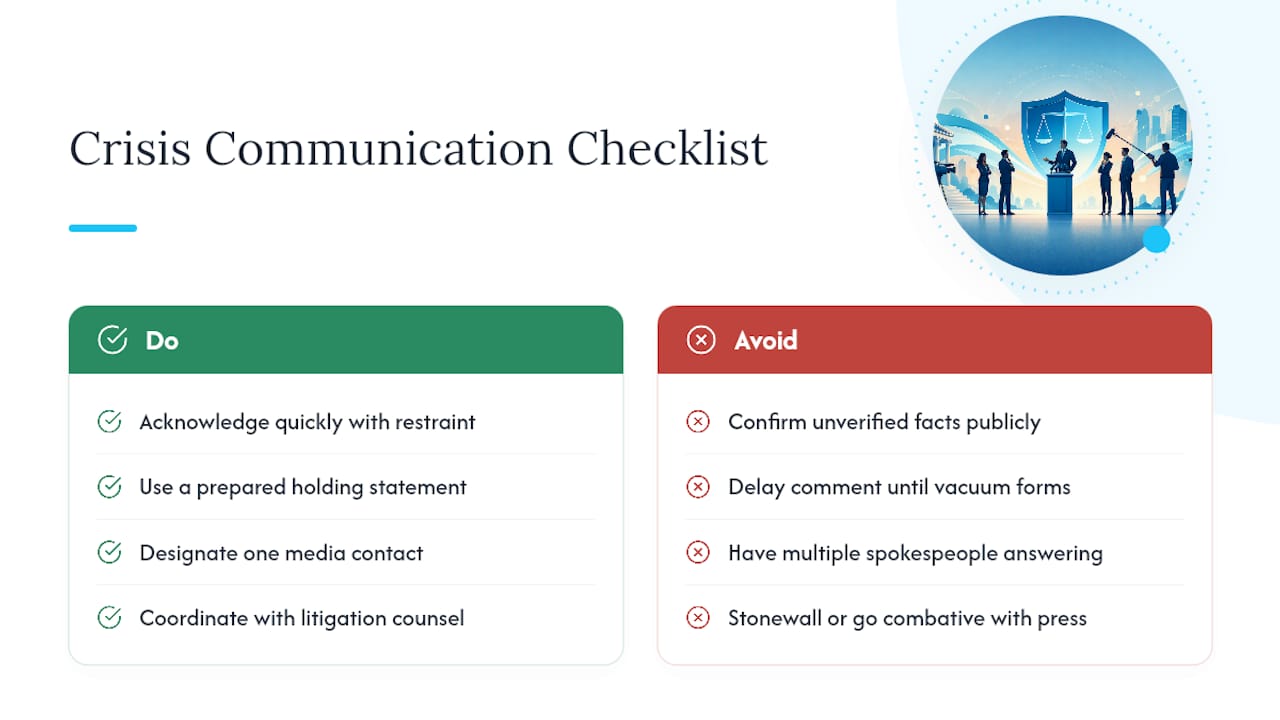
A law firm crisis is different from a corporate one because every public statement can become evidence, or at least fodder for opposing counsel’s cross-examination. The first rule is speed with restraint: acknowledge the situation quickly, but never confirm facts you haven’t verified with your legal team.
Build a holding statement before you need one. Something as simple as “We are aware of the situation and are gathering the facts” buys time without committing to details that could shift as the case develops. Firms that wait too long to say anything often find a vacuum filled by opposing counsel, a disgruntled former employee, or speculative reporting, none of which they control.
Designate a single point of contact for all media inquiries during a crisis, even if that means routing calls away from the attorney whose name is on the case. Reporters calling five different people at the same firm and getting five different answers is how a manageable situation turns into a credibility problem.
Coordinate closely with litigation counsel on what can and cannot be said publicly, since a poorly worded crisis statement can resurface as an exhibit. Positioning your firm as a reliable, respectful source even under pressure tends to earn more balanced coverage than stonewalling or going combative with reporters.
Handling Difficult or Sensitive Questions at the Podium
The question you didn’t prepare for is the one that ends up in every headline. That’s exactly why anticipating hard questions and running mock interviews beforehand matters more than almost anything else on this list.
Train your spokesperson to bridge back to one of the three core messages rather than getting pulled into speculation. A simple technique: acknowledge the question, state what can be confirmed, then pivot to the message you actually want repeated on air. “I understand why you’re asking that, but what I can tell you is…” works better than deflecting outright, which reads as evasive on camera.
For anything touching sealed records, ongoing investigation details, or privileged client information, the answer is a prepared holding statement, delivered calmly and without apology. “That’s a matter for the court, and we won’t be commenting on sealed proceedings” is a complete answer. Repeating it twice, calmly, usually ends the line of questioning.
Never let a spokesperson guess at an answer to sound helpful. A wrong guess at a press conference doesnn’t get a quiet correction later; it gets quoted as fact. If the honest answer is “I don’t have that information yet,” say exactly that, then follow up with the reporter directly once you do.
Coordinating With Clients and Managing Their Expectations
Clients often think a press conference will fix a problem instantly. Managing that expectation before the event, not during it, prevents a lot of friction on the day itself.
Walk the client through exactly what will and won’t happen: who’s speaking, what questions are likely, what the firm can and cannot say publicly, and what the realistic outcome looks like in terms of coverage. A client who understands the process going in is far less likely to freeze at the podium or go off script when a reporter asks something unexpected.
Get informed written consent before you schedule anything, not as a formality but because the client needs to understand the exposure they’re accepting. Some clients want visibility and are comfortable with the spotlight. Others are better served by a quieter, one-on-one briefing strategy, and part of your job is helping them see which situation actually applies to their case.
Set realistic timelines too. Clients frequently expect same-day national coverage from a single event, which rarely happens outside major stories. Frame success in terms your client can actually evaluate: number of outlets reached, tone of coverage, and whether the narrative reflects the story you agreed on together, rather than raw impression counts pulled from a general search.
Public Relations Professionals vs. In-House Legal Staff: Who Runs What
A press conference works best when legal staff and PR professionals stick to separate lanes instead of overlapping on the same tasks.
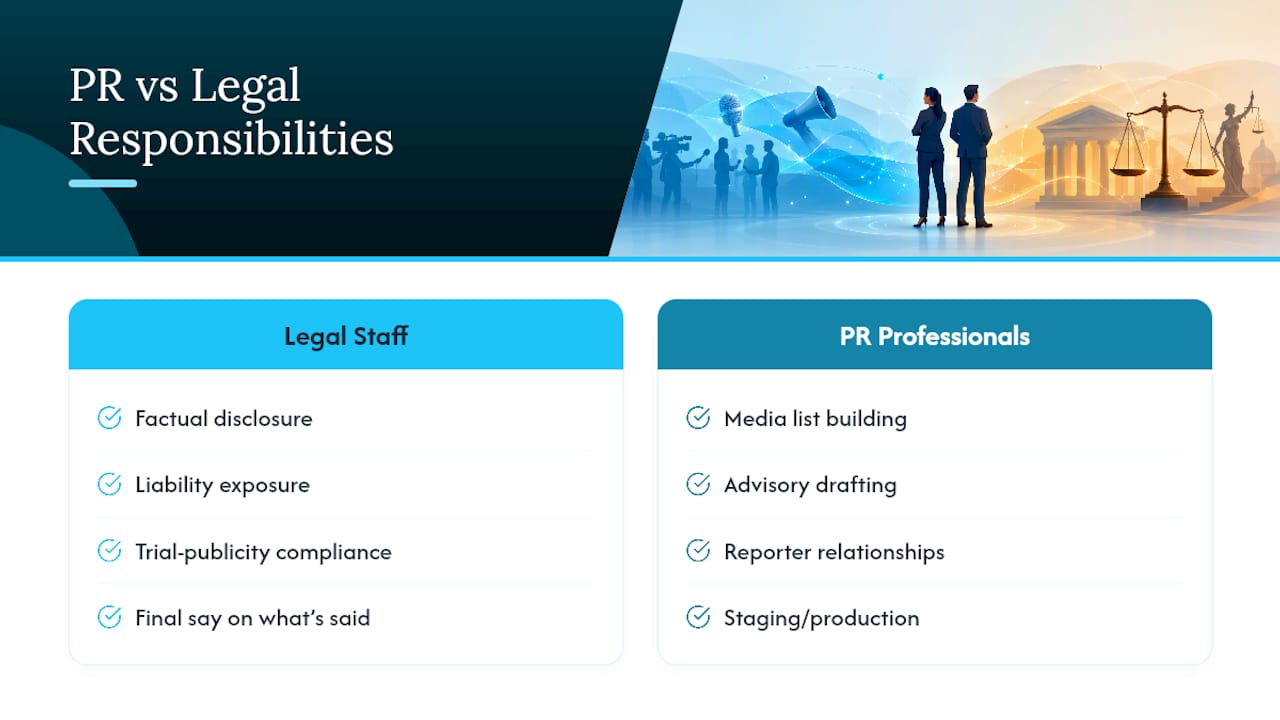
Legal staff, particularly litigation counsel, own everything related to substance: what facts can be disclosed, what language creates liability exposure, and whether a statement risks violating rules on trial publicity. That’s not a PR judgment call, and treating it as one is how firms end up with a public statement that becomes a legal problem.
PR professionals own execution: media list building, advisory drafting, reporter relationships, staging, spokesperson coaching, and the post-event follow-up that actually generates coverage. A litigation associate might understand the case cold, but rarely has the reporter relationships or production experience to get a story picked up by three local news stations on the same afternoon.
The firms that get this wrong tend to make one of two mistakes: they let attorneys run PR strategy without media training, which produces stilted, defensive soundbites, or they let a PR team draft language without legal review, which produces statements that read well but create exposure. The two teams should build the messaging together, with legal holding final say on what gets said and PR holding final say on how and to whom it gets delivered.
What Actually Breaks a Press Conference
Message control, timing, and production quality decide whether a press conference helps or hurts a case. In practice, most failures trace back to three habits: too many spokespeople diluting the message, AV problems that make the firm look unprepared on camera, and skipping legal review because the event got scheduled too fast. Fix those three, and most of the rest of the checklist takes care of itself.
— Ryan McCormick
Ready to Put a Press Conference on the Calendar?
Planning the logistics is one thing. Getting a room full of reporters who actually show up, film usable footage, and file a fair story is a different skill entirely. Goldman McCormick PR handles the parts most in-house teams don’t do every week: building targeted media lists, securing TV and radio placement, coaching spokespeople through mock Q&A, and managing the post-event follow-up that turns one event into a week of coverage.
Since 2010, the firm has focused specifically on attorneys and legal professionals, which means the media relationships and message discipline built into every event are shaped around the ethical constraints your case actually operates under, not generic corporate crisis playbooks. If your firm has a story worth telling and you want it handled by people who’ve run this exact playbook for New York attorneys for over a decade, visit the Goldman McCormick PR team to talk through your timeline and get a plan built around your case.
Sources
- Litigation Publicity and Press Conferences: What Law Firms Need to Consider | Furia Rubel Communications, Inc. – JDSupra
- Prosecutors and the Press: Ethical and Practical Guidance — PCE and PAAM
- Why & how to hold press conferences — Michigan Bar Association
- 7 tips on crisis communications from a media-savvy lawyer – Ragan Communications