
Yes, a practicing psychologist can become a sought-after media expert, and the fastest route runs through three moves: build media-ready assets, get short-format training, and answer reporters fast. The APA’s own guidance draws the line between commentator and clinician, while platforms like Qwoted show how reporters actually source quotes. Goldman McCormick PR, named one of America’s best PR firms by Forbes in 2021, has built this exact pipeline for clinicians for over a decade.
TL;DR:
- Psychologists should focus on building quick-to-verify credentials, clearly stating their licenses, specialties, and providing short media clips to increase booking chances.
- Media appearances require strict adherence to ethical guidelines, avoiding diagnosis, therapy-like advice, or referencing identifiable clients or public figures.
- Effective media interviews emphasize clear, concise answers and preparation for different formats like TV, radio, or podcasts to improve engagement and shareability.
- Tracking audience reach, inquiries, and bookings from media appearances helps measure impact, and promptly sharing clips and thanking producers boosts future opportunities.
- Signing and understanding release agreements is essential for protecting your rights, especially regarding content reuse, duration, and potential licensing through media contracts.
Table of Contents
- What Are the Ethical Limits for Psychologists Commenting in Media?
- How Do You Build a Media-Ready Professional Profile?
- What Media Interview Skills Do You Need for TV, Radio, and Podcasts?
- How Do You Secure Media Placements and Work With Producers?
- How Do You Measure and Convert Media Coverage Into Bookings?
- Maintaining Client Confidentiality and Privacy in Media Contexts
- Navigating Contractual Agreements and Usage Rights for Media Appearances
- How Do You Stay Current on Media Trends as a Psychology Expert?
- Agency Perspective: How Goldman McCormick PR Prepares Clinicians for Media
- Get Started With Goldman McCormick PR’s Media Services
- Sources
What Are the Ethical Limits for Psychologists Commenting in Media?
The APA’s guidance draws a hard line between two roles: expert commentator and treating clinician. On-air, you’re the former. That means no diagnosing a public figure, no “treating” a caller, and no offering advice that sounds like a therapy session broadcast to strangers. The APA’s professional considerations for working with media spell out why this distinction protects both the public and your license.
A few habits keep you inside those lines:
- Speak in general patterns and research findings, never about a specific named or implied individual.
- Decline to speculate about a public figure’s mental state, even when a host pushes for it.
- Use a disclosure line when useful: “I can’t speak to any one person’s situation, but the research on this pattern shows…”
- Flag risk topics before the segment airs, especially suicide or self-harm, so producers know what language to avoid.
Suicide coverage deserves its own caution. Research on short media-training interventions found that a brief session measurably improved psychiatrists’ compliance with WHO recommendations on responsible reporting, things like avoiding method detail and including crisis resources. A single sentence prepared in advance (“Let’s focus on warning signs and where people can get help, rather than specifics”) can steer a host away from harmful framing without you sounding preachy.
How Do You Build a Media-Ready Professional Profile?
Producers move fast, and they skip anyone whose credentials take five minutes to verify. Your “For media” page needs to answer their questions before they ask.
Include these elements:
- Your credential and license type, stated plainly (not buried in a bio paragraph).
- Your niche, no more than two or three specific topics you’re known for, not “general psychology.”
- Availability windows and preferred contact method, ideally an email checked daily.
- Two or three short video or audio clips, thirty to ninety seconds, showing you speaking clearly on camera or mic.
- A current headshot sized for broadcast use, at least 1000 pixels wide, neutral background.
Pro Tip: Name your clips file “LastName_Topic_Outlet.mp4” before sending. Producers juggle dozens of submissions daily, and a clearly labeled file gets opened first.
A therapy-practice media guide recommends keeping this entire package to one page, PDF format, so it forwards cleanly inside a newsroom. After any interview airs, share the clip within 24 hours on your site and social channels, tag the outlet, and add it to your reel. That reel becomes your best pitch for the next booking.
What Media Interview Skills Do You Need for TV, Radio, and Podcasts?
Live TV gives you fifteen to ninety seconds per answer, no do-overs. Taped segments allow retakes but get edited down to your sharpest line. Phone radio rewards a warm, conversational tone since listeners can’t see your face. Long-form podcasts let you actually develop an idea over several minutes. Treating all four the same way is the most common mistake first-timers make.
A framework that works across formats: lead with your bottom-line answer, follow with one concrete example, close with one action step the listener can use today. That’s it. Resist the urge to caveat everything up front, save nuance for a follow-up question.
A few micro-skills matter more than people expect:
- Pace yourself. Hosts read confidence into a slower, clearer delivery.
- Prepare one memorable sentence per topic; that’s the line that gets clipped and shared.
- Have a refusal phrase ready for questions that push you toward diagnosing someone: “I can’t speak to that specific case, but here’s what the research says generally.”
Journalists themselves report wanting exactly this kind of clarity. A British Psychological Society piece on what journalists want notes that reporters favor sources who can explain why a finding matters to an ordinary reader, not sources who recite methodology. That’s a skill you can practice, and the research backs it: even brief, structured media training sessions improved compliance with responsible-reporting standards among clinicians tested. A short session with a coach, or a practice run reviewing your own recorded documentary-style interview technique, can sharpen this faster than reading about it.
How Do You Secure Media Placements and Work With Producers?
A press release announces news. A targeted pitch sells a story idea to one specific reporter. For most psychologists, the pitch does more work, releases suit actual news (a new practice location, a published study), while pitches suit expert commentary on something already in the headlines.
The sequence that gets bookings:
- Identify a trending story where your specialty adds a genuinely new angle, not just a repeated take.
- Pitch one reporter directly, referencing their recent coverage, rather than mass-emailing a newsroom.
- Expect a pre-interview call where producers check your comfort on camera, confirm the angle, and ask what you’ll say, answer honestly and concisely.
- Follow up once within 48 hours if you hear nothing; twice is usually the ceiling before it reads as pushy.
Sample follow-up line: “Following up briefly on the pitch below, happy to jump on a quick call if the timing works for this week’s coverage.”
Decide whether to handle this yourself or bring in help based on three factors: how much time you can realistically spend pitching each week, how sensitive your specialty is (trauma, addiction, and forensic topics carry more reputational risk if mishandled), and whether you want syndicated reach across TV, radio, and print rather than one-off local hits. Clinics juggling patient care rarely have bandwidth left for daily pitch follow-up, which is exactly the gap a PR firm fills.
How Do You Measure and Convert Media Coverage Into Bookings?
Coverage that doesn’t convert is just a nice screenshot. Track four numbers after every appearance: audience reach or impressions, referral traffic to your site, direct inquiries mentioning the segment, and your booking rate from those inquiries.
After the segment airs, do this:
- Email the producer a thank-you note within 24 hours, keeping the relationship warm for next time.
- Repost the clip across your channels within a day, while the topic is still current.
- Add a “How did you hear about us?” field to your intake form, with a specific “saw/heard [outlet]” option.
- Ask satisfied callers if they’d be comfortable being referenced (anonymously) in future pitches as proof of demand.
That intake field alone tells you which outlets actually drive clients, not just clicks.
Maintaining Client Confidentiality and Privacy in Media Contexts
Every media appearance carries a quiet risk: blending your commentator role with details from your actual caseload. Even a heavily anonymized story can become identifiable if you include enough specifics, a small town, an unusual diagnosis combination, a distinctive timeline.

The safest practice is to never reference real client material at all, even reworded. Speak in aggregate patterns (“clinicians in this specialty commonly see…”) instead of composite anecdotes that sound like a disguised case file. If a host asks a question that edges toward a real scenario, redirect to general research rather than improvising a “hypothetical” that’s actually someone’s real story.
Confidentiality also extends to former clients. A practical guide on handling media requests recommends a written media policy that current and former clients see during intake, spelling out that you never discuss identifiable cases publicly under any circumstance, including anonymized ones. Put this in writing before your first booking, not after a reporter asks a question you didn’t anticipate.
One more layer worth building: a quick internal check before any interview airs, did anything you said, even in passing, reference something a client could recognize as their own situation? That habit costs you thirty seconds and prevents a genuinely damaging breach.
Navigating Contractual Agreements and Usage Rights for Media Appearances
Outlets often ask you to sign a release before taping, and reading it matters more than most clinicians assume. These agreements typically cover usage rights: whether the outlet can rebroadcast your segment, use clips in promotional material, or license the footage to other networks without paying or notifying you again.
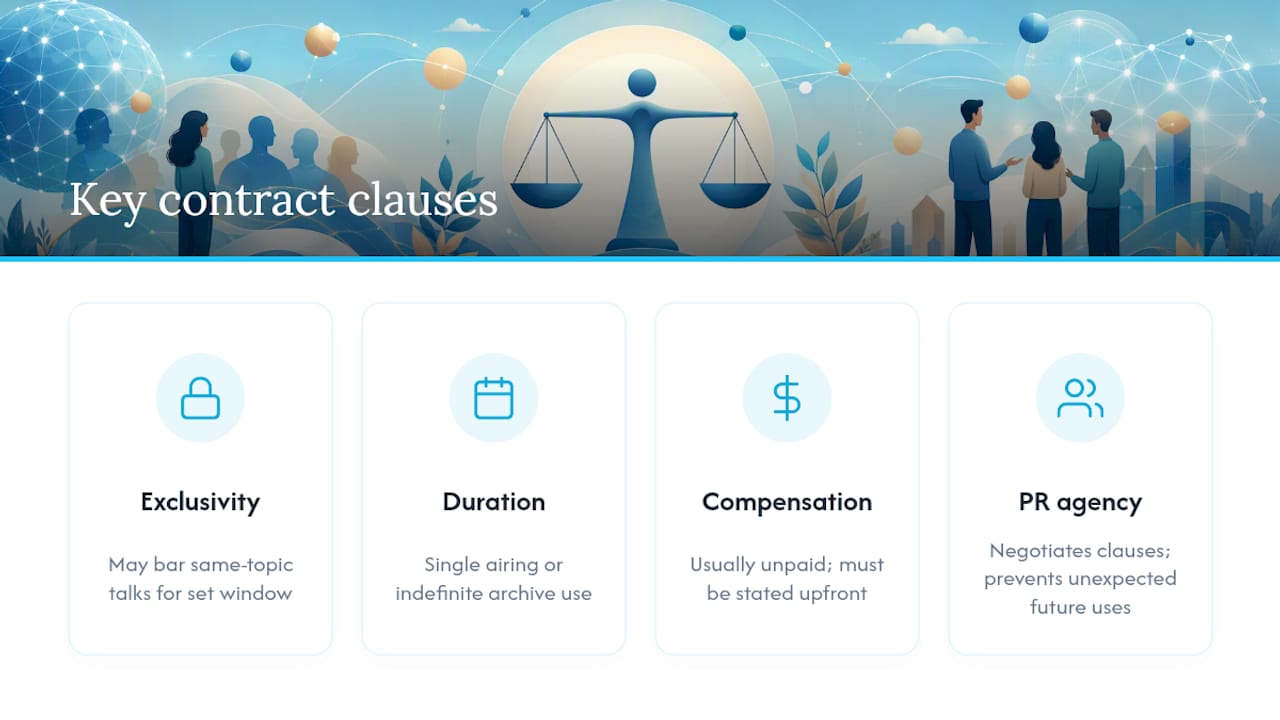
Watch for a few specific clauses. Exclusivity terms can quietly bar you from discussing the same topic with a competing outlet for a set window, which matters if you’re trying to build broad visibility rather than tie yourself to one network. Duration terms determine whether your appearance covers a single airing or an indefinite archive use. Compensation terms (or the lack of them) should be clear upfront; most earned-media bookings are unpaid exposure, and that’s standard, but it should never be a surprise.
Podcast appearances carry their own wrinkle: some hosts ask you to sign over rights to edited audio that could be repackaged later in ways you didn’t anticipate, a highlight reel, a paid course, a book excerpt. Ask directly how your segment might be reused before you sign anything.
If you’re working with a PR agency, this is exactly where that relationship earns its fee. A firm that’s negotiated hundreds of these agreements knows which clauses are standard and which ones deserve a pushback email before you sign. Reviewing a contract for ten minutes now costs far less than discovering a use you didn’t consent to six months later.
How Do You Stay Current on Media Trends as a Psychology Expert?
Media habits shift faster than most clinical training programs update their curriculum. Short-form video now drives a meaningful share of how the public first encounters expert commentary, and outlets increasingly want clips built for vertical viewing, not just traditional broadcast framing. If your media kit still only includes horizontal video, you’re behind the format producers expect.
AI-generated content has also changed the value of a credentialed human voice. As more health content online gets machine-drafted, outlets and readers alike are leaning harder on verified experts to separate accurate information from confidently wrong summaries, which raises the value of a psychologist willing to go on record with their name and license attached.
A few low-effort habits keep your skills current: watch how other psychologists handle tough live questions and note what worked, review a recording of your own last three appearances for pacing or filler words, and revisit the APA’s working-with-media guidance at least once a year since it gets updated as norms shift. If podcasts are a growing part of your pitch strategy, understanding how producers structure long-form audio segments helps you tailor pacing differently than you would for a three-minute TV hit.
None of this requires a major time investment. Twenty minutes a quarter reviewing your own clips and one policy update a year keeps you sharper than most of the clinicians competing for the same bookings.
Agency Perspective: How Goldman McCormick PR Prepares Clinicians for Media
The clinicians we place most successfully aren’t the ones with the longest CVs, they’re the ones who can say one clear thing in fifteen seconds. That’s a trainable skill, not a personality trait. Before any placement, we walk through likely questions, including the ones a host shouldn’t ask, so the clinician has a graceful redirect ready rather than an awkward pause on live television.
Producers remember clinicians who show up prepared and easy to work with, and they call back. That’s the outcome worth building toward: not one appearance, but a standing relationship with outlets that book you on repeat.
— Ryan McCormick
Get Started With Goldman McCormick PR’s Media Services
If pitching reporters and chasing follow-ups sounds like a second job you don’t have time for, Goldman McCormick PR runs that entire process for you, from media training to the actual TV, radio, and podcast bookings that come after it. Founded by former members of the media, the firm has earned a Bulldog Reporter Gold Award, a New York Observer citation among the top public relations agencies, and Forbes recognition as one of America’s best PR firms.
The service fits psychologists and clinic owners who want earned visibility without spending their own hours pitching producers or negotiating usage rights on interview agreements. Services include media training built around your specialty, targeted pitching to TV, radio, and print outlets, press release writing and distribution, and reputation management once coverage starts rolling in.
A first consult starts with a short call about your niche, your availability, and what kind of coverage you’re after, local, national, or syndicated. From there, the team builds your media kit and starts pitching on your behalf. Visit the Goldman McCormick PR site to schedule that first conversation and see what a real placement pipeline looks like.
Sources
Most reporters aren’t cold-calling therapists from a phone book. They’re posting queries on expert-sourcing platforms, checking their own contact lists, or searching for someone who already spoke clearly on the topic once before. Speed and brevity win far more bookings than credentials alone.
Qwoted is where a lot of that sourcing happens now. Journalists post a request, describe their deadline, and wait for vetted experts to respond. A concise, specific reply, two or three sentences with a clear angle, beats a long bio every time.
A workable response template:
- Professional considerations when working with the media | APA
- Qwoted — platform connecting journalists and experts
- Mini media training improves psychiatrists’ compliance with WHO recommendations (Frontiers in Psychology, 2021)
For outreach beyond platforms:
That tracker matters more than it sounds. Reporters who book you once often come back for the next related story, and you won’t remember who they are without notes.