
Earned media for psychologists is unpaid third-party publicity — TV segments, radio interviews, newspaper features, podcast appearances, op-eds, and verified directory mentions — secured on the strength of your expertise rather than a paid placement. The American Psychological Association and Goldman McCormick PR both recognize this category of visibility as distinct from advertising: a journalist, editor, or producer chooses to feature you because your perspective is newsworthy, not because you bought the slot. That distinction is what gives earned media its credibility edge. Research confirms that earned coverage delivers stronger trust signals than paid channels, though it comes with less editorial control and unpredictable timing. For psychologists, the primary payoff is referral amplification: when a physician, attorney, or school counselor sees your name in a credible outlet, the referral conversation is already half-won.
Key Takeaways
Earned media for psychologists is unpaid, third-party coverage secured through expertise — and sustained campaigns, not one-off pitches, are what convert it into referrals and patient acquisition.
| Point | Details |
|---|---|
| Earned media definition | Unpaid third-party publicity (TV, radio, op-eds, podcasts) distinct from paid advertising and owned content. |
| Top benefit for practices | Referral-network credibility: physicians and allied professionals refer to psychologists they recognize from trusted outlets. |
| Core ethics constraint | APA Ethics Code Standards 5.01–5.06 prohibit misleading claims, require accurate credential representation, and limit client testimonials. |
| Key KPI to watch | Referral inquiry calls — the most direct signal that earned coverage is driving practice growth. |
| Goldman McCormick PR | Forbes-recognized PR firm offering TV, radio, and editorial placements for psychologists, with APA-aligned campaign workflows. |
Table of Contents
- Why earned media matters for your psychology practice
- What earned media actually looks like for psychologists
- What are the ethical limits on earned media for psychologists?
- A five-step playbook for earning media as a psychologist
- How to measure earned media success and what it costs
- How to repurpose earned coverage across your owned channels
- How Goldman McCormick PR supports psychologists
- When should you DIY versus hire a PR firm?
- Goldman McCormick PR: earned media for psychologists who want results
- Sources
Why earned media matters for your psychology practice
The business case for earned media in psychology is specific and concrete. A trust-first, multi-pillar PR approach built around thought leadership, editorial placements, and awards recognition is the framework healthcare practices use to build credibility and referral pipelines. For psychologists, the same logic applies with a few practice-specific advantages:
- Third-party credibility. A feature in a local newspaper or a quoted comment in a national health publication carries more weight with prospective patients than any self-authored bio. Editors and journalists act as independent validators.
- Referral-network strengthening. Physicians, attorneys, and school administrators refer to psychologists they recognize as authorities. A podcast interview on pediatric anxiety, for example, can generate pediatrician referrals for months after the episode airs.
- Patient acquisition for specialty services. Neuropsychological testing, forensic evaluations, and trauma treatment are high-consideration services. Patients searching for these specialties respond to clinicians with visible, documented expertise.
- Payer and institutional positioning. Hospital systems and managed care panels look at professional reputation. Earned coverage supports credentialing narratives.
- Cost-effectiveness. Sustained PR activity builds patient trust over time and typically costs less per referral than paid digital advertising once a campaign gains traction.
What earned media actually looks like for psychologists
The formats vary widely, and the right mix depends on whether you are targeting clinical referrals, research visibility, or public trust.

Broadcast (TV and radio) carries the highest general-public reach. A segment on a local news station discussing back-to-school anxiety, or a nationally syndicated radio interview on trauma recovery, reaches audiences that no directory listing touches. Goldman McCormick PR produces and places clients on programs heard through the Genesis Communications Network, which gives psychologists access to broadcast infrastructure that would otherwise require years of independent relationship-building.
Print and online news (local papers, regional magazines, national health outlets) generates durable, searchable coverage. A quoted expert in a New York Times wellness piece or a regional business journal profile stays indexed for years.
Trade and clinical press (journals, association newsletters, clinical blogs) targets professional referrers directly. An op-ed in a state psychological association newsletter reaches exactly the colleagues and allied health professionals most likely to send referrals.
Podcasts have become a high-trust channel for clinicians. A well-placed interview on a physician-facing or therapist-facing podcast can generate professional referrals more reliably than a consumer-facing TV appearance.
Awards and speaking engagements function as earned media when covered by third parties. A “Top Psychologist” recognition in a regional publication, or a keynote covered by a conference’s media partners, creates citable, repurposable assets.
Directory mentions on Psychology Today and APA Locator are foundational visibility channels. They are not traditional earned media, but they amplify it: when a journalist or referrer finds your name in coverage and then confirms your credentials through a directory, the trust compounds.
What are the ethical limits on earned media for psychologists?
Earned media can be pursued aggressively — but it must stay inside the APA Ethics Code and HIPAA privacy rules. Standards 5.01 through 5.06 of the APA Ethics Code govern public statements, advertising, and media appearances. The practical requirements are clear:
In practice, this means:
- Do describe your specialty areas, training, and research accurately in every interview or op-ed.
- Do obtain written consent before referencing any patient’s story, even anonymously, in a media context.
- Do not solicit or publish testimonials from current psychotherapy clients. Former clients may provide testimonials under specific conditions, but the ethical risk is high enough that most practitioners avoid them entirely.
- Do not make outcome guarantees or imply that your treatment produces specific results for all patients.
- Do disclose any paid media arrangement (sponsored podcast, paid speaking slot) clearly.
- Do check your state licensing board’s advertising rules, which sometimes add restrictions beyond the APA baseline.
For edge cases involving patient stories, crisis communications, or forensic work, consult your professional liability carrier or institutional counsel before proceeding.
A five-step playbook for earning media as a psychologist
A repeatable process produces better results than one-off pitches. Here is a sequential framework you can execute internally or hand to a PR partner.
-
Define your niche expertise. Journalists need a specific angle, not a generalist. “Child neuropsychologist specializing in ADHD assessment” is pitchable. “Psychologist” is not. Write a one-paragraph positioning statement that names your specialty, your credential, and the population you serve.
-
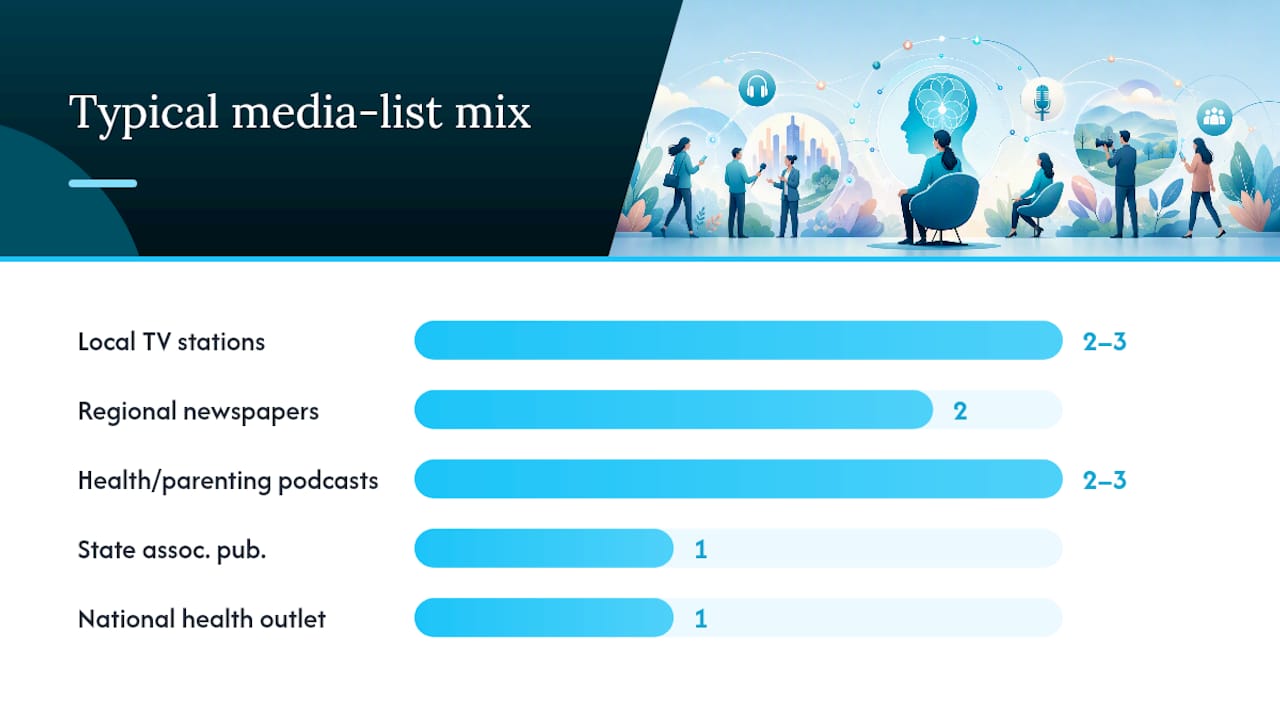
Build a targeted media list. Identify 10–15 outlets: two or three local TV stations, two regional newspapers, two or three health or parenting podcasts, one state association publication, and one national health outlet. Add the relevant editor or producer contact for each.
-
Craft story-driven pitches and op-eds. Journalists respond to original data, contrarian insight, and timely hooks — not generic announcements. A pitch tied to a news cycle (“Back-to-school anxiety is up — here’s what parents miss”) outperforms a generic “I’m available for interviews” email. An op-ed structure that works: a counterintuitive headline, one clinical data point or case pattern (de-identified), a practical takeaway for the reader, and a brief credential close.
-
Train and prepare materials. A one-page media bio, a headshot, and three to five “talking points” per topic area are the minimum. Media training — even a single session — prevents the common mistake of over-explaining clinical nuance on camera.
-
Follow up and repurpose. One follow-up email per pitch, sent five to seven business days after the initial contact, is standard. Once coverage runs, repurpose it immediately (see Section 7).
Pro Tip: To attract physician referrals ethically, pitch assessment services through a clinical lens rather than a consumer one. A pitch to a pediatrician-focused podcast framed as “how to identify when a child needs neuropsychological testing” positions you as a referral resource, not a competitor. Your Psychology Today profile and APA Locator listing then serve as the landing pages physicians check after hearing the episode.
A campaign cadence typically spans multiple months, starting with positioning and media list building, followed by pitching and outreach, and culminating in coverage placement and repurposing.
How to measure earned media success and what it costs
Measure earned media through three KPI categories: coverage volume, referral signals, and owned-channel lift.
| KPI | How to track it | Realistic benchmark |
|---|---|---|
| Media mentions | Google Alerts, manual search | First placement within 1–3 months |
| Estimated reach/impressions | Outlet’s published circulation or download count | Varies by outlet size |
| Referral inquiry calls | Ask new callers “How did you hear about us?” | Referral signal within a few months |
| Website traffic from coverage | UTM-tagged landing pages, Google Analytics | Measurable lift after 2–3 placements |
| New appointments from media | Track intake forms with source field | Conversion signal after several months |
Attribution is imperfect in psychology practices. The most reliable method is a simple intake question: “How did you hear about us?” Supplement it with UTM parameters on any link you share with media contacts, pointing to a dedicated landing page on your site.
Earned media is not free. A solo psychologist managing outreach internally should budget four to eight hours per month. Agency retainers for healthcare PR vary by scope and market; project-based engagements for a single placement campaign typically cost less than a full retainer. The tradeoff is time versus placement speed and media relationships. Building authority online through earned coverage compounds over time, which is why sustained campaigns outperform one-off efforts.
How to repurpose earned coverage across your owned channels
Every placement you earn should do more than one job. Repurposing converts a single media moment into sustained SEO and referral value.
- Add an “As Seen In” or “Media” page to your website and link to each placement with a brief summary and attribution.
- Embed placement badges (outlet logos) in your email signature, Psychology Today profile, and referral packets.
- Create a short quote card or audio clip from a podcast appearance and post it to LinkedIn or Instagram.
- Include recent coverage in your monthly or quarterly email to referral partners.
- Request an author link or backlink from the outlet when you contribute an op-ed — this directly supports your site’s search authority.
- Build UTM-tagged landing pages for each major placement so future pitches can reference measurable traffic data.
Thought leadership frameworks treat each earned placement as a building block, not a one-time event. The compounding effect is real: a psychologist with six months of consistent coverage has a media page, a backlink profile, and a referral narrative that a new entrant cannot replicate quickly.
How Goldman McCormick PR supports psychologists
Goldman McCormick PR secures earned placements, trains spokespeople, and manages reputation for psychologists while aligning every campaign with APA Ethics Code standards and HIPAA privacy requirements. The firm’s services relevant to psychology practices include media outreach and placement (TV, radio, newspapers), op-ed and editorial writing, media training, awards management, and reputation management.
Founded in 2010 by active and former media professionals, Goldman McCormick PR was named by Forbes Magazine as one of America’s Best PR Firms for 2021. The firm earned a Bulldog Reporter Gold Award for Best Cause/Advocacy Campaign in 2016, and the New York Observer cited it among the top five PR agencies specializing in legal PR in 2014. The firm’s broadcast relationships include the Genesis Communications Network and Starcom Radio Network, giving psychologist clients access to nationally syndicated radio placement.
A typical engagement runs three to six months. The first month focuses on positioning and materials; months two and three on active outreach and placement; months four through six on repurposing, follow-up campaigns, and referral tracking. Ethics safeguards are built into the workflow: consent protocols, APA-compliant messaging review, and HIPAA-aware content guidelines are standard, not optional add-ons.
When should you DIY versus hire a PR firm?
Solo clinicians with a narrow specialty and a local market can often generate their first two or three placements independently, particularly in local news and trade press. The playbook in Section 5 is executable without an agency if you have four to six hours per month and a clear niche.
The calculus shifts for small group practices and academic researchers. A group practice benefits from consistent, multi-channel outreach that a single clinician cannot sustain alongside a full caseload. Academic researchers seeking national visibility in clinical or policy media need relationships with national outlets that take years to build independently.
Hire a specialized PR firm when: you have tried two or three pitch cycles without placement; you need broadcast access (TV or radio); you are managing a reputation issue; or you want to compress a 12-month visibility timeline into three to six months.
Pro Tip: If you DIY, track one metric above all others in the first six months: referral inquiry calls. It is the most direct signal that earned media is working for your practice, and it requires no analytics platform to measure.
Whatever path you choose, keep APA Ethics Code Standards 5.01–5.06 visible during every visibility decision. A placement that misrepresents your credentials or implies outcome guarantees creates liability that no amount of referral growth justifies.
Goldman McCormick PR: earned media for psychologists who want results
Psychologists who want credibility-driven referrals without managing media relationships themselves have a direct route: Goldman McCormick PR handles the outreach, placement, and follow-through while you focus on clinical work.
Named by Forbes as one of America’s Best PR Firms for 2021 and recognized by Bulldog Reporter for advocacy campaign excellence, Goldman McCormick PR has the broadcast relationships, editorial contacts, and healthcare PR experience to move your name into the outlets that matter to your referral network. Visit Goldman McCormick PR to schedule a consultation and find out what a targeted earned media campaign looks like for your practice.