According to the 2024 State of the Media Report by Cision, 61% of journalists value original research in press materials, 48% want data-driven pitches, and 64% prefer a single follow-up. That data tells you exactly what a press bio needs to do: give a reporter every fact they need to say yes in under 60 seconds. Here is a copy-ready short bio and boilerplate you can drop in today.
Short press bio (20–30 words):
[Full Name], [Exact Title] at [Firm Name], represents clients in [primary practice area] and is available to comment on [specific topic]. Contact: [phone/email].
Press boilerplate (40–60 words):
[Full Name] is a [state]-licensed attorney at [Firm Name] with [X] years of experience in [practice area]. [He/She/They] has handled [type of matter] and been cited in [outlet or award]. For media inquiries, contact [name] at [phone] or [email]. High-resolution headshot and broadcast clips available at [hosted link].
Include a direct link to a verifiable case page, published article, or court docket wherever you reference a specific matter. The contact line is not optional.
Key Takeaways
A journalist-ready attorney press bio requires verifiable facts, hosted multimedia, and a direct contact line, not marketing language or a repurposed website bio.
| Point | Details |
|---|---|
| Use the right template | Match bio length to the use case: 10–20 words for on-air, 25–40 for press releases, 40–75 for media kits. |
| Attach verifiable links | Every credential, award, and media appearance needs a direct link to the primary source. |
| Provide hosted multimedia | A 300 dpi headshot and a 30–45 second broadcast-quality audio clip reduce producer friction immediately. |
| Avoid marketing language | Replace “passionate advocate” and similar phrases with named awards, docket references, and outlet appearances. |
| Goldman McCormick PR | Offers press material development, pitch distribution, and broadcast production for attorneys seeking national media placements. |
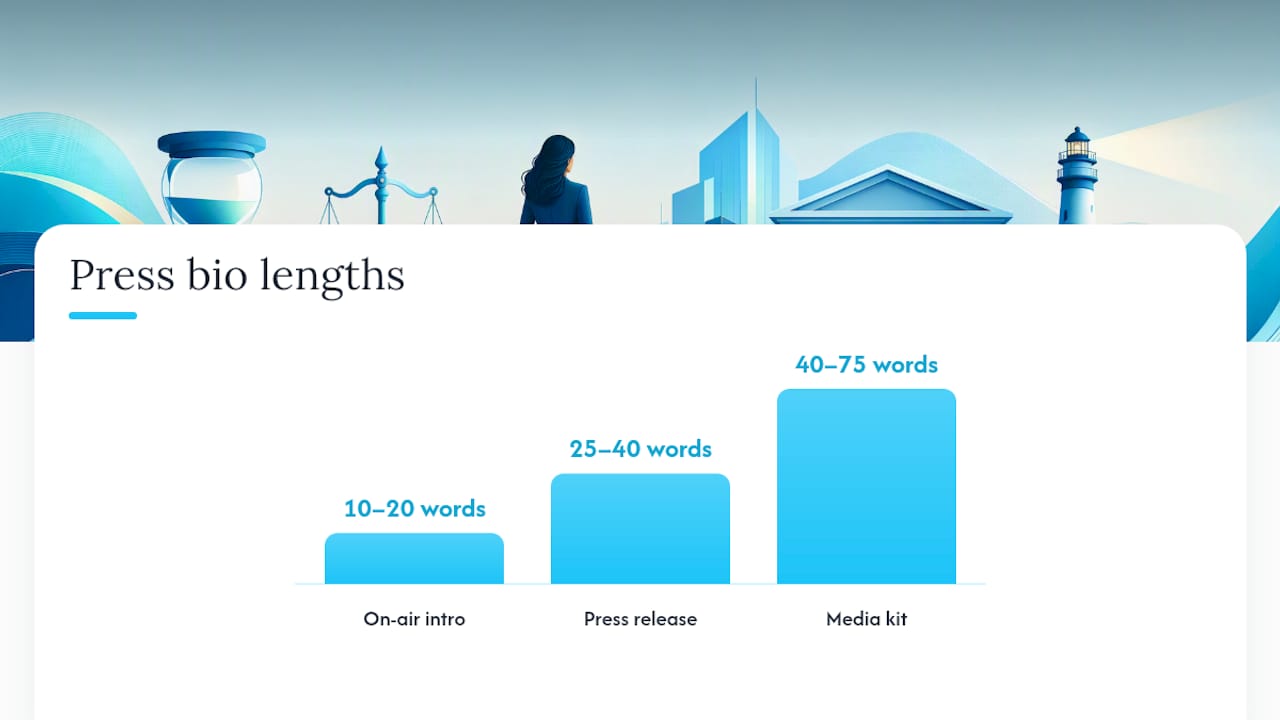
Table of Contents
- Three ready-to-use press bio templates you can fill in today
- What do reporters actually check before they call you?
- How to write each element of a press bio
- Headshot, audio, and video specs producers expect
- Attribution, confidentiality, and embargo rules for legal sources
- How to keep your press bio current and credible
- Final checklist before you send any press bio
- Why a tight press bio shortens a reporter’s decision time
- Goldman McCormick PR helps attorneys get placed, not just pitched
- Sources
Three ready-to-use press bio templates you can fill in today
Attorneys often paste their website bio into a pitch email and wonder why producers don’t call back. Press bios serve a different reader with a different deadline. Each template below is built for a specific use case.
Template 1: On-air/intro (10–20 words)
Use for: Radio booking forms, podcast intros, TV segment producers.
[Preferred on-air name], [title], [firm], [city]. Speaks to: [topic in 3–5 words].
Example: Jane Ortega, criminal defense attorney, New York. Speaks to: wrongful conviction and police misconduct.
Add a phonetic pronunciation in parentheses if your name is commonly mispronounced: (or-TAY-gah). Producers read this aloud in pre-show prep and will thank you for it.
Template 2: Press-release short bio (25–40 words)
Use for: Press releases, media advisories, journalist pitch emails.
[Full Name] is a [title] at [Firm], where [he/she/they] focuses on [practice area]. [He/She/They] has [one verifiable proof point, linked]. For comment: [direct phone] or [email].
Per Adviser Society’s 2026 law firm press release guide, objective third-person language and a meaningful quotation in the body increase pickup. Keep this bio in third person even when you write it yourself.
Template 3: Media-kit boilerplate (40–75 words)
Use for: Full media kits, speaker packets, broadcast producer packets.
[Firm Name] is a [city]-based law firm specializing in [practice areas]. [Attorney Name], [title], leads the firm’s [department or focus]. [He/She/They] has [specific credential or case outcome, linked] and has appeared on [outlet or network]. Media contact: [name, phone, email]. Assets: [hosted folder link].
Redaction guidance:
- Remove client names, case numbers for sealed matters, and any identifying detail from pending litigation.
- Replace specifics with category descriptions: “a federal securities case” rather than a client name.
- Bar rules in most states prohibit implying a specific outcome for a future client. Stick to past, verifiable results.
Word count at a glance:
- On-air intro: 10–20 words
- Press-release bio: 25–40 words
- Media-kit boilerplate: 40–75 words
Pro Tip: Convert a website bio to a press bio by stripping every sentence that begins with “I believe” or “I am passionate about.” Replace each one with a verifiable fact: a case type, a court, a publication, or an award.
What do reporters actually check before they call you?
The Cision 2024 data is specific: multimedia increases pickup likelihood by 37%, and 48% of journalists want data-driven pitches. That means a bio without a hosted clip and at least one cited figure is already behind.
PRSA’s media pitch guidance reinforces the same point: pitches that lack names, dates, or verifiable links get deleted. Reporters vet sources fast.
The reporter’s vetting checklist:
- Full legal name and exact title (not “partner” alone, but “managing partner” or “senior associate”)
- Firm name, city, and state bar admission
- Specific practice area, not a category (“federal criminal defense” beats “litigation”)
- One verifiable proof point with a link (published article, court docket, award page)
- Prior media appearances with outlet name and date
- Direct phone and email, not a general contact form
- High-resolution headshot link
- Hosted audio or video clip
Send one. Wait 48–72 hours. Do not call the desk and email simultaneously.
How to write each element of a press bio
The KSJ Handbook on finding and vetting sources is direct: journalists check collaboration, awards, and recent publications. Peer recognition outweighs a credential listed alone.
- Name and title. Use your full legal name and your exact bar-listed title. If you go by a shortened name on-air, note it in parentheses.
- Beat/area of expertise. One sentence, one practice area. “Federal white-collar criminal defense in the Southern District of New York” is more useful to a reporter than “criminal law.”
- One-line soundbite. Write a callable quote reporters can drop into copy: “[Attorney name] says [plain-language claim about the issue].” Keep it under 20 words and free of legal jargon.
- Credentials. List peer-recognized awards first (named awards with year and issuing body), then leadership roles in bar associations, then published work with links. For confidential matters, write: “represented a Fortune 500 company in a federal securities investigation” with no client name.
- Media experience. List outlet, segment name, and air date. Link to a timestamped clip wherever possible. The National Law Review recommends having prior clips ready before pitching, because producers use them to assess on-air suitability.
- Contact and availability. Format: Office: [number] | Mobile: [number] | Email: [address] | Available: [days/hours, time zone] | Booking contact: [name, phone].
Pro Tip: Write the soundbite before the bio. If you can’t compress your expertise into one plain-English sentence, the bio will be vague too. The soundbite is the test.
- Avoid passive constructions in credentials (“was recognized by” becomes “received the [Award Name] from [Body], [Year]”).
- Link every named award to its issuing organization’s announcement page.
- List media appearances in reverse chronological order.
Headshot, audio, and video specs producers expect
ReThink Media’s staff bio guidance lists a high-resolution photo as one of the first things reporters check. A low-resolution or cropped headshot signals that the rest of the materials will require extra work.
| Asset | Minimum spec | Why it matters |
|---|---|---|
| Headshot (JPEG/PNG) | 300 dpi, color | Print and broadcast both require high resolution |
| Audio soundbite (WAV or MP3) | 30–45 seconds | Radio producers need broadcast-quality files |
| Video clip (MP4) | 30 fps | TV segments require HD; compressed files get rejected |
| Media kit (PDF) | Single file, under 10 MB | Email-friendly; larger files bounce or go to spam |
File naming convention: LASTNAME_Firstname_Headshot_YYYYMMDD.jpg and LASTNAME_Firstname_Soundbite_Topic_YYYYMMDD.wav. Producers sort files by date; consistent naming prevents confusion when you update assets.
- Host all files in a shared folder (Google Drive or Dropbox) with a link that does not require a login.
- Set download permissions to “anyone with the link.” Expiring links frustrate producers on deadline.
- Include a one-line photographer credit in the folder: Photo credit: [Photographer Name], [Year].
- Pre-record a 30–45 second soundbite with a one-sentence lead-in: “I’m [Name], [title] at [Firm], and today I’m speaking about [topic].” Label the file with date, name, and topic.
Attribution, confidentiality, and embargo rules for legal sources
Attorneys face an extra layer of risk when speaking to the press: bar rules, client confidentiality, and the appearance of prejudging a case. A few clear protocols prevent most problems.
Attribution and verifiability:
- Always name the document you reference: docket number, exhibit number, or report title.
- Link to the public record, not a summary you wrote. Reporters verify independently.
- If you reference a study or data point, cite the original source, not a secondary article about it.
Handling confidential or sealed material:
- Never describe sealed case details, even in general terms that could identify the matter.
- Offer a public record summary instead: “I can speak to the general legal issues this type of case raises, but not the specific facts of this matter.”
- If a reporter asks about a pending case, use this script: “I’m not able to comment on active litigation, but I’m happy to provide background on how [legal issue] typically works.”
Embargo template:
This information is provided under embargo until [Date, Time, Time Zone]. You may prepare your story in advance but may not publish, broadcast, or share the contents until the embargo lifts. Please confirm receipt and acceptance of these terms by replying to this email.
Quoting rules:
- Never phrase a comment as legal advice: “In my opinion, the defendant should…” becomes “Cases like this typically involve…”
- Note any potential conflict of interest at the top of your media contact sheet.
- Attribute claims to public documents, not your own legal conclusions.
How to keep your press bio current and credible
A bio that was accurate 18 months ago can actively hurt a placement today. Reporters who find a stale clip or an outdated title move on quickly.
Update cadence:
- Quarterly: check that contact info, title, and firm name are current; add any new media appearances.
- Annually: rewrite the soundbite, update credentials, retire topics you no longer actively practice.
Media log template (keep a running spreadsheet):
- Date | Outlet | Segment/Article title | Link or clip | Reporter name and contact | Topic covered
After each appearance, add a transcript excerpt or timestamped clip to your hosted folder and note one lesson: what question caught you off guard, what soundbite landed well.
Future-proofing:
- Keep a short list (3–5 topics) where you can legitimately speak as a narrow expert. Retire a topic when your active caseload or publications no longer support it.
- Update your hosted folder link in every bio version simultaneously. A broken link in a media kit is a placement lost.
Pro Tip: Set a calendar reminder for the first Monday of each quarter labeled “Bio audit.” It takes 15 minutes and prevents the embarrassment of a reporter reading a bio that lists a firm you left two years ago.
Final checklist before you send any press bio
Run through this list before every pitch, booking form, or press release submission.
Red flags reporters hate:
- No direct phone number or email (a contact form is not a media contact)
- Claims without links (“nationally recognized” with no award citation)
- Marketing language (“passionate advocate,” “dedicated to justice”)
- Missing dates on media appearances
- A headshot under 300 dpi or behind a login wall
Five quick fixes:
- Add a direct link to every credential or award mentioned
- Shorten the soundbite to under 20 words
- Attach or link a broadcast clip
- State your availability window with a time zone
- Add a named booking contact separate from your general office line
Final actions before sending:
- Search your own name plus the outlet’s name to confirm no conflicting prior coverage exists.
- Add one sentence: “[Name] is available for comment [days], [hours], [time zone].”
- Set a calendar item to follow up once, 48–72 hours after sending.
Why a tight press bio shortens a reporter’s decision time
Most attorneys underestimate how little time a reporter spends on a bio before deciding to call or delete. The decision is often made in under 30 seconds. A vague credential, a missing clip, or a general contact email can end the conversation before it starts.
Goldman McCormick PR has been placing attorneys in national media since 2010. Named by Forbes as one of America’s Best PR Firms for 2021, recognized with a Bulldog Reporter Gold Award in 2016, and cited by the New York Observer in 2014 as one of the top five legal PR agencies in the country, the firm has built its placement record on one principle: reporters call sources who make their job easier.
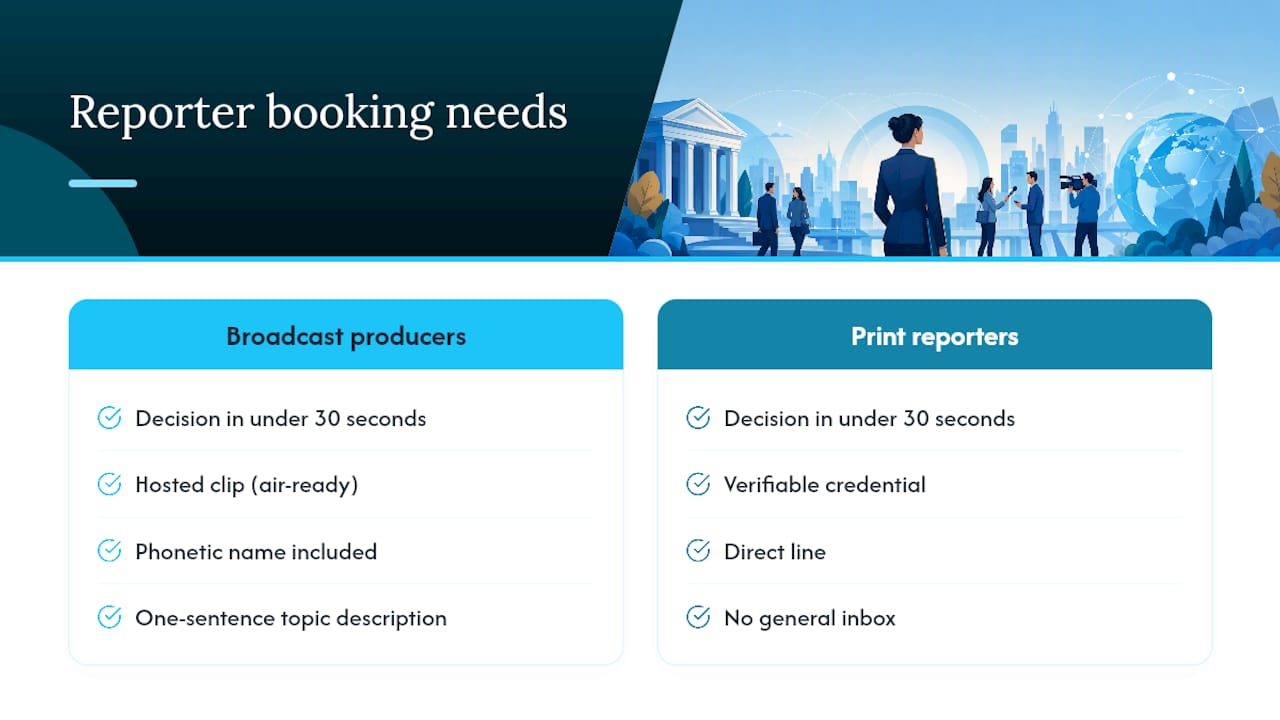
The templates in this article reflect what producers at the Genesis Communications Network and Starcom Radio Network actually ask for when booking legal experts. Broadcast producers need a hosted clip, a phonetic name, and a one-sentence topic description. Print reporters need a verifiable credential and a direct line. Neither group has time to chase a general inbox.
The National Law Review’s guidance on becoming a called-upon expert puts it plainly: anticipate the news cycle, be narrowly expert, and respond fast. A press-ready bio is what makes that speed possible. Without it, even the right attorney with the right expertise loses the placement to someone whose materials were easier to use.
Goldman McCormick PR helps attorneys get placed, not just pitched
Goldman McCormick PR works with attorneys and law firms on the full range of press materials: press release writing and distribution, media-ready bio development, pitch distribution, broadcast production, media training, and crisis communications. Named by Forbes as one of America’s Best PR Firms for 2021, recognized with a Bulldog Reporter Gold Award (2016), and cited by the New York Observer (2014) as a top-five legal PR agency, the firm brings direct newsroom experience to every engagement.
For attorneys seeking national broadcast placements, Goldman McCormick PR produces nationally syndicated radio programs distributed through the Genesis Communications Network and the Starcom Radio Network, which means the firm understands exactly what producers need before they book a guest. If your current bio and press materials aren’t generating callbacks, request a media-ready bio review and find out what’s missing.
Sources
The following sources support the guidance, templates, and checklist items in this article.