
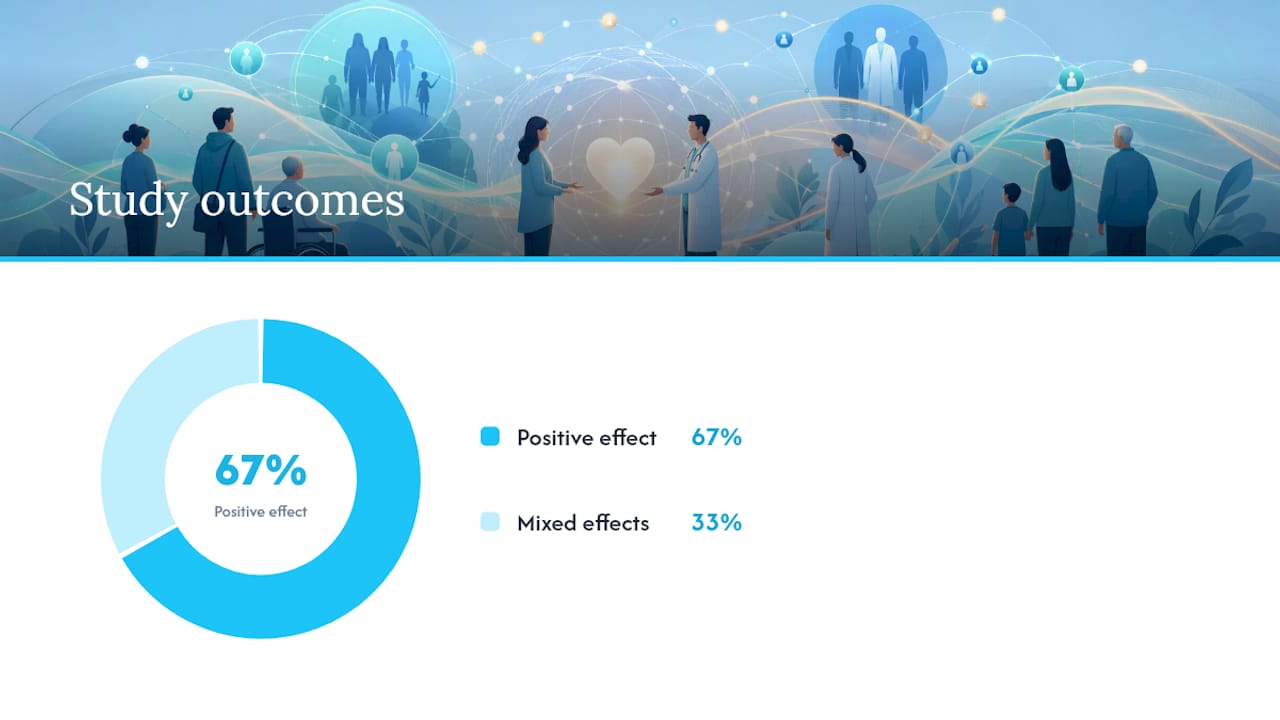
Patient trust through media exposure is the degree to which a patient’s confidence in a provider’s competence, integrity, and care is built or eroded by what they see, hear, or read about that provider across any media channel. The stakes are concrete: roughly two-thirds of consumers search for a specific doctor on social media, and more than half report trusting doctor-authored web posts as a credible health-information source. Three implications follow immediately. First, the content a provider publishes shapes whether patients follow through on treatment. Second, professional media content tends to build trust while personal posts that violate role expectations tend to erode it. Third, the misinformation environment surrounding a provider’s channel moderates the net effect, meaning even well-crafted content can lose ground when patients are already saturated with conflicting claims.
Key Takeaways
Media exposure shapes patient trust through competence, integrity, and benevolence signals, and professional content consistently outperforms personal content across every channel studied.
| Point | Details |
|---|---|
| Prevalence is high | A large proportion of consumers search for a specific doctor on social media before engaging. |
| Content type determines direction | Professional knowledge-sharing builds trust; personal posts that violate role expectations erode it. |
| Transparency is non-negotiable | Named sources, clear credentials, and honest disclosures are the strongest trust signals across channels. |
| Measurement requires a timeline | Baseline surveys before a campaign, then 30/90/180-day checkpoints, give the clearest picture of trust change. |
| Goldman McCormick PR | Earned-media placements and media training translate research-backed strategy into measurable patient trust outcomes. |
Table of Contents
- What the peer-reviewed evidence says about media and patient trust
- How media exposure actually changes what patients believe about a provider
- Which media channels produce which trust effects
- Risks that commonly reduce patient trust through media exposure
- Practical dos and don’ts for clinicians and communications teams
- How to measure whether your media exposure is actually building trust
- What organizational policy and training should actually look like
- How a PR team translates this evidence into a 30-day sprint
- The tension between authenticity and professional role
- Goldman McCormick PR helps healthcare clients build trust through media
- Sources
What the peer-reviewed evidence says about media and patient trust
The research base has grown fast, and the headline findings are consistent enough to act on, even where individual studies have limits.
Key studies at a glance:
- JMIR 2018 (cross-sectional survey): Found that approximately 67% of consumers searched for a specific doctor on social media and that more than half trusted doctor-authored posts, establishing the baseline prevalence that makes media exposure a clinical concern, not just a marketing one.
- Fatollahi et al. / Johns Hopkins (2020): Examined how physician social media content type and tone affect patient trust. Respectful professional narratives increased trust for some patients, while disrespectful narratives caused markedly larger decreases, and patient reactions varied by demographic group.
- George Washington University survey (2020): A GWU news summary reported that physician social media behavior may directly affect patient trust, corroborating the Fatollahi findings in a practice-facing context.
- Frontiers in Public Health (2024): Synthesized professional versus personal use, finding that professional content fosters trust and adherence while personal content that violates role expectations reduces both.
- Nature Scientific Reports (2026): Experimental work showing that interpersonal source signals and transparency consistently increase trust in health information, with interactivity adding trust only when paired with a credible, transparent human source.
- MDPI Healthcare (2026): Found that a provider’s biography and active follower engagement act as reputation signals that amplify the perceived weight of professional experience in patient decisions.
Study evidence summary:
| Study | Year | Method | Key Finding |
|---|---|---|---|
| JMIR (Ventola et al. type) | 2018 | Cross-sectional survey | ~67% search for doctors on social media; >50% trust doctor-authored posts |
| Fatollahi et al. (Johns Hopkins) | 2020 | Survey experiment | Respectful content raises trust; disrespectful content causes larger decreases; demographic variation |
| GWU survey | 2020 | Survey summary | Physician social media behavior linked to measurable trust changes |
| Frontiers in Public Health | 2024 | Systematic synthesis | Professional use improves adherence; personal role-violating use reduces it |
| Nature Scientific Reports | 2026 | Experiment | Transparency + interpersonal source = highest trust; interactivity conditional |
| MDPI Healthcare | 2026 | Observational analysis | Bio + engagement = reputation signals that amplify professional experience |
Limitations worth knowing: Most studies use cross-sectional designs, which means they capture association, not causation. Cultural and demographic sampling varies widely, so findings from one population may not transfer cleanly to another. Sample sizes for moderator analyses (gender, age, health literacy) are often small. Perhaps most importantly, the gap between measured trust scores and hard clinical outcomes like adherence rates or appointment completion remains underexplored. The evidence is strong enough to guide strategy, but not strong enough to treat any single mechanism as universal.
How media exposure actually changes what patients believe about a provider
Trust in healthcare research typically breaks into three components: perceived competence (can this provider help me?), integrity (will they be honest?), and benevolence (do they care about me?). Media exposure affects all three, but through different pathways.

Signaling and role congruence. When a physician posts evidence-based clinical content, they signal competence and align with the patient’s mental model of what a doctor does. That alignment, called role congruence, reinforces integrity and benevolence simultaneously. A cardiologist explaining a new stent study in plain language signals all three trust dimensions at once. A post complaining about a difficult shift signals something different, and patients notice.
The follower effect. A provider’s follower count, bio completeness, and engagement quality function as social proof. When biography and active, informative engagement are paired, professional experience carries more weight in patient decisions, because the audience size and engagement pattern reduce the perceived risk of choosing an unfamiliar provider. This is why a well-maintained profile with 2,000 engaged followers often outperforms a neglected profile with 20,000.
Misinformation as a moderator. The relationship between misinformation exposure and trust is not linear. Research suggests an inverted-U pattern: moderate exposure to inaccurate health claims can trigger verification behaviors that sometimes reinforce trust in credible sources, while very high exposure degrades trust sharply, even in providers who have done nothing wrong. A provider operating in a high-misinformation niche (weight loss, vaccines, chronic pain) faces a steeper trust-building challenge than one in a lower-noise specialty.
Transparency and interactivity. Interpersonal source signals and transparency consistently increase trust in health information, but interactivity only adds trust when it is paired with transparency and a credible human source. Responding to comments with vague reassurances does not move the needle. Responding with a named source, a clear explanation, and a visible professional identity does.
Pro Tip: Before scheduling a post, identify which trust component you are targeting. A short explainer video targets competence. A behind-the-scenes look at your practice’s patient intake process targets benevolence. A correction of a circulating myth, with a cited source, targets integrity. Mixing all three in one post usually dilutes all three.
Which media channels produce which trust effects
Not all media exposure works the same way, and treating every channel as interchangeable is one of the most common mistakes in healthcare communications.
- Organic social media (LinkedIn, Instagram, X/Twitter): The highest-volume channel for direct provider-patient contact. Professional knowledge-sharing posts build competence and integrity signals. Personal posts that stray into venting, humor, or political commentary risk role-violation effects. A physician posting a clear thread on antibiotic resistance builds trust; the same physician posting a sarcastic take on a difficult patient type erodes it, even if the post is technically accurate.
- Earned media (newspaper features, magazine profiles, podcast interviews): Third-party editorial endorsement carries a credibility premium that self-published content cannot replicate. TV and earned media shape trust components like perceived competence and empathy in ways that social posts rarely achieve alone. A single well-placed feature in a regional newspaper can do more for a practice’s perceived authority than months of social posting.
- Broadcast (TV, radio): The interpersonal cues available in broadcast, tone of voice, facial expression, pacing, carry benevolence signals that text cannot. A physician who appears calm, warm, and clear on a local news segment communicates trustworthiness in seconds. The risk is that broadcast is uneditable after airing, so preparation matters more here than anywhere else.
- Paid advertising: Patients are increasingly skeptical of paid placements in health contexts. Paid ads can drive awareness, but they rarely build deep trust on their own. They work best when they direct patients to earned or organic content that does the trust-building work.
- Patient reviews and testimonials: Peer-to-peer signals carry high credibility because patients assume other patients have no incentive to deceive. A consistent pattern of positive reviews on Google or Healthgrades functions as a distributed trust signal. One or two negative reviews handled professionally can actually increase trust by demonstrating responsiveness.
For audiences with lower health literacy, broadcast and interpersonal cues tend to matter most. For research-oriented patients, transparency and cited sources in written content carry more weight. Channel priority should follow audience, not convenience.
Risks that commonly reduce patient trust through media exposure
The harms are real and some are irreversible. Here are the main risks, ordered by likely impact on trust.
- Unprofessional personal content. A physician posts a photo from a party with a caption that reads as dismissive of patient concerns. Even without naming a patient, the post signals role incongruence. Fatollahi et al. found that disrespectful narratives cause markedly larger trust decreases than respectful narratives do increases, meaning the asymmetry favors caution.
- Misinformation originating from or amplified by a provider channel. A provider shares an unverified study on social media without checking the source. Followers share it. By the time a correction goes out, the original post has reached thousands. The provider’s credibility takes a hit that the correction rarely fully repairs.
- Privacy breaches and patient-identifying details. Even anonymized case descriptions can be identifying in small communities. A single HIPAA-adjacent post can trigger complaints, legal exposure, and a trust collapse that no media strategy recovers quickly.
- Boundary blurring. Providers who respond to patient health questions in public comment threads create ambiguous clinical relationships. Patients may interpret a social media reply as medical advice. When outcomes are poor, the provider’s credibility suffers regardless of what was actually said.
- Inconsistent or absent presence. A provider who posts actively for three months and then disappears signals unreliability. Patients notice gaps, and silence during a public health event can be read as disengagement or evasion.
On demographic and cultural moderators: Research by Fatollahi et al. shows patient reactions to physician social media content vary by demographic group. Gendered expectations about professionalism, cultural norms around provider authority, and generational differences in social media literacy all shape how the same post lands with different audiences. A tone that reads as refreshingly candid to one demographic may read as unprofessional to another.
Practical dos and don’ts for clinicians and communications teams
Dos:
- Share evidence-based clinical content with attribution to the original source.
- Respond to public health misinformation promptly, citing named institutions (CDC, NIH, peer-reviewed journals).
- Use your professional bio to establish credentials, specialty, and institutional affiliation before patients encounter your content.
- Disclose conflicts of interest when discussing treatments or products.
- Maintain a consistent posting cadence so patients experience you as reliably present.
Don’ts:
- Post personalized patient anecdotes, even anonymized, without explicit written consent and a clear clinical rationale.
- Use humor that could be read as dismissive of patient experiences or conditions.
- Respond to negative reviews with defensiveness or patient-identifying information.
- Share studies or statistics without checking the source and methodology.
- Let personal accounts bleed into professional channels without a clear separation policy.
Pre-post checklist:
- Who is the intended audience, and which trust component does this post target?
- Is the claim backed by a named, linkable source?
- Does this post align with my professional role as patients would expect it?
- Does it contain any detail that could identify a patient, even indirectly?
- If this post were screenshotted and shared out of context, what would it communicate?
- Is there an escalation path if this post generates a misinformation response or a complaint?
Template 1: Misinformation correction reply
“Thanks for raising this. The claim circulating about [topic] is not supported by current evidence. [Named institution/study] found [brief accurate summary]. Happy to share the source link if helpful.”
Template 2: Consent and limits notification for social interactions
“I’m glad to share general health information here, but I’m not able to provide personalized medical advice through social media. For questions about your specific situation, please contact our office directly at [contact info].”
How to measure whether your media exposure is actually building trust
Measurement is where most healthcare communications programs fall short. Reach and follower counts are easy to track and nearly useless as trust indicators on their own.
Recommended metrics:
- Reach and impression quality: Total reach matters less than whether you are reaching patients in your specialty or geography. Filter by audience demographics where platform tools allow.
- Engagement quality: Comments that ask substantive clinical questions signal genuine trust-building. Emoji reactions and generic shares do not.
- Sentiment analysis: Track the ratio of positive to neutral to negative sentiment in comments and mentions using tools like Brandwatch or Sprout Social.
- Trust score surveys: Short validated surveys administered to new patients asking how they first heard of the practice and what influenced their decision to book.
- Appointment attribution: Ask new patients at intake which media touchpoint influenced their decision. Even a simple intake form question yields useful signal.
- Patient-reported adherence: At follow-up appointments, brief questions about whether patients followed through on recommendations can be correlated with media activity periods.
Sample survey items (Likert scale, 1–5):
| Trust dimension | Sample item |
|---|---|
| Competence | “Based on what I’ve seen from this provider online, I believe they have the expertise to help me.” |
| Integrity | “This provider is honest and transparent in the health information they share publicly.” |
| Benevolence | “This provider seems genuinely concerned about patients’ wellbeing, not just their own reputation.” |
Measurement cadence: Establish a baseline before any media campaign begins. Check sentiment and engagement quality at 30 days. Run the trust survey at 90 days. Assess appointment attribution and adherence signals at 180 days. Effect sizes in trust research are typically modest in the short term; do not expect dramatic shifts before the 90-day mark.
Attribution pitfalls: Patients rarely convert from a single media touchpoint. A patient who books after seeing a TV segment likely also read a Google review and checked the practice website. Mixed-methods approaches, combining survey data with qualitative intake interviews, give a more accurate picture than any single metric.
Pro Tip: Pair your healthcare SEO content strategy with trust measurement so you can see whether discoverability gains are translating into trust signals, not just traffic.
What organizational policy and training should actually look like
A social media policy that lives in a PDF no one reads is not a policy. Effective governance requires short, specific clauses and a training program that makes the rules feel real.
Sample policy clauses:
- Professional content standard: All provider-authored public posts must align with the provider’s clinical role and be consistent with the organization’s patient care values. Posts that could reasonably be interpreted as dismissive of patients or their conditions are prohibited.
- Patient story consent: No patient story, case description, or outcome reference may be published on any organizational or personal professional channel without documented written consent from the patient and review by the compliance team.
- Misinformation escalation: Any post that generates significant misinformation-related engagement must be flagged to the communications lead within 24 hours. The communications lead and a clinical reviewer jointly determine whether a correction post is required.
- Personal account boundaries: Providers are encouraged to maintain separate personal and professional accounts. Personal accounts must not reference specific patients, clinical outcomes, or organizational matters in ways that could be attributed to the organization.
- Credential transparency: All provider-authored health content must include the provider’s full name, specialty, and institutional affiliation. Anonymous or pseudonymous health content is not permitted on organizational channels.
Training checklist for clinicians and communications staff:
- Onboarding: review social media policy, HIPAA social media guidance, and the pre-post checklist.
- Roleplay exercise: review three sample posts (one clearly appropriate, one borderline, one clearly problematic) and discuss as a team.
- Annual review: update training to reflect platform changes, new research, and any incidents from the prior year.
- Privacy refresher: annual HIPAA-awareness module with specific examples of social media scenarios.
- Escalation drill: at least once per year, simulate a misinformation incident and walk through the escalation path.
Governance: Designate one communications lead and one clinical reviewer as co-signatories for any post that touches a sensitive clinical topic. Establish a clear threshold for when legal or senior clinical leadership must be consulted, such as any post that generates media pickup or a formal patient complaint. Know in advance who has the authority to pull a post and what the response window is.
Pro Tip: For managing online reputation at the organizational level, build your escalation path before you need it. A response protocol written during a crisis is always slower and less clear than one written in advance.
How a PR team translates this evidence into a 30-day sprint
Research findings do not implement themselves. The gap between “professional content builds trust” and a functioning editorial calendar is where most clinical communications programs stall.
A brief case example: A mid-size specialty practice wanted to improve new-patient trust before the first appointment. The communications team used the JMIR and Frontiers findings to build a topical calendar focused on competence signals: short explainer posts on common patient questions, each citing a named clinical source. At 90 days, intake surveys showed a measurable increase in the proportion of new patients who cited online content as a factor in their decision to book. No single post drove the result. The cadence and consistency did.
30-day sprint checklist:
- Week 1: Audit existing social profiles. Update bios with full credentials, specialty, and institutional affiliation. Identify the top five patient questions in your specialty.
- Week 2: Publish two competence-signal posts (evidence-based explainers with cited sources). Set up sentiment monitoring using a tool like Brandwatch or Mention.
- Week 3: Publish one transparency post (a behind-the-scenes look at how the practice handles a common patient concern). Respond to all substantive comments within 48 hours.
- Week 4: Pitch one earned-media opportunity (a local news outlet, a health podcast, a professional association newsletter). Draft the misinformation correction template and the consent/limits notification so they are ready before they are needed.
- End of sprint: Run the three-item trust survey with new patients. Record baseline scores for the 90-day comparison.
Goldman McCormick PR, named by Forbes Magazine as one of America’s Best PR Firms for 2021 and a Bulldog Reporter Gold Award winner, has built media strategies for healthcare and legal professionals since 2010. The firm’s approach starts with the evidence, maps it to the right channels, and executes with the earned-media relationships that make the difference between a post and a placement.
The tension between authenticity and professional role
The most common mistake clinicians make in media strategy is treating authenticity and professionalism as opposites. They are not. Patients want to see a real person. They also want to see a competent, trustworthy clinician. The question is not whether to be authentic, but which authentic details belong in which channel.
A physician who shares their genuine enthusiasm for a new treatment approach is being both authentic and professional. The same physician sharing a frustrating day in a way that implicates patient interactions is being authentic in a way that costs trust. The practical test is simple: does this post show who I am as a clinician, or does it show who I am outside the clinical role? The first builds trust. The second is a gamble. Start by testing competence-signal content first, measure the trust response at 90 days, and only then experiment with warmer, more personal content once the baseline is established.
Goldman McCormick PR helps healthcare clients build trust through media
Goldman McCormick PR has placed healthcare and legal professionals on TV, radio, and in print since 2010, and the firm’s earned-media relationships are what separate a well-crafted message from one that actually reaches patients. Named by Forbes as one of America’s Best PR Firms for 2021 and recognized with a Bulldog Reporter Gold Award, Goldman McCormick PR brings the kind of third-party credibility that no social media post can manufacture on its own. Services relevant to the evidence in this article include media training, crisis communications, earned-media placement across TV and radio networks, press release writing and distribution, and reputation management. For healthcare professionals who want to move from knowing the research to executing a media strategy that measurably builds patient trust, the next step is a direct conversation. Reach out to Goldman McCormick PR to discuss what a media campaign looks like for your practice or organization.
Sources
- The Effect of Doctor-Consumer Interaction on Social Media on Consumers’ Health Behaviors: Cross-Sectional Study (JMIR)
- Social media stethoscope: unraveling how doctors’ social media behavior affects patient adherence and treatment outcome (Frontiers in Public Health)
- The Impact of Physician Social Media Behavior on Patient Trust (Johns Hopkins / Fatollahi et al.)
- Evaluating patients’ trust in health information based on different dimensions of trust | Scientific Reports (Nature)