
Effectively communicating case results to the media requires a combination of timing, ethical discipline, and clear messaging. News becomes stale soon after a case resolution, so the window to shape the story is narrow. Legal professionals and public information officers who get this right do three things consistently: they secure written client authorization before any media engagement, they issue press releases the same day as a filing or verdict, and they keep every statement free of language that could prejudice ongoing proceedings under ethical rule RPC 3.6. Miss any one of these, and you either lose the story or create a liability.
Here is what a sound media communication plan looks like in practice:
- Secure written client authorization before reaching out to any reporter or issuing any statement
- Issue press releases the same day as a case filing or resolution to meet reporters’ breaking-news cycles
- Use plain, jargon-free language focused on two or three key messages, not a full legal brief
- Coordinate internally between attorneys and communications staff before anyone speaks on the record
- Respect RPC 3.6 and related bar association rules that prohibit statements likely to prejudice adjudicative proceedings
- Maintain controlled, transparent communication channels rather than going dark or saying “no comment”
- Build and maintain a targeted journalist contact list so outreach reaches the right reporters fast
Each of these points gets its own full treatment below, along with the specific roles, tools, and ethical guardrails that make them work.
How to respond to media inquiries during high-profile legal cases
The first call from a reporter is not the time to improvise. High-profile cases attract aggressive media attention, and a poorly handled inquiry can define public perception before a single fact is confirmed. Preparation is the only real defense.

Designate one spokesperson before the case ever reaches the public eye. That person should know the approved messages cold, understand what is off-limits, and have a direct line to lead counsel. Everyone else on the team needs a single instruction: refer all media calls to the spokesperson, no exceptions.
Brief, clear messages outperform dense legal explanations every time. Reporters are working on deadline, and a three-paragraph answer full of legal qualifications will either get cut or misquoted. Give them one or two sentences that are accurate, quotable, and complete.
A few practical protocols that hold up under pressure:
- Respond promptly. Silence reads as guilt or evasion. Acknowledge the inquiry, give a timeline for a full response, and meet it.
- Distinguish on-the-record from off-the-record. On-the-record statements can be quoted directly. Off-the-record context helps a reporter understand background without attribution. On-background sits in between. Know which mode you are in before you start talking.
- Never say “no comment.” It signals you are hiding something. A better alternative: “We are reviewing the matter and will have a statement shortly.”
- Create a tailored journalist contact list that includes beat reporters who cover your specific legal area, not just general assignment desks. Curating journalist contact lists for legal stories takes time but pays off when speed matters.
- Train every team member on escalation procedures so no one accidentally becomes an unauthorized spokesperson.
- Correct misinformation fast. If a reporter publishes something inaccurate, contact them directly and professionally. A good relationship with a reporter makes that conversation much easier.
What does a public information officer actually do in legal case communications?
The public information officer, or PIO, is the operational center of any legal media strategy. In government agencies, law enforcement, and court systems, the PIO carries formal responsibility for everything that goes out to the press. In private litigation, that function often falls to a communications director or an outside PR firm.

The PIO’s job is not just to answer phones. It is to build and execute a media strategy that aligns with both legal strategy and ethical obligations. That means sitting in on case strategy meetings, not just receiving summaries after the fact. Attorneys who treat communications as an afterthought tend to find themselves reacting to the media rather than directing the story.
Core PIO responsibilities in a legal context:
- Serve as the primary liaison between the legal team and all media contacts
- Develop a media strategy at the start of the case, not after a verdict lands
- Coordinate every statement with lead counsel before release, without exception
- Manage the timing and content of press releases, including embargo decisions and exclusives
- Monitor media coverage daily and flag inaccuracies to the legal team immediately
- Train spokespersons on message consistency, including how to handle hostile questions
- Maintain strict confidentiality and stay current on RPC 3.6 and any jurisdiction-specific bar association rules that govern what can be said publicly
Building reporter trust over time is one of the PIO’s most valuable long-term assets. A reporter who trusts you will call before publishing a questionable claim. One who does not will simply publish it.
How to manage media access to court records and proceedings
Federal courts file documents electronically through the Case Management/Electronic Case Files system, known as CM/ECF. The public and press access those filings through PACER, the Public Access to Court Electronic Records service. Reporters who cover courts regularly should have a PACER account. Once a document is filed in CM/ECF, it is immediately available through PACER, and some courts offer RSS feeds that push automatic notifications of new case activity.
For cases that draw heavy public interest, many courts create dedicated “Cases of Interest” or “Notable Cases” sections on their websites, where docket entries, court orders, and sometimes trial exhibits are posted directly. Some courts also run email and text alert services during high-profile proceedings. Legal communications teams should monitor these channels closely, because reporters certainly do.
Practical considerations for managing media access:
- Know your court’s specific rules on media presence, cameras, and recording before a hearing begins
- Control access to sensitive records that are not yet part of the public docket, and document every access decision
- Use embargoed releases strategically. Sharing materials under embargo, with a clear lift date tied to when they are read into open court, gives reporters time to prepare accurate coverage without risking premature disclosure
- Prepare for virtual or hybrid proceedings with adequate technical support, including backup communication channels if a live stream fails
- Coordinate with court public affairs staff on information flow, especially in cases where the court itself is issuing statements
- Understand how media incentives shape coverage of public documents, including how discovery materials and docket filings get framed as stories
- Comply with all sealing orders and privacy regulations. If a party moves to seal a document, that motion itself appears in PACER and is visible to reporters. Handle sealing requests carefully and transparently.
Pro Tip: Set up PACER RSS alerts for your own case. Knowing the moment a new filing goes public gives you time to prepare a response before reporters call.
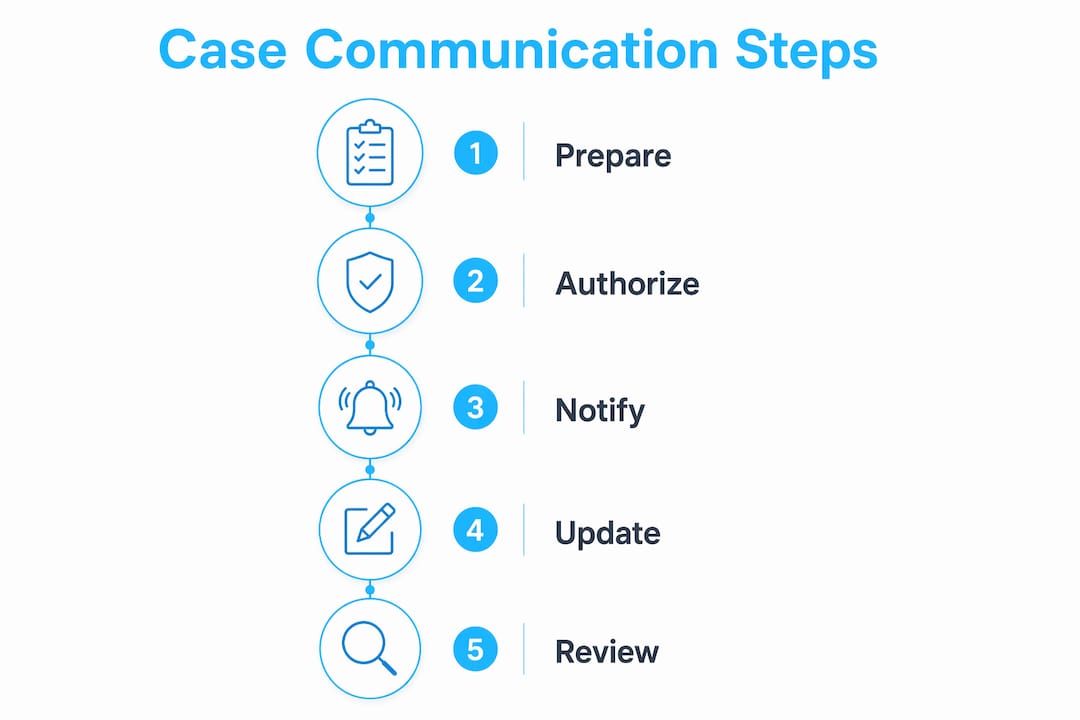
Practical tips for sharing case updates with the press
A well-timed, well-written press release is still one of the most effective tools for getting accurate coverage. Issuing a release the same day as a filing or verdict gives reporters the facts they need while the story is still live. Waiting even 24 hours often means the narrative has already been set by someone else.
Journalists do not want a document dump. They want to understand why the case matters, who is affected, and what happens next. Concise, plain-language summaries that answer those three questions outperform 20-page legal briefs every time. If you want a reporter to read your materials, make them easy to read.
- Plan communications in advance. Map out likely case milestones and draft template statements for each scenario before they happen. A verdict, a settlement, a dismissal, each needs a different message.
- Write press releases at a 10th-grade reading level. If a non-lawyer cannot understand it in one read, rewrite it.
- Lead with the news, not the background. The first sentence of a press release should state what happened, not who the parties are.
- Tailor pitches to individual reporters. A business reporter needs a different angle than a legal affairs correspondent. Sending the same generic pitch to both wastes everyone’s time.
- Use visuals, timelines, and fact sheets to help reporters tell the story accurately. A one-page timeline of key case events is something a reporter can actually use.
- Respect deadlines. If a reporter tells you they need a comment by 3:00 PM, that is not a suggestion.
- Avoid press conferences unless you have genuinely compelling news. Unnecessary press conferences with thin news value produce poor turnout and can make your team look disorganized. A well-crafted release or an embargoed exclusive often generates better coverage.
Pro Tip: Draft a “holding statement” at the start of every major case. It should be two sentences that confirm you are aware of the matter and are reviewing it. That statement buys you time without saying “no comment.”
Ethical guidelines and legal constraints when reporting case results
RPC 3.6 is the ethical rule that governs trial publicity for lawyers in the United States. It prohibits attorneys from making extrajudicial statements that they know, or reasonably should know, will be disseminated publicly and will have a substantial likelihood of materially prejudicing an adjudicative proceeding. That is not a technicality. Violating it can result in bar discipline, sanctions, or worse, a mistrial.
The rule does not mean silence. Lawyers can state the general nature of the claim or defense, confirm that a case has been filed, and describe the procedural status of a matter. What they cannot do is comment on the character or credibility of witnesses, the strength of evidence, or the expected outcome of the case while it is still active.
Key ethical obligations every legal communicator should internalize:
- Obtain written client authorization before disclosing any case-related information to the press, even information that seems innocuous
- Never disclose privileged communications or attorney work product, regardless of how the media frames the request
- Avoid statements that characterize evidence or predict outcomes during active proceedings
- Balance transparency with confidentiality. You can confirm facts that are already in the public record without volunteering information that is not
- Consult lead counsel before issuing any statement that goes beyond confirming publicly available information
- Recognize defamation risk. Statements about opposing parties, witnesses, or third parties that are false and damaging can expose your client and your firm to civil liability
- Document every media interaction. Keep a log of what was said, to whom, and when. That record protects you if a disclosure is later questioned.
Bar association ethics opinions vary by state, so legal teams operating across jurisdictions should verify the specific rules that apply in each venue.
How to handle social media during an active legal case
Social media is where cases get tried in public long before they reach a verdict. A single post from a client, a paralegal, or even a well-meaning attorney can compromise a case, create discoverable evidence, or violate court orders. The risk is not theoretical. Criminal case defendants regularly harm their own cases by sharing details online, and the same dynamic applies to legal teams.
The default rule is simple: do not discuss an active case on any social platform, personal or professional, without explicit authorization from lead counsel. That includes LinkedIn posts about “exciting developments,” Instagram stories from the courthouse steps, and Twitter commentary on related news stories.
A practical social media framework for legal cases:
- Develop a written social media policy for the entire legal team at the start of every high-profile matter. Everyone signs it. No exceptions.
- Advise clients directly and in writing on what they cannot post during the case. Clients who do not understand the stakes will post anyway.
- Monitor online coverage and public sentiment using tools like Google Alerts for case-related keywords. You need to know what is being said before a reporter calls you about it.
- Coordinate responses to rumors and inaccurate reporting through official channels, not comment sections or direct social replies
- Use official social platforms for controlled messaging only when counsel has approved the content and the timing. A firm’s LinkedIn page can post a statement after a verdict. It should not be live-tweeting the trial.
- Train the team on digital footprints. Screenshots last forever. Deleted posts are still discoverable. Every team member needs to understand that before they type anything.
- Protect client privacy by never posting photos, documents, or identifying details that could connect a client to a case without their explicit written consent.
Expert insights from Goldman McCormick PR on communicating case results
Goldman McCormick PR has worked at the intersection of legal affairs and media relations since 2010, founded by active and former members of the media. Named by Forbes Magazine as one of America’s Best PR Firms for 2021 and cited by the New York Observer in 2014 as one of the top five agencies specializing in legal PR, the firm has built its reputation on one core principle: the legal story you tell publicly is as important as the legal argument you make in court.
One of the most underused tools in legal media relations is the public court docket. Discovery materials and filings can illustrate the case narrative for the public and media in ways that a press release alone cannot. Legal teams that treat public filings as storytelling assets, not just procedural documents, consistently achieve better media representation of their clients’ positions. The facts are already public. The question is whether your team frames them first.
The legal teams that win the media battle are the ones that plan their communications strategy before the first filing, not after the first verdict. Timing, message discipline, and reporter relationships built over years are what separate reactive damage control from proactive narrative management. At Goldman McCormick PR, we treat every case filing as a potential media moment and every reporter relationship as a long-term investment.
Goldman McCormick PR’s approach to legal media communications reflects several hard-won lessons:
| Principle | Application |
|---|---|
| Same-day press release issuance | Release statements the day of a filing or verdict to capture breaking-news cycles |
| Plain-language storytelling | Translate legal filings into clear narratives reporters can use without editing |
| Reporter relationship investment | Build ongoing relationships with beat reporters before a crisis hits |
| Docket as PR asset | Use public filings strategically to advance the client’s version of events |
| Ethical compliance first | Every statement reviewed against RPC 3.6 before release |
| Crisis communication readiness | Prepare holding statements and escalation protocols at case onset |
The firm’s 2016 Gold Award from Bulldog Reporter’s CSR Awards in the “Best Cause/Advocacy Campaign” category reflects the same discipline applied to high-stakes public communications. Whether the matter involves a corporate defendant, a public agency, or an individual client, the fundamentals do not change: get the facts out fast, get them right, and get them to the reporters who cover the beat.
Long-term reporter relationships are the asset that most legal teams underinvest in. Developing reporter trust over time enables off-the-record background conversations that help shape accurate coverage and creates a direct channel for correcting errors before they compound. A reporter who has worked with your team before will call you for comment. One who has not will publish without you.
Key Takeaways
Effective legal media communication depends on timing, ethical discipline, and reporter relationships built before a crisis demands them.
| Point | Details |
|---|---|
| Secure written authorization first | Get client sign-off in writing before any media engagement to avoid delays and liability. |
| Issue press releases the same day | News goes stale within roughly two days of a case resolution, so same-day release is critical. |
| RPC 3.6 sets the ethical boundary | Lawyers cannot make statements that have a substantial likelihood of prejudicing active proceedings. |
| Treat public filings as storytelling assets | Discovery materials and docket filings can frame the client’s narrative before reporters do it for you. |
| Build reporter relationships before you need them | Long-term trust with beat reporters enables faster corrections and more accurate coverage during high-stakes moments. |
Ready to get your case results the coverage they deserve?
Goldman McCormick PR has spent many years placing legal stories in the outlets that matter, from national television and radio to major newspapers and digital publications. The firm produces nationally syndicated radio programs heard on the Genesis Communications Network and Starcom Radio Network, and its team knows how to translate complex legal outcomes into coverage that reaches the right audience at the right time.
If you are a legal professional or public information officer looking to manage media relations around a high-profile case, Goldman McCormick PR brings the editorial relationships, ethical grounding, and communications experience to do it right.