
Public relations in criminal trials does one thing above all else: it fights for your client’s reputation in the arena where verdicts are often decided before a jury ever deliberates. Litigation communications now operates as a parallel discipline to trial advocacy, and what gets said outside the courtroom can shape jury pool perception, drive settlement leverage, and define post-verdict narrative more durably than the verdict itself. The court of public opinion is not a metaphor. It is a second battleground, and leaving it uncontested is a decision with real consequences.
Here is what effective PR contributes to a criminal trial:
- Narrative control: Shaping the story the public and press receive before the opposition defines it first
- Reputation protection: Limiting reputational damage that persists regardless of the legal outcome
- Media management: Correcting misinformation quickly, before inaccurate coverage calcifies into public memory
- Legal alignment: Coordinating every public statement with defense counsel to stay within ethical and legal boundaries
- Ethical compliance: Operating within Model Rule of Professional Conduct 3.6, which governs extrajudicial statements to prevent trial prejudice
How public relations integrates with legal strategy in criminal trials
PR and legal counsel are not two separate teams running parallel tracks. In high-profile criminal cases, they function as one unit, with every public statement reviewed against the defense theory of the case.
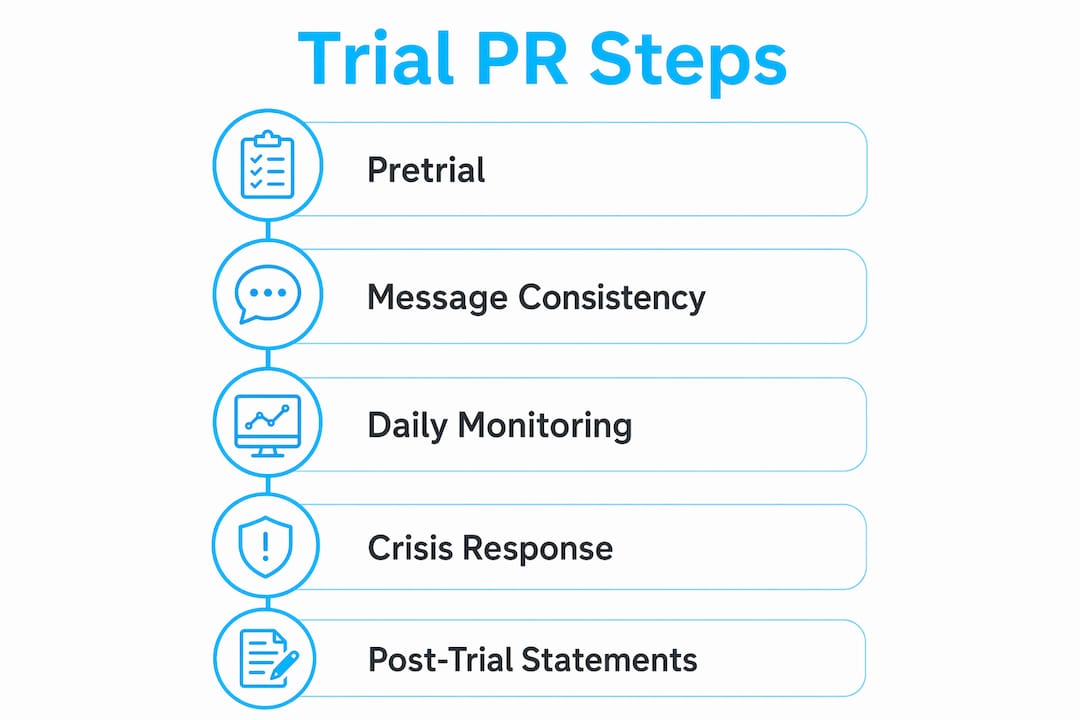
The PR team’s first job is message consistency. A designated spokesperson handles all press contact so that trial counsel stays focused on the courtroom. This separation matters because off-the-cuff attorney comments to reporters can create contradictions that opposing counsel exploits at trial. Court filings serve double duty: drafted to satisfy the judge and written clearly enough that a journalist can quote them directly. As litigation PR strategy developed over the past two decades, using filings as storytelling devices became one of the discipline’s most effective tools.
Daily media monitoring is non-negotiable. A misquote left uncorrected for 48 hours can spread across social platforms and become the version of events the public accepts as fact.
Legal experts consistently warn that ignoring public opinion allows adversaries to control the narrative, damaging reputation independent of what happens at trial.
Key public relations strategies used during criminal trials
The tactics that work in criminal trial PR are specific, disciplined, and tightly coordinated with legal counsel.
- Spokesperson discipline: Trial attorneys rarely handle press directly. A trained spokesperson delivers consistent, vetted messaging at every stage.
- Document-driven storytelling: Reporters get access to admitted exhibits and readable filings that frame the defense narrative on the public record.
- Witness media preparation: Witnesses entering and leaving the courthouse face cameras. Preparation prevents damaging off-script moments.
- Daily media and social surveillance: Catching inaccurate coverage early is the only way to correct it before it spreads. How algorithms shape public perception directly affects how quickly misinformation amplifies online.
- Jury consultant coordination: PR teams share perception data with jury consultants to identify and address narrative risks before they reach the jury box.
Pro Tip: Treat every court filing as a dual-purpose document. Write it to win in front of the judge, but draft it so a reporter can pull a clear, accurate quote without misreading the legal argument. Filings that read like press releases for the right audience give you free, credible media coverage on the public record.
Speed and clarity in media engagement are critical. Silence in a digital media environment almost always cedes the narrative to the opposing side.
Challenges and ethical considerations for PR in criminal trials
The ethical constraints on trial-related PR are real and carry serious consequences when violated.
Model Rule of Professional Conduct 3.6 prohibits lawyers and those working under their direction, including retained PR consultants, from making extrajudicial statements with a substantial likelihood of materially prejudicing the proceeding. Every state bar has adopted some version of this rule. PR consultants retained by counsel fall directly under its scope.
- Juror influence: Any direct media outreach intended to reach jurors can invalidate trial outcomes and end legal careers.
- Gag orders: Courts impose gag orders that extend beyond attorneys to parties, witnesses, and others within the court’s jurisdiction. PR teams adapt by using third-party advocates not subject to the order, drafting filings as de facto press releases, and relying on witness statements made outside lawyer participation.
- Misinformation risk: Inaccurate coverage spreads rapidly. As one litigation attorney put it, once false information is out, “it doesn’t matter if he said it or not. People think he said it.” Correcting the record fast, through direct reporter contact and formal retraction requests, is the only reliable defense.
- Ethical balancing: Transparency can protect a client, but it must never cross into conduct that prejudices the proceeding. How media incentives affect coverage shapes which stories get amplified, making ethical PR judgment more complex than it appears.
The line between protecting a client’s reputation and tainting a jury pool is narrow. Crossing it, even accidentally, can cost the case.
Goldman McCormick PR: a leading legal PR firm in the United States
Goldman McCormick PR has operated at the intersection of media and law since its founding in 2010 by active and former members of the media industry. Forbes Magazine named it one of America’s Best PR Firms for 2021. The New York Observer cited Goldman McCormick PR as one of the top five public relations agencies specializing in legal PR as far back as 2014. In 2016, the firm earned a Gold Award in the “Best Cause/Advocacy Campaign” category at Bulldog Reporter’s CSR Awards.
The firm’s national reach extends to syndicated radio programs on the Genesis Communications Network and Starcom Radio Network, giving legal clients access to audiences that go well beyond traditional print and digital coverage. For criminal cases requiring media training, courtroom communication support, and rapid response to breaking coverage, Goldman McCormick PR brings both the legal literacy and the media relationships that matter. Learn more about their approach to legal PR.
How reputation management works during a criminal trial
Reputation damage in a criminal case does not wait for a verdict. It starts the moment charges become public, and it compounds with every news cycle that goes unanswered.
Effective reputation management in this context means getting ahead of the narrative before the opposition defines your client as guilty in the public mind. That requires a clear, factual account of who the client is, what the charges actually allege, and where the defense stands, delivered consistently across every media touchpoint. Negative publicity that persists after an acquittal is one of the clearest signs that reputation management was either absent or too slow.
The goal is not spin. It is accuracy, delivered faster than the other side’s version of events.
Shaping public opinion during high-profile criminal trials
High-profile criminal trials attract coverage that operates on its own logic. Reporters file multiple times a day, social media reacts in real time, and the public forms opinions based on fragments of testimony stripped of context.
Shaping opinion in this environment requires a consistent “mantra” for the case: a short, memorable framing of the defense narrative that reporters can repeat accurately and that jurors absorb through ambient coverage. The Depp v. Heard trial in 2022 demonstrated how parallel media strategies can operate alongside live trial coverage, with each side’s narrative competing for dominance in real time. The Elizabeth Holmes trial took the opposite approach, with the defense largely declining active media engagement, which left the prosecution’s framing largely unchallenged in public coverage.
The lesson from both cases is that the choice to engage or stay silent is itself a strategic decision with measurable consequences.

Timing and crisis communication planning during trial phases
PR strategy in a criminal trial is not one plan. It is a sequence of plans, each calibrated to the phase of the proceeding.
Pretrial: This is when the narrative foundation gets built. Every public filing, every spokesperson statement, and every background conversation with reporters happens before the jury is seated. Getting the framing right here is far easier than correcting it mid-trial.
During trial: Mid-trial narrative shifts are visible to juries. PR activity during this phase focuses on daily courthouse briefings where local rules permit, document-driven storytelling using admitted exhibits, and rapid correction of inaccurate coverage. Direct comment on testimony typically violates Rule 3.6 and is off the table.
Post-verdict: Winners and losers each issue prepared statements within minutes of the verdict. Post-trial motions, sentencing memoranda, and appellate briefs all become public communications documents. The appellate phase often carries lower media volume, but the appellate decision can shift the historical narrative of the case dramatically.
Flexibility is the discipline. A communications approach that made sense on Monday may need to change by Wednesday when new facts emerge.
Case studies: when trial PR worked and when it did not
Depp v. Heard (2022): Both parties ran active media strategies during the Fairfax County civil trial, but the Depp team’s approach proved far more effective at shaping public sympathy. The case became a textbook example of how parallel media narratives can operate alongside live trial coverage and outlast the verdict itself in public memory.
Elizabeth Holmes (2021): The defense’s decision to limit media engagement left the prosecution’s framing largely unchallenged in public coverage throughout the trial. Whatever the legal merits, the public narrative was effectively ceded to one side.
High-profile military defense cases: Cases where defense teams adopted full transparency, sharing key evidence with leading print outlets and granting frequent media access to attorneys, have demonstrated that turning public opinion can pave the way to favorable resolution. As Justice Anthony Kennedy wrote in Gentile v. State Bar, PR strategy can “demonstrate in the court of public opinion that the client does not deserve to be tried.”
The pattern across successful campaigns is consistent: early engagement, disciplined messaging, and fast correction of inaccurate coverage. Failed campaigns share the opposite traits.
Key Takeaways
Public relations in criminal trials protects client reputation by controlling media narratives, correcting misinformation fast, and coordinating every public statement with legal strategy under Model Rule of Professional Conduct 3.6.
| Point | Details |
|---|---|
| PR starts before trial | Build the narrative foundation during the pretrial phase, before the jury is seated and the opposition defines your client. |
| Filings are PR tools | Draft court documents to be readable by reporters, not just judges, so the public record tells your client’s story clearly. |
| Rule 3.6 governs PR consultants | PR professionals retained by counsel fall under the same extrajudicial statement restrictions as the attorneys themselves. |
| Silence cedes the narrative | In a digital media environment, failing to respond quickly allows the opposing side’s version of events to become the public record. |
| Reputation damage precedes verdicts | Negative publicity compounds from the moment charges become public, making early, accurate communication the primary defense tool. |