
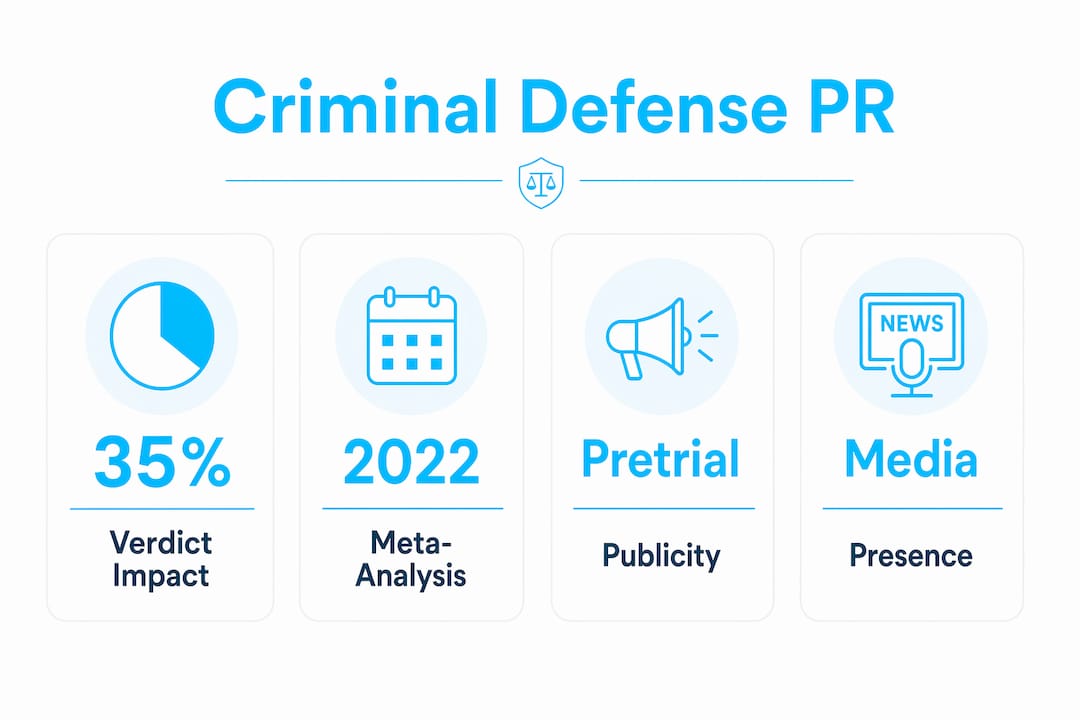
Criminal defense law firms need public relations because silence is a strategy that almost always loses. A A 2022 meta-analysis of 45 studies involving 11,240 participants found that negative pretrial publicity increases guilty votes with an effect size of r = .35, while positive pro-defendant coverage decreases guilty verdicts with an effect size of r = -.21. The prosecution holds press conferences. Police issue statements. The defense, by default, says nothing. That vacuum fills fast, and it fills with the other side’s story.
Criminal defense PR is the practice of managing media communications to protect both a client’s reputation and the legal strategy behind their case. It is not advertising. It is not spin. It is controlled, ethics-first messaging designed to prevent prosecutorial narratives from becoming the only ones the public, and potential jurors, ever hear.
The benefits are concrete:
- Narrative control before a story hardens in the public mind
- Juror bias reduction through pro-defendant media coverage
- Instant credibility signals for clients making urgent hiring decisions
- SEO authority through earned media that compounds over time
- Client trust established before the first consultation call
Why criminal defense needs PR more than any other practice area
Most legal fields give attorneys weeks to build a reputation with a prospective client. Criminal defense does not. Clients often hire within 24 hours of an arrest, sometimes within hours. Someone arrested at 11 PM is searching Google by 8 AM. The reputation has to do its work in a rapid scan, not a deliberative comparison.
That urgency creates a specific problem. Traditional credibility signals, like client reviews, barely work in criminal defense. Most clients will never publicly identify themselves as having needed a defense attorney, regardless of the outcome. A dismissal, a not-guilty verdict, a favorable plea — none of these feel like moments worth celebrating in writing under a real name. Clients avoid publicly identifying their use of criminal defense, which limits review volume and forces firms to build credibility through other means.
PR fills that gap. Media appearances, byline articles, podcast features, and expert commentary in news stories all signal authority without requiring clients to say a word publicly.

How PR shapes what happens inside the courtroom
The research on pretrial publicity is hard to ignore. The same 2022 PubMed meta-analysis that documented the r = .35 effect for negative coverage also showed that jurors exposed to anti-defendant publicity make more memory errors about evidence and rate defendants lower on credibility measures. Positive coverage, by contrast, reduced guilty verdicts measurably.
When media coverage saturates a jurisdiction, documented coverage supports a motion for change of venue under the Sixth Amendment right to an impartial jury. That documentation only exists if someone tracked it from day one. A PR strategy that monitors and archives media coverage from the moment charges are filed gives defense attorneys a concrete legal tool, not just a reputational one.
The prosecution controls the timing of arrests, charges, and press conferences. They have established relationships with crime reporters. Defense attorneys who stay silent cede that structural advantage entirely.
What ethical criminal defense PR actually looks like
PR for criminal defense operates under real constraints. ABA Rule 3.6 prohibits extrajudicial statements that an attorney knows or reasonably should know will materially prejudice a proceeding. That means no speculation about witnesses, no attacks on the complainant, no promises about outcomes.
Working within those limits still leaves room for meaningful communication. A brief, factual early statement emphasizing the presumption of innocence, correcting factual errors, and projecting calm confidence can prevent a narrative vacuum without crossing ethical lines. The goal is not to win the news cycle. It is to stop the prosecution’s version from becoming the only version.
A press counsel structure formalizes this. It designates who can approve a statement, who declines interviews, and who routes inquiries without comment. Without that structure, a junior staff member might accidentally confirm a detail, or a partner might issue an off-the-cuff remark that becomes the headline. The structure is not bureaucracy; it is protection.
Pro Tip: Build your press counsel protocol before a high-profile case arrives. Reactive media management under pressure produces mistakes that disciplined preparation prevents.
Goldman McCormick PR’s role in legal public relations
Goldman McCormick PR has operated at the intersection of media and law since 2010, founded by active and former media professionals who understand how newsrooms actually work. Forbes Magazine named them one of America’s Best PR Firms for 2021. The New York Observer cited them as one of the top five PR agencies specializing in legal PR back in 2014. In 2016, they earned a Gold Award in Bulldog Reporter’s CSR Awards for Best Cause/Advocacy Campaign.
Their approach covers the full media spectrum: television, radio, print, podcasts, and nationally syndicated radio programs on the Genesis Communications Network and Starcom Radio Network. For criminal defense firms, that breadth matters. A single earned media placement in a major outlet generates backlinks that improve search rankings and drive client inquiries indefinitely. A TV appearance gets shared on social media. A podcast episode builds authority with a different audience segment entirely.
What separates effective legal PR from generic media work is message discipline. Goldman McCormick PR develops narratives that align with ethical standards, which means the coverage they secure does not create courtroom problems for the attorneys they represent.
Key Takeaways
Criminal defense public relations is not optional for firms that want to compete on credibility, control their narrative, and convert urgent prospects into clients.
| Point | Details |
|---|---|
| Pretrial publicity affects verdicts | A 2022 meta-analysis found negative coverage increases guilty votes (r = .35); positive coverage decreases them (r = -.21). |
| Clients decide within hours | Criminal defense prospects often hire within 24 hours of arrest, requiring instant credibility signals before any consultation. |
| Reviews alone won’t build reputation | Clients avoid publicly identifying their use of defense attorneys, making earned media the primary credibility tool. |
| Ethical PR stays within ABA Rule 3.6 | Brief, factual statements and press counsel structures allow meaningful communication without prejudicing proceedings. |
| Goldman McCormick PR leads in legal PR | Named by Forbes as one of America’s Best PR Firms for 2021 and cited by the New York Observer as a top five legal PR agency. |
The case for treating PR as a risk management tool, not marketing
Most criminal defense attorneys think about PR the wrong way. They frame it as promotion, something to consider when business is slow or a high-profile case arrives. That framing misses the point entirely.
Effective criminal defense PR is risk mitigation. The risk is that the prosecution’s narrative becomes the public’s narrative, that potential jurors arrive in the courtroom already convinced, and that prospective clients searching at 2 AM find nothing credible about your firm. Media presence shortens the sales cycle by having clients arrive already convinced of credibility. That is not a marketing outcome. It is a structural advantage in a practice area where the decision window is measured in hours.
The attorneys who build media relationships before a major case arrives are the ones who can actually use those relationships when it counts. Proactive engagement, byline articles, podcast appearances, expert commentary in legal publications, these create the distributed credibility that compounds over time. Reactive statements during active cases are better than silence, but they cannot substitute for the authority that consistent media presence builds.
The firms that dominate criminal defense search results are not necessarily the best litigators. They are the ones whose names appear in trusted publications, whose attorneys are quoted as experts, and whose reputations arrive before they do.
Goldman McCormick PR brings legal media expertise to criminal defense firms
Criminal defense firms that need media presence without the risk of mismanaged messaging have a clear option. Goldman McCormick PR specializes in placing clients on television, radio, and in print, with a track record in legal PR that dates back to when most firms were still treating media as an afterthought.
Their work covers the full range of earned media: TV segments, radio appearances, newspaper features, podcasts, and nationally syndicated programs. For criminal defense attorneys, that means credibility signals across every channel a prospective client might encounter, built by professionals who understand both the media landscape and the ethical constraints of legal communications. Forbes, Bulldog Reporter, and the New York Observer have all recognized Goldman McCormick PR’s standing in this space. If your firm needs to build authority, manage a narrative, or establish the kind of media presence that converts urgent prospects into retained clients, Goldman McCormick PR is worth the conversation.
Additional resources and citations
The research and expert insights referenced throughout this article draw from the following sources:
“According to a 2022 meta-analysis published in PubMed reviewing 45 studies and 11,240 participants, negative pretrial publicity significantly increases the likelihood that jurors will vote to convict, with an effect size of r = .35 for deliberating juries. Positive (pro-defendant) publicity, by contrast, decreased guilty verdicts (r = -.21). The data is clear: media coverage is not neutral, and it affects the people who decide your client’s fate.” — Inoriseo, Criminal Defense Attorney Media Strategy
- Meta-analysis of pretrial publicity effects (PubMed, 2022)
- Criminal Defense Attorney Media Strategy, Inoriseo
- Reputation Management for Criminal Defense Attorneys, TrueReview
- Digital PR for Lawyers and Law Firms, Legal Hero Marketing
- Ethical Media Strategies for Criminal Defense Firms, Judgments.pro
- Media Communications: Legal and Ethical Considerations for Lawyers, CriminalDefense.com
- Power of Public Relations in Law Firms, Solicitors Journal
- How to manage online reputation for SMBs
- AI content optimization for legal marketers