
Press coverage is the most powerful credibility tool available to attorneys because it delivers third-party validation that paid advertising cannot replicate. Earned media, the industry term for coverage you earn through newsworthiness rather than payment, shifts prospective clients from consideration to commitment before they ever call your office. Lawyers who appear in newspapers, on television, and in national publications signal capability in a way no billboard or Google ad can match. This guide explains exactly why press coverage matters for attorneys in 2026 and how to build it deliberately.
Why lawyers need press coverage to win client trust
The trust gap between paid and earned media is not subtle. Prospects absorb editorial endorsements at face value, treating a journalist’s mention of your name as an implicit recommendation. A paid ad, by contrast, is immediately recognized as self-promotion. That distinction changes how potential clients evaluate you before the first consultation.

Earned media works because it transfers credibility from the publication to the attorney. When the Wall Street Journal quotes a bankruptcy lawyer on rising corporate defaults, that lawyer inherits the publication’s authority. No advertising budget produces the same effect.
The practical consequences are real:
- Prospective clients who find you through press coverage arrive with higher baseline trust than those who find you through ads.
- Referral partners, including other attorneys and financial advisors, are more likely to send complex cases to lawyers they have seen quoted in credible outlets.
- Opposing counsel and judges form impressions of professional standing, and media visibility contributes to that perception.
Pro Tip: Save every media mention in a press kit and link it prominently on your website’s bio page. Clients read those pages before they call.
How media training protects and amplifies your press coverage
Media training is now a governance necessity for any attorney who speaks publicly. Every statement you make to a reporter is indexed by AI search engines and summarization tools, meaning a poorly worded answer to a single question can follow your name for years. Precision and consistency are not optional.
The AI-driven media landscape magnifies both the reach and the permanence of public visibility. A comment that once faded from a print edition now surfaces in AI-generated summaries, podcast transcripts, and news aggregators indefinitely. Lawyers who lack a disciplined communication framework face compounding reputational risk.
Effective media training for attorneys covers three core skills:
- Bridging: Redirecting a hostile or off-topic question back to your key message without appearing evasive.
- Narrative architecture: Framing your expertise around a clear, consistent story that aligns with your practice area and client interests.
- Speed and clarity: Delivering a usable quote in under 20 seconds, which is what most broadcast journalists actually need.
Successful lawyers differentiate legal advocacy from media communication. The courtroom rewards exhaustive argument. The media rewards a single clear sentence. Training bridges that gap.
Pro Tip: Before any media interview, prepare three core messages and practice returning to them regardless of the question asked. This is the single most effective technique in media training.
How strategic media relations build lasting visibility
One-off press placements produce a spike in visibility and then disappear. A relationship-driven approach to media relations compounds over time. The most effective framework is what practitioners call the orchard strategy: consistent, low-stakes engagement with journalists that builds a trust reservoir, enabling rapid and high-impact coverage when a major story breaks.
The mechanics of this approach follow a clear sequence:
- Identify your beat. Pick two or three practice areas where you can offer genuine depth. Journalists covering securities litigation, family law, or immigration need reliable expert sources. Become the attorney they call first.
- Provide insight, not summaries. Journalists seek attorneys who offer in-depth interpretation, not generic recaps of what a ruling says. Tell the reporter what the ruling means for the next 18 months.
- Respond fast. News cycles move in hours. An attorney who responds to a media inquiry within 30 minutes gets quoted. One who responds the next day does not.
- Stay consistent. A lawyer who appears in three publications over two years on the same topic becomes the recognized authority on that topic. Sporadic outreach does not build the same recognition.
“Media relations is not a campaign. It is a long-term investment in a trust reservoir that pays out when the story that defines your career finally breaks. The attorneys who are ready for that moment are the ones who have been showing up consistently for years.”
Exposure, not expertise, is the primary challenge for most attorneys. Lawyers who provide insightful legal interpretation attract both media attention and the high-value clients that follow it.
What are the practical business benefits of press coverage for attorneys?
National press recognition transforms trial lawyers from local practitioners into trusted experts for catastrophic, high-profile cases. That shift drives referrals from attorneys in other markets who need local counsel with a credible public profile. It also influences juror confidence and peer recognition in ways that local advertising never reaches.
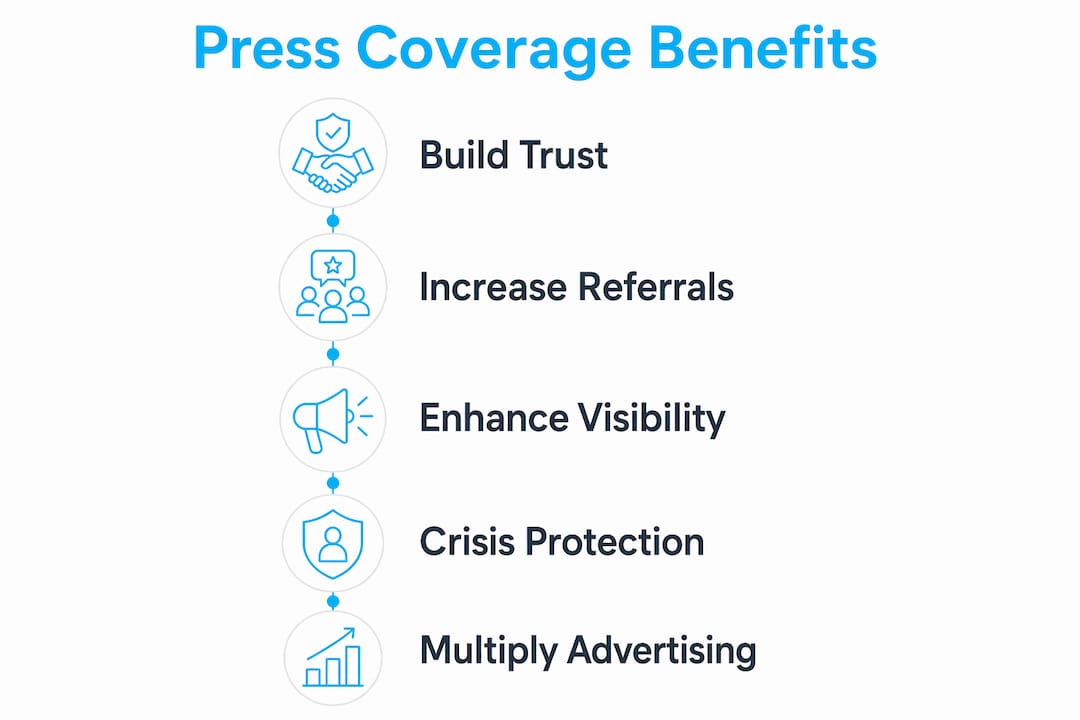
The business benefits of press coverage extend across multiple channels:
| Benefit | How it works |
|---|---|
| Client acquisition | Earned media builds trust before first contact, increasing conversion rates from inquiry to retained client |
| Referral growth | National visibility signals capability for complex cases, attracting referrals from attorneys and professionals |
| SEO authority | Press mentions generate backlinks and branded search volume, improving organic search rankings |
| Juror and peer perception | Media recognition shapes how jurors and opposing counsel perceive an attorney’s standing |
| Crisis protection | Established media credibility provides a reputational buffer when disputes or controversies arise |
The PR cost of a crisis can exceed litigation costs. Attorneys who build media relationships before a crisis have a platform and trusted journalist contacts to work with when reputational damage threatens. Those who have ignored media relations have neither.
Press coverage also integrates with paid advertising in a way that multiplies the return on both. A prospective client who sees your Google ad and then finds three press mentions when they search your name converts at a significantly higher rate than one who finds only the ad.
Pro Tip: Pair your attorney partnership resources with a media presence strategy. Clients who see you as a well-connected, publicly recognized attorney trust your referrals and recommendations more readily.
Key Takeaways
Press coverage builds the credibility infrastructure that converts prospective clients, drives referrals, and protects reputations in ways paid advertising cannot replicate.
| Point | Details |
|---|---|
| Earned media outperforms ads | Editorial endorsements transfer publication credibility to the attorney, increasing client trust before first contact. |
| Media training is governance | AI indexes every public statement, making disciplined communication a reputational risk management requirement. |
| Consistency compounds credibility | The orchard strategy of regular journalist engagement builds a trust reservoir that pays out during high-stakes moments. |
| National press drives referrals | Visibility in national outlets signals capability for complex cases and attracts referrals from attorneys in other markets. |
| Crisis readiness requires media presence | Attorneys with established media relationships have a platform and contacts to manage reputational threats effectively. |
Why I think most lawyers are leaving credibility on the table
I have worked in media and public relations long enough to say this plainly: most attorneys treat press coverage as a bonus rather than a foundation. That is a mistake that costs them clients they never know they lost.
The lawyers who call Goldman McCormick PR after a crisis are often the same ones who dismissed media relations as unnecessary when things were going well. By the time a damaging story runs, the window for proactive narrative control has already closed. The attorneys who fare best in those moments are the ones who spent years building journalist relationships and a consistent public record of expertise.
Media coverage is not a tactic you deploy when you need clients. It is credibility infrastructure you build continuously so that when a major case, a high-profile dispute, or a career-defining opportunity arrives, your reputation precedes you. The attorneys who understand this in 2026 will hold a durable advantage over those who do not.
Patience is the part nobody wants to hear. A single press mention does not change your practice. Twelve mentions over two years, all reinforcing the same area of expertise, absolutely does.
— Ryan McCormick
How Goldman McCormick PR helps attorneys build lasting media presence
Goldman McCormick PR has specialized in legal public relations since 2010, and the New York Observer named the firm one of the top five PR agencies in legal PR as early as 2014. Forbes Magazine recognized Goldman McCormick PR as one of America’s Best PR Firms for 2021. That track record reflects a focused approach: getting attorneys seen on television, heard on radio, and quoted in newspapers that matter to their clients and peers.
Attorneys working with Goldman McCormick PR gain access to media training programs built specifically for legal professionals, established journalist relationships across national and regional outlets, and a team that understands both the legal and communications dimensions of reputation management. The firm also produces nationally syndicated radio programs on the Genesis Communications Network and Starcom Radio Network, giving attorneys broadcast exposure that most PR firms cannot offer. If building a credible, durable media presence is the goal, Goldman McCormick PR delivers the infrastructure to make it happen.
FAQ
Why does earned media build more trust than paid advertising?
Earned media carries third-party credibility because a journalist or editor chose to include the attorney, rather than the attorney paying for placement. Prospective clients treat editorial mentions as implicit endorsements, which paid ads cannot replicate.
How does media training protect a lawyer’s reputation?
Media training teaches attorneys to deliver precise, consistent messages that align with their firm’s positioning. Every public statement is now indexed by AI tools, so a single poorly worded answer can create lasting reputational exposure.
What is the orchard strategy in legal media relations?
The orchard strategy is a long-term approach to media relations built on consistent, low-stakes journalist engagement. It creates a trust reservoir that enables rapid, high-impact coverage when a major story breaks.
How does national press coverage affect client referrals?
National press recognition signals that an attorney can handle complex, high-profile cases. This drives referrals from attorneys in other markets who need credible local counsel and from professionals who follow industry news.
When should a lawyer start building media relationships?
Attorneys should build media relationships before they need them. Established press credibility provides a reputational buffer during crises and a compounding advantage in client acquisition over time.