
Psychology professionals need PR agencies because earned media, ethical compliance, and consistent public messaging are skills that clinical training does not cover. Generic marketing agencies routinely violate advertising regulations that govern mental health practitioners, putting professional registrations at risk. Specialized public relations firms build the kind of media credibility that referral networks, search engines, and AI citation systems actually reward. The result is a practice that grows on trust rather than ad spend.
Why psychology professionals need PR agencies for earned media
Earned media is editorial coverage you did not pay for. It appears in publications like Behavioral Health News, Psychology Today, and mainstream outlets when a journalist decides your expertise is worth quoting. That distinction matters because earned media compounds across three critical marketing systems simultaneously: backlink authority, AI citation authority, and referral source trust. Generic paid advertising touches none of those three.
The backlink benefit is concrete. When a credible publication links to your practice website, Google treats it as a vote of confidence. AI tools like ChatGPT and Perplexity pull from sources with strong citation histories. Referral partners, including primary care physicians and school counselors, check your media presence before recommending you to clients. A single well-placed article in a behavioral health publication can move all three metrics at once.

Pro Tip: Ask any PR agency you evaluate to show you placements in trade publications specifically covering mental health or behavioral health. Vanity placements in low-authority directories do not produce the compounding effect described above.
The numbers behind pitch success rates tell the rest of the story. Without journalist relationships, pitch success rates sit at 1–3%. With cultivated relationships, that rate rises to 15–25%. PR agencies build those relationships over years. You cannot replicate them with a press release template.
| Media Type | Backlink Authority | AI Citation Value | Referral Trust |
|---|---|---|---|
| Earned editorial coverage | High | High | High |
| Paid advertorial | Low | None | Low |
| Social media posts | None | Low | Moderate |
| Press release wire | Low | Low | None |
Do generic marketing agencies put your license at risk?
The short answer is yes. Advertising non-compliance including prohibited patient testimonials and unsubstantiated clinical claims is a leading cause of complaints investigated by regulatory bodies. In the United States, state psychology licensing boards and the American Psychological Association both publish ethics codes that restrict how practitioners may advertise. Most general marketing agencies are unaware these rules exist.
The most common violations fall into three categories:
- Patient testimonials. Many states prohibit licensed psychologists from soliciting or publishing client testimonials. A generic agency running a Google review campaign may trigger a licensing board complaint before you realize what happened.
- Unsubstantiated outcome claims. Phrases like “proven to cure anxiety” or “guaranteed results” violate both FTC guidelines and professional ethics codes. Generic copywriters use them routinely.
- Misleading credential displays. Listing degrees or specializations in ways that imply board certification you do not hold is a sanctionable offense in most jurisdictions.
Specialized PR agencies understand these boundaries. They produce messaging that builds authority without crossing ethical lines. The decision to seek mental health care is deeply personal, and aggressive or misleading marketing actively pushes vulnerable clients away rather than attracting them.
Pro Tip: Before signing any marketing contract, ask the agency to identify two specific advertising regulations that apply to licensed psychologists in your state. If they cannot answer, walk away.
How PR agencies match the therapy client’s consideration cycle
Therapy clients do not book appointments the same day they search. The consideration cycle spans 3–6 weeks, and clients visit 4–7 different provider websites before committing to one. That timeline requires a consistent, recognizable professional presence across every channel they might encounter. A one-time ad campaign cannot sustain that presence.
PR agencies maintain your voice across the full consideration arc by coordinating several channels at once:
- Trade and consumer media coverage that surfaces when clients search your specialty
- Podcast appearances and radio segments that let clients hear your communication style before booking
- Directory profiles and website content that reinforce the same credentials and approach
- Email and newsletter placements in mental health advocacy publications
The strategy behind this consistency is called issue positioning. Rather than promoting your services directly, issue positioning ties your expertise into ongoing media conversations about mental health topics. A psychologist quoted in a Washington Post piece on adolescent anxiety is not selling anything. That psychologist is building authority. Clients who read that article and later search for a provider already trust the name they recognize.
“Media coverage connecting mental health topics to available professional services encourages individuals to seek expert help.” — Agility PR Solutions
This approach works because it aligns with how hesitant clients actually make decisions. They are not responding to calls to action. They are looking for a practitioner whose name and perspective they have encountered before.
Specialized PR agency vs. in-house or hybrid models
Single-practice psychologists rarely have the budget or the time to build a full in-house PR function. The comparison below reflects realistic options for most practitioners.
| Model | Journalist Relationships | Regulatory Knowledge | Cost | Best For |
|---|---|---|---|---|
| Specialized PR agency | Established, ongoing | High | Moderate to high | Solo and group practices |
| Generic marketing agency | Minimal | Low | Low to moderate | Non-regulated industries |
| In-house PR staff | Must be built from scratch | Varies | High (salary + benefits) | Large hospital systems |
| Hybrid model | Agency-led, clinician-supported | High | Moderate | Growing group practices |
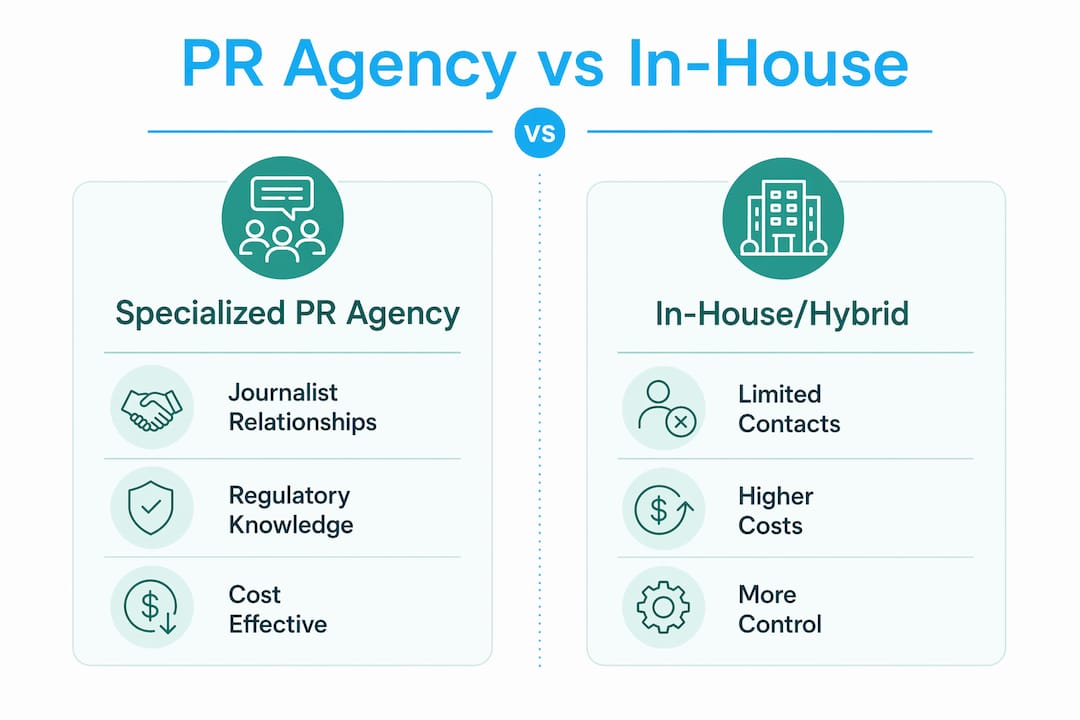
The hybrid model deserves specific attention. Clinical staff develop the stories while the agency manages media outreach. This combines authentic clinical content with professional pitch execution. A psychologist who writes a 500-word commentary on a trending mental health topic gives the agency something real to pitch. The agency then places it in the right publication at the right time.
Specialized agencies also follow a staged media outreach strategy: trade publications first during months 1–12 to build a citation base, then mainstream outlets once credibility is established. That sequencing matters because mainstream journalists check whether a source has been published in trade media before agreeing to an interview.
Pro Tip: If you are a solo practitioner, start with a specialized agency on a project basis rather than a retainer. Commission a three-month trade media campaign first, then evaluate results before committing to a longer engagement.
Key takeaways
Psychology professionals who engage specialized PR agencies gain compounding media authority that generic marketing cannot produce, while staying within the ethical and regulatory boundaries that protect their licenses.
| Point | Details |
|---|---|
| Earned media compounds across systems | Editorial coverage builds backlink authority, AI citation value, and referral trust simultaneously. |
| Regulatory compliance is non-negotiable | Generic agencies routinely violate psychology advertising rules, risking your professional registration. |
| Consideration cycles require consistency | Clients evaluate 4–7 providers over 3–6 weeks, so your presence must be consistent across every channel. |
| Issue positioning beats direct promotion | Tying your expertise to media mental health conversations builds authority without aggressive sales tactics. |
| Hybrid models offer the best balance | Combining clinical storytelling with agency media outreach produces the most credible and cost-effective results. |
What i have learned after years of working with health professionals
Most psychologists I have worked with come to us after a bad experience with a generic agency. The pattern is almost always the same. The agency ran ads, generated clicks, and produced a report full of impressions. The phone did not ring. Worse, in a few cases, the content the agency published created compliance concerns that required legal review to resolve.
The real problem is that mental health PR is not a volume game. You are not selling a product with a 30-day return policy. You are asking someone in a vulnerable moment to trust you with their psychological wellbeing. That requires a different kind of communication. It requires patience, credibility, and a voice that feels consistent and authoritative over time.
Earned media coverage in the right publications does something that no paid ad can replicate. It signals to a prospective client that a third party, a journalist or an editor, found your expertise credible enough to publish. That signal is worth more than any click-through rate. I have seen a single well-placed article in a behavioral health publication generate referral inquiries for 18 months after publication.
My advice to any psychologist reading this is to think about PR as infrastructure, not advertising. Build it early, build it with specialists who understand your regulatory environment, and measure it in referral quality rather than raw traffic.
— Ryan McCormick
How goldman McCormick PR helps psychology professionals get noticed
Goldman McCormick PR has spent over a decade placing clients in front of the audiences that matter most. Named by Forbes Magazine as one of America’s Best PR Firms for 2021, Goldman McCormick PR specializes in earned media coverage across TV, radio, and print. For psychology professionals, that means getting your expertise in front of journalists, podcast hosts, and editors who cover mental health topics.
Goldman McCormick PR’s team includes active and former media professionals who understand how newsrooms work and what editors actually want to publish. The firm produces nationally syndicated radio programs heard on the Genesis Communications Network and Starcom Radio Network, giving psychology professionals access to audiences that generic agencies cannot reach. If you are ready to build the kind of media presence that generates lasting referral trust, Goldman McCormick PR is the right partner to start with.
FAQ
What is earned media and why does it matter for psychologists?
Earned media is editorial coverage published by a third party without payment. It builds backlink authority, AI citation credibility, and referral trust simultaneously, which paid advertising cannot replicate.
How do PR agencies help psychologists stay compliant?
Specialized PR agencies understand psychology advertising regulations, including restrictions on patient testimonials and outcome claims. They produce messaging that builds authority without triggering licensing board complaints.
How long does it take for PR to produce results for a therapy practice?
Most specialized agencies recommend a 12-month trade media campaign before pitching mainstream outlets. The staged outreach approach builds citation credibility first, then scales to broader recognition.
What is issue positioning in mental health PR?
Issue positioning ties a psychologist’s expertise to ongoing media conversations about mental health topics rather than promoting services directly. It builds authority and name recognition with prospective clients before they ever search for a provider.
Can a solo practitioner afford a PR agency?
Yes. Many specialized PR agencies offer project-based engagements rather than long-term retainers. A focused three-month trade media campaign is a practical starting point for solo practitioners evaluating the benefits of PR for psychologists.