
Public relations in jury trials is the deliberate coordination of communication strategies to manage perceptions inside and outside the courtroom, directly shaping juror attitudes and case outcomes. As of Q2 2026, combined legal and PR teams conduct voir dire alongside real-time social media monitoring to inform juror questioning. The role of public relations in jury trials has expanded far beyond press releases. It now covers message alignment, crisis communication, and continuous media surveillance throughout every phase of litigation. For legal professionals and communication strategists, understanding this interplay is no longer optional.
How does public relations impact juror attitudes and jury selection?
Trial counsel must treat jury selection as both a legal and a communications exercise. Jurors arrive in the courtroom already shaped by YouTube, podcasts, and social media influencers, and that exposure creates fixed impressions before a single witness takes the stand. Winning attorneys build a dual strategy that addresses both courtroom proceedings and the public opinion arena simultaneously.
Confirmation bias is the mechanism that makes pre-trial PR so consequential. Jurors interpret testimony to confirm beliefs they already hold, which means the narrative a juror absorbs from media before trial can override evidence presented during it. Jury questionnaires serve as strategic tools to seed and reinforce trial themes early, enabling juror self-disclosure that informs both selection and case tailoring. Skilled trial teams use questionnaires not merely for discovery but as a PR instrument to prime jurors on topics like corporate responsibility and media bias.
Media literacy and strategic communication can build rapport with jurors during voir dire, addressing biases and public narratives openly to enhance credibility. A dedicated social media research team working alongside trial lawyers allows for dynamic refinement of juror questioning based on real-time sentiment analysis.
Key PR actions during jury selection include:
- Social media profiling: Reviewing juror candidates’ public posts to identify pre-existing biases before voir dire begins.
- Questionnaire design: Embedding case themes into written questions to surface attitudes that direct examination might miss.
- Sentiment tracking: Monitoring public conversation about the case to anticipate the beliefs jurors are likely to carry into the courtroom.
- Voir dire updates: Adjusting questioning lines in real time as new media coverage or social posts emerge during the selection process.
Pro Tip: Assign a dedicated PR analyst to the trial team during jury selection, not just during the media-heavy opening and closing phases. The selection phase is where narrative battles are often won or lost.
Why does message alignment between PR and courtroom strategy matter?

Public-facing narratives become a battleground alongside the legal courtroom, requiring coordinated PR and legal strategies to control the trial story effectively. When a client’s spokesperson delivers a message to CNN that contradicts the narrative the trial team is building before the jury, credibility collapses on both fronts. The damage is often irreversible.
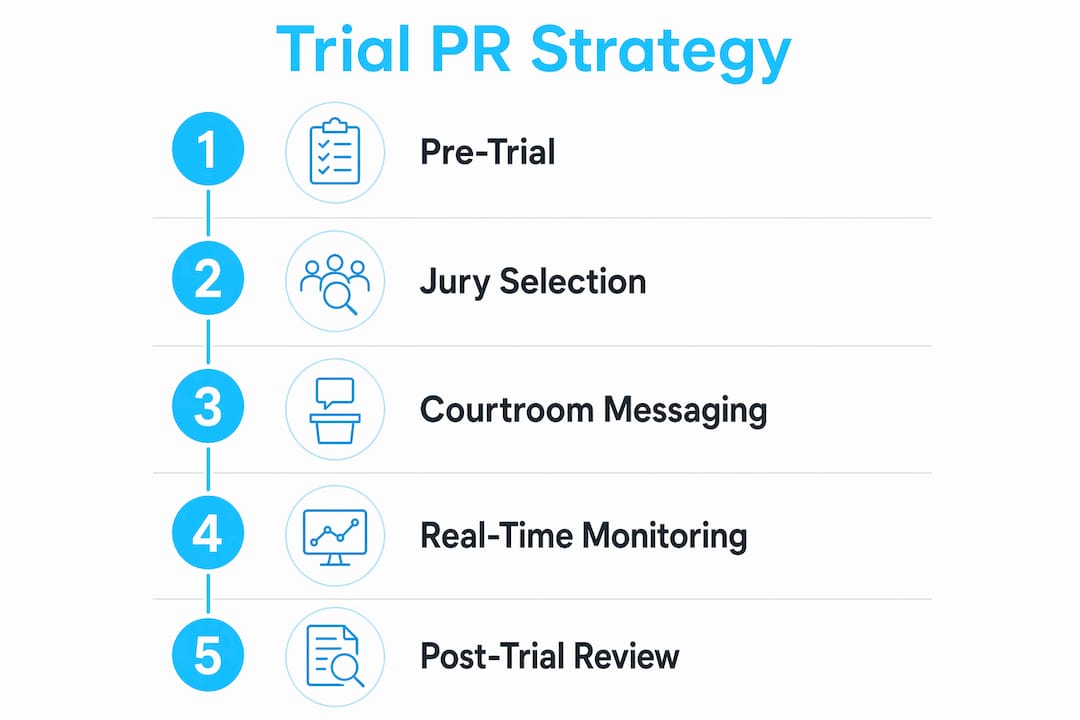
When public-facing messaging aligns with trial strategy, it amplifies persuasive impact. Jurors who hear a consistent story in the media and then hear that same story reinforced in the courtroom are far more likely to accept it as true. Misalignment, by contrast, signals confusion or deception.
Legal and PR teams must collaborate closely to ensure public messaging respects court rules and maintains credibility while managing trial publicity. Here is a practical framework for achieving that discipline:
- Establish a unified message brief. Before the trial begins, the legal team and PR team must agree on three to five core themes that will appear in both courtroom arguments and public statements.
- Designate a single spokesperson. Multiple voices create inconsistency. One trained spokesperson reduces the risk of off-script statements that undermine trial themes.
- Schedule daily alignment calls. As trial testimony evolves, the PR team needs real-time updates to keep external messaging current and consistent.
- Train spokespeople on court rules. Crisis communications and media training are vital for maintaining message consistency and managing high-profile trial publicity risks.
- Review all statements before release. Every press release, social post, or media comment should pass through both legal and PR review before publication.
“Communications discipline helps avoid contradictions and preserves authority.” — SKDKNICK
This level of coordination requires budget and planning. Teams that treat PR as an afterthought, brought in only when a crisis erupts, consistently underperform against opponents who integrated communications from day one.
What does real-time media monitoring look like during a trial?
Real-time monitoring during a jury trial is a 24-hour operation, not a weekly check-in. Ongoing social media monitoring is a critical requirement throughout the trial, and failure to maintain it may be considered a critical lapse in trial preparation.
The monitoring operation typically involves three functions working in parallel:
| Function | Team Role | Output |
|---|---|---|
| Social media surveillance | PR analyst or research team | Daily sentiment reports on juror-accessible platforms |
| News media tracking | Communications director | Real-time alerts on coverage that could reach jurors |
| Juror social media review | Legal and PR combined | Updated voir dire questions and challenge strategy |
The insights from monitoring feed directly into trial strategy. If a news outlet publishes a damaging story on a Tuesday evening, the trial team needs to know by Wednesday morning so they can adjust witness examination or request a jury instruction. Ignoring that story means the jury may absorb it without any counter-narrative in place.
Pro Tip: Use tools like Brandwatch, Meltwater, or Cision for automated media alerts during trial. Manual monitoring alone cannot keep pace with the volume of content generated during a high-profile case.
How does PR affect public trust and the rule of law during trials?
Public relations serves a function that extends beyond winning a single case. The public’s trust and confidence is vital for courts to fulfill their constitutional mandates. When courts and legal teams communicate poorly, public misunderstanding of court processes erodes confidence in the entire justice system.
Effective PR in this context means explaining what courts do and why, not just managing a client’s image. The National Association for Court Management identifies public relations as a tool for improving public understanding of court processes and building trust in the judicial system’s role in safeguarding rights. Courts that communicate transparently about procedures, timelines, and outcomes see higher rates of public cooperation and jury participation.
For legal teams, the public trust dimension of jury trial PR includes:
- Accurate process communication: Explaining legal procedures to the public in plain language to reduce misinformation circulating on social media.
- Transparency on outcomes: Releasing clear post-verdict statements that contextualize the result without undermining judicial authority.
- Encouraging civic participation: PR campaigns that frame jury duty as a civic responsibility increase the quality and diversity of jury pools.
Courts that balance open communication with judicial impartiality produce better-informed jurors and stronger public confidence in verdicts. That outcome benefits every party in the courtroom.
Key Takeaways
Effective PR in jury trials requires continuous coordination between legal and communications teams, from jury selection through verdict, to control narrative and protect credibility.
| Point | Details |
|---|---|
| PR shapes juror attitudes before trial | Jurors arrive with media-formed beliefs; PR must address those beliefs before voir dire begins. |
| Message alignment is non-negotiable | Contradictions between public statements and courtroom arguments destroy credibility with both the jury and the press. |
| Real-time monitoring drives strategy | Daily social media and news tracking allows legal teams to adjust questioning and messaging as the trial evolves. |
| Jury questionnaires are PR tools | Questionnaires seed trial themes early and surface juror biases that direct examination alone cannot reveal. |
| Public trust is a long-term asset | Transparent court communications build the civic confidence that sustains fair jury participation over time. |
Why I think most legal teams still underestimate PR’s role in trials
After years of working at the intersection of media and legal communications, I have watched brilliant trial attorneys lose the public narrative and then lose the case. The pattern is consistent. The legal team treats PR as a support function, something to manage press calls and draft statements. The opposing side treats PR as a core strategy, integrated from the moment litigation begins.
The media environment has changed faster than most law firms have adapted. Jurors in 2026 are not just reading newspapers. They are consuming TikTok videos, true crime podcasts, and Reddit threads about cases that are actively in trial. A legal team that monitors only traditional media is working with incomplete intelligence.
My strongest advice is to budget for PR the way you budget for expert witnesses. Both shape how decision-makers perceive your case. The difference is that expert witnesses speak to twelve people in a courtroom. A well-executed jury trial media strategy speaks to the entire community from which those twelve people are drawn.
The firms that win consistently in high-profile litigation are not always the ones with the best legal arguments. They are the ones who control the story.
— Ryan McCormick
How Goldman McCormick PR supports legal teams in high-profile trials
Goldman McCormick PR has specialized in legal public relations since 2010, and the New York Observer named it one of the top five PR agencies specializing in legal PR as early as 2014. Forbes Magazine recognized Goldman McCormick PR as one of America’s Best PR Firms for 2021.
For legal teams managing jury trial communications, Goldman McCormick PR provides media relations, spokesperson training, real-time monitoring coordination, and message alignment across TV, radio, and print. The firm’s background in media production, including nationally syndicated radio programs on the Genesis Communications Network and Starcom Radio Network, gives it direct access to the channels that reach and influence jury pools. If your case demands a communications partner with proven legal PR expertise, Goldman McCormick PR delivers results that match the stakes.
FAQ
What is the role of public relations in jury trials?
Public relations in jury trials manages external communications to shape juror perceptions, align public messaging with courtroom strategy, and protect the client’s credibility throughout litigation.
How does PR affect jury decisions?
PR affects jury decisions by shaping the media environment jurors are exposed to before and during trial. Confirmation bias means jurors interpret evidence through the lens of narratives they already hold, making pre-trial PR highly consequential.
When should a legal team bring in a PR firm for a trial?
A PR firm should be integrated at the start of litigation, not after a media crisis emerges. Early involvement allows the PR team to shape the initial narrative and align messaging with the legal strategy from day one.
What tools are used for jury trial media monitoring?
Platforms like Brandwatch, Meltwater, and Cision provide automated alerts for news coverage and social media activity. These tools allow legal and PR teams to track public sentiment and juror-accessible content throughout the trial.
How do jury questionnaires connect to PR strategy?
Jury questionnaires are designed to surface juror attitudes on case themes and media exposure. Skilled trial teams use them to identify confirmation biases and to prime jurors on key narratives before opening arguments begin.