
According to a 2025 survey of 832 PR professionals, 82% say measuring PR is extremely or very important, yet only 11% follow established standards like the Barcelona Principles. That gap tells you everything about where the industry stands. Understanding how PR firms measure media results requires looking past the comfort of story counts and reach numbers toward something much harder and far more useful: proof that coverage actually moved the needle. This article breaks down the full picture, from common metrics to advanced attribution methods, so you can evaluate and improve your own measurement approach.
Table of Contents
- Key Takeaways
- How PR firms measure media results today
- Moving from outputs to outcomes with proven frameworks
- Integrating analytics and attribution to show business value
- Practical steps to improve your measurement process
- My take on PR measurement as a discipline
- How Goldman McCormick PR approaches media measurement
- FAQ
Key Takeaways
| Point | Details |
|---|---|
| Volume metrics have limits | Story count and impressions measure output, not whether audiences changed their thinking or behavior. |
| Frameworks drive better decisions | Tools like AMEC’s IEF connect PR activities to business outcomes instead of just counting coverage. |
| Attribution reveals true ROI | Multi-touch attribution and UTM tracking tie earned media directly to web traffic and conversions. |
| Message scoring matters | Tracking key message presence in coverage links media results to your actual strategic goals. |
| Set protocols before campaigns start | Agreeing on metrics and data access upfront prevents output-only reporting at the end. |
How PR firms measure media results today
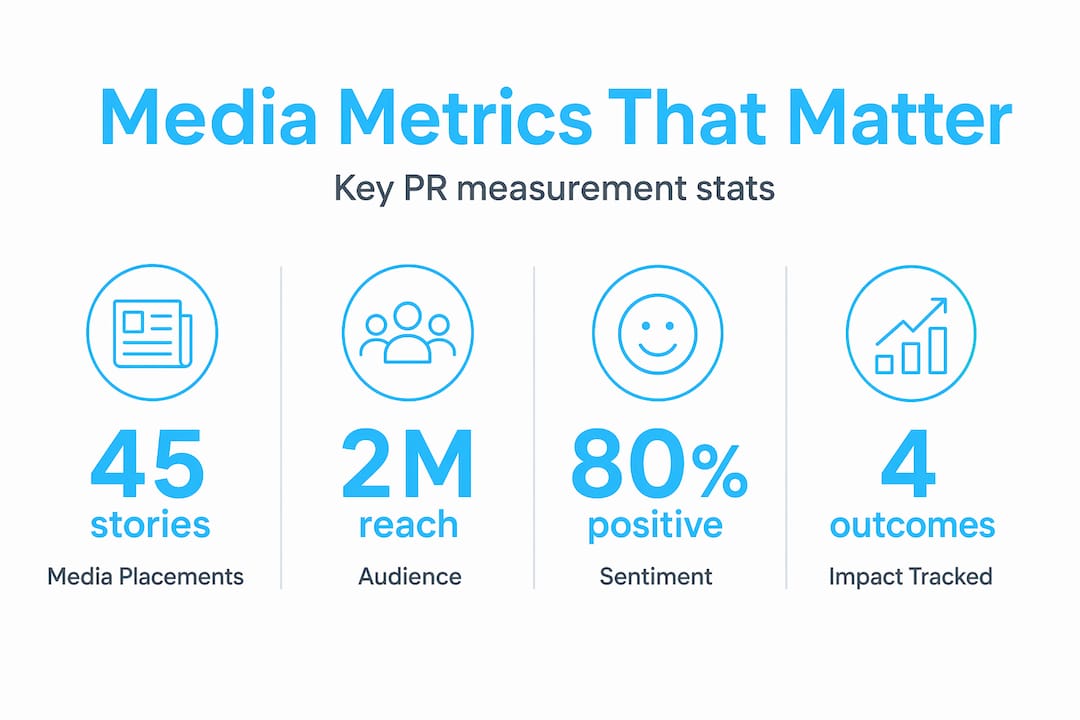
The most common PR measurement techniques in use right now are built around three core metrics: number of stories placed, reach or impressions, and sentiment. According to the same IPR survey, 86% of PR pros track story count, 79% track reach, and 43% track sentiment. These numbers are easy to pull, easy to present, and easy to misread.
Here is where the problem lives. These are output metrics. They tell you what happened in terms of media activity, not what that activity meant for your client’s business. A brand can generate 200 stories in a quarter and still see no movement in brand awareness, purchase intent, or trust. Coverage volume alone does not tell you whether your messaging landed with the right people in the right way.
The metrics that actually matter for assessing media coverage results include:
- Share of voice: Your brand’s coverage as a percentage of all coverage in your category. Useful for competitive positioning, but still an output measure.
- Sentiment analysis: Positive, negative, or neutral tone scoring. More useful when combined with context, not as a standalone signal.
- Message pull-through: Whether your defined priority messages actually appeared in coverage, scored consistently across outlets.
- Audience reach quality: Not just how many people could have seen the story, but whether those people match your target audience profile.
Pro Tip: Never present reach figures without qualifying the audience. A story in a publication with 2 million readers means little if none of those readers are relevant prospects or stakeholders for your client.
The PR Measurement Gap Study 2026 found that clients typically evaluate agencies on deliverables, which pushes agencies to report on outputs rather than outcomes. That cycle is self-reinforcing and hard to break without a deliberate structural change.
Moving from outputs to outcomes with proven frameworks
The shift from counting coverage to evaluating impact requires a framework, not just better intentions. AMEC’s Integrated Evaluation Framework is the most widely recognized tool for this. It connects PR activities to outputs, then to outtakes (what audiences took away), then to outcomes (actual behavior or perception changes), and finally to organizational impact.

Here is how that hierarchy compares to standard output reporting:
| Measurement Level | What It Measures | Example |
|---|---|---|
| Output | What PR produced | 45 stories placed in target publications |
| Outtake | What audiences absorbed | 60% of coverage included the primary brand message |
| Outcome | What changed in audience behavior | Brand awareness increased 12% among target segment |
| Impact | Business result connected to PR | Website inquiries rose 18% during campaign period |
Most firms report at the output level. The goal is to get to outcomes and impact, and that requires planning from the beginning, not retrofitting metrics after a campaign runs.
Effective media results evaluation should include baseline measurement and structured tracking of perception shifts, narrative influence, and audience behavior over time. Without a baseline, you cannot demonstrate change. Without defined success criteria set before the campaign, you will always be measuring whatever is convenient rather than whatever is meaningful.
Scoring priority messages in coverage is one practical step that connects media monitoring to strategy. Define three to five key messages before the campaign starts, then score their presence across all coverage. That score directly answers the question every client is really asking: did our story get told?
Pro Tip: Use a pre/post perception survey even on a small sample of your target audience. The data gives you an outcome measure that no media monitoring tool can replicate.
Integrating analytics and attribution to show business value
PR firm analytics methods have evolved well beyond media monitoring dashboards. The most sophisticated approaches now tie earned media activity directly to digital behavior using multi-touch attribution and media mix modeling.
Multi-touch attribution and media mix modeling estimate PR’s contribution by correlating earned media spikes with outcomes like web traffic, form fills, and conversions. When a major story runs and your site traffic jumps 30% in the following 48 hours, attribution modeling helps you quantify that relationship rather than just observe it anecdotally.
Practical tools for this integration include:
- UTM parameters on press release links and media pitches: Tag every trackable URL so you can see exactly which media placements drive site visits.
- Micro-conversion tracking: Monitor actions beyond purchases, such as newsletter sign-ups, whitepaper downloads, and demo requests. These signal audience engagement before a sale closes.
- Sentiment plus conversion correlation: When positive sentiment spikes in coverage coincide with conversion increases, you have a defensible story about PR’s business contribution.
- Integrated dashboards: Combining earned media data with platforms like Google Analytics 4 or your CRM shows the full path from coverage to customer action.
Videos used in PR campaigns can also support this kind of integrated campaign analysis, connecting media placements to digital performance in ways that purely text-based coverage tracking cannot.
Practical steps to improve your measurement process
Improving how you measure media impact does not require a complete overhaul. It requires discipline at the start of every engagement and honesty in every report.
- Set measurement protocols before the campaign launches. Define what success looks like in terms of outcomes, agree on the metrics with your client, and confirm what data you will have access to. Without client data access and agreed criteria, you will default to output reporting every time.
- Align every metric to a specific business goal. Coverage volume means nothing in isolation. Tie each metric back to awareness, trust, lead generation, or retention.
- Automate data collection wherever possible. PR pros already spend one to four or more hours weekly on reporting. Automating the data pull frees that time for analysis.
- Write reports around insights, not data. Every report should answer one question for the reader: what should we do differently next month because of what we learned this month?
- Use the Barcelona Principles as a maturity benchmark. They are not a rigid checklist but a useful reference for evaluating where your measurement practice stands.
Pro Tip: Shift your reporting structure from “here is what happened” to “here is what we learned and what we recommend.” That framing transforms a data dump into a strategic conversation.
My take on PR measurement as a discipline
I’ve spent years watching teams collect more data while making fewer decisions from it. The truth I keep coming back to is this: measurement struggles not because PR pros lack awareness, but because standards adoption remains dangerously low. And the reason adoption is low is not laziness. It is time. When you are spending four hours a week assembling a report, you have no bandwidth left to actually think about what the data means.
What I’ve found is that the teams doing measurement well have made one cultural shift: they treat measurement as an intelligence function, not a reporting function. They are asking “what does this tell us?” not “what can we show the client?” That distinction changes everything about what gets measured and how results get communicated.
I also believe the integration of AI-powered scale with human editorial expertise is genuinely changing what is possible in media results evaluation. AI can process coverage at a scale no team can match manually. But a tool cannot tell you whether a narrative shift is strategically significant. That judgment still requires a person who understands the client’s business. The best measurement frameworks I’ve seen pair both deliberately.
— Ryan McCormick
How Goldman McCormick PR approaches media measurement
When your firm needs PR measurement that connects coverage to real business outcomes, credentials and process both matter.
Goldman McCormick PR, named by Forbes as one of America’s Best PR Firms for 2021, builds reporting frameworks around client goals rather than default metrics. Whether you need earned media tracked across TV, radio, and print or analytics that connect coverage to site behavior and conversions, the Goldman McCormick PR team works with the frameworks and tools that make PR results defensible. Explore the firm’s PR insights blog for ongoing guidance on measurement, analytics, and campaign strategy from practitioners who have been building results-driven PR programs for over a decade.
FAQ
What metrics do PR firms most commonly track?
The most commonly tracked metrics are number of stories placed, reach or impressions, and sentiment, according to a 2025 IPR survey of 832 PR professionals. These output metrics are widely used but do not measure actual business outcomes on their own.
What is the difference between PR outputs and outcomes?
Outputs are what PR produced, such as story count or reach. Outcomes are what changed as a result, such as increased brand awareness, shifts in audience perception, or measurable increases in web traffic or conversions.
How do PR firms measure campaign ROI?
PR firms use multi-touch attribution and media mix modeling to correlate earned media activity with business results like web traffic, lead generation, and conversions. UTM parameters and micro-conversion tracking add precision to these estimates.
What is the AMEC Integrated Evaluation Framework?
The AMEC Integrated Evaluation Framework (IEF) is a structured tool that links PR planning and evaluation to outputs, outtakes, outcomes, and organizational impact. It helps PR teams move beyond counting coverage toward measuring what that coverage actually achieved.
Why do so few PR firms follow established measurement standards?
Only 11% of PR professionals follow established standards like the Barcelona Principles despite most valuing measurement. The primary barrier is time: assembling data for routine reports consumes hours that could otherwise go toward strategic analysis and insight.