
Most law firm marketing professionals treat CSR as a feel-good add-on, something to mention in a year-end newsletter or decorate the website’s “About” page. That framing is expensive. The role of CSR in law firm PR is far more operational than decorative, and research confirms it directly supports long-term reputation, client retention, and employee loyalty when executed with measurable evidence behind it. The firms that get this right do not just look responsible. They are responsible, and their communications prove it.
Table of Contents
- Key Takeaways
- The role of CSR in law firm PR starts with definitions
- Integrating CSR into law firm PR strategies
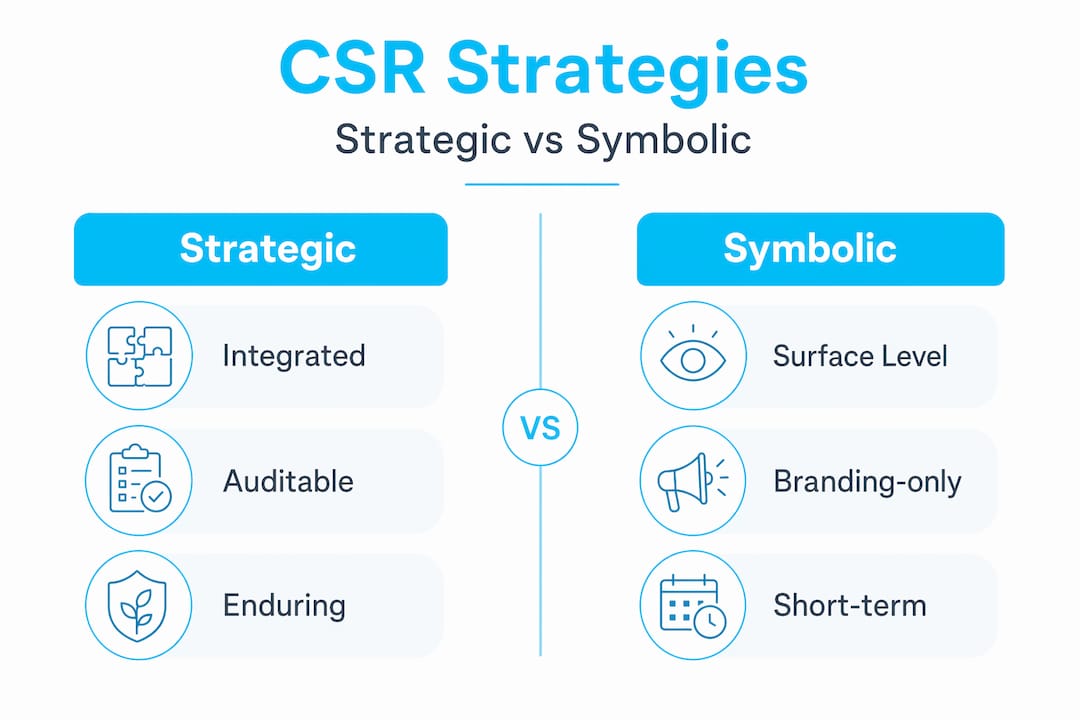
- Strategic CSR versus symbolic gestures
- Practical steps for law firm marketers
- My perspective on where law firm CSR PR is going
- How Goldman McCormick PR helps law firms communicate CSR
- FAQ
Key Takeaways
| Point | Details |
|---|---|
| CSR is a PR foundation, not decoration | Genuine CSR activity generates auditable proof points that support credible media narratives. |
| Measurable outputs matter most | Pro bono hours, grant metrics, and participation counts are the raw material of convincing PR. |
| Strategic CSR beats symbolic gestures | Firms that align CSR with client advisory services build stronger trust than those chasing branding. |
| Governance alignment is non-negotiable | Legal, PR, and community leadership teams must coordinate to avoid messaging inconsistency. |
| Ethical compliance shapes CSR messaging | Lawyer advertising rules require transparency that actually reinforces authentic CSR storytelling. |
The role of CSR in law firm PR starts with definitions
Before any strategy can work, you need a clear understanding of what CSR actually means inside a law firm context. It is not a charity budget. It is not a diversity statement. CSR in law firms is best understood as a responsible business program that spans pro bono legal services, community investment, legal education initiatives, and sustainable firm operations. White & Case describes this architecture precisely, treating free legal services, volunteer programs, charitable giving, and environmental responsibility as interconnected pillars rather than isolated activities.
Why does that definition matter for PR? Because each pillar generates its own category of evidence. Pro bono work produces hours logged, client outcomes, and community partnerships. Sustainability programs produce operational metrics. Volunteer participation produces headcounts and beneficiary data. These are not soft talking points. They are the raw material that separates a press release worth running from one that gets deleted.
Common CSR activities that law firms can build PR narratives around include:
- Pro bono representation: civil rights cases, immigration clinics, nonprofit legal counsel
- Legal education: law school partnerships, public workshops, access-to-justice programs
- Community investment: grants, charitable partnerships, foundation work
- Sustainable operations: energy reduction targets, supplier standards, office waste programs
- Diversity and inclusion: pipeline programs, mentorship, pay equity reporting
Pro bono, legal education, and sustainability are the three most cited pillars in law firm CSR communication, and they are the easiest to translate into compelling stories for media, clients, and recruits alike.
Integrating CSR into law firm PR strategies
Knowing what your firm does is not enough. The harder work is packaging it for credible PR. Here is how to move from activity to strategic narrative.
- Identify initiatives with quantifiable outputs. A firm that completed 12,000 pro bono hours in a calendar year has a story. A firm that simply “values access to justice” does not. Tie every initiative to a number: hours, individuals served, grants awarded, carbon reductions achieved.
- Use earned and owned media together. Place data-backed stories in legal trade publications, regional business press, and bar association newsletters. Pair that with owned content on the firm website and a CSR or responsible business report published annually.
- Align CSR messaging with client advisory. Responsible business runs alongside client-facing work, not separately from it. If your firm advises clients on ESG risk, your own CSR record either reinforces or undermines that advisory credibility. Make sure the messages connect.
- Build audit trails for governance. Legal, PR, and community leaders coordinate on public messaging and evidence disclosure at the firms doing this well. That coordination prevents contradictions between what a partner says in a client pitch and what the PR team publishes in a press release.
- Check ethical compliance before publishing. Lawyer advertising rules require transparency about fee relationships and compliance with professional conduct standards. CSR messaging is not exempt from professional responsibility review.
Pro Tip: Build a quarterly CSR communications calendar that coordinates with your firm’s practice group news cycle. A major pro bono win timed alongside an ESG client announcement creates a multiplier effect for media coverage.
Strategic CSR versus symbolic gestures
The difference between a law firm with a strong CSR reputation and one that faces skepticism often comes down to one question: does the CSR activity connect to actual firm operations, or does it exist only as a communications asset?
Academic research shows many firms engage more in branding than substantive CSR, creating credibility gaps that undermine the very reputation benefits they seek. Clients and journalists notice when claims are not supported by evidence. This comparison table makes the distinction concrete.
| Dimension | Strategic CSR | Symbolic CSR |
|---|---|---|
| Connection to firm operations | Embedded in daily practice and client advisory | Isolated to marketing department |
| Evidence available | Measurable outputs: hours, beneficiaries, metrics | Vague statements and aspirational language |
| Governance structure | Legal, PR, and community leadership aligned | PR team operates independently |
| Client trust impact | Reinforces advisory credibility | Creates skepticism when claims cannot be verified |
| Long-term outcome | Reputation asset and recruitment advantage | Short-term visibility with reputational risk |
Firms that treat CSR as integral to strategy consistently outperform those using it as a branding overlay. The client-facing benefits are real: when a firm advising on corporate governance can point to its own transparent reporting practices, that alignment speaks louder than any press release.

Practical steps for law firm marketers
Translating theory into a working PR program requires a few deliberate choices. Start here.
Identify what your firm already does well. Audit existing activities before launching new initiatives. Most firms have more CSR substance than they realize. Pro bono records, community partnerships, and sustainability policies may exist without ever being compiled for communications use.
Engage internal stakeholders early. Partners, associates, and staff who participate in CSR activities are your best storytellers. Quotes, case summaries, and firsthand accounts from people inside the firm add credibility that no press release can manufacture. The importance of CSR in law firms extends to talent retention, and employees who see their work celebrated in firm communications stay longer.
Use data to substantiate every claim. A firm announcing a new pro bono initiative should include projected hours, practice areas involved, and the population served. A sustainability announcement should reference baseline metrics. Data turns a claim into a story, and a story into coverage.
Coordinate channels and timing deliberately. A major CSR milestone, say a 10,000 pro bono hour milestone, warrants a press release to legal trade media, a LinkedIn post from firm leadership, and a feature in the firm newsletter. Staggering these by a few days extends the story’s visibility without looking repetitive.
Avoid overpromising. The fastest way to damage a CSR reputation is to announce a commitment you cannot verify. Set targets you can document. Report progress honestly, including setbacks, because transparency is itself a competitive advantage in PR.
Pro Tip: CSR initiatives tied to employee volunteer programs double as recruitment assets. Publish volunteer participation rates in hiring materials and watch how quickly they resonate with associates evaluating firm culture.
My perspective on where law firm CSR PR is going
I have worked with law firms at Goldman McCormick PR for over a decade, and the single most consistent mistake I see is treating CSR as a communications exercise rather than a governance one. Firms spend money crafting the message before they have built the substance behind it. That sequence always fails eventually.
What I have found actually works is building the proof first. Annual responsible business reports with real metrics, published on a firm’s own website, create a reference point that journalists can cite and clients can verify. When a reporter calls about a firm’s community commitment, pointing them to a 40-page report with audited data is the difference between a story and a statement.
The CSR integrated with legal advisory approach is where I expect the industry to converge. Clients hiring firms for ESG risk work increasingly want to see that the firm walks the same path. Firms that cannot show their own responsible business record will find that gap used against them in competitive pitches. Authenticity is not just an ethical consideration. It is a business one.
— Ryan McCormick
How Goldman McCormick PR helps law firms communicate CSR
Goldman McCormick PR has specialized in legal PR services since 2010, and the New York Observer recognized us as one of the top five PR agencies in the legal space. In 2016, we earned a Gold Award in the “Best Cause/Advocacy Campaign” category at Bulldog Reporter’s CSR Awards. We know how to translate a law firm’s responsible business work into media coverage that builds genuine reputation capital. From earned media placements in national outlets to coordinated CSR storytelling programs, we help firms connect their community impact to client-facing communications. If you are ready to make your firm’s CSR activity work harder in public relations, Goldman McCormick PR can build a strategy around what your firm has already earned. Law firms looking to strengthen their digital presence alongside PR can also explore law firm SEO services to amplify CSR content reach.
FAQ
What is the role of CSR in law firm PR?
CSR provides the substantive foundation for law firm PR by generating measurable proof points, such as pro bono hours and community investment data, that support credible media narratives and build long-term reputation.
How does CSR enhance a law firm’s reputation?
CSR enhances reputation when it is tied to verifiable activity and aligned with client advisory services, creating consistency between what a firm promises publicly and what it delivers operationally.
What are the ethical considerations in law firm CSR communications?
Lawyer advertising rules require transparency and compliance with professional conduct standards, which means all CSR claims in public communications must be accurate, substantiated, and free from misleading implications.
What makes a CSR strategy effective for legal firms?
Effective CSR strategies for legal firms combine measurable initiatives, coordinated governance across legal and PR teams, and integration with the firm’s core advisory services rather than treating CSR as a standalone marketing function.
How can law firm marketers avoid symbolic CSR?
Focus on activities with auditable outputs, publish annual responsible business reports with hard metrics, and align CSR messaging directly with the firm’s client-facing practice areas to prevent the credibility gaps that undermine symbolic CSR programs.