
Most attorneys underestimate what a public relations firm actually does for them. Understanding what does a PR firm do for attorneys requires looking past marketing hype. The real answer involves earned media, ethical guardrails, and strategic reputation management that no paid advertisement can replicate. Legal PR sits between marketing and credibility, winning trust through coverage you earn rather than buy. This guide breaks down exactly how attorney public relations works, where the ethical lines sit, and how you can use PR to grow your practice with authority.
Table of Contents
- Key Takeaways
- What a PR firm does for attorneys
- Ethical constraints attorneys and PR firms must respect
- Litigation communications and crisis management
- Practical steps to partner effectively with a PR firm
- My perspective on legal PR
- How Goldmanmccormick supports attorney public relations
- FAQ
Key Takeaways
| Point | Details |
|---|---|
| Earned media beats advertising | Third-party media coverage builds credibility that paid ads cannot replicate for attorneys. |
| Ethics shape every PR move | Attorney-client privilege and bar rules restrict what a PR firm can say publicly on your behalf. |
| Litigation PR protects outcomes | Coordinated messaging during high-profile cases prevents reputational damage that could affect legal results. |
| Media readiness matters | Attorneys trained in media engagement become trusted repeat sources and reinforce firm visibility. |
| PR amplifies your digital presence | Press mentions linked on your website improve SEO performance and long-term reputation signals. |
What a PR firm does for attorneys
The foundation of legal PR is third-party validation. When a journalist at a major publication quotes you as the expert, readers perceive that as credibility no ad budget can manufacture. Earned media moves prospects from consideration to contact faster than any digital campaign.
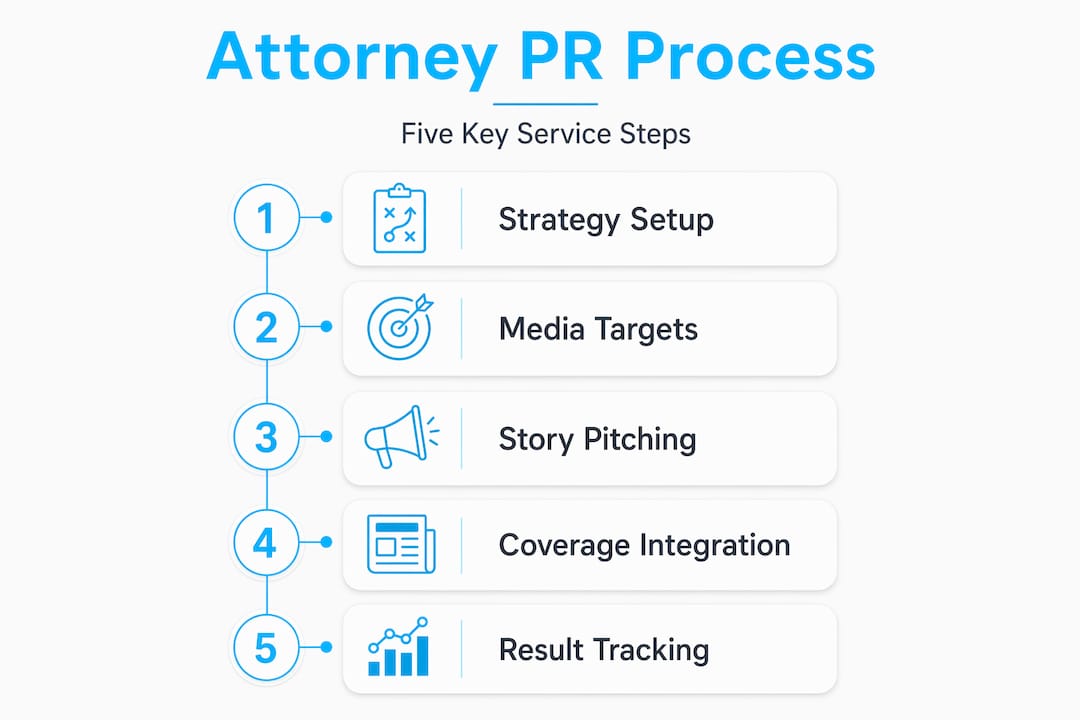
A PR agency for lawyers typically delivers value through several specific channels:
- Media interviews: Placing attorneys as expert commentators on breaking legal news in television, radio, and print
- Thought leadership: Ghostwriting or placing bylined articles in trade publications that your clients and referral sources actually read
- Feature profiles: Securing in-depth coverage of firm milestones, landmark case outcomes, or firm culture to build name recognition
- Podcast and broadcast placement: Creating exposure through programs where your target audience listens
The alignment between your practice area and your media targets matters enormously. A personal injury attorney appearing on a general news program reaches a different audience than a securities litigator placed in The Wall Street Journal. Good PR firms map those targets deliberately.
Pro Tip: Ask any PR firm you consider working with to show you the specific publications, programs, or platforms where they have placed legal clients in the past 12 months. A firm with no track record in legal media is not a legal PR firm.
Ethical constraints attorneys and PR firms must respect
This is where legal PR separates itself from every other industry. Attorney-client privilege is a foundational constraint that shapes every piece of messaging your PR firm creates. No communications strategy can compromise privileged information, misrepresent facts, or violate bar rules on attorney advertising.
There are clear lines between what is permissible and what is off-limits:
- Permissible: Commenting on publicly filed documents, discussing general legal trends, sharing professional background and firm philosophy, and publicizing case results that are already part of the public record
- Permissible: Writing articles about areas of law without referencing specific ongoing matters or clients
- Restricted: Disclosing client communications, predicting case outcomes, making comparative claims about other attorneys, or issuing statements that could prejudice a pending case
- Restricted: Discussing settlement terms or case strategy even when the client wishes you would
Bar rules prohibit false claims, comparisons with other lawyers, and predictions about case outcomes in any public statement. Your PR firm must know these rules as well as you do.
“The best legal PR work happens when communications professionals and legal teams collaborate early, not after a press inquiry lands in your inbox with a two-hour deadline.”
The collaboration between your PR team and your legal team is not optional. It is the only way to execute media relations that serves your visibility without creating liability.
Litigation communications and crisis management
High-profile cases attract media attention whether you want it or not. The question is whether your narrative is shaped by you or by someone else. Litigation PR requires messaging coordination to prevent reputational pressure from adversely affecting legal outcomes.
PR firms working on litigation support attorneys in several specific ways:
- Preparing press statements that are legally reviewed before release
- Training attorneys to answer media questions without inadvertently disclosing privileged information
- Monitoring news coverage and social media for misinformation that requires a response
- Advising on when silence is the correct strategy and when a proactive statement is necessary
Tracking emerging narratives and correcting them quickly prevents reputational damage from compounding during an active matter. A single misleading headline, left uncorrected, can become the defining story of a case.
| Scenario | PR role | Legal team role |
|---|---|---|
| Breaking news about a client | Draft and review reactive statement | Approve for privilege compliance |
| Regulatory investigation announced | Manage media inquiries, prepare holding statements | Assess disclosure obligations |
| Verdict or settlement reached | Pitch story with approved messaging | Confirm what is publicly releasable |
| Misinformation circulating online | Coordinate correction across platforms | Advise on defamation risk before response |
Pro Tip: Never let your PR firm issue a statement about active litigation without having a licensed attorney review it first. The speed of news cycles creates pressure to respond fast. That pressure has cost attorneys and their clients dearly.
Litigation communications integrated with legal strategy represent one of the most specialized and valuable services a PR firm offers. It is not something a generalist agency can improvise under pressure.

Practical steps to partner effectively with a PR firm
Knowing what PR firms offer is one thing. Getting value from that relationship requires preparation on your end.
Start by setting objectives that connect to real business goals. Do you want to attract a specific type of case? Build referral relationships with other professionals? Establish yourself as the go-to media source in your practice area? Each goal requires a different PR approach, and a firm without clear direction from you will default to generic activity.
Attorneys trained in media engagement become repeat sources for journalists, which compounds your visibility over time. Media readiness training is worth investing in. It teaches you to deliver clean, quotable commentary without oversharing, which is a skill that does not come naturally to most litigators.
Integrate your PR coverage with your digital presence. Press mentions linked to your website improve SEO performance and create credibility signals that AI-driven search algorithms increasingly factor into reputation rankings. Pairing earned media with a strong law firm SEO strategy multiplies the return on both investments.
Finally, measure results in terms that connect to firm growth. Track media coverage volume, placement quality, inbound inquiry sources, and referral attribution. A PR firm that cannot show you where its work shows up in your business pipeline is not accountable to your goals.
My perspective on legal PR
I’ve watched attorneys walk away from PR opportunities because they assumed it was just fancy advertising with different packaging. That belief is expensive.
What I’ve learned from working at the intersection of media and law is that the attorneys who grow the fastest are the ones reporters call back. They are the ones who have built trust with journalists over time, who deliver usable quotes under deadline pressure, and who appear credible before a client ever schedules a consultation. That credibility does not come from a billboard. It comes from a pattern of earned coverage that accumulates like compound interest.
The ethical complexity is real, and it should not be minimized. But the attorneys who treat those constraints as a reason to avoid PR entirely are making the wrong calculation. The constraints make legal PR harder. They do not make it less valuable.
— Jack
How Goldmanmccormick supports attorney public relations

Goldmanmccormick has specialized in legal PR since 2010, and was cited by the New York Observer as one of the top five PR agencies for lawyers in the country. Named by Forbes Magazine as one of America’s Best PR Firms for 2021, Goldmanmccormick places legal clients on television, radio, in newspapers, and in nationally syndicated programs heard on the Genesis Communications Network and Starcom Radio Network. The firm understands the ethical boundaries that govern attorney communications, and builds media strategies that work within those constraints rather than around them. If you are ready to move from invisible to authoritative, Goldmanmccormick is built for exactly that conversation.
FAQ
What does a PR firm do for attorneys specifically?
A PR firm builds attorney visibility through earned media, including TV interviews, trade publication features, and expert commentary placements. Unlike paid advertising, these efforts create third-party credibility that directly influences client trust and acquisition.
How does attorney-client privilege affect PR strategy?
Client confidentiality restricts PR messaging from disclosing privileged communications, predicting case outcomes, or referencing active matters without careful legal review. Every public statement must be cleared against bar rules before release.
Can PR firms help attorneys during high-profile litigation?
Yes. Litigation communications specialists coordinate messaging with legal teams to manage public narratives, respond to misinformation, and protect reputational integrity without compromising case strategy or privilege obligations.
How does PR connect to an attorney’s digital marketing?
Press coverage linked on attorney websites and firm news pages improves SEO performance and builds long-term reputation signals. PR and digital marketing reinforce each other when coverage is systematically captured and published online.
What should attorneys look for when choosing a PR firm?
Look for demonstrated placements in legal media, knowledge of bar advertising rules, and experience with litigation communications if you handle high-profile cases. A generalist firm without legal sector experience will not know where the ethical lines are until they cross one.