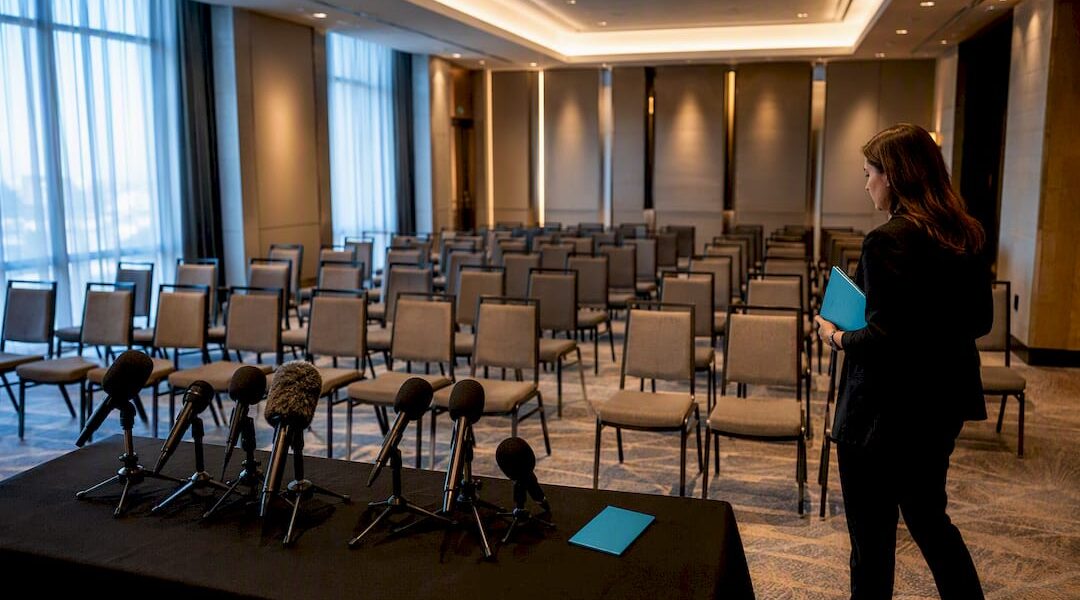
A press conference succeeds when you lock a timeline and a single logistics lead, nail down 3 to 5 key messages and a press kit, confirm your venue and AV setup, run a tight show, and follow up within hours, not days. Start planning at least a week or two ahead whenever you can, and earlier for anything with real stakes, according to the Community Tool Box. Keep slides to a maximum of 5 to 7 and lead every statement with your conclusion, per EGU’s media guidance.
TL;DR:
- A successful press conference requires starting planning at least three weeks in advance for high-stakes events, with earlier timelines for national or regional announcements.
- Lock a single logistics lead, confirm venue and AV setup early, and prepare a press kit with key messages, supporting materials, and clear distribution plans.
- Technical rehearsals and equipment checks must be completed at least 48 hours before, including testing live stream connections, backup internet, and multiple microphones per speaker.
- Media advisories should go out five to seven days prior, with personalized follow-up calls to top outlets on the day of the event, and a quick post-event distribution of materials within hours.
- Small organizers can effectively run DIY press conferences using detailed checklists, but larger or high-stakes events may benefit from professional support to manage logistics, media outreach, and technical execution.
Table of Contents
- Planning and Timeline: Who to Involve and When to Start
- Defining Key Messages and Building the Press Kit
- Venue Setup, Signage, and Logistics Coordination
- AV and Technical Checklist: Mics, Streaming, and Backups
- Media Outreach: Advisories, Invitations, and Follow-Up Calls
- Run of Show and Speaker Preparation
- On-the-Day Execution Checklist
- Post-Event Follow-Up and Measuring Coverage
- What Most Organizers Get Wrong About Press Conferences
- How Goldman McCormick PR Handles the Heavy Lifting
- Templates and Reference Guides Worth Bookmarking
- Sources
- FAQ
Planning and Timeline: Who to Involve and When to Start
Most organizers underestimate how early the clock starts running. A press conference is not a one-week sprint. It’s a sequence of decisions, each one gating the next, and skipping the order is how you end up with an empty room or a room full of the wrong reporters.
The Community Tool Box recommends starting at least a week or two out, and for anything with regional or national stakes, that window should stretch to a month or more. Reserve the format itself for news that earns it. The CDC’s guidance on press communications is blunt about this: press conferences work best for high-interest or high-stakes announcements, while routine updates are usually better served by a press release and direct outreach to the reporters who cover the beat.
Here’s a timeline you can copy directly into your planning document:
- 3+ weeks out: Confirm the announcement is genuinely press-conference-worthy, assign a logistics lead, and set a target date (Tuesday through Thursday morning tends to align best with newsroom deadlines).
- 2 to 3 weeks out: Book the venue, secure permits or insurance if needed, and start drafting your key messages and press release.
- 10 to 14 days out: Finalize your media list, draft the press advisory, and confirm speakers.
- 1 week out: Send the media advisory, finalize the press kit, and schedule an AV/technical rehearsal.
- 2 to 3 days out: Send reminder emails to your media list and confirm RSVPs.
- 24 hours out: Walk the venue, test every mic and camera line, and brief every speaker on final talking points.
Assign one person as the logistics lead. Not a committee, not “whoever’s free.” One name, one phone number, and everyone on-site defers to that person for anything logistical. A logistics planning guide from Abastio makes the same point: a single accountable lead cuts down on the day-of confusion that stalls decisions when something breaks.
Budget items to lock early include venue rental, AV rental or crew, signage printing, catering if you’re hosting a reception, and any permit fees tied to your location, especially for outdoor or public-space events.
Pro Tip: Build your timeline backward from the event date, not forward from today. Working backward forces you to see exactly how many days you actually have left for each task, which is usually fewer than it feels.
Defining Key Messages and Building the Press Kit
Every reporter in that room is asking one silent question: why should my audience care? If your materials don’t answer it in the first ten seconds, you’ve lost them before the Q&A even starts.
Craft 3 to 6 key messages before you write a word of your press release. EGU’s press conference guide recommends narrowing to 3 to 5 core points and building every statement, slide, and answer around them. Each message should be a single sentence a reporter could drop into a story without needing to call you back for clarification.
Your press kit should include:
- A press release following the standard structure: headline, dateline, lead paragraph, supporting quotes, boilerplate, and contact information.
- A one-page fact sheet with key statistics, dates, and background context.
- Speaker bios, each no longer than 100 words.
- High-resolution photos, ideally in both landscape and portrait orientation.
- Any data sheets, reports, or documents referenced during the event.
- A one-page media contact sheet with names, roles, and direct phone numbers.
Distribution matters as much as content. A press kit that includes slides and clear contact details tends to generate wider pickup when it goes out promptly, since reporters working under deadline pressure use whatever is easiest to grab and cite, according to the Community Tool Box.
If you’re building the press release itself, tools like an AI press release generator can help you move quickly through a first draft, though you’ll still want a human eye on tone and accuracy before anything goes out.
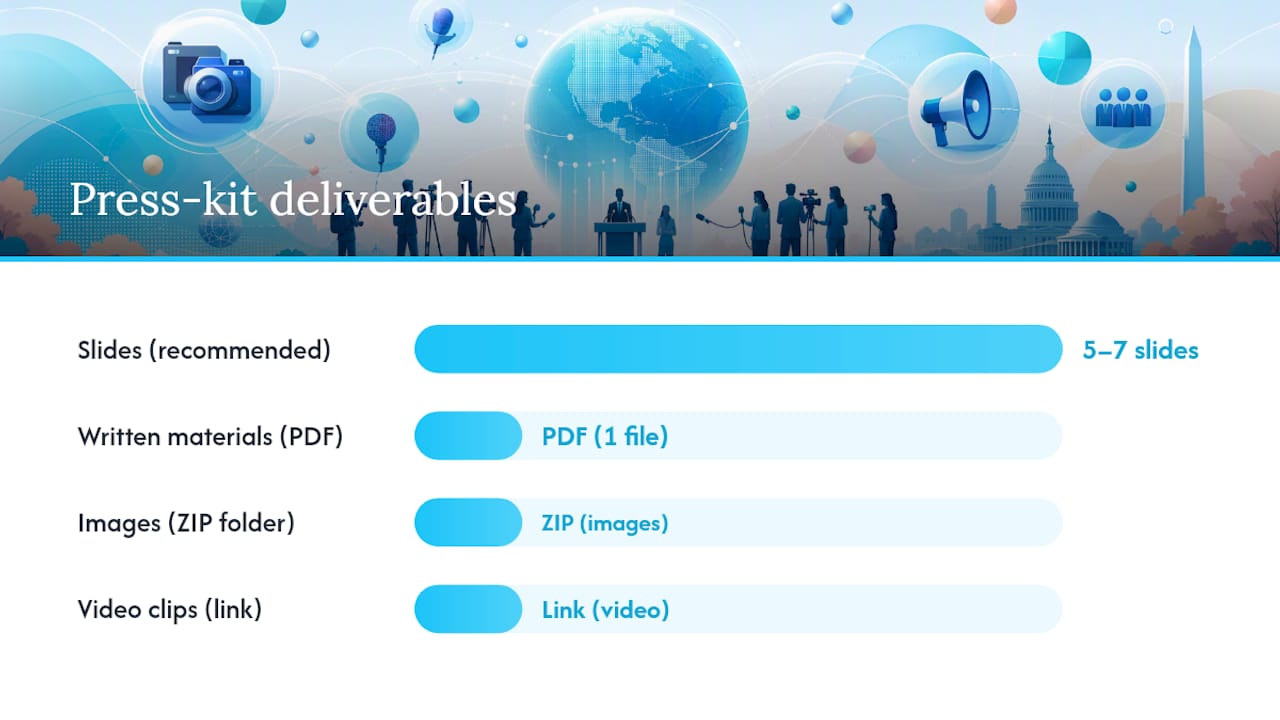
Keep any presentation slides to a maximum of 5 to 7 and skip the acronyms. Reporters who don’t cover your industry daily will tune out the moment jargon appears on screen. Package everything as a PDF for the written materials, a ZIP folder for images, and a separate link or drive folder for any video clips.
Venue Setup, Signage, and Logistics Coordination
The room itself is where good planning either holds up or falls apart. Get the physical setup wrong and no amount of great messaging saves the story.
Start with the backdrop. It should carry your organization’s name or logo, positioned so it appears behind every speaker in every camera angle. Walk the room from where television cameras will actually sit, not just from the podium. Sightlines matter more than most organizers expect, since a beautifully designed backdrop is useless if the camera lane cuts it off.
- Set the podium or table layout so all speakers face the room and the primary camera position simultaneously.
- Mark camera lanes with tape or cones so photographers and videographers aren’t blocking each other mid-event.
- Post signage at the entrance, in the lobby, and near the press check-in table, all pointing clearly toward the event space.
- Confirm accessibility, including a step-free path to the podium and reserved seating near the front for any attendees who need it.
- Map parking and load-in routes for both media vehicles and any AV or catering vendors.
- Designate staging zones, away from the press area, where speakers can wait and get last-minute briefings without being overheard.
Vendor sequencing deserves its own attention. Staggering vendor arrivals in 30 to 60 minute windows, spaced roughly 30 minutes apart, cuts down on the load-in bottlenecks that happen when the AV crew, the catering team, and the signage installer all show up at the same door at once, per Abastio’s event logistics guide.
Build a one-page contact sheet with every vendor’s arrival time, contact number, and assigned task. Hand it to your logistics lead and nobody else needs to carry it.
Pro Tip: Walk the room at the exact time of day your event will happen, not the day before at a different hour. Sunlight through windows, hallway noise, and shadow angles all shift with the clock, and what looked fine at 9 a.m. can wreck your 2 p.m. camera shots.
AV and Technical Checklist: Mics, Streaming, and Backups
Technical failure is the single most preventable disaster at a press conference, and it’s also the most common one. A dead microphone or a stalled livestream doesn’t just embarrass you. It kills the news cycle you worked weeks to earn.
- Use at least two wireless lavalier or handheld mics per speaker area, plus one backup mic that’s fully charged and tested.
- Set up a dedicated press feed (a mult box or direct XLR outputs) so broadcast crews can patch into clean audio instead of relying on room mics.
- Confirm recording and re-broadcast permissions with every speaker in writing before the event, not verbally on the day.
- If streaming live, test your encoder and internet bandwidth at least 48 hours ahead, ideally at the actual venue, not from an office network.
- Keep a backup internet connection (a mobile hotspot works) in case the venue’s primary connection drops.
- Have one alternate presenter briefed and ready in case your primary spokesperson can’t go on.
Run a full technical rehearsal, ideally with your actual speakers and moderator standing in the actual room, at least once before doors open. EGU’s guidance recommends recording that rehearsal and reviewing it, since timing problems and awkward phrasing show up far more clearly on playback than they do live.
Pro Tip: Test every mic at the volume level the room will actually have once it’s full of people. An empty room absorbs sound differently than one packed with reporters, coats, and equipment bags.
Media Outreach: Advisories, Invitations, and Follow-Up Calls
Getting reporters in the room takes more than a single email blast. It takes sequencing, and it takes knowing who you’re actually talking to.
Send your media advisory 5 to 7 days before the event, a short, scannable document with the who, what, when, where, and why, but none of the full quotes or detail you’re saving for the release itself. Follow up with a reminder email 2 to 3 days out, and place personal phone calls to your priority outlets the morning of the event.
- Segment your media list by beat. A crime reporter, a business reporter, and a general assignment reporter at the same outlet need different angles on the same news.
- Tailor your pitch language to each beat. Step outside your own technical framing and translate the story into terms that matter to that reporter’s specific audience, a point NACCHO’s press conference guide emphasizes directly.
- Send the advisory on a Tuesday, Wednesday, or Thursday morning when possible. That window aligns best with newsroom planning meetings and deadline cycles, according to the same NACCHO guidance.
- Call your top 5 to 10 outlets personally the day before or morning of, confirming attendance and offering a quick preview of what they’ll hear.
- Set up a check-in table at the venue entrance where arriving press can sign in, grab a press kit, and get a name tag if you’re running one.
On the day itself, keep credentialing simple: a sign-in sheet with name, outlet, and contact info, plus a staffer whose only job is greeting press as they arrive. Complicated accreditation processes at a small event just create a bottleneck nobody needed.
Run of Show and Speaker Preparation
A press conference lives or dies in the first 90 seconds and the last unscripted answer. Everything in between is largely a matter of pacing.
Here’s a sample run of show for a standard 30-minute event:
- 0:00 to 0:02 — Moderator welcomes the room and introduces the first speaker.
- 0:02 to 0:07 — Speaker one delivers opening statement, leading with the conclusion, not the buildup.
- 0:07 to 0:12 — Speaker two delivers their statement, also conclusion-first.
- 0:12 to 0:15 — Moderator summarizes key messages and opens the floor.
- 0:15 to 0:27 — Q&A session.
- 0:27 to 0:30 — Moderator closes, reminds press where to find the press kit and follow-up contact.
Limit yourself to 2 to 3 speakers, each capped at 3 to 5 minutes. Every one of them should lead with their conclusion first and save supporting detail for the Q&A, exactly the structure EGU’s media tips recommend for keeping statements short enough for journalists to use.
For Q&A prep:
- Draft a list of every hard question you can imagine and rehearse the answer out loud, not just on paper.
- Never say “no comment.” Offer a brief, honest reason for holding back, something like “we’re still awaiting verified results,” a specific alternative EGU’s guidance recommends over a flat refusal.
- Assign a clear hand-off protocol so the moderator knows exactly which speaker fields which category of question.
On-the-Day Execution Checklist
Everything you’ve planned funnels into a two-hour window, and that’s where a written checklist stops being optional.
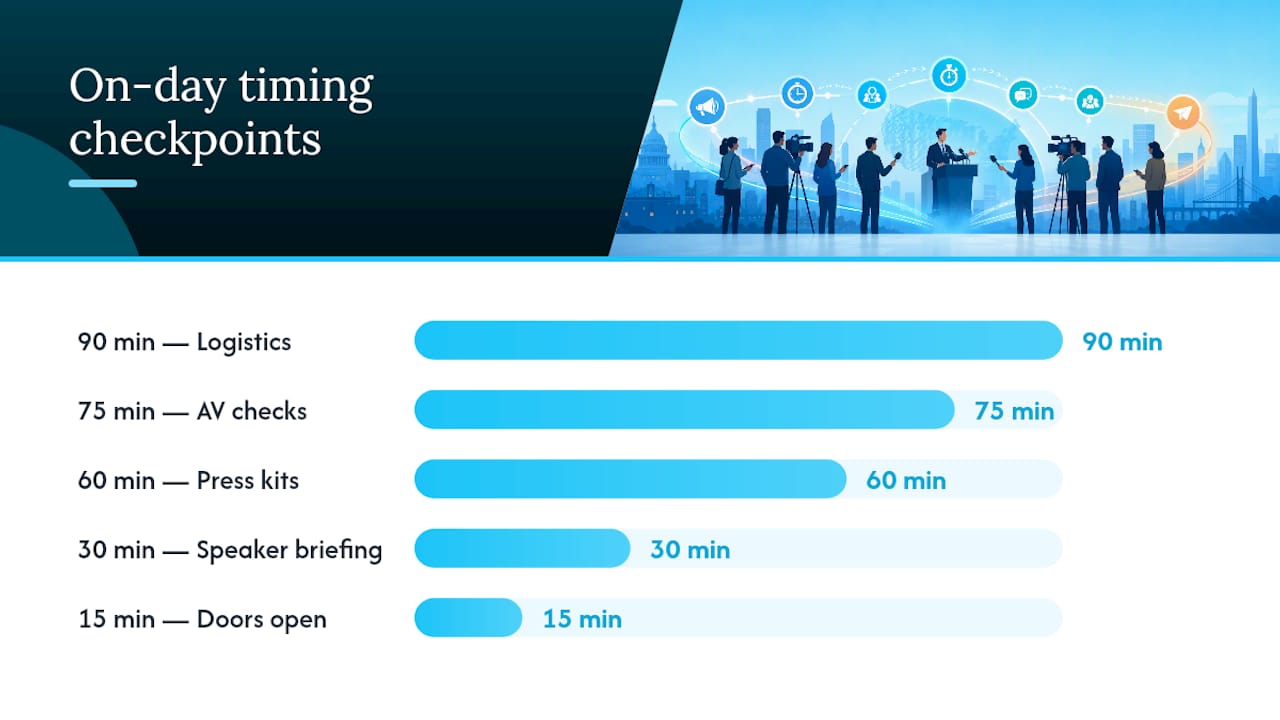
- 90 minutes before doors open: Logistics lead arrives, unlocks staging areas, and confirms vendor arrivals against the contact sheet.
- 75 minutes before: AV crew completes final mic and camera checks; streaming connection gets tested live, not just pinged.
- 60 minutes before: Press kits get placed at the check-in table; signage goes up in the lobby and entrance.
- 30 minutes before: Speakers arrive at the staging area for a final briefing, not the main room.
- 15 minutes before: Doors open to press; greeter staffs the sign-in table.
- At start time: Moderator opens on schedule, even if the room isn’t full. Waiting for stragglers signals disorganization and eats into your own timeline.
Late arrivals should be handled quietly. A staffer walks them to open seating without interrupting the speaker. If the room is thin on turnout, resist the urge to explain the empty chairs. Just proceed.
If a protestor or disruption occurs, have a pre-briefed security or venue staff member positioned near the exit, and instruct your moderator in advance to keep speaking through minor interruptions rather than stopping the event. For a technical failure, mid-event, mid-statement, your backup mic and alternate internet connection should already be within reach of your AV lead, not stored in a case across the room.
Immediately after the event ends, spokespeople should not linger for informal chats with reporters unless that’s intentional. Direct any lingering questions to your media contact, and have that contact ready with follow-up materials on hand.
Pro Tip: Assign one staffer whose only job during the event is watching the clock and quietly signaling the moderator at each timing checkpoint. Speakers and moderators get absorbed in the moment, and somebody outside that bubble needs to keep the show on schedule.
Post-Event Follow-Up and Measuring Coverage
The press conference isn’t over when the last reporter leaves the room. What happens in the next 24 hours often determines whether the event turns into coverage or just a memory.
Distribute your full press kit, including any images and video clips from the event itself, within 2 to 4 hours of wrap-up. Reporters who couldn’t attend, or who need supplementary material for their story, are working against same-day deadlines, and a fast turnaround is often the difference between getting included and getting cut.
- Send a same-day follow-up email to every attending outlet with a thank-you note and a link to the full asset folder.
- Reach out individually to any priority outlets that didn’t attend, offering a phone briefing or written statement.
- Track basic coverage metrics: number of clips or articles published, estimated audience reach or impressions, and social media engagement tied to your key messages.
- Log which specific key messages made it into published coverage versus which ones got dropped, useful intelligence for your next event.
A press kit that goes out fast and includes everything a reporter needs tends to drive broader pickup, the same principle the Community Tool Box applies to same-day distribution.
Assign ownership of follow-up to one person, ideally your logistics lead or media contact from the day itself, with a 48-hour deadline to complete outreach to every outlet on your original media list, attendees and no-shows alike.
What Most Organizers Get Wrong About Press Conferences
I have watched plenty of well-funded organizations blow a good story on a badly run press conference, and it is rarely the big things that sink them. It’s the assumption that a press conference is inherently more impressive than a well-placed press release. It isn’t. A press conference is a tool for a specific kind of announcement, one with real stakes or genuine reporter interest, and using it for routine news just trains journalists to skip your next invitation.
The mistake I see most often is treating message development as an afterthought, something you draft the night before because the venue and catering felt more urgent. Reporters remember weak messaging longer than they remember a slightly awkward room layout. Get your 3 to 5 key messages locked early, and build everything else around them.
Where a managed service actually earns its cost is scale and stakes: a multi-outlet regional push, a crisis-adjacent announcement, or an organizer with real bandwidth constraints who cannot personally chase down reporter RSVPs while also finalizing a press kit. For a smaller, lower-stakes internal announcement, a disciplined DIY approach using a checklist like this one works fine. Know which situation you’re in before you decide how much help you need.
— Ryan McCormick
How Goldman McCormick PR Handles the Heavy Lifting
Running a press conference well takes a logistics lead, a media relations specialist, an AV coordinator, and a writer, often all at once, which is a tall order for a communications team of one or two people juggling other responsibilities.
Organizers who want a press conference run by professionals rather than occasionally can consider hiring experienced specialists. Services can include media outreach and targeted list-building, press kit and press release writing, media training to help spokespeople answer hard questions with confidence, and on-site execution to support the logistics lead. Experienced communicators understand which reporters tend to attend when pitched effectively and which advisories are often ignored.
If your announcement carries real stakes, spans multiple markets, or your team simply doesn’t have the bandwidth to run every item on this checklist while also doing their day job, bringing in a firm is worth the conversation. Reach out through the Goldman McCormick PR contact page to talk through your event and get a plan built around your specific announcement.
Templates and Reference Guides Worth Bookmarking
For a downloadable planning reference, the Community Tool Box’s press conference guide walks through the full checklist step by step. NACCHO’s press conference PDF covers scheduling and media timing in more depth. EGU’s media communications guide is the sharpest resource on message crafting and Q&A handling.
Sources
- Tips for Communicating with the Media (Press Conferences) – EGU
- Arranging a Press Conference – Community Tool Box (KU)
- Successful press releases (CDC guidance)
FAQ
What Is Needed for a Press Conference?
You need a locked timeline with an assigned logistics lead, 3 to 5 key messages, a complete press kit, a confirmed venue with tested AV, a media list with sent advisories, and a same-day follow-up plan for distributing assets after the event.
What Are the 7 Parts of a Press Release?
A standard press release includes a headline, a dateline, a lead paragraph, supporting body paragraphs with quotes, boilerplate company information, contact details, and a closing notation such as “###” or “End” to signal the release is complete.
How Do You Plan a Conference Checklist?
Build your checklist backward from the event date: lock the timeline and roles first, then messages and materials, then venue and technical setup, then media outreach, then run of show, then follow-up, following the phased order outlined throughout this press conference checklist.
What Are the 7 Steps to a Press Release?
The typical sequence is: define your key message, research your angle, write the headline and lead, draft supporting quotes, add boilerplate and contact information, proofread against your fact sheet, and distribute through your targeted media list.
When Should You Hold a Press Conference Instead of Sending a Release?
Reserve a press conference for announcements with genuine stakes or high reporter interest; routine updates are typically better handled through a press release and direct outreach to relevant beat reporters, per CDC guidance.