
An exclusive gives one outlet sole rights to break a story, trading reach for depth and loyalty. An embargo gives many outlets the same story at once but holds publication until a set time, trading exclusivity for wider, coordinated coverage. Pick an exclusive when the story’s value depends on relationship and depth with one reporter; pick an embargo when you need broad, same-day pickup, as PR Newswire and the Association of Health Care Journalists both outline.
TL;DR:
- An exclusive provides deeper engagement with a single outlet, making it ideal for stories requiring narrative control like funding or human-interest features.
- Embargoes are best for broad, time-sensitive coverage such as product launches or scientific studies, with most lasting 48 to 72 hours and set for morning eastern lift times.
- Breaking an embargo harms trust and can result in losing access to future materials, as embargoes mainly rely on reputation rather than legal enforcement.
- Tiered embargoes offer a middle ground, staggered over a few outlets, balancing depth and reach for complex stories with multiple audience segments.
- Building clear, Confirmed embargo agreements and choosing timing carefully enhances long-term journalist relationships and coverage quality.
Table of Contents
- Exclusive vs Embargo: The Core Definitions and How Each Works
- When to Use an Exclusive vs an Embargo
- What Breaking an Embargo Actually Costs You
- Building an Embargo Brief and Choosing a Lift Hour
- The Four Distribution Patterns and Where Each One Wins
- Why Track Record Matters in Exclusive vs Embargo Decisions
- Legal Considerations Behind Embargo and Exclusive Agreements
- How Embargo and Exclusive Choices Shape Your Coverage Results
- Why the Relationship Layer Matters More Than the Mechanics
- The Real Skill Isn’t Choosing. It’s Choosing Deliberately.
- Sources
- FAQ
Exclusive vs Embargo: The Core Definitions and How Each Works
An embargo is a request that journalists hold a story until a specific date and time, giving them advance material without letting them publish early, according to the Association of Health Care Journalists. An exclusive is different: it hands one reporter or outlet the sole right to break a story first, often with no formal release time attached at all. The two get confused constantly because both involve giving a journalist something before the public sees it. The difference is who gets it, not when.
Here’s how each signals itself in practice:
- Embargo: carries a specific lift time, usually stamped at the top of the release or in the pitch email, and applies to multiple recipients simultaneously.
- Exclusive: carries no shared lift time because only one outlet has the material; publication timing is that outlet’s call, often coordinated informally with you.
- “For Immediate Release” signals the opposite of an embargo. No hold applies.
- Written acknowledgement matters for embargoes. PR Newswire recommends securing a firm “yes” before sending embargoed material, not just assuming silence means agreement.
Journalists trade convenience (an embargo gives them lead time to report well) for a promise not to jump the gun. In an exclusive, they trade wider access to competitors for a guaranteed first crack at the story.
When to Use an Exclusive vs an Embargo
The choice usually comes down to one question: does this story need depth with one outlet, or reach across many? Here’s how that plays out by announcement type.
- Funding rounds and acquisitions. A single business outlet with the right beat reporter often produces a stronger, more credible story than a mass embargo blast. Go exclusive.
- Product launches with broad consumer relevance. You want simultaneous coverage across tech, lifestyle, and trade press. Go broad embargo.
- Earnings and quarterly results. These are usually open releases with no embargo at all, since the information becomes material and time-sensitive the moment it’s finalized.
- Science and medical studies. Embargoes are standard here, giving reporters time to interview outside experts before publication, a norm the Association of Health Care Journalists documents in detail.
- Human-interest stories. These almost always work better as exclusives. A single outlet with narrative space can do the story justice; splitting it across ten newsrooms flattens it.
Skip both tactics for routine announcements, hires, or minor updates. An open release with no embargo and no exclusivity clause is faster and creates no obligation on either side.
What Breaking an Embargo Actually Costs You
Breaking an embargo, whether by you or a journalist, isn’t just an etiquette slip. Reporters who jump early risk being cut from future embargoed material entirely, and PR teams whose materials leak early risk journalists feeling burned and pulling back on trust. Embargoes function as social agreements rather than legal contracts in most cases, which means enforcement is reputational, not judicial. That makes the damage harder to measure and easier to underestimate.
Most breakage isn’t malicious. It’s usually:
- Ambiguous timing (no time zone specified, so a reporter on the other coast publishes “on time” by their own clock but two hours early by yours).
- No named contact for questions, so a junior editor makes a judgment call without checking.
- Internal leaks, where someone inside your own client’s company forwards embargoed material without knowing the rules apply to them too.
If a break happens, the recovery playbook is short: acknowledge it directly with the affected outlets, avoid public finger pointing, and document what changed in your process so it doesn’t repeat. Reuters Institute research on embargo history notes that even major science journals defend embargoes precisely because the alternative, a scramble to publish first, produces worse reporting.
Pro Tip: Never rely on a single email to establish an embargo. Follow up with a one-line confirmation request (“Can you confirm receipt of this embargo and the 9 AM ET lift time?”) so you have a paper trail if something goes wrong.
Building an Embargo Brief and Choosing a Lift Hour
A good embargo brief is short enough to read in ten seconds and specific enough to leave zero ambiguity. Three lines usually cover it:
- Embargo lifts: 2026, 9:00 AM ET / 6:00 AM PT.
- Contact for questions: [name, direct phone or email, not a general inbox].
- What’s allowed before lift: confirm receipt only; no pre-briefing sources, no social teasing, no early publication under any headline.
For exclusives, the “brief” looks different. Instead of a lift time, you’re recording a promise: what the outlet gets (an interview, first look at data, an on-site visit) and what you expect in return (a specific publication window, no early leaks to competitors). Put that agreement in writing, even if it’s just a confirming email, since verbal-only exclusives are where most disputes start.
On timing, PressVerified’s embargo pattern research points to a 48 to 72 hour window as the sweet spot for tiered or broad embargoes. Anything under 24 hours rushes reporters into thin coverage. Anything past a week and busy newsrooms tend to forget or deprioritize it entirely.
Lift hour matters more than most PR teams assume. Early morning Eastern time (8 to 10 AM ET) tends to catch both coasts before their news cycles fill up, which is why it’s the default choice across most embargo campaigns.
The Four Distribution Patterns and Where Each One Wins
Every embargo or exclusive decision fits into one of four patterns, and knowing which one you’re running changes how you write the pitch, brief, and follow-up.
- Exclusive: one outlet, full depth, highest narrative control, lowest reach. Best for stories that need context and nuance a wire blast would flatten.
- Tiered: a small handful of outlets get early access at slightly staggered times, balancing depth with some multiplication. PressVerified’s framework recommends this when you have two or three outlets with genuinely different audiences.
- Broad embargo: wide distribution to many outlets simultaneously, all lifting at the same hour. Maximizes same-day pickup volume but carries the highest breakage risk since more people are holding the same information.
- Open release: no embargo, no exclusivity, published the moment it’s sent. Fastest option, appropriate when timing pressure (like a regulatory filing) outweighs any coordination benefit.
A funding announcement might run as an exclusive with the lead trade outlet, followed by an open release the next morning for everyone else. A product recall almost always goes broad, since speed and universal awareness matter more than narrative depth.
Why Track Record Matters in Exclusive vs Embargo Decisions
Goldman McCormick PR was named one of America’s Best PR Firms for 2021 by Forbes and earned a Gold Award in Bulldog Reporter’s CSR Awards for Best Cause/Advocacy Campaign in 2016. The New York Observer separately cited the firm among the top five agencies specializing in legal PR in 2014. Those distinctions matter here because embargo and exclusive decisions carry real risk. A firm that has managed sensitive media rollouts for attorneys and other professionals under public scrutiny understands what’s at stake when timing goes wrong.
A well-run exclusive isn’t about withholding information from everyone else. It’s about matching the story’s real value to the outlet that can do the most with it, then moving fast and cleanly to broader coverage once that story runs.
In practice, the firm’s approach favors deliberate selection over convenience. A client facing a high-stakes announcement gets a recommendation built around what the story needs, not a default broad blast because it’s easier to execute.
Legal Considerations Behind Embargo and Exclusive Agreements
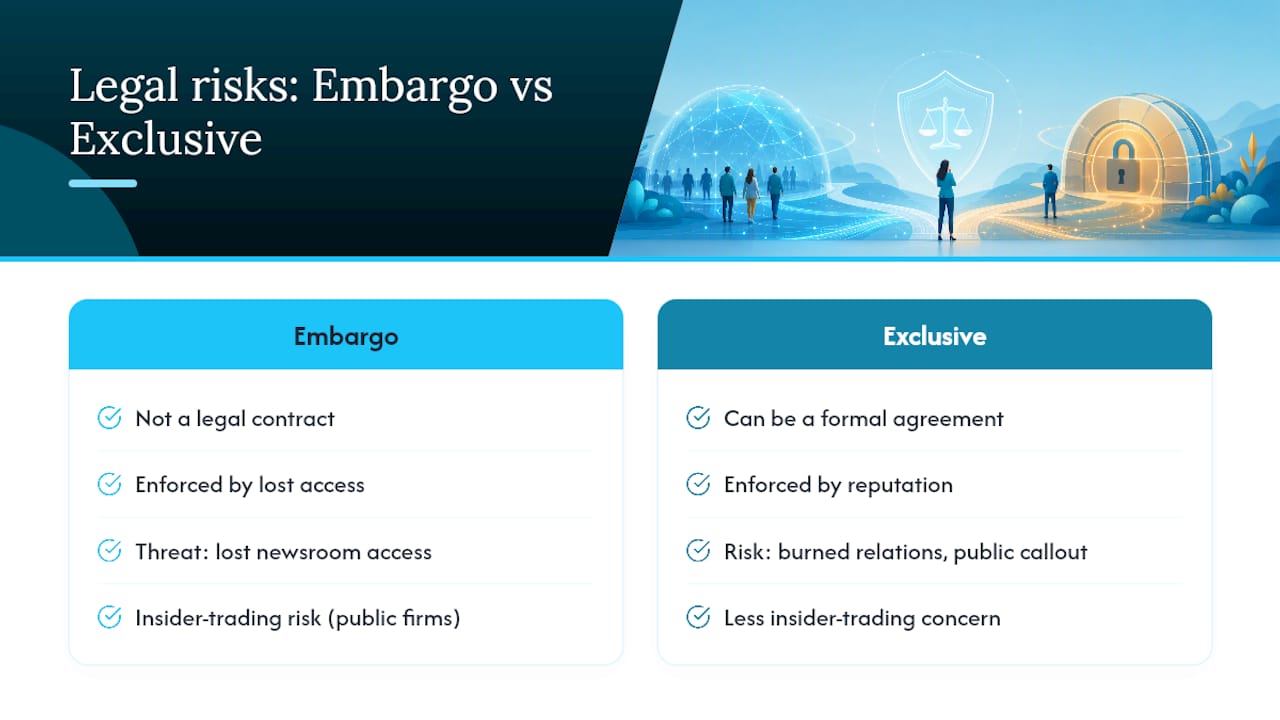
Embargoes are not enforceable contracts in the legal sense for most PR use cases. They function as professional norms, backed by the threat of lost access rather than litigation, which the Reuters Institute’s embargo research documents as a long-standing industry pattern rather than a formal legal mechanism. That said, a few real legal considerations do apply.
Publicly traded companies need to treat embargoed financial information with the same care as material nonstandard disclosure. Sharing embargoed earnings data too widely, or too early, can raise insider trading concerns, which is one reason the Association of Health Care Journalists notes embargo material often comes with an explicit expectation that details won’t circulate beyond the newsroom before lift.
Exclusive agreements carry a different kind of risk: if you promise an outlet sole rights and then leak the same story to a competitor, you’re not looking at a lawsuit, but you are looking at a burned relationship and possibly a public callout. Some larger organizations formalize exclusive arrangements with a short letter of agreement specifying scope (interview access, data, embargo window) precisely to avoid this kind of dispute. For most PR engagements, though, enforcement comes down to reputation management, not legal recourse. Treat every embargo and exclusive as a promise you intend to keep, because the only real penalty for breaking one is losing the trust that made it useful in the first place.
How Embargo and Exclusive Choices Shape Your Coverage Results
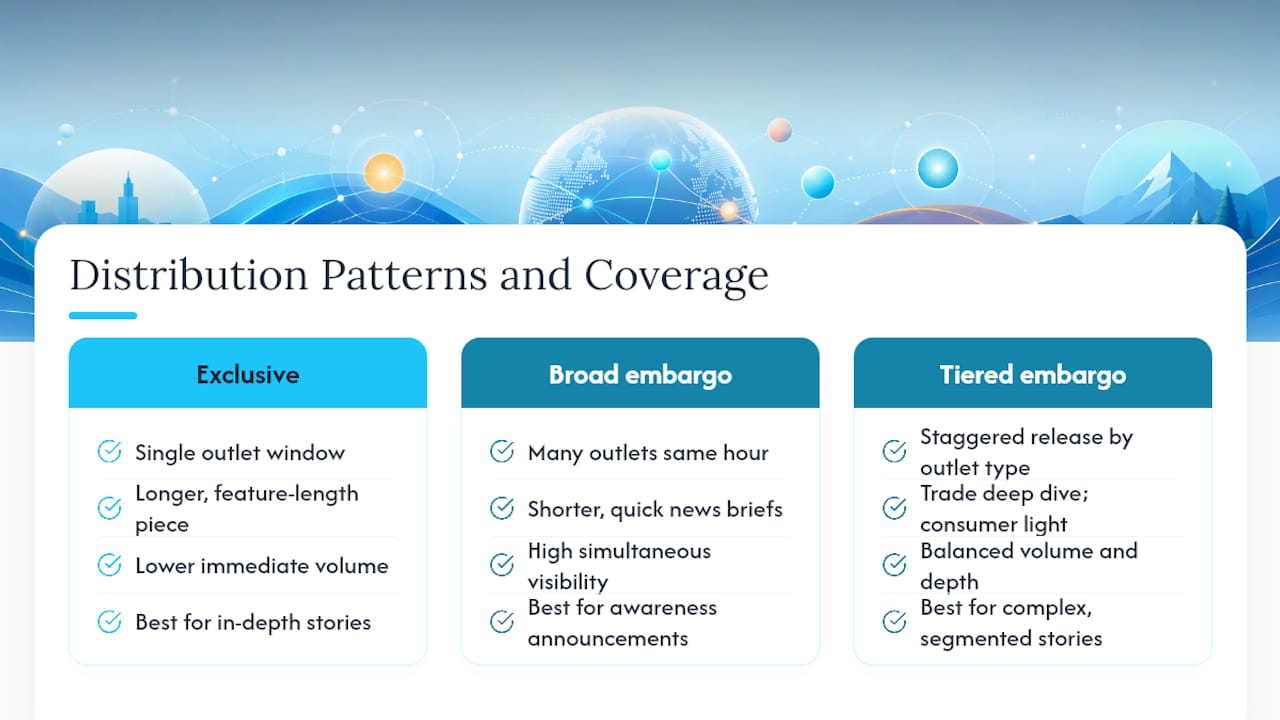
The distribution pattern you choose directly shapes the kind of coverage you get back. An exclusive tends to produce a longer, more considered piece because the reporter has room and incentive to invest in it. There’s no competitive pressure to rush, so you often get a feature-length story instead of a quick news brief.
A broad embargo produces the opposite effect: many shorter pieces landing at the same hour, creating a wave of visibility across search results and social feeds simultaneously. That volume matters for stories where awareness itself is the goal, like a product recall or a major public announcement, more than any single article’s depth.
Tiered embargoes split the difference, and this is where PR teams often get the most value for complex stories with multiple audience segments. A trade outlet gets early access for a deep dive, while consumer outlets get the same material a few hours later for a lighter treatment. The PressVerified pattern framework frames this as a genuine middle ground rather than a compromise, since each outlet still gets coverage suited to its own format.
One frequent misstep is defaulting to broad distribution because it feels safer, when a tiered or exclusive approach would have produced sharper, more durable coverage. Broad-by-default rarely fails outright, but it consistently underperforms what a deliberate pattern choice could have delivered.
Why the Relationship Layer Matters More Than the Mechanics
The exclusive vs embargo decision isn’t just tactical. It shapes how journalists perceive your organization over the long run. A PR contact who reliably delivers clear embargo briefs, confirms lift times without ambiguity, and follows through on exclusive promises builds a reputation reporters actively want to work with again.
That reputation compounds. Journalists who trust a PR contact are more likely to take a pitch seriously on a busy news day, more likely to grant flexibility when timing shifts, and more likely to reach out proactively for future stories. The inverse is just as true. A single mishandled embargo, especially one where a reporter gets scooped because of a leak on your end, can quietly close doors for months.
This is part of why PR Newswire’s guidance stresses getting explicit agreement before sending embargoed material rather than assuming implicit consent. It’s not just about avoiding an accidental break. It’s about signaling to the journalist that you respect their time and their editorial process enough to ask first. That small courtesy does more for a long-term media relationship than any single well-placed exclusive ever could.
The Real Skill Isn’t Choosing. It’s Choosing Deliberately.
Pick deliberately, not broad-by-default. The trust you build with a journalist over a dozen clean embargoes gets spent fast on one careless leak, and it rarely comes back at the same rate it left. If you want to see how a deliberate, story-by-story approach plays out across real campaigns, Goldman McCormick PR’s team can walk through it with you directly.
— Ryan McCormick
Sources
- Embargo | Association of Health Care Journalists
- How to Use Embargos & Exclusives in PR | PR Newswire
- News embargoes under threat but not extinct — Reuters Institute
FAQ
What are some examples of embargoes in PR?
Common examples include a pharmaceutical company holding a clinical trial result until a journal’s publication date, a tech company giving reporters advance access to a product ahead of a launch event, and government agencies releasing economic data under a timed hold to give reporters time to prepare accurate coverage.
What does “exclusive” mean in journalism?
An exclusive means one outlet has sole rights to break a story first, with no other newsroom receiving the same material at the same time, as PR Newswire distinguishes from the shared-access model of an embargo.
What does embargo mean in journalism?
An embargo is a request, not a legal requirement, that journalists hold a story until a specified date and time, giving them advance access in exchange for agreeing not to publish early, per the Association of Health Care Journalists.
How long do embargoes typically last?
Most embargoes run 48 to 72 hours from pitch to lift, based on PressVerified’s pattern research, since shorter windows rush reporting and longer ones risk being forgotten in a busy newsroom.