Legitimate pay to play radio means fee-based airtime: host endorsements, produced spots, sponsored segments, or PR-arranged syndicated programming that a station or network runs because a client paid for it, clearly and openly. SiriusXM Media and PR Newswire both treat this as standard practice, not a gray area. For an attorney, psychologist, or nonprofit weighing this option, the right move is to hire a PR or production team, like Goldman McCormick PR, that can produce the audio, book the placements, and prove the results, rather than trying to buy airtime cold from a station sales desk.
TL;DR:
- Combining host endorsements with produced spots increases trust and message consistency, improving campaign effectiveness.
- Host endorsement costs are typically two to three times higher than standard spots, with prices varying based on market size and package scope.
- Agencies should provide detailed documentation of placements, final audio files, and KPIs, and avoid vague promises or undisclosed station schedules.
- Booking radio media tours requires at least four to six weeks of lead time, and long-term campaigns generally offer better cost efficiency than single spots.
- Paid radio yields the best results for professionals needing credibility and repetition, especially when integrated with measurable goals and professional production.
Table of Contents
- What Counts as Pay to Play Radio for Professionals?
- How Much Does Pay to Play Radio Cost?
- How Do You Measure Whether Paid Radio Actually Works?
- What Should You Require From a PR Firm or Producer?
- When Does Paid Radio Actually Move the Needle for Professionals?
- Get Produced and Syndicated Radio Placements Done Right
- Sources
- FAQ
What Counts as Pay to Play Radio for Professionals?
The phrase covers several distinct products, and confusing them is where most first-time buyers lose money. Each format trades off credibility, control, and cost differently, so the right choice depends on whether you’re building long-term authority or chasing an immediate response.
- Host endorsements (live reads): The on-air personality delivers your message in their own voice, often during a segment they control. Listeners trust these more than obvious ads, which is why they carry a premium, but you sacrifice some message consistency since the host may improvise.
- Produced spots: Pre-recorded, professionally edited ads that run exactly as scripted every time. They’re the workhorse for sustained frequency campaigns because the message never drifts and costs stay predictable.
- Sponsored segments and branded content: A recurring block, say, a weekly legal advice minute or a health tip segment, where your firm becomes the associated expert. SiriusXM Media notes this format performs especially well for mid- to lower-funnel goals like driving calls or site visits, while full branded shows build authority over a longer arc.
- Radio media tours (RMTs) and audio news releases (ANRs): A PR firm books you as a guest across multiple stations in a short window, useful for a book launch, a legal precedent, or a nonprofit campaign that needs broad reach fast.
- Streaming audio and podcast sponsorships: Digital platforms let you target listeners by demographic and interest with more precision than broadcast, though the audience often skews younger and smaller per outlet.
Marketers who mix formats, say, a host endorsement paired with produced spots, tend to outperform single-format buys because one builds trust while the other locks in the message.
How Much Does Pay to Play Radio Cost?
Budgets swing wildly by market size, host popularity, and format, so treat any single number as a starting point, not a quote.
Pro Tip: Ask any vendor for a written rate card before you negotiate. Stations rarely advertise host-endorsement pricing publicly, and the gap between a quoted “package” and an itemized breakdown is often where budgets get padded.
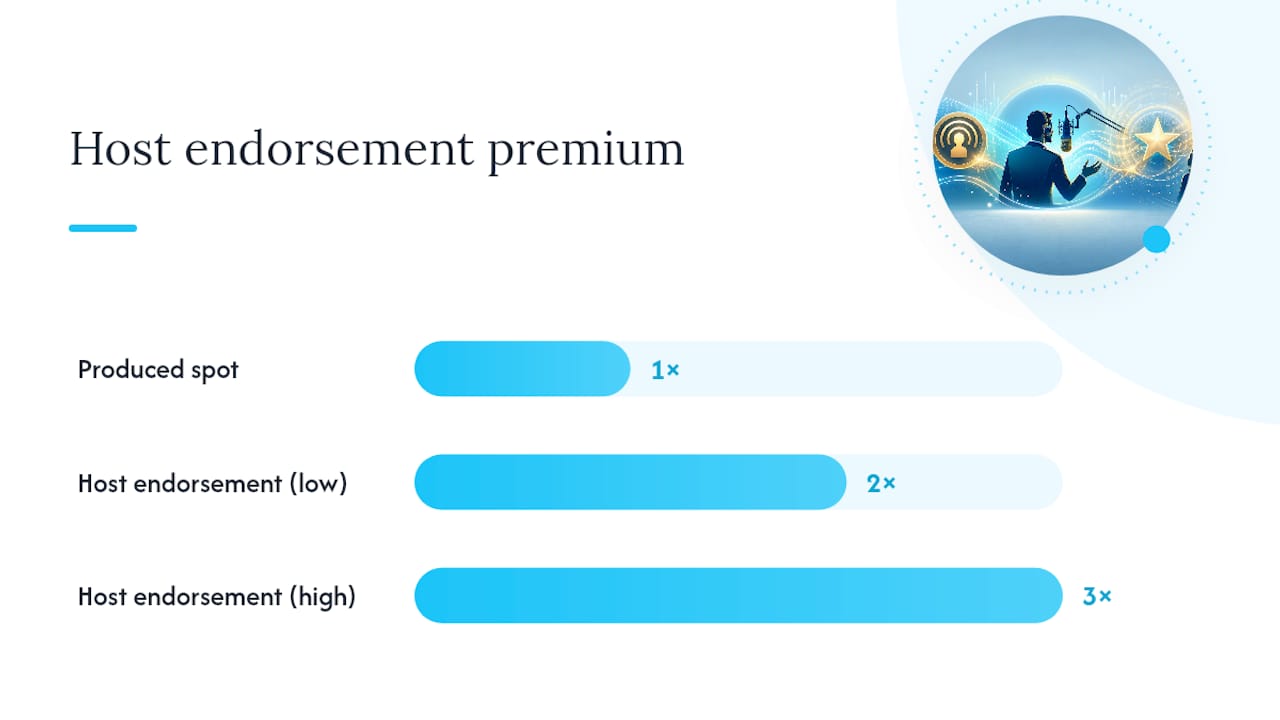
- Host endorsements typically run 2 to 3 times the cost of a standard produced spot, reflecting the host’s personal credibility with their audience.
- In small markets, expect several hundred dollars per host-read spot; major metro packages can be several thousand dollars per week.
- Line items to budget for separately: studio time, talent fees, script and production editing, syndication or distribution fees, and the PR or media-buying agency’s fee.
Host endorsements command a 2x to 3x premium over produced spots, largely because listeners rate the host’s personal recommendation as more trustworthy than a straight ad read, according to radio industry pricing data.
Timing matters as much as budget. PR Newswire recommends starting outreach for satellite, virtual, or radio media tours at least 4 to 6 weeks before your target air dates, which gives producers time to pitch stations, clear scripts, and lock studio slots. Many satellite and network platforms also carry minimum spend requirements, so a one-off ad rarely gets you the best rate; a short campaign almost always beats a single spot on cost-per-impression.
How Do You Measure Whether Paid Radio Actually Works?
Radio has a reputation for being hard to track, but that’s a failure of planning, not a limit of the medium. Build measurement into the buy before it airs.
- Set your primary KPIs up front. For most professional services, that means tracked phone calls, unique landing-page visits, form submissions, or promo-code redemptions, not vague “brand awareness.”
- Assign a unique phone number or extension to the campaign. This is the single cheapest way to prove a call came from radio and not from a Google search.
- Build a dedicated landing page with UTM parameters. Compare traffic in a narrow window around each air date against your pre-campaign baseline; a spike inside 24 to 48 hours of a live read is a strong signal the ad drove it.
- Calculate cost-per-thousand impressions and cost-per-acquisition. Divide total spend by estimated audience reach for CPM, then by actual leads generated for CPA, so you can compare radio against your other channels on the same terms.
- Track conversion lift, not just raw volume. A jump from two inquiries a week to six during a campaign tells you more than the six alone.
Tools built for measuring website performance and KPIs can help you connect that landing-page traffic to actual conversions once the campaign is live.
What Should You Require From a PR Firm or Producer?
A professional radio campaign should come with paperwork, not just promises. Before you sign anything, get clarity on three things: deliverables, contract terms, and warning signs.
Deliverables to require in writing:
- A media list or confirmed station schedule showing exactly where and when your spot or segment airs
- Final production files (the actual audio) delivered to you, not just to the station
- Booking confirmations for every placement, not a verbal assurance
- A reporting package tied to the KPIs you set, delivered after the campaign closes
Contract questions worth asking directly: Who pays the on-air talent, the firm or the station? How is each placement documented, an affidavit, a screenshot, a station log? What happens if a promised placement falls through, is there a refund or a makeup spot? Who owns the usage rights to the produced audio afterward?
Red flags: a firm that won’t name the stations before you pay, no written schedule, vague promises of “guaranteed placement” with no documentation, or no measurement plan offered at all. If a producer can’t tell you which market, which daypart, and which show, walk away.
When Does Paid Radio Actually Move the Needle for Professionals?
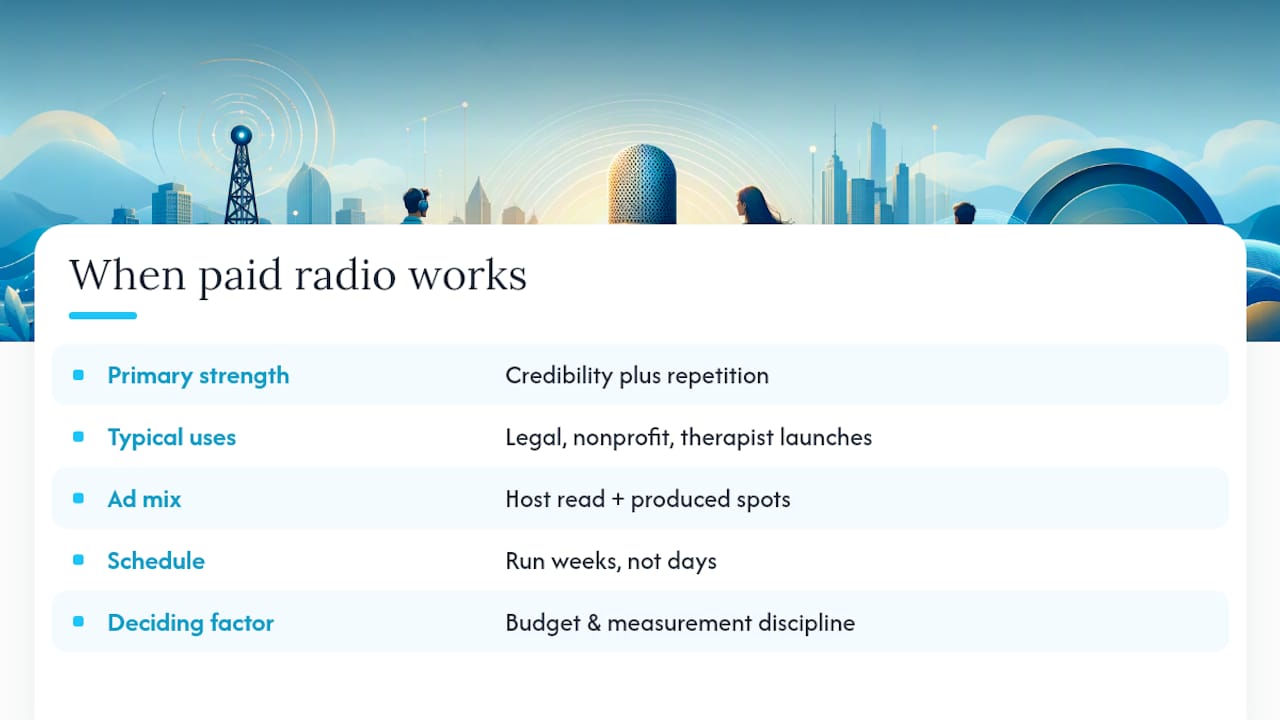
Paid radio earns its keep when a professional service needs both credibility and repetition at once, a personal injury firm after a verdict, a nonprofit mid-campaign, a psychologist launching a new practice. A single host endorsement rarely closes the deal; what works is a host read for trust layered with produced spots for frequency, run over weeks, not days.
Streaming and podcast sponsorships fit better when the audience skews younger, since broadcast radio’s core listenership runs older. The real deciding factor isn’t creative, it’s whether you have the budget and measurement discipline to run this yourself or need a firm to buy, produce, and track it for you.
— Ryan McCormick
Get Produced and Syndicated Radio Placements Done Right
Goldman McCormick PR gives attorneys, psychologists, and nonprofits a faster path to credible airtime than assembling host reads, studio time, and station bookings piece by piece on your own. Our team produces radio programming and syndicated shows and handles the scheduling, production standards, and station relationships that usually eat weeks of a professional’s time.
When you work with us, you get a confirmed station schedule, professional-grade production, and reporting tied to the metrics that matter to your practice, calls, inquiries, and site visits, not vague impressions. If you’re weighing a host endorsement against a produced campaign, or need a syndicated show built from scratch, contact Goldman McCormick PR to scope your project and get a realistic timeline before you commit a budget.
Sources
- Branded podcasts vs sponsored segments — SiriusXM Media
- Radio host endorsement cost and pricing guide — RadioAdvertisingHome
- How to plan satellite, virtual and radio media tours in 2026 — PR Newswire
- Host endorsements vs produced spots — Retail & Response
FAQ
Is Pay to Play Radio the Same as Traditional Advertising?
Not exactly. Traditional spot advertising is a straight paid ad; pay to play radio often includes host endorsements or sponsored segments that blend paid placement with the host’s own credibility, disclosed as sponsored content.
How Far in Advance Should You Book a Radio Media Tour?
Plan for 4 to 6 weeks of lead time before your target air dates, which gives a producer time to pitch stations, clear scripts, and confirm studio slots.
How Much Does a Host Endorsement Cost Compared to a Produced Spot?
Host endorsements generally cost 2 to 3 times more than a standard produced spot, with small-market rates around $100 to $500 and major-metro weekly packages reaching $3,500 or higher.
What Should a PR Firm Provide After a Radio Campaign?
Expect a confirmed station schedule, final production files, booking confirmations for every placement, and a reporting package tied to your agreed KPIs, such as tracked calls or landing-page visits.
Can Small Firms or Nonprofits Afford Paid Radio?
Yes. Smaller organizations can often negotiate remnant inventory or work with an independent media buyer to lower costs, then start with a focused sponsored segment or short RMT rather than a full syndicated campaign.