
A legal op-ed is opinion journalism, not legal analysis; it is a short, sourced argument that tells general readers why a legal issue matters right now. The single habit that separates published pieces from rejected ones is pairing a sharp, contrarian thesis with a genuine news hook, then submitting it fast. Editors want submissions within 24 hours of a breaking event, and top papers publish only three to five pieces a day out of hundreds received, so timing and a distinctive angle decide most outcomes before an editor even reads your evidence.
TL;DR:
- Timing is crucial, with submissions for breaking news needing to be within 24 hours to stay relevant and avoid obsolescence.
- A clear, concise thesis must be crafted first, tested on non-lawyers, and then supported with three focused points, evidence, and a real-world example.
- Editors prefer straightforward language, single supporting claims, and a strong hook at the start, avoiding hedging, footnotes, and exhaustive counterarguments.
- Pitch emails should be brief, with a compelling argument and credentials in the first paragraph, and the full draft pasted directly below the pitch.
- Legal accuracy, transparency about client ties, and avoiding overcitation or unnecessary legal detail are essential to maintain credibility and impact.
Table of Contents
- What Makes Legal Op-Ed Writing Different From Legal Writing
- How Do You Structure a Legal Op-Ed?
- How Do You Choose the Right Publication?
- What Should a Legal Op-Ed Pitch Email Look Like?
- Editing and Fact-Checking Before You Hit Send
- How Media Professionals Help Attorneys Place Op-Eds
- Why Timing Decides Whether Your Op-Ed Runs at All
- Building a Legal Argument That Persuades General Readers
- Ethical Lines Attorneys Should Not Cross in Op-Eds
- Where Legal Op-Eds Succeed and Where They Fail
- Keeping the Law Accurate While Still Telling a Story
- An Editor’s-Eye View of What Actually Gets Attorneys Published
- Get Help Placing Your Legal Op-Ed
- Sources
What Makes Legal Op-Ed Writing Different From Legal Writing
An op-ed is a short opinion essay written for a general newspaper or online audience, not a brief, memo, or blog post you’d share with colleagues. It shares DNA with a letter to the editor (both are opinion, both are short) but carries more argument and evidence; it differs from a legal essay or law review article in almost every way that matters to an editor.
Most run 600 to 800 words, use AP style rather than Bluebook citations and favor plain declarative sentences over qualified legal phrasing. Editors want evidence and a clear point of view, not footnotes or hedged legal subtext.
When converting a legal analysis into op-ed form, cut these habits:
- Multiple qualifying clauses (“subject to,” “notwithstanding,” “to the extent that”)
- String citations and footnotes; replace with a name, date, or a hyperlink
- Passive constructions that hide who did what
- Exhaustive counterargument surveys; pick the one that matters
- A conclusion that summarizes instead of a kicker that lands a point
How Do You Structure a Legal Op-Ed?
Every publishable op-ed follows a version of the same skeleton, and you can build it in this order without losing the persuasive momentum an editor is scanning for in the first ten seconds.
- Headline. Write it last, but it earns its keep first: a specific claim, not a topic label. “The Bail Reform Law Is Working. The Data Proves It” beats “Thoughts on Bail Reform.”
- Lede with a news hook. Open with the event, ruling, or anniversary that makes this piece timely. Editorial guidance is consistent here: for breaking events, submit within 24 hours to stay relevant. A hook can also be a court decision handed down that morning, a bill moving through committee, or the anniversary of a landmark case.
- Nut graph. One sentence, usually the second or third paragraph, stating your thesis plainly: “X should happen because Y, and here’s the evidence.” If a reader stopped after this sentence, they’d still know your argument.
- Three supporting points. Each point gets a claim, one piece of evidence (a statute, a study, a specific case), and a brief real-world example. Do not stack four or five points; three is the ceiling most 700 word pieces can support.
- The “to be sure” paragraph. Name the strongest objection to your argument in one or two sentences, then answer it. Skipping this makes your piece read as one-sided; editors notice.
- Kicker. Close with a specific ask, a policy recommendation, or a line that echoes your opening hook. Never end by restating your thesis word for word.
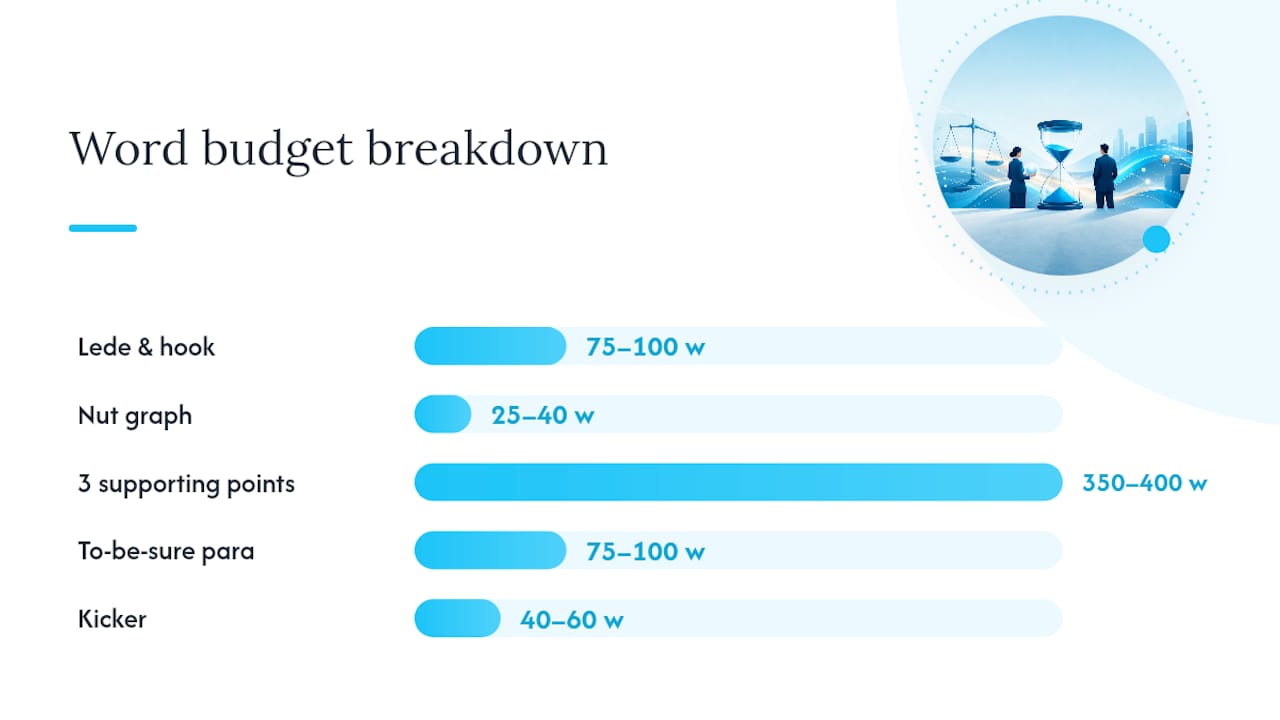
A rough word budget for a 750 word piece: headline (free), lede and hook (75 to 100 words), nut graph (25 to 40 words), three supporting points (350 to 400 words combined), to-be-sure paragraph (75 to 100 words), kicker (40 to 60 words).
Pro Tip: Write your nut graph before anything else. If you can’t compress your argument into one sentence, you don’t have an op-ed yet. You have a topic.
Translating dense legal reasoning into a public-facing hook is its own skill, and it overlaps heavily with what copywriters do when developing persuasive copy for a general audience: find the one sentence that makes a stranger care, then build evidence underneath it.
How Do You Choose the Right Publication?
Fit matters more than prestige. A piece perfectly tuned for The New York Times often gets rejected everywhere else because its tone assumes a national audience; the same argument, retooled for a local paper, can run within days.
Think in tiers:
- Local and regional papers want pieces tied to a local case, local legislator, or local impact. Word limits often run 600 to 700 words, and turnaround is faster because there’s less competition for space.
- National outlets (major papers, wire opinion sections) want national relevance, a strong hook, and often cap pieces around 750 to 800 words. Competition is fierce; a generic angle rarely survives here.
- Trade and legal publications (bar journals, legal trade press) tolerate more technical language and longer pieces but reach a narrower, professional audience.
- Online-only opinion sections are often more flexible on length and turnaround but pay less or nothing.
Check each outlet’s own submission page before pitching. It will state word limits, exclusivity rules, and whether simultaneous submission is allowed. Most major outlets require exclusivity while your piece is under consideration; violating that can get you flagged as unreliable to that editorial desk. Cast wide with backups lined up, but never submit the identical, unedited draft to two top-tier outlets at once.
What Should a Legal Op-Ed Pitch Email Look Like?
The pitch itself should be almost invisible next to the draft. Pitches should be very short, consisting of two brief paragraphs: the first states your argument and why it matters now, the second states your qualification in one line and any logistics.
Build your submission like this:
-
Subject line: name the argument, not the topic (“Why New York’s Bail Law Needs One Fix” beats “Op-Ed Submission”)
-
Paragraph one: your thesis and the news hook driving it
-
Paragraph two: one sentence on why you’re qualified to write it, plus word count and exclusivity status
-
Below the pitch: paste the full, finished draft directly into the email body, not as an attachment
-
Signature: name, title, one line of contact information, and a short bio
Successful pitches follow this exact pattern: thesis and hook up top, credentials brief, full draft pasted below so an editor can read it in one scroll without opening a file.
Follow-up cadence depends on urgency. If your hook is breaking news, follow up within 24 hours if you haven’t heard back; for evergreen pieces, wait three to five business days. If a major outlet goes silent past that window, move to your backup list rather than waiting indefinitely.
Pro Tip: Keep a ranked list of three to five backup outlets before you pitch your first choice. When the top pick goes quiet, you retool your opening paragraph for the new outlet’s audience and resubmit within the hour, not the week.
Editing and Fact-Checking Before You Hit Send
A clean draft gets read faster and trusted more. Run through this before submitting:
- Cut every sentence with more than one qualifying clause; if a sentence needs “however” and “although,” split it into two
- Replace Bluebook citations with a plain-language reference or a hyperlink to the source
- Confirm every factual claim against a primary source: the actual court decision, the statute’s text, or the official report, not a secondhand summary
- Prepare the direct links you used so an editor’s fact-checker can verify them in seconds
- Read the piece aloud; if you stumble on a sentence, an editor will too
- Get one trusted colleague to read it for logic gaps, not grammar, and cap that review at same-day turnaround
For time-sensitive pieces, set up a rapid review workflow ahead of time: one or two reviewers and a single decision-maker, so a breaking news hook doesn’t die waiting on committee-style feedback.
How Media Professionals Help Attorneys Place Op-Eds
Placing an op-ed is competitive by design. Editors at major outlets receive hundreds of submissions a day and run only a handful, which is exactly the environment Goldman McCormick PR has worked in since it was founded in 2010 by former members of the media. Forbes named the firm one of America’s best PR firms for 2021, Bulldog Reporter awarded it a Gold Award for cause and advocacy campaigns, and the New York Observer named it among the top five agencies specializing in legal PR.
What that experience translates into for attorneys writing op-eds:
- Sharpening a legal thesis into the kind of contrarian hook editors actually want
- Matching a draft to the right editor and outlet tier instead of guessing
- Handling the pitch, the follow-up cadence, and the backup list so a good piece doesn’t die from silence
- Media training so that a published op-ed leads smoothly into a TV or radio interview request
Why Timing Decides Whether Your Op-Ed Runs at All
Nothing kills a legal op-ed faster than lateness. An argument about a court ruling is a news story on the day it’s decided; by the following week, it’s a stale take that every editor has already seen three versions of. That’s why the consistent editorial guidance across outlets is blunt: for breaking news, submit within 24 hours to remain relevant.
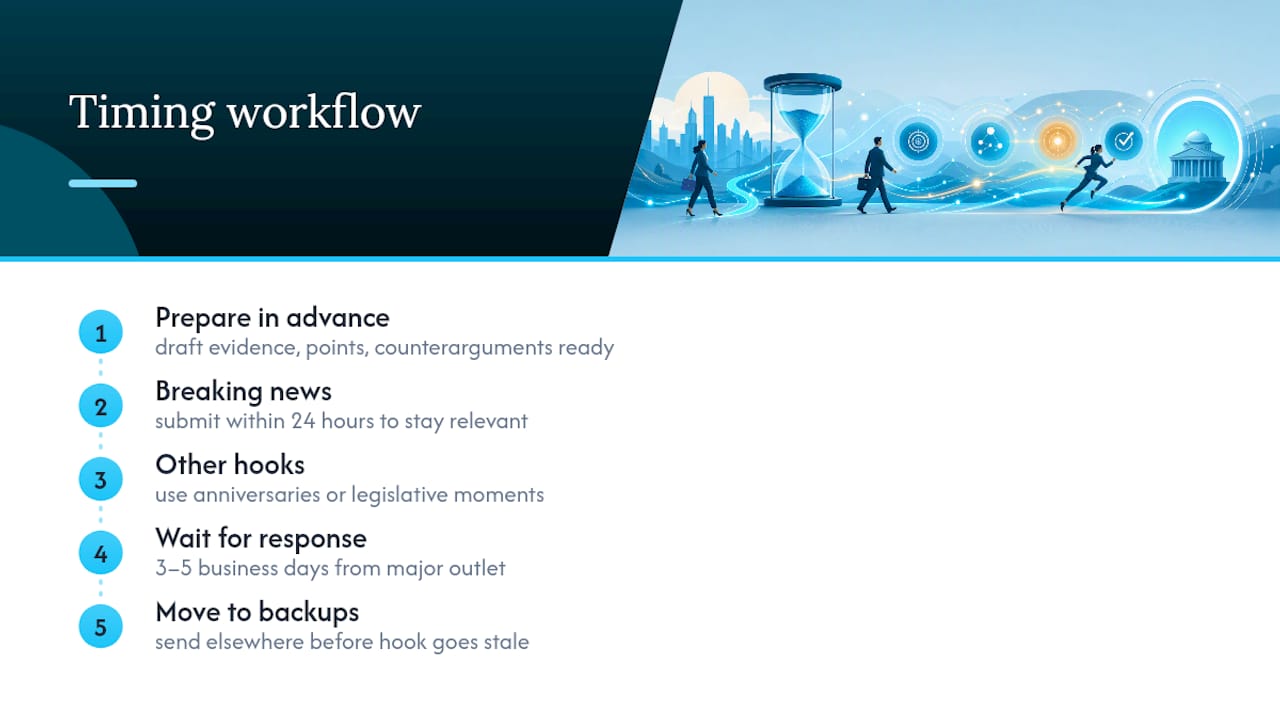
That doesn’t mean every legal op-ed needs a same-day court decision. Anniversaries work as hooks too: the anniversary of a landmark ruling, a statute’s effective date, or a high-profile trial’s verdict a year later. Legislative calendars offer another entry point: a bill moving through committee, a public comment period closing, an agency rule taking effect. Each of these gives you a legitimate “why now” without requiring you to chase breaking news.
The practical move is to draft the argument before the hook arrives. If you know a circuit split is likely to reach the Supreme Court this term, or that a state legislature is debating a bill you have strong views on, write the bulk of your argument in advance. Keep your evidence, your three supporting points, and your counterargument response ready. When the news breaks, you’re revising an opening paragraph and a headline, not starting from a blank page at 11 p.m.
This is also why exclusivity rules matter for timing. If you’ve pitched one outlet and it sits on your piece for three days, you’ve likely lost the news hook entirely. A three to five business day silence window from a major outlet is your signal to move to backups, not to keep waiting.
Building a Legal Argument That Persuades General Readers
Legal training rewards thoroughness. Op-ed writing rewards ruthlessness. A brief covers every angle because a judge expects it; an op-ed covers one angle because a reader will abandon it after the second paragraph if it doesn’t move fast.
Start by identifying the single strongest reason your position matters to someone with no legal background. Not the doctrinal nuance, the human stake: whose rent goes up, whose case gets dismissed, whose civil rights narrow. Build your nut graph around that stake, then use your legal expertise to prove it rather than to explain it.
Evidence in an op-ed works differently than evidence in a memo. A statute citation persuades a judge. A concrete number, a named case, or a specific outcome persuades a reader. If you’re arguing about sentencing disparities, one real case with real facts will do more work than five statistics stacked in a row. Editors consistently favor pieces that explain why an issue matters now and offer a genuinely fresh angle rather than restating a position readers have already seen in a dozen other pieces on the same ruling.
The strongest legal op-eds also make a specific ask. “This is a problem” is a complaint. “This court should adopt X standard” or “this legislature should pass Y bill” is an argument a reader can act on, share, or argue against. That specificity is what separates an op-ed from a rant, and it’s usually the difference between a piece an editor forwards to a colleague and one they pass on.
Ethical Lines Attorneys Should Not Cross in Op-Eds
Writing publicly about the law carries obligations that don’t apply to other opinion writers. If you represent a client with a stake in the issue you’re writing about, disclose it. An op-ed arguing for bail reform written by a criminal defense attorney with active cases affected by that reform needs a disclosure line; omitting it isn’t just an ethics risk, it undermines the argument once readers find out.
Confidentiality rules don’t loosen because you’re writing for a newspaper instead of a court filing. Never use client facts, even anonymized ones, in a way that could let a reader identify the matter or the client. If your argument depends on an example from your own practice, get clearance or use a hypothetical instead.
Accuracy carries extra weight when you write as a lawyer. Readers assume legal credentials mean legal precision, so an error in how you describe a ruling or a statute damages more than your credibility with that editor. It can misinform thousands of readers who have no way to check your work. Cite the actual holding, not the popular misreading of it; if a case is more nuanced than your argument needs, say so briefly rather than oversimplifying it into something the opinion doesn’t support.
Finally, be honest about your bar status and jurisdiction. Writing “as an attorney” implies current, active standing. If you’re a law student, say so; if you’re licensed in one state discussing another state’s law, note that distinction rather than letting the byline imply broader authority than you have.
Where Legal Op-Eds Succeed and Where They Fail
The op-eds that get shared widely tend to share a structure: a specific, named case or event as the hook, one clear ask, and a voice that sounds like a person talking, not a brief being read aloud. A piece arguing against a sentencing guideline works better anchored to one defendant’s real outcome than to an abstract discussion of proportionality. A piece on a new privacy statute lands harder when it opens with what a reader’s own data exposure looks like under the old rule versus the new one.
What separates the effective examples from the forgettable ones usually isn’t legal sophistication. It’s restraint. The strongest pieces resist the urge to address every possible objection, cite every relevant precedent, or hedge every claim. They pick one fight and win it convincingly in under 800 words.
The recurring pitfalls are just as consistent. The most common: opening with background instead of a hook, so the actual news or stake doesn’t appear until paragraph three or four, by which point most readers have moved on. A close second is writing a thesis so hedged (“there may be some concerns worth examining”) that it reads as no thesis at all. Editors want an argument they can headline, not a survey of considerations.
Overloading a short piece with legal citations is another frequent misstep, usually a habit carried over from brief writing that doesn’t translate. So is ignoring the counterargument entirely, which makes even a well-reasoned piece look like propaganda rather than analysis. Simultaneous submission to multiple top-tier outlets without disclosure remains a fast way to damage a relationship with an editorial desk, since most major outlets expect exclusivity while your piece is under review.
Keeping the Law Accurate While Still Telling a Story
The tension every legal op-ed writer faces is real: the story needs momentum, but the law needs precision. The fix isn’t to sacrifice one for the other. It’s sequencing them correctly.
Establish the emotional or practical stake first, in plain language, before you introduce the legal mechanism behind it. A reader will follow you into a discussion of qualified immunity doctrine if you’ve first shown them the specific person harmed by how it works today. Reverse that order and most readers won’t reach the doctrine at all.
When you do explain the law, resist the academic instinct to caveat every claim. If a statute has three exceptions but only one matters to your argument, mention that one and move on; a footnote-style aside about the other two reads as hedging to a general reader, even though it would read as rigor to a fellow attorney. Precision and thoroughness are not the same thing, and op-ed space rewards the former while punishing the latter.
The most reliable test: read your draft to someone outside the legal field before you submit it. If they can repeat your argument back to you in one sentence, and if they didn’t get lost anywhere in the middle, your balance is probably right. If they can only tell you it was “about a legal thing,” go back and cut whatever slowed them down, even if it was your favorite paragraph.
An Editor’s-Eye View of What Actually Gets Attorneys Published
Most advice on legal op-ed writing treats structure as the hard part. It isn’t. Structure is mechanical, and any competent writer can learn the headline, lede, nut graph, three points, to-be-sure paragraph pattern in an afternoon. The real bottleneck is almost always the thesis, and specifically, attorneys’ reluctance to commit to one sharp enough to survive an editor’s first skim.
Legal training builds people who see every side of an argument, which makes for good lawyers and mediocre op-ed writers. The instinct to qualify, to acknowledge complexity, to avoid overclaiming, works against you in 700 words. An editor with three minutes and forty other submissions isn’t looking for nuance. They’re looking for a clean, defensible claim they can put a headline on.
If there’s one piece of conventional wisdom worth pushing back on, it’s the idea that timing and hooks matter more than argument quality. They matter enormously, but a perfectly timed piece with a mushy thesis still gets passed over. Get the claim right first. Then chase the calendar.
What should a first-time legal op-ed writer prioritize? Write the nut graph before anything else, test it on a non-lawyer, and only then build the rest of the piece around it.
— Ryan McCormick
Get Help Placing Your Legal Op-Ed
Writing a strong draft is half the work; getting it in front of the right editor before your news hook goes cold is the other half, and it’s the half most attorneys underestimate. Some public relations firms handle both sides: sharpening your legal argument into an editor-ready op-ed, and running the pitching and follow-up process so your piece doesn’t sit unread in an inbox while its relevance expires.
Certain firms offer op-ed and media placement work tailored for attorneys, psychologists, and other professionals and organizations seeking media exposure, not general readers looking for writing tips. If that describes your situation, visit the Goldman McCormick PR site to request help or schedule an inquiry about placing your next op-ed.