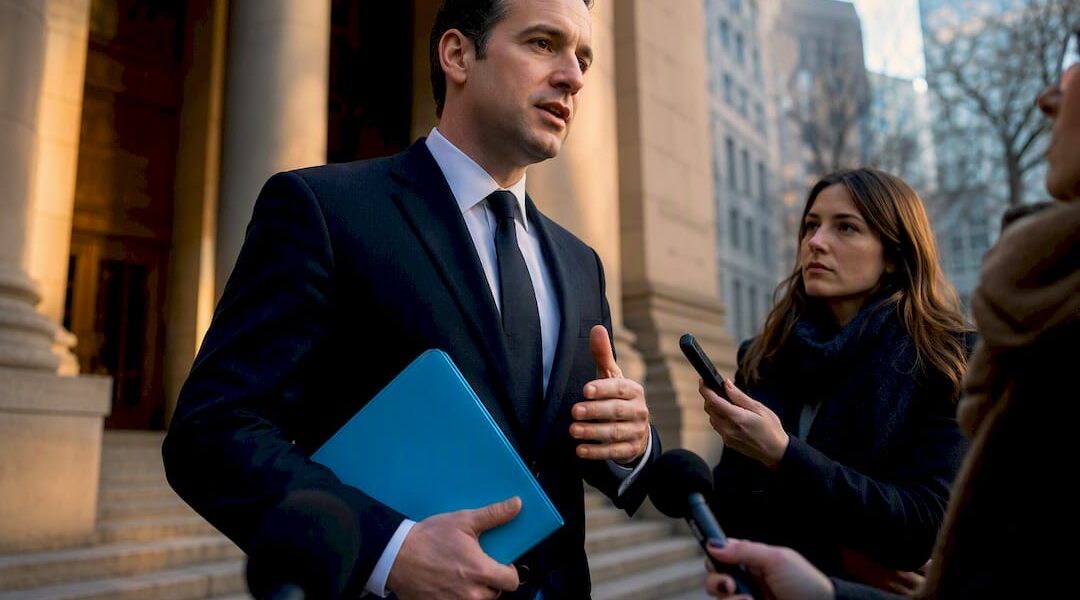
The right move when a client’s arrest hits the news is to designate one spokesperson, issue a single pre-cleared holding statement, and log every reporter contact before you say another word to anyone. ABA Model Rule 3.6 limits what you can say publicly about a pending case, and the NACDL Press Center exists precisely because defense attorneys need a compliant way to speak up without prejudicing the proceeding. Do those three things now, then read the rest.
TL;DR:
- A single, pre-cleared statement and designation of one spokesperson prevent mixed messages and ensure quick, controlled communication within the first 24 hours.
- Internet and TV coverage can quickly escalate to viral levels, which warrants immediate outside PR support to manage high-profile cases effectively.
- Rule 3.6 permits discussing general case updates and procedural information but prohibits opinions on guilt, witness credibility, or evidence details.
- Proactive media outreach and relationship-building with reporters increase the likelihood of favorable coverage and prevent the narrative from being controlled solely by prosecutors.
- Engaging a litigation PR firm early, especially for cases gaining national attention or media attention, can significantly influence case framing and protect client confidentiality.
Table of Contents
- Your Hour 0 to 24 Media Response Checklist
- How Do You Write a Public Statement Reporters Can Actually Use?
- What Does ABA Rule 3.6 Actually Let You Say?
- How Do You Pitch a Reporter Instead of Just Talking to Them?
- Social Media and Broadcast Rules Every Defense Attorney Should Follow
- Building an Internal Media Response Process That Actually Works
- Your 72-Hour Crisis Response Timeline for High-Profile Cases
- Why Litigation PR Experience Changes the Outcome
- Protecting Client Confidentiality While Talking to the Press
- Should You Reach Out First or Wait for Reporters to Call?
- Handling Hostile or Aggressive Media Questions
- Measuring Whether Your Media Outreach Is Actually Working
- Turning One Case Into a Career-Long Press Relationship
- The Part Most Defense Attorneys Get Backward
- When to Bring In a Litigation PR Team
- Sources
Your Hour 0 to 24 Media Response Checklist
The first day sets the tone for every story written about your client afterward. Reporters are working on deadline, prosecutors may already be talking, and silence gets filled with someone else’s narrative. Here’s the order of operations.
- Designate the spokesperson. One person talks to media. It’s usually the lead attorney, sometimes a trained associate or a hired PR contact, but never a paralegal fielding calls ad hoc.
- Draft and clear a holding statement. Get language approved within an hour, not a day. A short, neutral statement beats no comment almost every time.
- Log every media request. Reporter name, outlet, deadline, and what they asked. This becomes useful later, both for follow-up and for documenting publicity patterns.
- Set an approval SLA. Decide now who signs off on quotes and how fast. Fifteen minutes is realistic if you’ve pre-cleared the language; two days is not.
- Decide your escalation threshold. National wire pickup, TV trucks outside the courthouse, or a viral clip are all signals to bring in outside PR support immediately.
Beyond the sequence, three things matter more than people expect:
- Silence is not neutral. Reporters will run a story with or without you.
- A generic “no comment” from your office often reads worse in print than a two-sentence statement about presumption of innocence.
- The first statement sets the frame every follow-up story references, so get it right the first time rather than issuing a correction later.
Pro Tip: Keep a one-page “dark site” statement pre-written and pre-approved by the client before anything happens. Waiting until reporters are already calling to draft your first sentence is how firms end up quoted saying something they regret.
How Do You Write a Public Statement Reporters Can Actually Use?
Rule 3.6 doesn’t ban talking to the press. It bans statements with a substantial likelihood of prejudicing the proceeding. That’s a narrower restriction than most attorneys assume, and knowing the line lets you engage with confidence instead of defaulting to silence.
Generally permitted: the general nature of the defense, the fact that an investigation is ongoing, scheduling information, a request for public assistance, warnings of danger, and a defendant’s identifying background. Generally prohibited: opinions about guilt, comments on a witness’s credibility, statements about test results or expected testimony, and anything about the character or criminal record of the accused or a victim.
A workable press release for a criminal matter follows a simple skeleton:
- Headline: neutral, factual, no adjectives.
- Dateline and lead: who, what, when, in one sentence.
- Quote: one or two sentences from the attorney, pre-approved.
- Context paragraph: procedural posture only. No evidence commentary.
- Boilerplate: firm name, contact, and how to reach you for follow-up.
Sample holding statement: “We have reviewed the charges against our client and look forward to presenting the full facts in court. Our client maintains the presumption of innocence, and we ask the public to reserve judgment until all evidence is heard.”
Sample short release excerpt: “Defense counsel confirmed today that [client] entered a plea of not guilty at arraignment. The defense will address the specific allegations through the appropriate legal process and has no further comment on the evidence at this time.”
Attorneys who consistently get quoted fairly, rather than misquoted or ignored, tend to follow the same fast-approval habit: pre-clear language before reporters call, so the only decision left in the moment is whether to send it, not what it should say. The AP Stylebook is worth keeping on hand too. Reporters format quotes and attribution a specific way, and a release written in that style gets used with fewer edits.
What Does ABA Rule 3.6 Actually Let You Say?
Rule 3.6 governs “trial publicity,” meaning any extrajudicial statement an attorney knows or reasonably should know will be publicly disseminated and will have a substantial likelihood of materially prejudicing an adjudicative proceeding. That’s the whole test. Most statements defense attorneys want to make don’t come close to it.
The rule doesn’t ask you to say nothing. It asks whether what you’re about to say could materially tilt a jury pool against a fair trial. A statement about scheduling, the defense’s general theory, or a plea for public calm rarely crosses that line. A statement calling a witness a liar almost always does.
Practical examples:
- Permitted: “The defense believes the evidence will show mistaken identity.” “Arraignment is scheduled for next week.” “We’re asking anyone with dashcam footage from that intersection to contact our office.”
- Prohibited: “The alleged victim has a documented history of dishonesty.” “Our client’s polygraph came back clean.” “The prosecution’s key witness is not credible and has a criminal record.”
Gag orders complicate this further. A judge can restrict extrajudicial comment beyond what Rule 3.6 already limits, and violating a gag order carries contempt exposure on top of any bar complaint. Jurisdictions also vary in how strictly local disciplinary boards interpret “substantial likelihood,” so a statement that’s routine in one state can draw scrutiny in another. When a gag order is in place, document every media request you decline and why. That record matters if the order itself later becomes a point of appeal.
How Do You Pitch a Reporter Instead of Just Talking to Them?
A pitch is not a press release restated as an email. A topic is “high-profile criminal defense attorney available for comment.” A pitch is “the plea deal in [named case] sets an unusual precedent for how prosecutors are charging [specific statute] this year, and here’s why that matters to anyone watching the docket.” Reporters respond to the second one because it does their thinking for them.
Legal-PR research backs this up directly: journalists consistently favor timely, story-driven hooks over resumes, and coverage rates improve when the pitch is tied to breaking news, a court ruling, or a seasonal trend rather than a general credential. Strong pitch angles built around active court decisions and monitored beats get picked up far more often than cold outreach.
A workable pitch process:
- Research the reporter’s beat, not just the outlet. Read their last five stories before you email.
- Lead with the hook in the subject line. “New sentencing guideline could affect 200 pending cases in this county” beats “Attorney available for interview.”
- Offer one exclusive angle if the story is genuinely time-sensitive, and say so plainly. Reporters will move faster for something no one else has.
- Attach usable materials: a one-paragraph bio, a headshot, and a two-sentence case summary. Don’t make them ask.
- Follow up once, briefly, within 48 hours. A second silence means move on.
Pro Tip: Track which reporters cover courts and crime in your market and read their bylines weekly. When you pitch someone who already knows your name from three prior stories, your reply rate roughly triples compared to a cold email.
Social Media and Broadcast Rules Every Defense Attorney Should Follow
Platforms carry different risks. A tweet lives forever and gets screenshotted before you can delete it; a TV soundbite gets clipped and replayed out of context. The rules change slightly by medium, but the underlying constraint, Rule 3.6, does not.
- Social media: Never post case specifics on an active matter. A general statement of principle (“everyone deserves a defense”) is safe; commentary on evidence or the accuser is not.
- Amplification risk: A comment that seems harmless to a small following can go viral once picked up by a legal-news account. Assume anything public gets seen by the judge’s clerk.
- TV soundbites: Prepare two or three tight sentences in advance. Reporters will use eight seconds of a two-minute answer, so give them your best eight seconds first.
- Camera presence: Look at the interviewer, not the lens. Slow down. A rushed answer reads as evasive even when it isn’t.
- Radio and podcasts: Longer format means more room to explain context, but also more room to wander into prohibited territory. Stick to your pre-cleared talking points even when the host pushes for more.
- Turning coverage into authority: Earned broadcast appearances belong on your firm’s website and bio pages. A clip embedded with a transcript builds search visibility long after the news cycle moves on.
Building an Internal Media Response Process That Actually Works
Most firms improvise their media response the first time a case goes public, which is exactly when mistakes happen. A repeatable process removes the guesswork.
- Name one spokesperson per matter. Everyone else in the firm gets a standing instruction: forward media calls, don’t answer them.
- Pre-clear a bank of phrasing. Holding statements, “no further comment” language, and background context should exist before you need them.
- Set a fast-approval chain. One partner, one phone call, a yes or no within fifteen minutes. Delay is what pushes attorneys into off-the-cuff answers.
- Rehearse before high-stakes interviews. Run through three likely hostile questions and the answer you’ll give each one, out loud, with another attorney playing the reporter.
- Debrief after every interview. What worked, what got cut, what the reporter asked that you didn’t expect. Feed that back into your talking points for next time.
Coordinated firms treat legal strategy and media response as one conversation, not two. High-profile cases have shown repeatedly that distinct media and courtroom voices, coordinated from the start, reduce the risk of a spokesperson accidentally contradicting a filing.
Pro Tip: Assign a backup spokesperson before you need one. The lead attorney is often in court exactly when a reporter is calling with a two-hour deadline.
Your 72-Hour Crisis Response Timeline for High-Profile Cases
A high-profile arrest or indictment compresses weeks of normal PR decisions into three days. Priorities by the clock:
- First 6 hours: Confirm the spokesperson, issue the holding statement, and freeze all other firm communication about the case.
- First 24 hours: Monitor coverage, log every outlet that’s reported on it, and identify factual errors that need correction versus commentary you should simply ignore.
- 24 to 72 hours: Decide whether outside PR support is warranted. National pickup, TV trucks, or trending social posts are the usual triggers.
When you bring in outside help, brief them on the charging documents, the holding statement already issued, any gag order in place, and every outlet that’s already covered the story. Don’t make them start from zero.
Keep a running log of every article, broadcast segment, and social post about the case, with dates and outlet reach. That record can matter later, since documented publicity patterns support motions for venue change or jury-bias challenges if coverage is shown to have materially affected the jury pool.
Why Litigation PR Experience Changes the Outcome
Goldman McCormick PR was recognized by Forbes as one of America’s best PR firms, earned a Gold Award from Bulldog Reporter for its cause and advocacy work, and was named by the New York Observer as a top firm specializing in legal PR. That track record comes from handling exactly the scenario described above, repeatedly, under deadline pressure.
A typical litigation media engagement follows a pattern: intake and risk assessment within hours of the first call, a pre-cleared holding statement issued before reporters start publishing assumptions, a single point of contact for every outlet, and a documented log the legal team can use if publicity later becomes relevant to a motion.
The cases that go badly in the press are rarely the ones with bad facts. They’re the ones where nobody controlled the first 24 hours.
Author Ryan McCormick has spent years advising attorneys on how to speak to media without compromising a defense, drawing on the firm’s history of litigation-adjacent campaigns and crisis response work.
Protecting Client Confidentiality While Talking to the Press
Every statement you issue has to survive contact with attorney-client privilege and confidentiality rules, not just Rule 3.6. The two obligations overlap but aren’t identical, and treating them as one thing is how attorneys slip up.
Never share anything the client hasn’t authorized for public release, even background context that seems harmless. A detail about a client’s medical history, financial situation, or family circumstances might feel useful for humanizing the story, but it’s the client’s information to disclose, not yours to volunteer. Get written authorization, even informal email confirmation, before including personal details in any statement or interview.
Be careful with “off the record” conversations. Reporters use the term differently than lawyers assume, and some outlets don’t honor it consistently across editors. If information is sensitive enough that its disclosure would matter, don’t say it at all rather than trusting an informal agreement to hold.
Watch for questions designed to get you to confirm or deny specific facts, especially about evidence, plea negotiations, or cooperation with prosecutors. A reporter asking “can you confirm your client was offered a deal” is fishing, and confirming or denying either answer gives them a story. The safest response acknowledges the question without engaging its substance: “We don’t discuss the specifics of any negotiations.”
Document what you’ve disclosed to whom and when. If a confidentiality dispute arises later, that log is your defense.
Should You Reach Out First or Wait for Reporters to Call?
Reactive media handling, responding only when a reporter calls, is the default for most defense attorneys, and it’s the weaker position. By the time a reporter is asking for comment, they usually already have a draft written and a narrative half formed. You’re editing their story, not shaping it.
Proactive outreach flips that. If you know charges are coming, or a hearing is scheduled that will draw attention, get ahead of it. A brief statement issued the morning of a hearing, before reporters start calling, positions your framing as the first thing anyone reads rather than a reaction buried in paragraph nine.
Proactive outreach also works outside crisis moments entirely. Pitching a reporter on a legal trend, a notable motion win, or commentary on a statute change keeps your name in circulation between cases. That’s the outreach that builds a beat relationship, and it’s the reason reporters call you first the next time something breaks.
The tradeoff: proactive outreach requires confidence that nothing you say will need walking back, so it only works alongside disciplined pre-clearance. Reactive response is lower risk in the moment but cedes narrative control. Most firms need both, deployed deliberately rather than by default. Decide in advance which stance fits which type of story, so you’re not making that call for the first time while a reporter is on hold.
Handling Hostile or Aggressive Media Questions
Some reporters push. Some are openly adversarial, either because the story leans toward the prosecution or because aggressive questioning gets better quotes. Neither is a reason to abandon your prepared language.
The most common hostile tactic is the compound question, stacking three assumptions into one sentence so any direct answer confirms something you didn’t intend to confirm. Answer the part you can address and decline the rest explicitly: “I can speak to the scheduling question. I’m not going to comment on the allegations themselves.”
Repetition works. If a reporter rephrases the same prohibited question five different ways, give the same boundary five different times. Sounding like a broken record is far better than sounding cornered into a slip.

Silence and dead air are pressure tactics, especially on camera. A pause after your answer is an invitation to keep talking and fill the space. Don’t take it. Give your answer, stop, and let the silence sit with the reporter instead.
If a reporter becomes genuinely aggressive, harassment-level calls, showing up uninvited, misrepresenting prior statements, document it. That pattern matters if it later becomes relevant to a motion about publicity or press conduct affecting the case. And if a specific outlet consistently misquotes or distorts your statements, it’s fair to require written questions going forward rather than live phone comment.
Measuring Whether Your Media Outreach Is Actually Working
Coverage volume alone tells you very little. A dozen mentions that mischaracterize your client’s position are worse than three that get the facts right. Measure outcomes, not just output.
Track accuracy first: did coverage reflect the framing in your statement, or did the story run with the prosecution’s version instead? That’s the single clearest signal of whether your outreach is working. Track pickup speed too, how quickly outlets ran your statement versus a competing narrative, since the first version published tends to anchor everything written afterward.
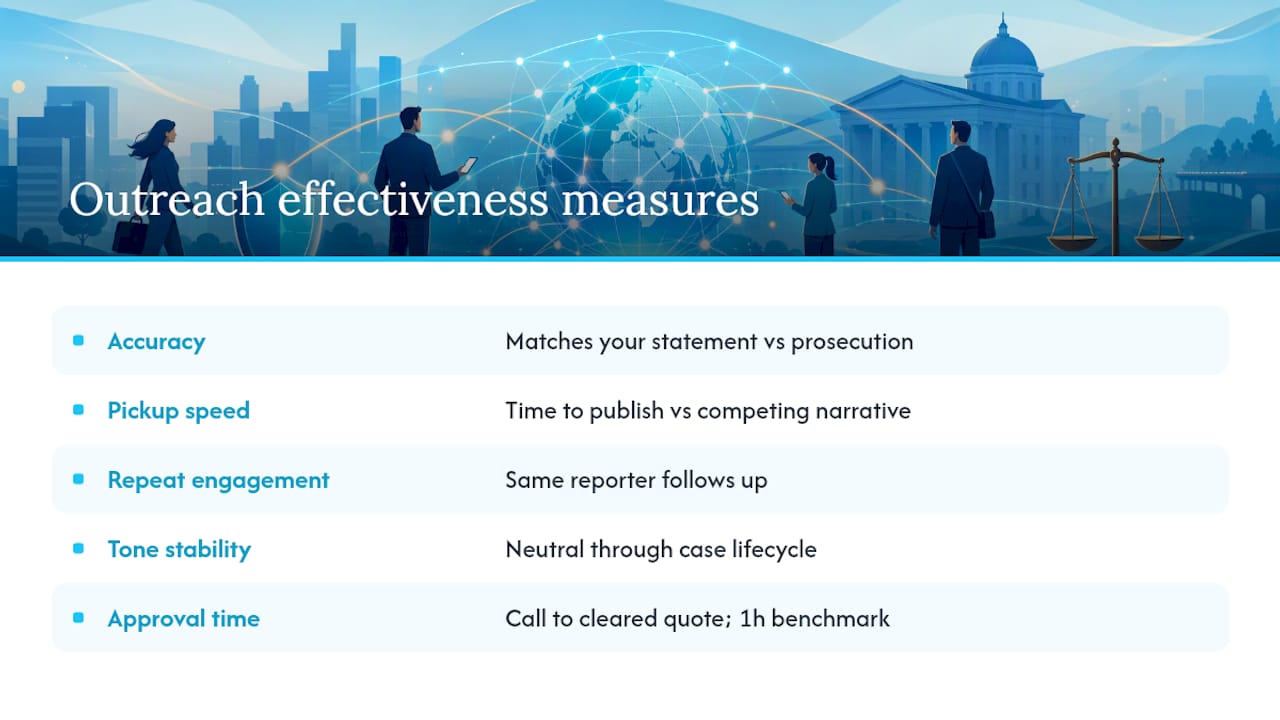
Watch which reporters follow up for more information versus those who ran one story and moved on. Repeat engagement from the same byline usually means you’ve become a trusted source on that beat, which is worth more long term than a single big hit. Also track tone shifts across a case’s lifecycle. A story that opens neutral and stays neutral through sentencing suggests your ongoing outreach is holding the frame you set on day one.
Finally, review your approval-speed metrics internally. How long did it take from a reporter’s call to a cleared quote going out? If that number creeps past an hour on a routine request, your fast-approval chain has a bottleneck worth fixing before the next case tests it.
Turning One Case Into a Career-Long Press Relationship
The attorneys who get called first when a big story breaks aren’t the ones who pitched hardest during their own case. They’re the ones who stayed useful after it ended.
Reporters remember sources who help without an agenda. Offering background context on a legal trend, unrelated to any case you’re working, costs you nothing and builds real trust. A five-minute call explaining how a new sentencing guideline works, with no request for coverage attached, is worth more over time than a dozen self-promotional pitches.
Stay visible between cases. Comment on relevant appellate decisions, offer perspective when a similar case makes news elsewhere, and respond quickly when a reporter reaches out for general expertise rather than a specific case. Reporters build mental shortlists of reliable sources by beat, and attorneys who show up consistently, not just when they need something, land on those lists.
Keep the relationship personal, not just transactional. A short note congratulating a reporter on a strong story, or checking in after they move to a new outlet, keeps you top of mind. When your next case breaks, that reporter already trusts your framing, and trust is what gets your quote in the first version of the story instead of the fifth.
The Part Most Defense Attorneys Get Backward
The conventional advice is to say as little as possible and let the case speak for itself in court. That instinct is understandable and often wrong. Courts don’t control the narrative that follows a client for years after a case closes; the first week of headlines does. Silence doesn’t protect a client from that; it just hands the pen to whoever else is willing to talk, usually the prosecution.
What the research actually supports is narrower and more useful than “talk more” or “talk less.” It’s talk fast, talk within Rule 3.6’s real boundaries rather than an imagined stricter version of them, and have the language ready before you need it. Most attorneys who avoid media entirely aren’t protecting their client from prejudice. They’re avoiding the discomfort of speaking on record, which is a different problem with a different fix.
Prioritize the holding statement and the fast-approval chain before anything else on this list. Everything downstream, pitching, relationship-building, crisis response, only works if that foundation is already in place.
— Ryan McCormick
When to Bring In a Litigation PR Team
Some cases can be handled with a solid internal checklist and a well-drafted holding statement. Others, the ones drawing national wire pickup, TV trucks outside the courthouse, or a client whose name is already trending, need more hands and faster turnaround than most firms can staff internally.
Goldman McCormick PR works specifically in that gap: rapid-response statement drafting, crisis PR for active litigation, media training so your team sounds prepared instead of rehearsed, and broadcast placement when the story calls for a TV or radio appearance rather than a print quote. Retaining a specialized team early, before the first reporter calls rather than after the fifth one, is usually what separates coverage a firm controls from coverage a firm is reacting to for weeks.
If your firm is facing a case that’s already drawing press attention, or you want a crisis communications plan in place before you need one, reach out to Goldman McCormick PR to talk through what rapid-response support would look like for your practice.
Sources
ABA Model Rule 3.6 is the baseline every defense attorney should reread periodically, since disciplinary interpretations shift and jurisdictional nuance matters. The NACDL Press Center offers ongoing resources for defense attorneys engaging with reporters and stays current on media issues specific to criminal defense. The AP Stylebook remains the standard reference for formatting statements and press materials the way reporters expect to receive them, and litigation-communications analysis from outlets like Everything-PR offers real-case context for how coordinated legal and media strategy plays out under pressure.
This article is general information, not a substitute for advice from a qualified lawyer. Consult a qualified legal professional about your own circumstances before acting on anything here.