
A Martindale-Hubbell rating is a peer-reviewed score built on five criteria (legal knowledge, analytical ability, judgment, communication, and experience), and it sits on a three-tier scale: AV Preeminent at the top, Distinguished in the middle, and Notable at the base. AV Preeminent goes to about 10% of rated attorneys. Client Review awards run on a completely separate track with their own thresholds.
TL;DR:
- About 10% of lawyers earn the AV Preeminent rating, which requires peer scores between 4.5 and 5.0 and a very high ethical standard.
- The rating process relies on confidential peer reviews from attorneys and judges, with at least 25 references recommended for better response rates.
- Client reviews are separate and measure client satisfaction, with thresholds for different levels of recognition starting from one review with no minimum score.
- Verifying a lawyer’s rating involves checking their tier, ethics status, and practice-area experience on Martindale-Hubbell’s platform before making an hiring decision.
- Using the rating for marketing or public relations is most effective when paired with media outreach, third-party verification, and example case results.
Table of Contents
- What the Martindale-Hubbell Rating Actually Measures
- AV Preeminent, Distinguished, and Notable: What Each Tier Signals
- How the Peer-Review Process Actually Works
- Client Reviews and Client Champion Awards Aren’t the Same Thing
- How to Check and Use a Martindale-Hubbell Rating When Hiring
- Why Peer Recognition Matters Beyond the Badge
- Turning a Peer Rating Into Media Coverage
- Sources
What the Martindale-Hubbell Rating Actually Measures
The rating splits into two distinct judgments: how good the lawyer is at the job, and how they behave while doing it. Reviewers, who are other practicing attorneys and judges, score five specific dimensions on a confidential survey. Their responses never get attributed by name, which is what makes the system harder to game than a public star rating.
The five criteria are:
- Legal knowledge — depth of understanding in the relevant practice area
- Analytical capabilities — how well the attorney reasons through complex fact patterns
- Judgment — the quality of strategic decisions made on a client’s behalf
- Communication ability — clarity with clients, opposing counsel, and the court
- Legal experience — years and breadth of relevant practice
An attorney also has to clear a “Very High” ethical standard before qualifying for the broader professional-ability tiers. A lawyer can score well on ability and still miss the top designations if peers flag concerns about integrity or professionalism. That ethics gate is why the credential carries weight with other lawyers, not just with clients Googling a name before a consultation.
AV Preeminent, Distinguished, and Notable: What Each Tier Signals
The three current tiers replace what used to be a jumble of letter grades, and each one maps to a different level of peer consensus.
- AV Preeminent marks the highest tier, reserved for attorneys with average peer scores between 4.5 and 5.0. It’s held by about 10% of rated attorneys, which makes it a genuinely selective mark rather than a participation credential.
- Distinguished covers attorneys who’ve built a strong professional record but haven’t yet accumulated the volume or score consistency AV requires. It still signals real standing among peers, just a notch below the top band.
- Notable recognizes attorneys who’ve cleared a solid ethical and professional bar, though the emphasis leans more toward good standing than exceptional ability scores.
If you’ve seen older references to A/BV/CV ratings, that’s the legacy system. Martindale-Hubbell retired those letter combinations in favor of the three-tier language above, though some archived bios and directories still use the old terms, so don’t assume they mean something different from what you’re reading now.
How the Peer-Review Process Actually Works
Getting rated isn’t automatic, and it isn’t instant. Here’s the practical sequence:
- Confirm eligibility. You need at least three years of bar admission and an active profile on martindale.com.
- Nominate your references. You submit a list of peers, typically other attorneys and, where jurisdiction allows, judges.
- Martindale supplements the pool. The platform adds randomly selected peers from your practice area and geography, which keeps the process from becoming a popularity contest among people you hand-picked.
- Reviewers respond confidentially. Nobody sees who said what, which is the entire point.
- A rating gets assigned once you clear the response threshold.
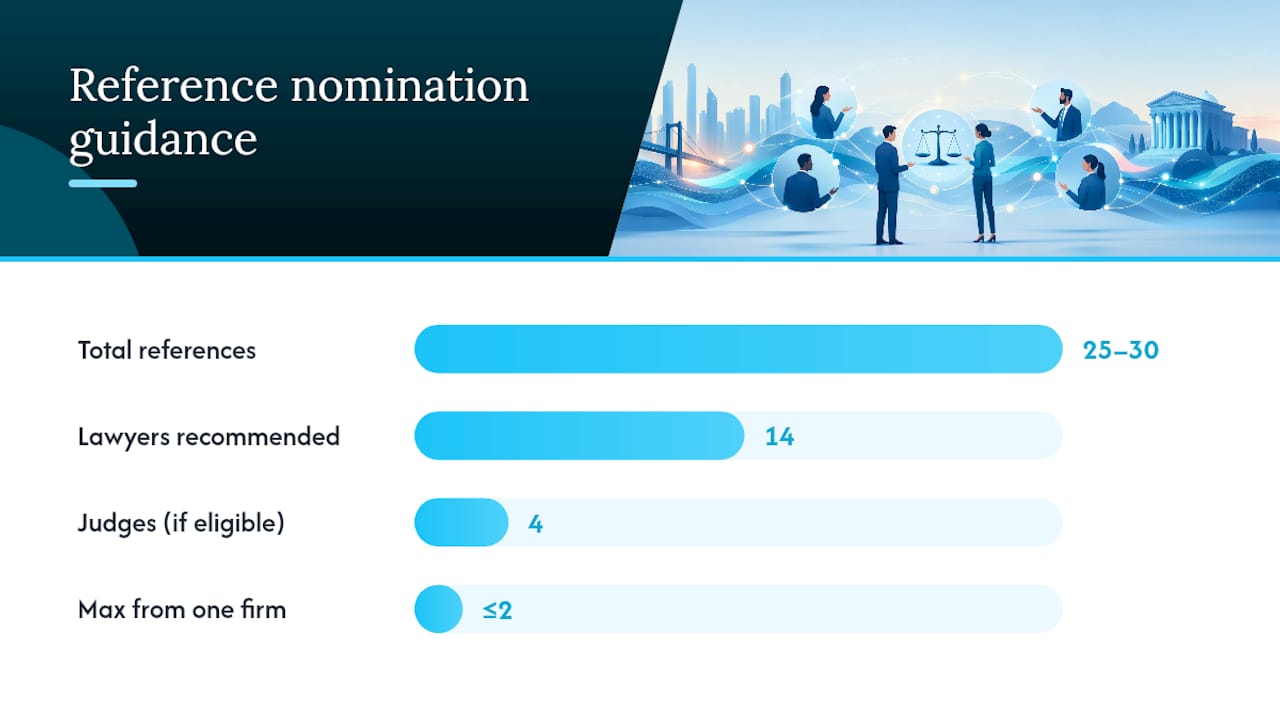
Practitioner guidance recommends listing 25 to 30 references rather than the bare minimum, since not everyone responds and some jurisdictions like New Jersey, Connecticut, Georgia, and South Carolina exclude judges from the process entirely. A workable split is 14 lawyers and 4 judges where judges are eligible, avoiding more than two people from any single firm so the sample doesn’t look stacked.
The whole cycle typically runs about six to eight weeks. Once you’re rated, you can display the badge on your website, in proposals, and in bios, provided you follow Martindale-Hubbell’s brand usage guidelines.
Pro Tip: Email or call every reference you nominate before the survey goes out. Peer-review invitations land in spam folders more often than you’d expect, and a two-minute heads-up call can be the difference between a completed rating and a stalled one.
Client Reviews and Client Champion Awards Aren’t the Same Thing
Peer ratings measure professional ability and ethics as judged by other lawyers. Client Review awards measure something else entirely: how satisfied actual clients were with the experience. The two systems run in parallel, and a lawyer can hold a strong peer rating with no client reviews at all, or vice versa.
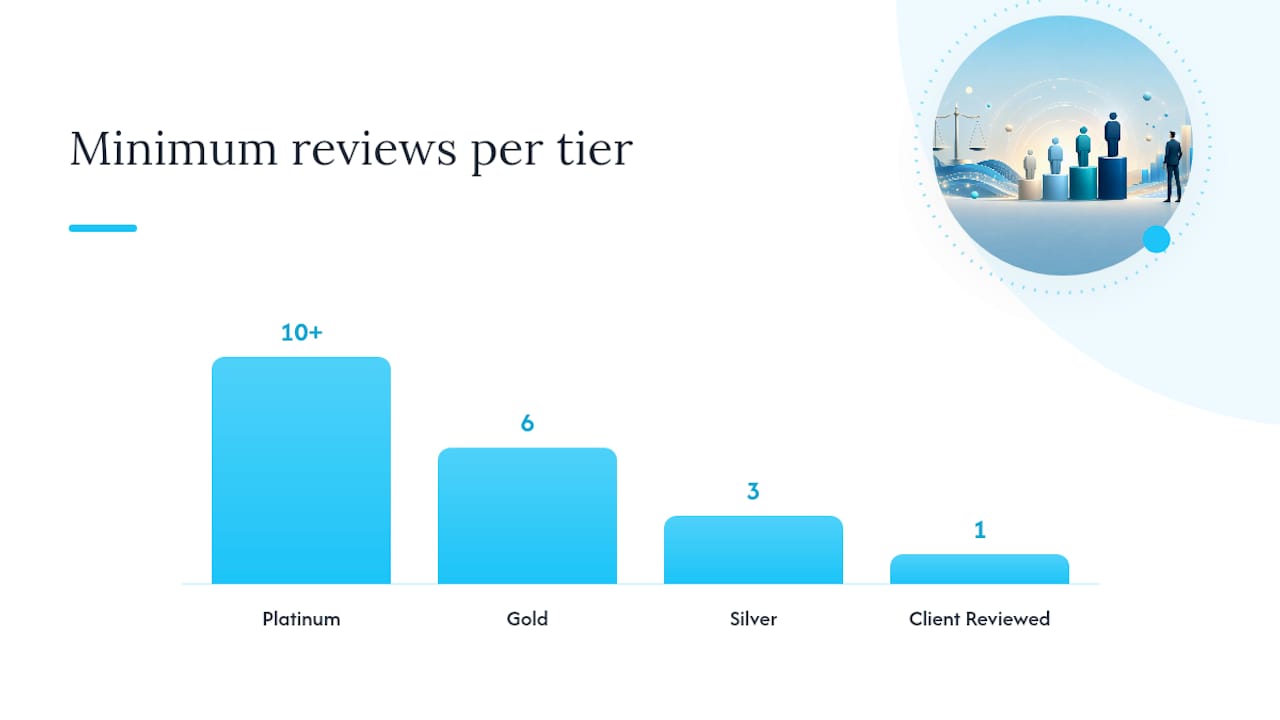
Client Champion thresholds, introduced in 2017, break down like this:
- Platinum — 10 or more reviews, average rating of 4.5 or higher
- Gold — 6 or more reviews, average rating of 4.2 or higher
- Silver — 3 or more reviews, average rating of 4.0 or higher
- Client Reviewed — at least 1 review, no minimum score tier
Collecting legitimate reviews means asking past clients directly after a matter closes, not soliciting them in bulk right before an award cycle. Reviews display on the attorney’s Martindale-Hubbell profile alongside the peer rating, giving prospective clients both signals in one place.
How to Check and Use a Martindale-Hubbell Rating When Hiring
Looking up a rating takes a few minutes if you know where to check and what to weigh against it.
- Search martindale.com or Lawyers.com directly by the attorney’s name or firm.
- Check the tier and the ethics status listed on the profile, not just the badge graphic.
- Read the client reviews if any exist, and note the review count next to the average score.
- Cross-reference practice-area experience against your specific legal issue. A high rating in real estate law doesn’t tell you much about a criminal defense matter.
- Book a consultation before deciding. A rating narrows the field; it doesn’t replace a conversation about your case.
Firms also lean on these ratings internally. Attorneys cite their tier in proposals and RFP responses, and marketing teams often build bios around the badge because it’s a third-party signal a firm can’t fabricate on its own. That said, peer credentials work best as one input among several rather than the deciding factor, a point covered in more depth in legal marketing guidance on reviews.
Why Peer Recognition Matters Beyond the Badge
A rating tells other lawyers something about you, but it doesn’t tell a reporter, a producer, or a potential referral source anything on its own unless someone puts it in front of them. That’s the gap most attorneys miss. An AV Preeminent designation is a credential a journalist can verify in thirty seconds, which makes it more useful in a media pitch than almost any other line on a bio.
The mistake is treating the badge as the finish line. Peer recognition earns credibility with other lawyers; media visibility earns it with the public. Pairing the two, a verified rating alongside a documented case result or client outcome, gives a reporter something concrete to run with instead of a vague claim of expertise. Use the badge exactly as Martindale-Hubbell’s guidelines allow, and build the rest of your public reputation around it rather than in place of it.
— Ryan McCormick
Turning a Peer Rating Into Media Coverage
A Martindale-Hubbell badge earns trust with other attorneys, but it takes deliberate outreach to earn trust with the public. Goldman McCormick PR works with attorneys, including a number of criminal defense lawyers in New York, to turn a peer credential into something a reporter can actually use: a pitch backed by third-party verification instead of self-promotion.

Our services cover media placement on TV, radio, and in newspapers, along with press release writing and distribution, awards and recognition management, and reputation management for attorneys who’ve already built the professional record but haven’t translated it into public visibility. An AV Preeminent rating paired with a well-placed op-ed or a local news segment does more for referral volume than either one alone. If you’ve got the rating and want the coverage to match it, start a conversation with Goldman McCormick PR about what a media strategy could look like for your practice.