
Attorneys build authority through media by earning consistent, credible coverage rather than chasing one-off headlines. The benchmark that separates lawyers who become go-to sources from those who stay invisible is roughly five visibility touchpoints per month, a mix of quotes, bylines, podcast appearances, and speaking slots. That cadence matters because reporters and AI search tools alike reward repetition from credible sources over sporadic mentions. Law notes that AI-driven discovery now leans heavily on authoritative earned placements to judge who counts as a real expert, and Business of Law Digest confirms that reach and outlet credibility matter more than the raw number of hits.
Three things happen when this cadence holds:
- Reporters start pitching you instead of the other way around.
- Search engines and AI assistants index your name alongside your practice area.
- Referral sources see your byline enough times to trust it.
Quick stat: earned placements in reputable outlets function as backlinks that strengthen both search ranking and AI discoverability, according to Law.com’s analysis of legal PR in an AI-driven environment.
Key Takeaways
Attorneys build measurable authority by combining roughly five monthly media touchpoints with outlet credibility, media-ready assets, and consistent measurement, not sheer volume of placements.
| Point | Details |
|---|---|
| Hit the cadence benchmark | Aim for about five visibility touchpoints monthly across quotes, bylines, podcasts, and speaking. |
| Reach beats volume | One high-credibility placement often outperforms several minor mentions in traffic and backlinks. |
| Prepare assets first | Have a bio, headshot, soundbites, and cleared case examples ready before pitching. |
| Track the right metrics | Monitor referral traffic, backlinks, inbound inquiries, and speaking invitations, not just mention counts. |
| Vet PR partners carefully | Goldman McCormick PR’s Forbes recognition and legal PR track record reflect the credibility standard to look for. |
Table of Contents
- How Attorneys Build Authority Through Media: The Tactical Playbook
- What Media-Ready Assets Do You Need Before Pitching?
- Should You Hire a PR Professional or Handle Media Yourself?
- How Do You Measure Whether Media Coverage Is Working?
- What Mistakes Undermine an Attorney’s Media Strategy?
- Why These Recommendations Hold Up
- How We Approach Attorney PR at Goldman McCormick PR
- What Goldman McCormick PR Does Differently for Attorneys
- Frequently Asked Questions
- Sources
How Attorneys Build Authority Through Media: The Tactical Playbook
Building a media presence isn’t about landing one big story. It’s about stacking smaller wins around a few larger ones until journalists, referral sources, and search algorithms all recognize your name in the same context repeatedly.
Core channels that work for attorneys:
- Reactive quotes. Responding quickly when a reporter needs comment on a breaking legal story.
- Op-eds and bylines. Longer pieces that let you frame an issue in your own words.
- Podcast guest spots. Lower barrier to entry than TV, and often more durable as searchable content.
- Speaking engagements. Bar association panels, CLE events, and industry conferences.
- Byline syndication. Getting a single piece picked up or referenced across multiple outlets.
- Social amplification. Sharing coverage on LinkedIn with added context, not just a link drop.
Hitting five touchpoints a month usually means combining one or two high-reach placements (a quote in a major outlet, a byline in a trade publication) with three or four supporting touchpoints (a podcast episode, a LinkedIn post breaking down a recent ruling, a local panel appearance). A single placement in a well-read outlet often outperforms several minor mentions combined, both in audience reach and backlink value, so don’t treat all five touchpoints as equal in weight.
The mechanics behind consistent outreach come down to monitoring and timing. Watching for breaking news in your practice area and pitching relevant analysis within hours, not days, is what separates attorneys who become a reporter’s go-to source from those who get ignored after one slow response. Reactive pitching handles the news cycle; proactive topical scaffolding, building a bank of commentary-ready positions on issues likely to resurface, fills the gaps.
Channel-specific details matter too. LinkedIn posts perform better with a point of view than a link and a headline. Podcast prep means having two or three tight stories ready, not a general willingness to “talk about the law.” Op-ed pitches need a genuine news hook, not just an opinion you’d like published.
Pro Tip: A quote in a niche trade publication that covers your exact practice area often builds more durable authority than a brief mention in a general-interest outlet with ten times the readership. Topical fit beats circulation numbers almost every time.
What Media-Ready Assets Do You Need Before Pitching?
Journalists move fast, and attorneys who lose placements usually lose them to slower response times, not weaker expertise. Having assets ready in advance closes that gap.
The essentials:
- A two-paragraph bio with credentials, not a full CV.
- A professional headshot sized for both print and digital use.
- A one-page firm summary with practice areas and notable results.
- A list of prior coverage, so reporters see you’ve done this before.
- Two or three quote-ready soundbites on current issues in your practice area.
Case studies need care. Strip identifying details, get client sign-off where confidentiality rules require it, and never reference an active case without checking for gag orders or bar association guidance on public commentary.
| Asset | Ready When |
|---|---|
| Bio and headshot | Updated recently |
| Case examples | Anonymized and confidentiality-cleared |
| Soundbites | Tied to a current news topic, not generic |
Should You Hire a PR Professional or Handle Media Yourself?
No reputable firm guarantees a fixed number of placements, and any pitch that promises otherwise is a red flag. What a good PR partner delivers instead is faster response times, existing relationships with the right reporters, and pitching skill that turns a routine case into a story editors want.
| Factor | DIY | PR Professional |
|---|---|---|
| Media contacts | Limited to existing network | Established relationships across outlets |
| Response speed | Often delayed by caseload | Built for same-day turnaround |
| Pitch quality | Varies with experience | Refined through repetition |
| Time cost | High, competes with billable hours | Handled externally |
Vetting questions worth asking any PR firm:
- What outlets have you placed clients in recently, and can you show it?
- How do you measure success beyond a placement count?
- Do you offer media training before interviews happen?
- What’s your process if a client faces a reputational crisis mid-campaign?
Pro Tip: Ask for a client reference in your specific practice area, not just a general portfolio. A firm that’s placed criminal defense attorneys in local news may not have the same contacts for white-collar or family law coverage.
Recognition signals worth checking include industry awards, a specific track record in legal PR, and named citations in trade press. Quick stat: firms that secure faster, higher-quality reach for clients typically outperform in-house efforts precisely because they bring outlet relationships attorneys can’t build overnight.
How Do You Measure Whether Media Coverage Is Working?
Track five numbers: earned mentions weighted by outlet reach, referral traffic from coverage links, backlinks from domain-authority sites, inbound inquiries you can trace to a specific placement, and speaking or podcast invitations that come in unprompted.

Set a rhythm around it. Monitor weekly, report monthly, and step back quarterly to ask whether the coverage is actually shifting business outcomes, not just generating clippings.
| Metric | Why It Matters |
|---|---|
| Referral traffic | Shows readers are acting on coverage, not just seeing it |
| Backlink quality | Signals authority to search engines and AI tools |
| Inbound inquiries | Ties PR directly to business development |
| Speaking invitations | Indicates organic recognition, not paid placement |
One placement in a widely read outlet can outperform ten smaller mentions on referral traffic and backlink strength alone. That reach also compounds: Velocitas points out that repeated visibility in trusted publications builds brand recognition and inbound inquiries over time, not just after a single hit. For firms tracking search performance alongside PR, pairing earned coverage with dedicated SEO work tends to compound both channels’ returns.
What Mistakes Undermine an Attorney’s Media Strategy?
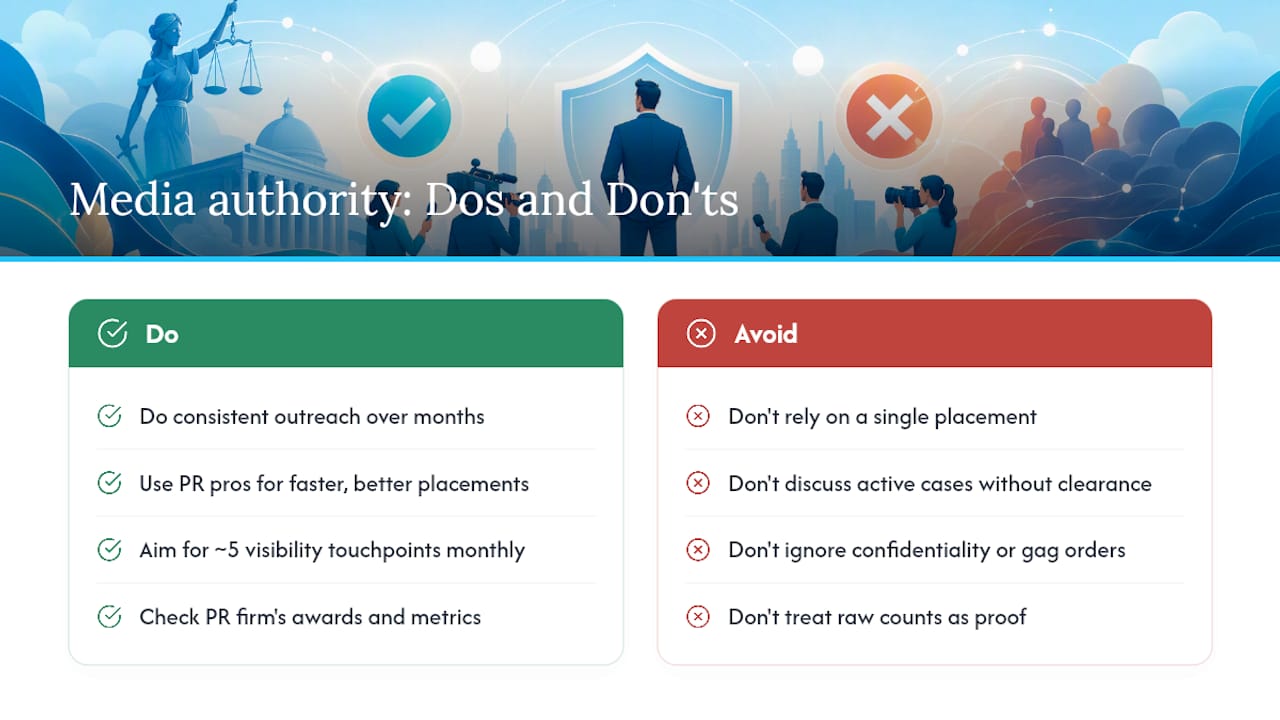
The most common failure is chasing volume. An attorney who accepts every interview request regardless of outlet fit ends up diluting their expertise instead of sharpening it.
- Poor pitching. Sending a promotional pitch with no actual news hook.
- Skipping media training. Walking into an on-camera interview unprepared and rambling past the point.
- Ethical missteps. Discussing confidential client details or violating a gag order for a quote.
- Red flags in a PR provider. Guaranteed placement counts, vague reporting, or case-handling practices that conflict with bar rules.
A single unprepared, on-record comment about an active case can undo months of carefully built credibility, and no placement count makes up for it.
Pro Tip: Before any interview involving a live case, run the talking points past co-counsel and confirm nothing violates a protective order. One sentence can trigger a bar complaint faster than any placement can build your reputation.
Why These Recommendations Hold Up
These tactics come from synthesizing legal PR practice with reporting from Law.com, Attorneys.media, and Business of Law Digest, not guesswork.
Goldman McCormick PR, founded in 2010 by former members of the media, was named by Forbes one of America’s Best PR Firms for 2021, earned a Bulldog Reporter Gold Award in 2016 for Best Cause/Advocacy Campaign, and was cited by the New York Observer in 2014 among the top five legal PR agencies.
Earned media is compounding infrastructure. Every credible placement becomes a signal that search engines and AI systems reuse to judge who actually knows the subject.
Quick stat: AI-driven discovery increasingly weighs authoritative earned coverage from reputable outlets when evaluating expertise.
Pro Tip: Data and trust signals belong in the first paragraph of anything you publish about your own expertise. Readers and AI systems both look for proof up front, not buried at the end.
How We Approach Attorney PR at Goldman McCormick PR
We treat earned media as a sustained campaign, not a press release fired off once and forgotten. Most attorney clients see a meaningful footprint develop over several months of consistent outreach, not overnight. That means steady pitching, prepared spokespeople, and a realistic view that quality placements compound faster than volume ever will.
What Goldman McCormick PR Does Differently for Attorneys
Most attorneys trying to build media authority hit the same wall: they don’t have existing reporter relationships, and building them from zero while running a caseload eats months you don’t have. Goldman McCormick PR closes that gap directly, we already have the media contacts, the pitching experience, and the crisis communications background to get you placed faster than cold outreach ever could.
Our services for attorneys include earned media placement across TV, radio, and print, media training to prepare you for on-camera moments, crisis communications when a case turns public, press kit development, and podcast or radio show production. Engagements run either as project-based campaigns or ongoing retainers, depending on whether you need a single push or sustained visibility.
If you’re ready to build a media presence that actually holds up, reach out to Goldman McCormick PR for an audit of your current visibility and a realistic plan for where it should go next.
Frequently Asked Questions
How long does it take for an attorney to build media authority?
Most attorneys see a meaningful footprint develop over several months of consistent outreach, not from a single placement or press release.
Do I need a PR firm, or can I pitch media myself?
You can pitch yourself, but a PR professional typically secures faster, higher-quality placements because of existing reporter relationships and pitching experience.
What’s a realistic number of media placements per month?
Aim for roughly five visibility touchpoints monthly, mixing one or two high-reach placements with several supporting appearances like podcasts or LinkedIn commentary.
Can I discuss active cases in media interviews?
Only within confidentiality rules, bar association guidance, and any applicable gag orders. When in doubt, anonymize details or skip the specifics entirely.
How do I know if a PR firm is legitimate?
Look for a documented track record, industry recognition such as Forbes or Bulldog Reporter awards, and a measurement approach that goes beyond a raw placement count.