
Editorial media coverage is earned, third-party reporting about a person, brand, or company that appears in news stories, features, reviews, or broadcast segments, written and controlled by journalists rather than paid for by the subject. Collins Dictionary confirms the roots of the term: “editorial” means material prepared for publication, and “coverage” means reporting on a topic. Put together, that’s the definition PR professionals work from every day. It matters because a meta-analysis of publicity versus advertising found that publicity typically produces stronger credibility effects than advertising, even though advertising still wins on message control. That trade-off is the entire reason PR exists as a discipline separate from ad buying.
For an attorney, a psychologist, or any professional whose business depends on trust, that credibility premium is not academic. A quote in a newspaper carries weight an ad never will, because the audience knows the reporter had no financial stake in saying it.
Editorial coverage shows up in a few recognizable forms:
- News stories that mention your work as part of a larger story
- Feature articles or profiles built around you or your company
- Product or service reviews written independently
- Broadcast segments on TV or radio
- Op-eds and guest columns you write but a publication accepts on merit
Key Takeaways
Editorial media coverage earns third-party credibility that advertising cannot buy, and pairing a newsworthy pitch with the right reporter relationship is what turns that credibility into consistent coverage.
| Point | Details |
|---|---|
| Definition matters | Editorial coverage is earned, third-party reporting, distinct from paid advertorials that must carry disclosure labels. |
| Credibility beats control | Publicity produces stronger credibility effects than advertising, though advertising keeps the edge on message control. |
| Newsworthiness comes first | Every pitch checklist starts with a real news hook the outlet’s own audience cares about. |
| Measure quality, not just volume | Track sentiment, backlinks, and audience fit alongside clip counts, and treat AVE figures with caution. |
| Work with a specialist | Goldman McCormick PR builds pitches, reporter relationships, and media training around the same earned-coverage principles covered here. |
Table of Contents
- What Is Editorial Media Coverage in Practice?
- How Is Editorial Coverage Different From Advertising?
- Why Does Editorial Coverage Matter for Brands?
- How Do PR Teams Earn Editorial Coverage?
- How Do You Measure Editorial Coverage?
- How Long Does Editorial Coverage Take, and What Does It Cost?
- What Are the Ethics Rules Around Editorial Coverage?
- What Evidence Backs Editorial Coverage Claims?
- A View From the Pitch Desk
- How Goldman McCormick PR Helps You Earn Editorial Coverage
- Frequently Asked Questions
- Sources
What Is Editorial Media Coverage in Practice?
Editorial coverage takes different shapes depending on the outlet and the news hook behind it, and each format carries its own editorial weight.

A news story mentions your company or client as part of a broader event, like a local news outlet quoting a criminal defense attorney about a high-profile case. A feature or profile goes deeper, writing a feature or profile that goes deeper into a person or business because the outlet decided the story stands on its own. A product or service review comes from a journalist or trade publication testing or evaluating something independently, which is why negative reviews are always possible and part of the deal. An op-ed or guest column lets an expert write in their own voice, but the publication still edits it and decides whether to run it. A broadcast segment on local or national TV or radio puts a spokesperson in front of an audience that ads can’t buy the same trust with. A podcast interview or trade publication feature reaches a narrower but often more engaged professional audience.
Owned and social channels don’t create editorial coverage, but they extend its life. When a firm shares its own newspaper mention on LinkedIn, or a radio segment gets clipped and posted to Instagram, the original placement keeps working long after the broadcast or print run ends. That’s one reason smart PR teams treat every placement as content twice: once for the initial audience, once for the recirculated version.
How Is Editorial Coverage Different From Advertising?
The distinction comes down to who controls the message and who pays for it. Advertising guarantees your words, your timing, and your placement, in exchange for a fee. Editorial coverage gives up that control in exchange for third-party credibility no ad can replicate.
An advertorial sits in the middle. It’s paid content designed to look like an article, and reputable outlets label it as sponsored, promoted, or paid content to keep the line visible to readers. PA Media’s explainer on editorial versus advertorial lays out the mechanics: editorial is written and approved by the newsroom with no payment involved, while advertorial content is paid for and disclosed as such, even when it mimics editorial style.
Here’s the practical difference in three lines: a journalist writes the editorial piece and can say no; the brand writes (or commissions) the advertorial and the outlet’s business side says yes because a check cleared; only the editorial piece carries the implicit “we vetted this” stamp readers trust.
Pro Tip: If a reporter asks you to pay for coverage or “guarantee” a placement fee, that’s advertorial, not editorial, no matter what the invoice calls it. Walk away or ask for the sponsored-content label.
Why Does Editorial Coverage Matter for Brands?
The meta-analytic research on publicity and advertising is worth sitting with: publicity outperforms advertising on credibility in most conditions the researchers tested, even as advertising kept its edge on message control. That’s not a marginal advantage in categories where trust decides the sale.
The core benefits stack up like this:
- Third-party validation that no amount of ad spend can buy
- SEO and backlink value that compounds, since earned media coverage tends to persist online and generate organic backlinks long after a paid campaign ends
- Longer shelf life than a paid placement, which disappears the moment the invoice runs out
- Stronger influence on purchase and hiring decisions in trust-sensitive categories
Legal services, healthcare, psychology practices, and B2B thought leadership are where editorial coverage does its heaviest lifting. Nobody hires a criminal defense attorney because of a banner ad; they hire one because a newspaper quoted the attorney as an authority on the exact charge they’re facing.
The trade-off is real: you can’t script what the reporter writes, and there’s no guarantee the story runs at all. Budget for that unpredictability rather than fighting it.
How Do PR Teams Earn Editorial Coverage?
Nothing on this list works if the pitch isn’t newsworthy to the publication’s actual readers. That’s the filter every other tactic sits behind.
The pitch checklist that gets read:
- Lead with a genuine news hook, not a company announcement dressed up as one
- Attach data, a credential, or a firsthand statistic that makes the reporter’s job easier
- Give it a local or timely angle tied to something already in the news
- Name the specific reporter and beat, never a generic newsroom inbox
- Spell out embargo terms clearly if you need one, and honor them
- Provide ready assets: high-resolution images, a pull quote, and a one-line bio
Outreach tactics that separate results from silence:
- Build relationships with reporters before you need something from them
- Send targeted pitches to two or three well-matched journalists instead of blasting two hundred
- Follow up once, politely, after three to five business days, then let it go
- Time pitches around real news cycles rather than your internal calendar
A workable pitch template runs like this: subject line states the news, not the brand name; two to three sentences give the hook, the proof point, and why it fits that outlet’s audience; a closing line offers a quote, data, or interview availability on short notice. Pitches that lead with the audience benefit and an easy angle for the reporter consistently get picked up more often than pitches that open with “We’re excited to announce.”
Do this: personalize every pitch to the specific reporter’s recent work. Don’t do this: copy-paste the same paragraph to fifty inboxes and hope one bites.
Pro Tip: In trade and specialist press, a consistent advertiser relationship can sometimes increase the odds an editorial team actually reads your pitch, though it never guarantees the story runs. Newsworthiness still has to carry the piece.
How Do You Measure Editorial Coverage?
Clips are the easy part. Knowing what they’re actually worth is where most teams get sloppy.
Track these metrics together, not in isolation: number and quality of clips, reach or impressions, audience sentiment, share of voice against competitors, referral traffic from the placement, backlinks generated, and any conversions you can credibly tie to the coverage window.
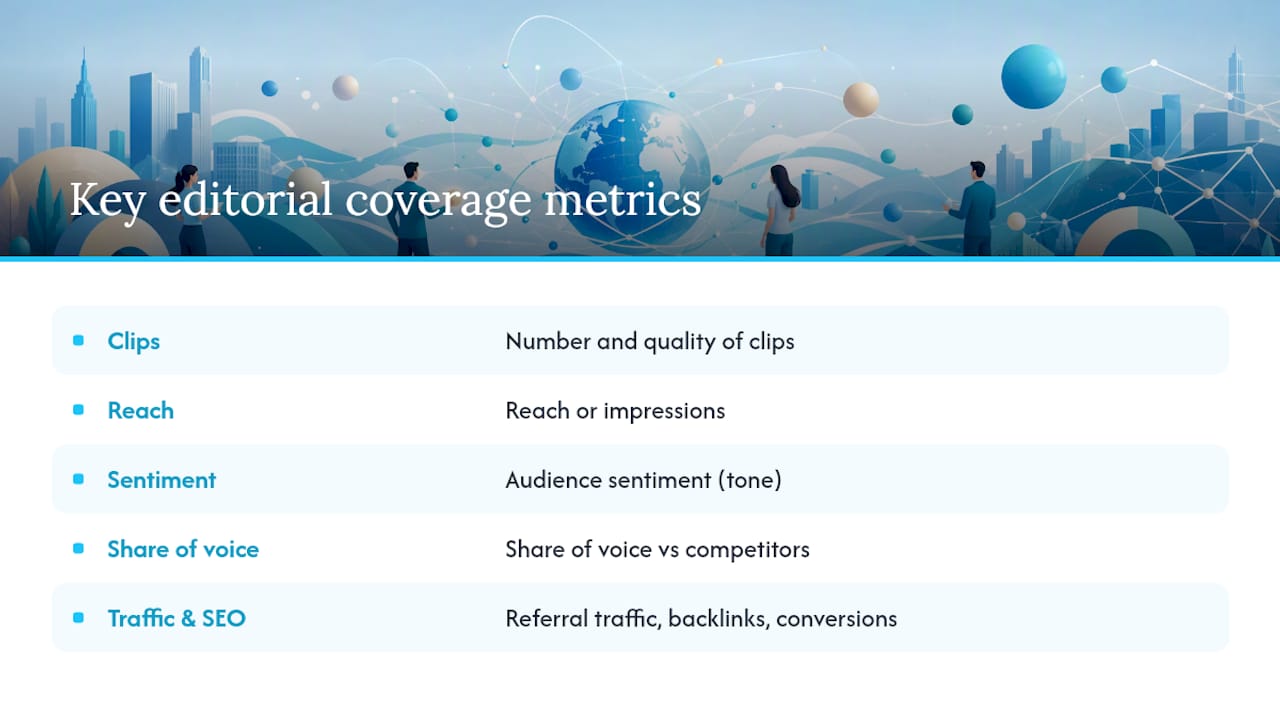
A monthly or quarterly report should contextualize reach numbers against placement quality, not just list totals. A single feature in a respected trade outlet often matters more than ten small mentions nobody in your buyer’s world reads.
Advertising value equivalency gets thrown around a lot, and it’s worth treating with skepticism. Placement quality, audience fit, and backlink presence matter more than AVE, which can wildly overstate or understate real impact depending on the formula used. Tools that track brand awareness through analytics can help connect coverage to actual traffic and search lift, which tells a more honest story than a dollar-value guess.
Pro Tip: Pair every coverage report with a note on sentiment, not just volume. Ten neutral mentions rarely beat two glowing ones.
How Long Does Editorial Coverage Take, and What Does It Cost?
A quick mention in a roundup or trend piece can happen in days if the timing and hook line up. A feature story or in-depth profile usually takes weeks to a few months, since reporters need time to interview, verify, and fit the piece into an editorial calendar. A full campaign, like a thought-leadership push around a book launch or a legal case, often takes several months from first pitch to sustained coverage.
Cost factors include in-house PR staff time, agency fees or retainer arrangements, research or data you might need to commission, content production for press materials, media training so your spokesperson doesn’t fumble a live interview, and travel for press events when relevant.
Realistic timeline scenarios:
- Product or service launch: four to eight weeks of lead time before the announcement date
- Thought-leadership positioning: three to six months to build reporter relationships and land a first major feature
- Crisis response: hours to days, which is exactly why crisis PR retainers exist before the crisis hits
Organic, low-cost outreach works fine for smaller regional stories. Sponsored content or advertorials make sense when you need guaranteed placement and timing for something like a product launch that can’t wait on a reporter’s calendar.
What Are the Ethics Rules Around Editorial Coverage?
Disclosure isn’t optional. Sponsored content gets labeled as sponsored, full stop, and a paid placement dressed up as independent editorial is the fastest way to torch trust with both the outlet and the audience.
A short ethics checklist:
- Disclose any payment, gift, or material relationship tied to a placement
- Never ghostwrite a byline without the named author’s real review and approval
- Correct factual errors quickly and openly once you spot them
- Keep editorial independence intact; don’t pressure a reporter for control over final copy
Breach these norms and the damage compounds. Once an outlet or an audience catches an undisclosed paid placement, every future pitch from that source gets read with suspicion.
What Evidence Backs Editorial Coverage Claims?
The credibility case for editorial coverage rests on more than intuition. The meta-analytic comparison of publicity and advertising found publicity’s credibility advantage holds across a range of conditions, with the caveat that combining earned coverage with paid advertising can outperform either alone in some campaigns.
Three practitioner sources shaped the guidance here: Collins Dictionary for terminology, PA Media for the editorial-versus-advertorial mechanics, and Prezly Academy for pitch practices that actually get read.
Goldman McCormick PR has built its practice around these same principles since 2010, working with attorneys, psychologists, and other professionals whose reputations depend on getting the credibility calculation right.
A View From the Pitch Desk
One pattern shows up again and again in this business: clients chase volume when they should chase fit. A single well-placed profile in an outlet a client’s actual peers and prospective clients read does more for a law practice than a dozen scattered mentions in outlets nobody in that world opens.
The pitch checklist in this guide isn’t theoretical. It reflects what actually gets a reporter to open an email instead of archiving it: a real hook, a specific ask, and proof the pitch was written for that reporter’s beat and not copied from a template. What doesn’t work, reliably, is treating every outlet the same way. A trade legal publication and a local TV assignment desk want different things, and pitching them identically wastes both shots.
How Goldman McCormick PR Helps You Earn Editorial Coverage
Getting the pitch checklist right on paper is one thing. Doing it week after week, with the reporter relationships and news judgment that come from being former members of the media, is what actually moves the needle for busy attorneys, psychologists, and other professionals who don’t have time to chase editors themselves.
Goldman McCormick PR was named one of “America’s Best PR Firms” by Forbes, earned a Gold Award in Bulldog Reporter’s CSR Awards, and was cited by the New York Observer as a top legal PR agency. That track record comes from doing exactly what this guide describes: building the pitch, finding the right reporter, and managing the relationship long after the first placement runs. Beyond media outreach, the firm handles press materials, media training, and crisis support so a client is ready the moment a reporter calls back. If you’re ready to see what earned coverage could look like for your practice, start a conversation with Goldman McCormick PR about your next campaign.
Frequently Asked Questions
What is editorial media coverage in simple terms?
It’s coverage a journalist or outlet chooses to publish about you or your company, without payment, because they decided it’s newsworthy for their audience.
Is editorial coverage the same as public relations?
No. PR is the practice and set of tactics used to earn editorial coverage, along with crisis management, media training, and reputation work.
How much editorial coverage costs depends on what?
Costs vary by in-house time, agency fees, content production, and media training rather than a fixed rate, since no reporter charges for a story.
Can you guarantee editorial coverage?
No legitimate agency can guarantee a story runs, since the outlet’s editorial team makes that call independently. Paid guarantees signal advertorial, not editorial.
Does editorial coverage help SEO?
Yes. Earned placements from reputable outlets often generate backlinks that compound organic visibility over time, unlike a paid ad that stops working the day the budget ends.
Sources
- The effectiveness of publicity versus advertising: A meta-analytic investigation of its moderators
- Collins Dictionary — editorial coverage
- Editorial vs Advertorial: What are the key differences? — PA Media
- Earned Media vs. Paid Advertising: Which One Builds a Better Business? – CSU Business Center
- What is an advertorial — Prezly Academy