
A favorable court decision is a time-sensitive media asset. Execute a pre-approved rapid PR playbook within a few days — press release, client alert, LinkedIn article, and reporter outreach, and you can convert that ruling into earned coverage before the news cycle moves on. According to Law, reporters who follow court decisions often receive the news at the same time you do and write quickly, which means pre-drafted materials are your only real speed advantage. Baker Tilly reports that litigation news loses news value quickly — after a short time, journalists are unlikely to cover it.
Your five immediate actions, in priority order:
- Read the opinion and flag quotable lines and any confidentiality restrictions
- Lock client quotes and written approval (email signoff, 24-hour window)
- Distribute the press release to legal press and industry reporters (same day)
- Publish the client alert and LinkedIn article (within 24 hours)
- Confirm spokesperson availability for broadcast and podcast interviews
Key Takeaways
Leverage a court win for publicity by executing a pre-approved 24–72 hour playbook — pre-drafted materials, fast client signoff, and targeted multi-channel outreach are what separate firms that get coverage from firms that miss the window.
| Point | Details |
|---|---|
| Pre-draft everything | Press release, client alert, and LinkedIn article should be 90% complete before the ruling publishes. |
| News goes stale fast | Litigation coverage loses news value within roughly two days, so same-day distribution is the target. |
| Tailor every pitch | Legal press wants precedent; trade press wants compliance impact; broadcast needs a 30-second soundbite. |
| Lock approvals in advance | A 24-hour email signoff window built into the engagement agreement prevents delays that kill same-day pickup. |
| Goldman McCormick PR | Provides rapid-engagement legal PR with multi-channel placement across TV, radio, print, and podcasts. |
Table of Contents
- What should you prepare before the decision drops?
- Step-by-step actions for the first 24–72 hours after the ruling
- Which outlets should you target, and how do you tailor each pitch?
- How do you prepare the spokesperson for interviews?
- How to amplify the ruling through owned channels
- Metrics to track and a 30/60/90 follow-up plan
- What ethical and legal guardrails apply when publicizing a court decision?
- Common pitfalls that undermine publicity after a court win
- Post-publicity client relations and business development after media coverage
- Why speed plus accuracy is the only combination that works
- Goldman McCormick PR converts your court win into coverage
- Sources
What should you prepare before the decision drops?
Speed on decision day comes entirely from work done before it. Firms that wait until the ruling publishes to start drafting lose the first critical hours to writing, approvals, and formatting — hours competitors with pre-built materials spend pitching.
Press release draft. Write a headline with two or three options (one emphasizing legal precedent, one emphasizing client outcome) and open with a single sentence that states the impact. Pre-approve a client quote in the engagement agreement so you are not chasing signatures at deadline.
Client alert template. Keep it plain-English: a one-paragraph summary of what the court decided, a short compliance checklist, and two or three recommended next steps for clients and stakeholders. The goal is something a non-lawyer can act on in ten minutes.
LinkedIn article draft. Save it as a timed-publish draft the moment you expect a ruling. Coordinate posting across the attorney’s personal profile and the firm’s company page so both go live simultaneously.
Confidential media list. Build it before the case closes: legal press, relevant trade and industry reporters, local TV and radio assignment desks, and podcast producers who cover your practice area. Keep it internal.
Media kit checklist:
- PDF of the opinion (redacted if needed)
- Case timeline and key documents
- Attorney and client bios
- Pre-approved quote sheet
- High-resolution headshots
| Material | Owner | Status at Decision Day |
|---|---|---|
| Press release draft | PR team | Final, pending quote insert |
| Client alert | Attorney | Drafted, pending ruling details |
| LinkedIn article | Attorney + PR | Saved as draft, ready to publish |
| Media list | PR team | Built and segmented by outlet type |
| Media kit | PR team | Assembled, pending opinion PDF |
Step-by-step actions for the first 24–72 hours after the ruling
Hour 0–2
- Read the full opinion. Annotate key holdings, quotable language, and any court-imposed restrictions (gag orders, sealed exhibits, confidential settlement terms).
- Brief the client immediately. Confirm the pre-approved quote still works or get a revised one in writing within the hour.
- Insert the opinion’s direct language into the press release and client alert. Cite the case name, docket number, and court.
Hours 2–8
- Distribute the press release to legal press contacts (same day). Include a short pitch note — two sentences maximum — explaining why this ruling matters beyond the parties.
- Send the client alert to your email list and post it on the firm website.
- Publish the LinkedIn article and coordinate employee sharing.
Hours 8–48
- Pitch trade and industry reporters with a tailored cover note that translates the ruling into business impact. Trade reporters rarely monitor court dockets, so the cover note does real work here.
- Respond to all reporter inquiries within two hours. Log every request.
- Confirm spokesperson availability for broadcast interviews and podcast appearances.
Hours 48–72
- Follow up with any reporters who opened the pitch but did not respond.
- Monitor coverage and flag any inaccurate or negative framing for immediate review.
- Send a clippings summary to the client.
Which outlets should you target, and how do you tailor each pitch?
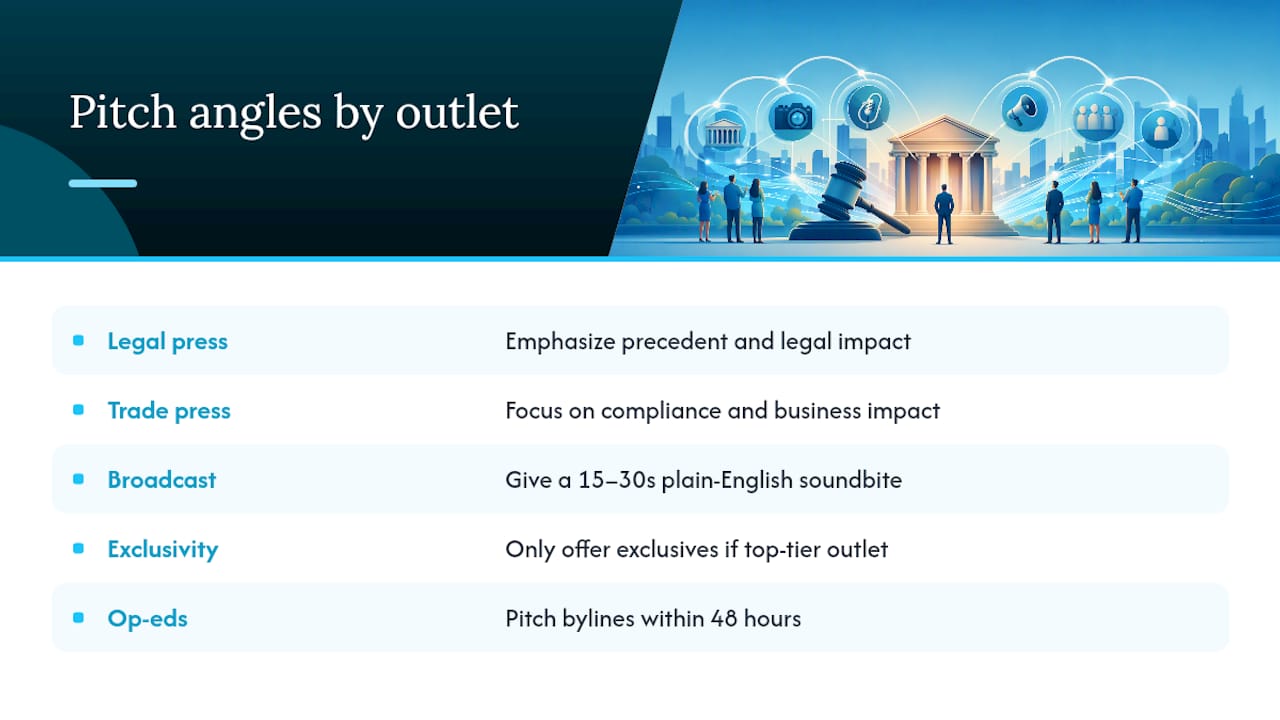
Not every outlet wants the same angle. Legal reporters care about precedent; trade reporters care about compliance and business impact; broadcast producers need a soundbite a general audience can follow in thirty seconds.
Legal press (Law.com, The National Law Journal, regional legal journals): lead with the jurisprudential significance. What does this ruling change? Does it create a circuit split, clarify a standard, or overturn prior precedent? These reporters already know the procedural context, so skip the background.
Trade and industry press (sector-specific publications, business journals): open with the business consequence. A ruling that changes how a company must handle data, price a product, or structure a contract is a compliance story first and a legal story second. Law.com advises including a clear cover note that explains the decision’s industry impact to reporters who do not monitor the courts.
Broadcast and podcasts: one-liner hooks and 15–30 second soundbites. Producers need something a host can read cold. Give them a single sentence that states the “so what” for a general audience, then offer the attorney as a guest who can explain it in plain English.
Embargo and exclusivity: offer an exclusive to one outlet only when the story is strong enough that a single placement in a top-tier outlet outweighs broad distribution. For most rulings, distribute broadly and simultaneously.
Op-eds: pitch a bylined piece to a relevant trade publication or regional business journal within 48 hours. The ruling gives you a news hook; the op-ed gives you a platform to establish thought leadership that outlasts the news cycle.
How do you prepare the spokesperson for interviews?
Media training is not optional when the subject is litigation. One careless comment about ongoing related matters or a privileged communication can create a problem larger than any coverage is worth.
Media training checklist:
- Practice bridging: “That’s an important question, and what I can tell you is…”
- Prepare three key messages and repeat them across every interview
- Decline hypotheticals about related cases or future litigation
- Never discuss confidential settlement terms, even indirectly
- Rehearse a 30-second “lead” answer and a 90-second plain-English explanation
Three key messages template:
- Legal import: What the court decided and why it matters as precedent
- Client impact: What this means for the client and similarly situated parties
- Practical next steps: What businesses or individuals should do now
Pro Tip: Record a mock interview the day before any scheduled broadcast appearance. Watch it back specifically for filler words, eye contact, and whether the 30-second lead answer actually lands in 30 seconds. Most attorneys run 90 seconds on what producers need in 30.
How to amplify the ruling through owned channels
Earned coverage gets you visibility for 24–72 hours. Owned content extends that window by weeks.
Priority owned pieces and cadence:
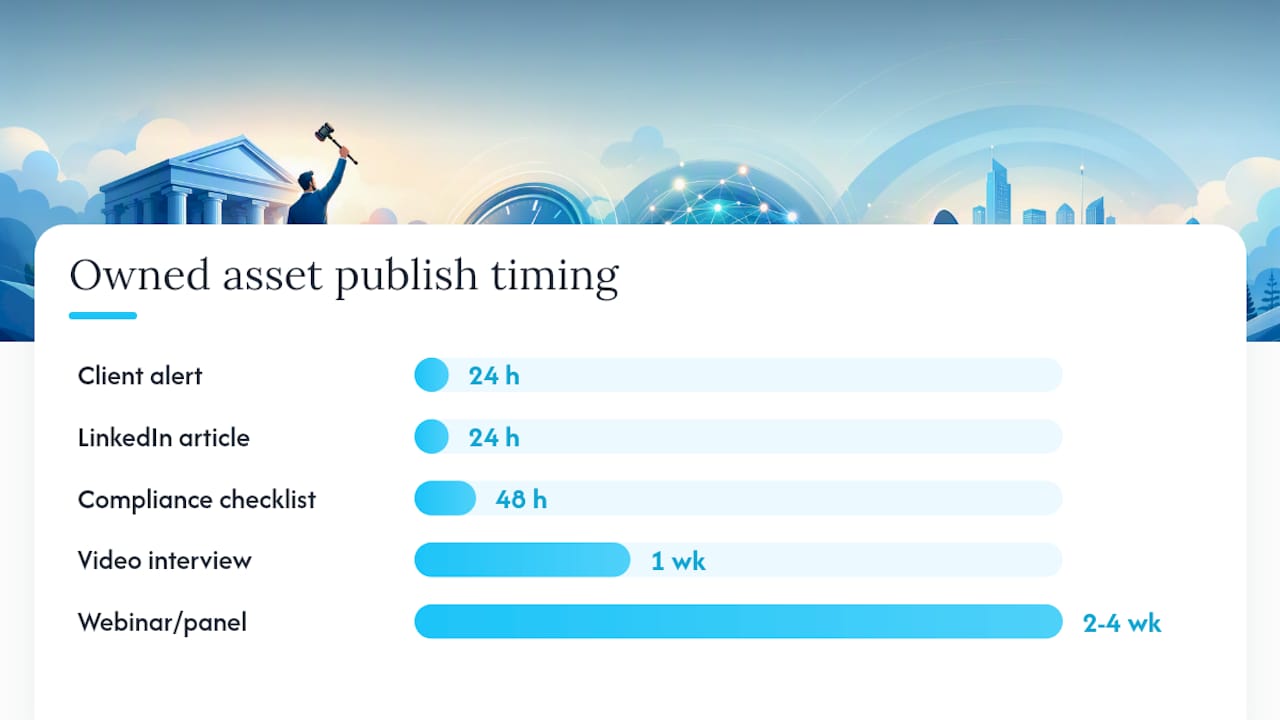
- Client alert on the firm website: publish within 24 hours
- LinkedIn longform article: publish within 24 hours, coordinate employee shares
- Downloadable compliance checklist: post as gated content within 48 hours
- Short video interview with the lead attorney: record within the first week
- Webinar or panel discussion: schedule within 2–4 weeks of the ruling
Repurpose earned coverage aggressively. Pull direct quotes from press placements onto the firm’s website. Cut broadcast segments into 60-second social clips. Package all coverage into a clippings PDF for the client and for business development use.
Building thought leadership with AI-assisted drafting can accelerate bylines and LinkedIn articles, but every draft needs attorney review before publication — accuracy and privilege considerations do not change because the first draft was fast.
| Owned Asset | Publish Window | Purpose |
|---|---|---|
| Client alert (website) | Within 24 hours | Client retention, SEO |
| LinkedIn article | Within 24 hours | Professional network reach |
| Compliance checklist | Within 48 hours | Lead generation (gated) |
| Video interview | Within 1 week | Social clips, website |
| Webinar/panel | Within 2–4 weeks | Thought leadership, leads |
Metrics to track and a 30/60/90 follow-up plan
Suggested metrics dashboard:
- Earned placements (count and outlet tier)
- Unique impressions across all placements
- Top-tier outlet hits (national legal press, major trade publications)
- Social engagement (LinkedIn shares, comments, profile views)
- Website referral traffic from coverage
- Inbound lead count attributed to the campaign
30/60/90 follow-up plan:
| Period | Action |
|---|---|
| 30 days | Amplify top placements; send clippings package to client; pitch deeper feature stories to outlets that covered the ruling |
| 60 days | Schedule webinar or panel; convert media interest into speaking engagement invitations |
| 90 days | Review inbound leads attributed to coverage; identify follow-on story angles (compliance updates, anniversary of the ruling) |
Track attribution by tagging press release landing pages with UTM parameters and logging inbound inquiries in your CRM with a campaign tag tied to the ruling. That data makes the business case for the next PR engagement.
What ethical and legal guardrails apply when publicizing a court decision?
Publicity after a court ruling carries real professional risk if the signoff process is skipped.
Ethical guardrail checklist:
- Confirm no court gag order or sealing order restricts public comment
- Preserve attorney-client privilege — do not disclose client communications, strategy, or confidential facts not already in the public record
- Avoid commenting on ongoing related litigation or appeals
- Do not disclose confidential settlement terms, even when the public outcome is favorable
- For matters involving minors or sealed records, consult bar counsel before any distribution
Recommended signoff workflow: attorney review → client written approval (email, 24-hour window) → PR distribution. Goldman McCormick PR builds compliance review into its rapid-rollout process so clearance does not become a bottleneck when the clock is running.
Common pitfalls that undermine publicity after a court win
The most common mistake is waiting. Attorneys who treat the ruling as the starting line for drafting lose the news window entirely. By the time a press release clears internal review three days later, the story is cold.
A close second: over-claiming. A favorable ruling in one jurisdiction is not a national precedent, and press materials that overstate the significance invite corrections from opposing counsel and skeptical reporters. Keep the language precise and sourced directly to the opinion.
Other pitfalls worth flagging:
- Sending a generic press release to every outlet on a purchased list, rather than a targeted pitch to reporters who cover the relevant area
- Failing to prepare the spokesperson, then watching an attorney go off-message in a live interview
- Ignoring negative coverage or inaccurate framing instead of responding quickly with a correction
- Skipping the client alert and going straight to media outreach, which leaves the client’s own stakeholders uninformed
Post-publicity client relations and business development after media coverage
Coverage is a relationship asset, not just a vanity metric. Send the client a curated clippings package with a brief note on reach and impressions — most clients have never seen their name in a national legal publication, and that moment builds loyalty.
Use the coverage in business development conversations. A clippings package in a pitch meeting demonstrates capability more concretely than any agency credential sheet. Attorneys who have been quoted in Law.com or featured on a legal podcast carry that credibility into every subsequent client conversation.
Schedule a debrief call with the client within two weeks of the coverage. Review what worked, what the coverage generated in terms of inbound interest, and whether a follow-on piece (a webinar, a bylined article, a speaking engagement) makes sense. That conversation often leads directly to the next engagement.
Why speed plus accuracy is the only combination that works
The attorneys who get the most out of a court win are not necessarily the ones with the biggest cases. They are the ones who treated the ruling like a product launch — with pre-built materials, a clear approval chain, and a PR team that was already briefed.
Speed without accuracy produces corrections and credibility damage. Accuracy without speed produces a well-written press release that nobody reads because the story is two weeks old.
Goldman McCormick PR has been named by Forbes as one of America’s Best PR Firms (2021), earned a Bulldog Reporter Gold Award for Best Cause/Advocacy Campaign (2016), and was cited by the New York Observer as one of the top five legal PR agencies in the country (2014). Those credentials exist because the firm has run this playbook under real deadline pressure, across TV, radio, newspapers, and podcasts, for attorneys who could not afford to let a win go unnoticed.
When the clock is running, retain a legal-specialist PR team to maximize placement and protect client interests.
Goldman McCormick PR converts your court win into coverage
Goldman McCormick PR offers attorneys a rapid-engagement option built specifically for the 24–72 hour post-ruling window. Services include press release drafting and distribution, targeted media outreach to legal and trade press, media training, multi-channel placement across TV, radio, newspapers, and podcasts, and clippings packages for client reporting and business development.
Named by Forbes as one of America’s Best PR Firms (2021) and recognized by the New York Observer as a top legal PR specialty firm (2014), Goldman McCormick PR brings established media relationships and a proven clearance process to every engagement. Project-based fees and ongoing retainers are both available — the right structure depends on case complexity and the breadth of the media campaign you want to run. Budget conversations start with scope: a single press release and targeted outreach is a different engagement than a multi-channel campaign with broadcast placements and a webinar.
To discuss a rapid-engagement rollout for an upcoming or recent ruling, contact Goldman McCormick PR directly. The sooner the conversation starts, the more of the news window you keep.