
The fastest path to getting featured in New York news is a short, news-hooked pitch sent directly to the right beat reporter’s inbox, or a response to an active New York Times reader questionnaire when one aligns with your story. The New York Times itself spells out exactly what makes a tip worth pursuing: documentation or evidence, specificity, and clear real-world consequences. Those three criteria are not suggestions. They are the filter every pitch gets run through before an editor gives it a second look. Within the first 24 hours, you can identify the correct reporter, draft a two-sentence hook, and submit through the right channel. The rest of this guide shows you exactly how.
Your first 24–72 hours:
- Search the outlet’s masthead or author pages for the reporter who covers your beat
- Draft a one-to-two sentence hook that answers: what happened, why it matters now, and who is affected
- Attach or link one piece of verifiable evidence (a document, data set, or court record)
- Submit through the correct channel: reporter email, department inbox, tip form, or reader questionnaire
- Set a calendar reminder to follow up once, politely, seven to ten days later
Key Takeaways
Getting featured in NY news comes down to one discipline: sending the right pitch to the right person at the right moment, with evidence that makes the story impossible to ignore.
| Point | Details |
|---|---|
| Lead with evidence | Every pitch needs documentation, a named source, or verifiable data before an editor will act on it. |
| Match pitch type to story | News tips go to reporters; features go to section editors; op-eds go through opinion submission routes. |
| Follow up once only | One polite follow-up email, seven to ten days after the original pitch, is the professional standard. |
| Build reporter relationships | Consistent, accurate tips over time matter more than any single pitch for sustained NY coverage. |
| Goldman McCormick PR | For sustained campaigns, legal PR, or broadcast placements, Goldman McCormick PR handles outreach end-to-end. |
Table of Contents
- What should you do right now to improve your chances of coverage?
- How New York newsrooms are organized and what that means for your pitch
- How do you find the right reporter or editor to contact?
- How to craft a pitch editors will actually open
- Where to submit your pitch: the right route for each story type
- What happens after you pitch: timelines, pay, and follow-up
- Editor-tested dos and don’ts for pitching New York outlets
- When should you hire a PR firm instead of pitching yourself?
- What pitching top outlets has actually taught me
- Goldman McCormick PR helps you get the coverage you’ve earned
- Sources
What should you do right now to improve your chances of coverage?
Before you read another word, run through this checklist. Reporters and editors make fast decisions. A pitch that arrives incomplete gets passed over even when the underlying story is strong.
- Identify the beat reporter. Search the outlet by topic keyword, then click through to the reporter’s author page. Confirm they are still covering that beat by checking their three most recent articles.
- Write your hook first. One to two sentences: what the story is, why it matters right now, and who is affected. If you cannot write it in two sentences, the pitch is not ready.
- Attach evidence. A document, a data set, a court filing, a photograph. The NYT tips page is explicit: documentation is what separates a tip from a rumor.
- Use the correct inbox. A pitch sent to the wrong desk is effectively deleted. Confirm the submission route before you hit send.
- Follow up once. One polite follow-up email, seven to ten days after the original pitch. Nothing more.
Pro Tip: Send your pitch on a Tuesday or Wednesday morning. Early-week mornings align with editorial planning sessions at most major outlets, giving your email a better chance of landing when editors are actively looking for stories to assign.
If your tip involves sensitive information or a source who needs protection, the Times offers multiple submission methods with varying levels of anonymity. Review those options on the tips page before you send anything that could identify a vulnerable source.

How New York newsrooms are organized and what that means for your pitch
Most people pitch the wrong person because they do not understand how a newsroom divides its work. The New York Times, for example, is not one monolithic entity that accepts “stories.” It is a collection of desks, each with its own editors, reporters, and assignment logic.
The three story types you need to know:
- News: Breaking or time-sensitive coverage. Staff reporters almost always write this. Outside contributors rarely break into this lane unless they are primary sources or witnesses.
- Features: Reported, longer-form pieces that run in sections like Science, Health, Business, or Style. This is where outside contributors and freelancers have the most realistic entry point.
- Opinion: Essays, op-eds, and letters to the editor. These are submitted through a separate route entirely and are evaluated on argument quality and timeliness, not reporting credentials.
The NYT’s “Behind the Journalism” explainers describe how reader contributions feed reporting, particularly in features and investigative work. Reader questionnaires are a direct product of this: the Times publishes them when editors are actively building a story and need sources with lived experience. Responding to one is not a long shot. It is an invitation.
A 2026 panel with NYT editors reinforced this point: understanding which story types use freelancers versus staff reporters is one of the most important things a prospective contributor can do before pitching. Features and reader-sourced pieces are the realistic targets. Breaking news is not.
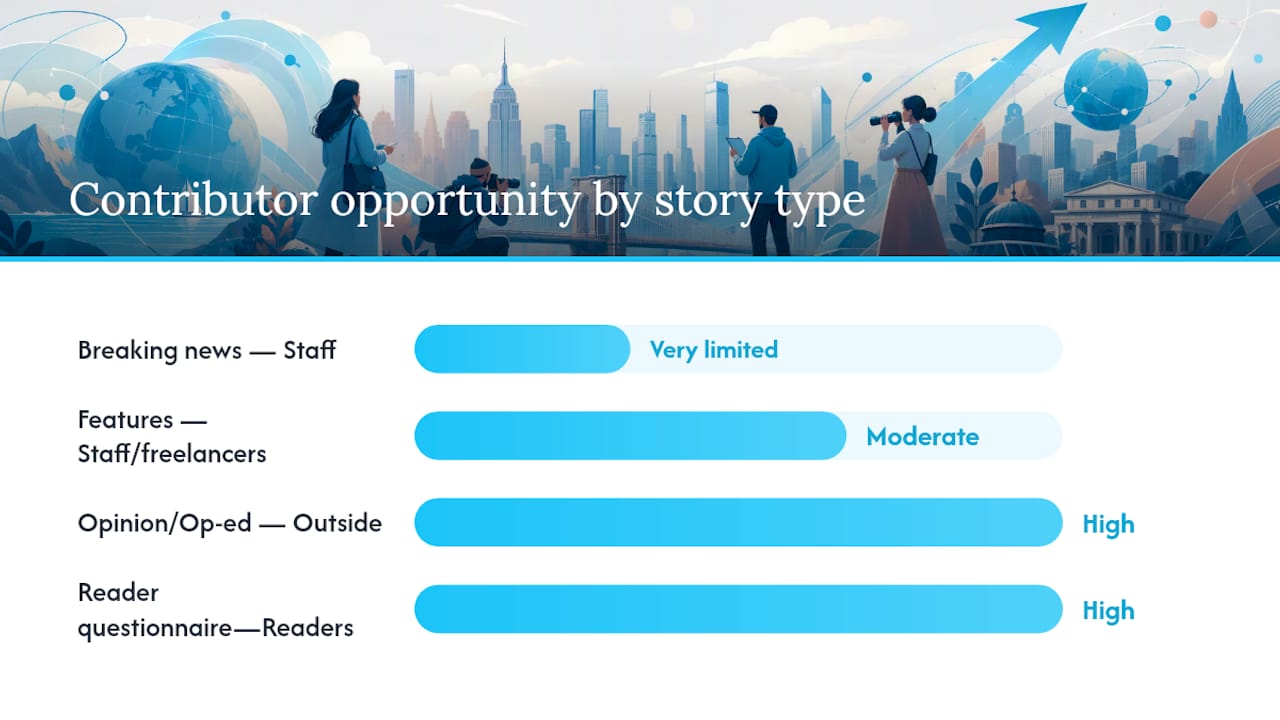
| Story type | Who typically writes it | Outside contributor opportunity |
|---|---|---|
| Breaking news | Staff reporters | Very limited; mainly as a primary source |
| Features | Staff or freelancers | Moderate; pitch with a clear angle and sources |
| Opinion/Op-ed | Outside contributors | High; evaluated on argument and timeliness |
| Reader questionnaire | Readers as sources | High; respond directly when one matches your story |
How do you find the right reporter or editor to contact?
Sending a pitch to a generic newsroom address is the equivalent of mailing a letter to “someone at the company.” It may eventually reach the right person. More likely, it disappears.
Here is a repeatable process for finding the exact contact you need:
- Search the outlet by topic. Type your subject into the outlet’s own search bar and filter by “past 30 days.” The reporters whose bylines appear most often on that topic own that beat.
- Read the author bio. Most major outlets link reporter bios from their bylines. The bio usually names the beat explicitly and sometimes lists a contact email or Twitter/X handle.
- Check the masthead. The NYT masthead lists section editors by name. If you cannot find a reporter, the section editor is your next best contact.
- Verify through social profiles. Twitter/X and LinkedIn bios often confirm current beats and sometimes include direct contact preferences. A reporter who says “DMs open for tips” means it.
- Use JournalistDB to verify contact information and confirm the reporter’s recent coverage before reaching out. Reading two or three of their recent pieces is not optional. It is the minimum.
When you email a reporter directly, open with a one-line reference to their recent work. Not flattery. A specific reference: “Your piece last month on the city’s housing voucher backlog is directly relevant to what I’m seeing in the Bronx.” That line tells the reporter you actually read their work, and it frames your tip as a continuation of a story they already care about.
Department inboxes are appropriate when you cannot identify a specific reporter, when the story crosses multiple beats, or when the outlet’s submission guidelines direct you there. Tip forms are best for sensitive information where source protection matters.
How to craft a pitch editors will actually open
Brevity is not a courtesy. It is a requirement. A pitch over 200 words signals that the sender has not done the work of identifying what actually matters about their story. Nieman Lab’s compilation of editor feedback makes this plain: many weak pitches are salvageable simply by tightening the news hook and sharpening the focus.
Subject line formulas that work:
- [Topic] + [Timely Hook]: “NYC landlords exploiting a loophole in the new rent law — I have documents”
- [Who] + [What happened]: “Brooklyn surgeon suspended after unreported malpractice settlements”
- [Data/Evidence first]: “Three years of NYPD data showing a pattern no one has reported”
Avoid subject lines that read like press releases (“XYZ Company Announces Exciting New Partnership”) or that bury the news (“Regarding a potential story idea you might find interesting”).
Three sample pitches:
News tip: “I have documentation showing that a city contractor overbilled the Department of Education by roughly $2 million over three years. I have invoices, internal emails, and a former employee willing to speak on record. This affects 14 schools in Queens. Available to share documents immediately.”
Feature pitch: “I’m proposing a reported piece on the growing number of New York attorneys using AI-generated briefs without disclosure — and the judges who are starting to catch them. I have three sources (two attorneys, one federal clerk) and access to court records. The story fits your Legal/Courts coverage and has not been reported in depth anywhere.”
Op-ed pitch: “I want to argue that New York’s new mental health diversion courts are producing worse outcomes than the data suggests, and that the city is measuring the wrong metrics. I’m a licensed psychologist with 15 years of court-referral experience. The piece would run approximately 900 words and is exclusive to the Times.”
Each pitch names sources, offers evidence, states the “why now,” and fits under 150 words. That is the template. Offering exclusivity, as the Ampifire guide on NYT press releases notes, can meaningfully improve your odds when the story has broad relevance and you are prepared to hold it for one outlet.
Where to submit your pitch: the right route for each story type
The submission route matters as much as the pitch itself. Using the wrong channel is one of the most common and most avoidable mistakes.
- Reporter email: Best for feature pitches and op-eds where you have identified the right person. Keep it short. Attach nothing in the first email unless the outlet’s guidelines say otherwise.
- Department inbox: Use when the story crosses beats or when you cannot identify a specific reporter. The NYT lists section contacts on its masthead.
- NYT tip form: Best for investigative tips, sensitive information, or when you want to submit anonymously. The Times offers multiple protection levels, including SecureDrop for high-risk submissions.
- Reader questionnaires: Watch the NYT homepage and section pages for active questionnaires. These are published when editors are actively building a story and need sources. Responding is a direct line into a reported piece.
- Opinion/Letters: The NYT Opinion section has its own submission route. Op-eds should be sent to [email protected] with a brief cover note. Letters to the editor go to [email protected]. Both have strict length guidelines.
Pro Tip: For time-sensitive tips, the tip form is faster than email. For feature pitches, a direct reporter email with a specific subject line will almost always outperform a generic inbox submission.
If you are submitting sensitive information about a powerful institution or individual, review the Times’s protection options before you send. The difference between a standard email and a SecureDrop submission is not trivial when a source’s safety is involved.
What happens after you pitch: timelines, pay, and follow-up
Most pitches do not receive a response within 48 hours. That is normal, not a rejection. Editorial inboxes at major outlets receive hundreds of pitches weekly, and response times vary with news volume, staffing, and whether the pitch landed during a busy news cycle.
What to expect:
- No response in 7–10 days: Send one polite follow-up. If there is still no response after another week, consider the pitch passed and move on.
- A reply asking for more information: This is a good sign. Respond quickly and completely.
- An assignment: Congratulations. Clarify the deadline, word count, kill fee policy, and payment terms before you start writing.
- A pass: Ask (briefly) if there is a better fit elsewhere in the outlet, then pitch the story to your next target.
Poynter’s pitching guidance notes that response times vary with volume and that sending well-targeted pitches to the right editor or desk is the single biggest factor in getting a reply. Spray-and-pray pitching to multiple desks simultaneously does not accelerate the process. It damages your credibility.
On pay: freelance rates at major outlets vary widely. Early assignments for new contributors tend to be shorter pieces. The Society of Professional Journalists notes that small early assignments often lead to larger work as the relationship develops. Do not pitch with a rate negotiation in the first email.
Follow-up template:
Subject: Following up — [your original subject line]
Hi [Name], I wanted to follow up on the pitch I sent on 2026 regarding [one-line summary]. Happy to provide additional documentation or sources if helpful. Let me know if this fits your current coverage plans.
That is it. Two to three sentences. No pressure, no guilt, no “I just wanted to make sure you saw this.”
Editor-tested dos and don’ts for pitching New York outlets
The behaviors that get pitches opened are not secrets. Editors have been saying the same things for years. The behaviors that get pitches ignored are equally consistent.
Do:
- Research the beat before you pitch. Read the reporter’s last five articles.
- Lead with news value. The first sentence of your pitch should be the reason an editor would assign the story today, not background.
- Attach verifiable evidence or name your sources. Vague tips without documentation rarely move forward.
- Keep it under 200 words. Every word over that threshold reduces your odds.
- Offer exclusivity when you can. It signals confidence in the story.
Don’t:
- Send a mass BCC pitch to 30 reporters simultaneously. Editors talk. Getting caught doing this will close doors.
- Use promotional language. “Groundbreaking,” “unprecedented,” and “you won’t believe” are signals that the story is not strong enough to speak for itself.
- Call the newsroom to follow up on an email pitch. This is universally cited as a credibility-killer.
- Ignore the outlet’s stated submission preferences. If the guidelines say “no attachments in the first email,” send no attachments.
- Pitch a story that ran last week somewhere else without disclosing it.
The Nieman Lab editor roundup is direct: a pitch that demonstrates the sender read the outlet carefully is far more likely to get a response than a generic pitch with a strong story. Familiarity with the outlet’s framing is not a bonus. It is table stakes.
Self-audit your pitch before sending:
- Does the subject line tell the story in under ten words?
- Is the news hook in the first sentence?
- Have you named at least one source or piece of evidence?
- Is the pitch under 200 words?
- Did you confirm this reporter covers this beat?
If any answer is no, revise before sending.
When should you hire a PR firm instead of pitching yourself?
DIY pitching works for a single, well-documented story with a clear news hook. It gets harder fast when the stakes rise, the story is complex, or you need sustained coverage rather than a one-time placement.
Hire a PR firm when:
- You need coverage across multiple outlets simultaneously, not just one placement
- The story involves legal or reputational risk and requires careful message management
- You lack existing relationships with reporters who cover your beat
- You need media training before going on record with a major outlet
- You are managing a crisis and cannot afford a misstep in how the story is framed
- You want TV or radio bookings alongside print coverage
What a firm like Goldman McCormick PR typically delivers:
- Targeted media outreach to reporters and editors with existing relationships
- Press release writing and distribution timed to maximize pickup
- Media training so you perform well in interviews, not just in print
- Exclusivity negotiation with major outlets when the story warrants it
- Op-ed and editorial writing for placement in opinion sections
- TV and radio booking alongside print placements
Pro Tip: When vetting a PR firm, ask for specific placement examples in outlets relevant to your industry, not just a general client list. A firm that has placed clients in The New York Times, not just regional papers, operates at a different level of media access.
Red flags when hiring: firms that guarantee placements (no ethical firm can promise a specific story will run), agencies that pitch you with a generic deck rather than a story-specific strategy, and any firm that cannot name the specific reporters they have relationships with in your space.
What pitching top outlets has actually taught me
The single biggest misconception professionals bring to media outreach is that a strong story sells itself. It does not. A strong story, poorly framed for the wrong reporter at the wrong moment, gets deleted. The same story, sent to the right person with a two-sentence hook that connects to something they published three weeks ago, gets a reply within 48 hours.
The second lesson: editors at major outlets are not looking for reasons to say yes. They are looking for reasons to say no quickly, because their inbox demands it. A pitch that makes them work to understand the news value is a pitch that gets passed. The hook has to be in the first sentence. Not the second. Not after the background paragraph.
The third, and most counterintuitive: relationships built over time matter more than any single pitch. A reporter who knows your name, knows you send accurate tips, and knows you will not waste their time is a reporter who will read your next pitch before they read the one from a stranger. That relationship is built by being right, being brief, and being reliable. Not by following up three times a week.
Goldman McCormick PR helps you get the coverage you’ve earned
Getting press in NY at the level of The New York Times or major broadcast outlets is not just about having a good story. It is about knowing who to call, how to frame the pitch, and when to push for exclusivity versus broad distribution. Goldman McCormick PR, named by Forbes Magazine as one of America’s Best PR Firms for 2021, has been placing clients in newspapers, on television, and on radio since 2010. The firm earned a Gold Award in Bulldog Reporter’s CSR Awards in 2016 and was cited by the New York Observer as one of the top five legal PR agencies in 2014.
If you are an attorney, psychologist, executive, or expert who needs more than a one-time placement, Goldman McCormick PR handles the full campaign: media outreach, press release writing, media training, op-ed placement, and TV and radio bookings. The firm’s team includes active and former media professionals who know how New York newsrooms actually work. Contact Goldman McCormick PR to discuss what a targeted media campaign looks like for your specific situation.
Sources
These primary resources will help you research reporters, verify submission routes, and understand what each major outlet actually wants.