
Earned media and structured PR outreach are among the most reliable ways to build psychology referral networks, and the evidence backs that up fast. APA guidance ranks in-person contact as the most effective outreach method for establishing rapport, followed by phone, formal letter, and email. Referrals commonly generate 30–50% of new clients for established practices, and referred leads convert at roughly 2–3x the rate of directory inquiries. PR accelerates this by raising your credibility before you ever make contact, so referral sources already recognize your name when you call. Three actions to take right now:
- Map 10 target referral sources by role and geography before any outreach begins.
- Run a manual-first outreach sequence: in-person or phone first, then a personalized follow-up anchored to a press clip or earned-media story.
- Start a referral tracker and set 90-day KPIs: contacts engaged, referrals received, and conversion rate.
Table of Contents
- How does PR uniquely strengthen clinical referral networks?
- What outreach sequence gets the best referral results?
- How do you map and prioritize your referral infrastructure?
- What should you say when you first engage a referral source?
- How do you measure PR-driven referral growth?
- What legal and ethical rules apply to PR for clinicians?
- What does a 90-day PR and referral action plan look like?
- How Goldman McCormick PR implements this for psychology clients
- Key Takeaways
- Why PR should be treated as professional infrastructure, not branding
- Goldman McCormick PR can shorten your path to consistent referrals
How does PR uniquely strengthen clinical referral networks?
Most clinicians think of PR as brand awareness, but it also helps move you from unknown to trusted resource in a referrer’s mind before you ever ask for a referral.
Three mechanisms drive this:
- Visibility: A local TV segment or newspaper feature puts your name in front of PCPs, school counselors, and attorneys who would never have found you through a directory.
- Credibility: Third-party editorial coverage signals expertise in a way a CV cannot. A journalist calling you an authority on adolescent anxiety carries more weight than your own website saying the same thing.
- Associative endorsement: When a referral source sees your name in a trusted outlet, they associate your practice with that outlet’s credibility. That association lowers the psychological barrier to referring.
The practical implication: referral networks built on systematized relationship-building outperform ad-hoc outreach because they combine personal trust with institutional credibility. PR creates the institutional credibility layer.
Pro Tip: Turn every press placement into a referral asset. Print the clip, add a one-line context note (“I was recently quoted in the Tribune on managing teen anxiety — thought this might be useful for your practice”), and use it as the opener for your next outreach call or email.
What outreach sequence gets the best referral results?
Follow the APA-recommended hierarchy: in-person first, then phone, then a tailored letter or packet, then email. PR activities map directly onto each step.
- In-person (highest impact): Attend CE events, medical society meetings, or lunch-and-learns; consider ways to volunteer for community support to build local connections. Bring a role-specific referral one-pager that lists your populations, turnaround times, insurance panels, and exact referral steps. A general CV is friction; a one-pager removes it.
- Phone: Use a recent press placement as a natural reason to call. “I was just featured in [outlet] on [topic] and wanted to introduce myself” is a warmer opener than a cold pitch.
- Tailored letter or packet: Send a press kit with your media clips, a brief bio, and the referral one-pager. This works well for PCPs and school counselors who prefer something they can file.
- Email: Lowest response rate for initial contact. Reserve it for follow-up after a phone or in-person touchpoint, or for referral sources you already know.
Sample phone opener for a PCP office:
“Hi, this is [Name] from [Practice]. I specialize in [anxiety/trauma/adolescent issues] and was recently featured in [outlet] on [topic]. I’d love to introduce myself and learn more about the patients you’re typically looking to refer out.”
Sample email subject line for a follow-up:
“Following up — [Practice Name] referral resources for your patients”

Pro Tip: Before any outreach batch, spend 4–8 hours manually verifying each contact’s current role, location, and active patient population. Precision targeting produces meaningfully higher response rates than bulk automated lists.
How do you map and prioritize your referral infrastructure?
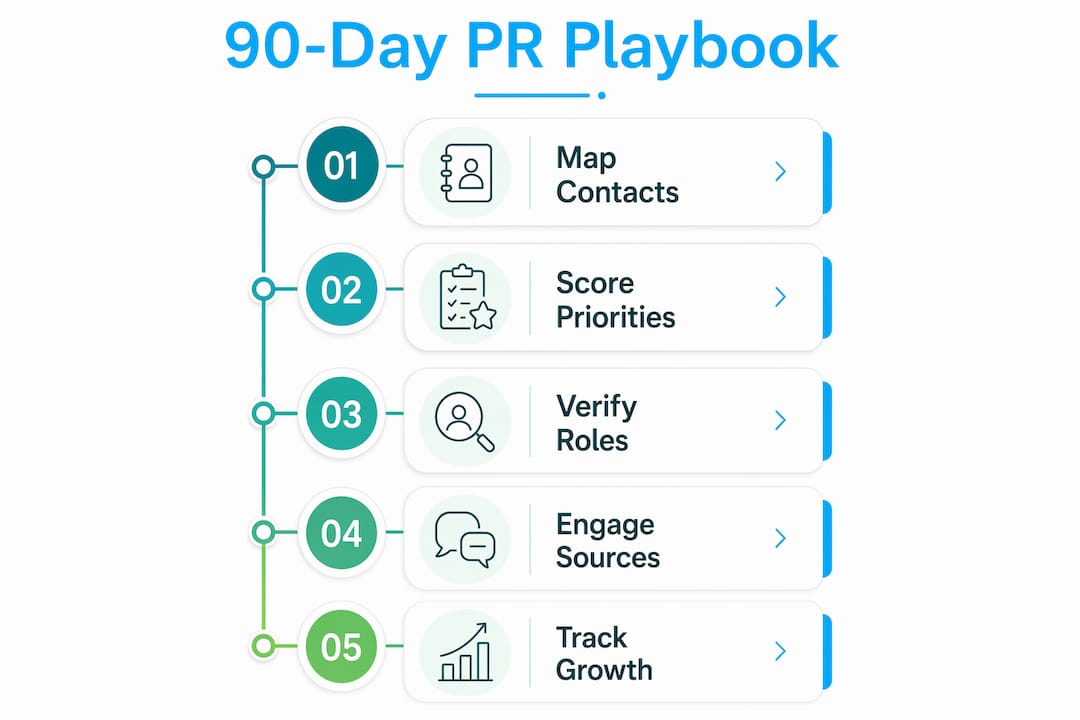
Build a role-geography-priority matrix before you send a single message. This tells you who to pursue first and why, so your PR and outreach time goes to the contacts most likely to refer.
Discovery channels to find targets:
- Local medical society directories
- School counselor association rosters
- LinkedIn manual search by role and zip code
- CE event attendee lists
- Hospital department directories
Referral tracker columns to maintain:
| Column | What to track |
|---|---|
| Contact name & role | PCP, school counselor, attorney, social worker |
| Geography | Zip code, proximity to practice |
| Typical client types | Pediatric, adult, trauma, substance use |
| Triage priorities | Urgency level they typically refer |
| Last contact date | Date of most recent touchpoint |
| Referrals sent / received | Running count for reciprocity tracking |
| Next action | Specific task with a due date |
Scoring matrix: Rate each contact on fit (do their clients match your populations?), access (can you reach them in person or by phone?), and reciprocity potential (do they refer regularly?). Sort by combined score and work the top 10 first. Practices that use structured touchpoints and trackers consistently outperform those relying on memory.
What should you say when you first engage a referral source?
Lead with fit, not availability. Asking a PCP “what kinds of patients do you refer most often?” signals that you care about their clients’ outcomes, not just filling your schedule. That reframe changes the entire tone of the conversation.
Research on referral quality confirms that fit-oriented referrals produce better outcomes and more durable professional relationships than generic availability statements.
Questions that open fit-first conversations:
- “What presentations do you refer most often, and what’s your typical urgency level?”
- “Are there populations you find hard to place right now?”
- “What does your current referral process look like — do you prefer a warm handoff or a direct call?”
- “What would make it easier for you to refer to a specialist like me?”
Dos and don’ts:
- Do open with a specific clinical question, not a general introduction.
- Do acknowledge their workflow and constraints before describing your own.
- Don’t overpromise availability (“I can always take urgent cases”) before you know their volume.
- Don’t lead with your CV or credentials — let the press clip or one-pager carry that weight.
A coffee meeting or a 15-minute phone call built around these questions will do more for a referral relationship than three generic emails. Clinicians who reframe networking as a clinical service rather than self-promotion consistently report less discomfort and better results.
How do you measure PR-driven referral growth?
Expect early outreach traction within the first 30–60 days. Measurable referral increases typically appear by the 90-day mark when manual-first outreach runs alongside earned media. National data show that a substantial proportion of mental health referrals in primary care result in no appointment, which means your follow-through communications matter as much as the initial contact.
KPIs to track weekly:
- New referral contacts engaged
- Referrals received (by source)
- Referral-to-client conversion rate
- Average time to first appointment for referred clients
- Reciprocity ratio (referrals sent vs. received per partner)
90-day milestone table:
| Milestone | Target outcome |
|---|---|
| Day 30 | 10 contacts mapped and verified; — |
| Day 60 | 3 follow-up meetings or calls; 1 press placement or speaking slot secured |
| Day 90 | First referrals received from at least 2 sources; KPI baseline established |
Cost reality: manual verification and outreach require 4–8 hours per batch of contacts. A modest local earned-media push (media kit, one event) adds time and modest out-of-pocket costs. Agency support compresses the timeline significantly.
What legal and ethical rules apply to PR for clinicians?
PR and media outreach are fully permissible for clinicians, but HIPAA and state advertising rules set clear boundaries. The core rule: never disclose protected health information (PHI) in press materials without explicit, documented client consent.
Compliance checklist:
- Secure signed consent before referencing any client outcome, even anonymously.
- Never include identifying details (diagnosis, dates, demographics that could identify someone) in press releases or media pitches.
- Follow your state’s advertising rules for licensed health professionals — some states restrict testimonials or outcome claims.
- Coordinate with legal or compliance counsel before offering case examples to media.
- Use your practice’s secure communication channels for any referral-related information sharing.
Pro Tip: Use anonymized composite examples or your own professional commentary (“In my clinical experience, adolescents presenting with X often benefit from Y”) instead of individual patient stories. You demonstrate expertise without any PHI risk.
This article provides general information, not legal or compliance advice. Confirm current HIPAA requirements and your state’s advertising rules with a qualified attorney or your licensing board.
What does a 90-day PR and referral action plan look like?
| Weeks | Priority tasks | Deliverable |
|---|---|---|
| 1–2 | Map and score 10 target referral sources; build tracker | Completed tracker with fit/access scores |
| 3–4 | Manual verification; draft referral one-pagers by role | 3 role-specific one-pagers ready |
| 5 | First in-person or phone outreach to top 10 contacts | — |
| — | Pitch one local media story; | |
| schedule a lunch-and-learn or CE event | 1 media pitch sent; event date confirmed | |
| — | Follow-up calls to all initial contacts; distribute press clip | Follow-up logged in tracker |
| — | KPI review; identify reciprocity opportunities; plan next outreach batch | 90-day KPI report; next 10 contacts mapped |
Weekly accountability: assign one owner for outreach and one for media/PR tasks. Review the tracker every Friday. Report three numbers: contacts engaged, referrals received, and next week’s priority action.
How Goldman McCormick PR implements this for psychology clients
The agency workflow follows a clear sequence: identify target referral sources by role and geography, manually verify each contact, execute a high-touch outreach sequence, secure local earned-media placements, and deliver tailored referral one-pagers to priority partners. Earned media inserts credibility at every step, turning a cold introduction into a warm one.
Goldman McCormick Public Relations was founded in 2010 by active and former members of the media. Forbes Magazine named it one of America’s Best PR Firms for 2021. In 2016, the firm earned a Gold Award in the “Best Cause/Advocacy Campaign” category at Bulldog Reporter’s CSR Awards. The New York Observer cited Goldman McCormick PR as one of the top five public relations agencies specializing in legal PR in 2014.
Agency proof points for psychology referral work:
- Manual-first contact verification before any outreach begins
- Local earned-media placements (TV, radio, print) that create warm referral introductions
- Role-specific referral one-pagers tailored to PCPs, school counselors, and attorneys
- Event production (lunch-and-learns, CE webinars) that create in-person referral touchpoints
- Referral tracker setup and 90-day KPI framework
The PR insight resources on the Goldman McCormick PR site offer additional tactical depth on earned-media strategy for service-based practices.
Key Takeaways
PR builds psychology referral networks by combining earned-media credibility with manual-first outreach, producing referral sources that convert at roughly 2–3x the rate of directory inquiries within a measurable 90-day window.
| Point | Details |
|---|---|
| Outreach hierarchy matters | Follow APA guidance: in-person and phone outreach outperform letters and email for building referral rapport. |
| Referrals drive practice growth | Referrals generate 30–50% of new clients for established practices and convert at roughly 2–3x the rate of directory inquiries. |
| Precision beats scale | Manual verification of contacts by role and geography produces higher-quality responses than automated bulk outreach. |
| 90-day milestones work | Map 10 targets by day 30, secure a press placement by day 60, and measure first referrals by day 90. |
| Goldman McCormick PR accelerates this | The firm’s earned-media placements and manual outreach workflow shorten time-to-first-referral for psychology practices. |
Why PR should be treated as professional infrastructure, not branding
Most clinicians who come to PR thinking about “exposure” leave thinking about something more specific: professional positioning. There is a real difference. Exposure is passive. Positioning is active. A well-placed media story does not just put your name out there; it tells a specific professional audience exactly what you do, who you serve, and why you are the right call when a patient needs what you offer.
What gets underestimated is how much referral partners rely on mental shortcuts. A PCP managing 25 patients a day does not have time to vet every specialist. When your name appears in a credible outlet, that vetting has already happened in their mind. PR does not replace the relationship; it creates the conditions for the relationship to start at a higher level of trust.
The newsroom instinct that drives good PR, knowing how to frame a story for a specific audience, translates directly into referral outreach. The same discipline that makes a pitch land with a journalist makes a referral one-pager land with a school counselor. Narrative control, audience specificity, and timing are not media skills. They are professional relationship skills.
Goldman McCormick PR can shorten your path to consistent referrals
Getting your first referral from a new professional contact typically takes months of relationship-building. Goldman McCormick PR compresses that timeline by handling the earned-media placements, manual contact verification, and referral asset creation that most practices never get around to doing systematically.
The firm’s services map directly to the playbook in this guide: target mapping, local TV and print placements, role-specific referral one-pagers, event production, and referral tracker setup. For practices that want measurable referral growth without building a media operation from scratch, that combination covers the hardest parts of the work.
Three questions worth asking before you engage any PR firm: What is your realistic timeline to a first referral from a new source? What does a press placement actually cost versus what it produces in referral value? What would you need to see at 90 days to know the investment is working?
If you want direct answers to those questions for your practice, reach out to Goldman McCormick PR and start the conversation.