
A media pitch is a short, personalized email sent to a named journalist proposing a specific story angle and explaining why it matters right now. According to MuckRack, a pitch is a brief communication suggesting a news story to a journalist or editor, with the goal of generating earned coverage. Cision reports that relevance to the reporter is the single most important factor in whether a pitch succeeds or fails. The PRSA and Goldman McCormick PR both treat the pitch as the foundation of earned media strategy. Send one when you have timely news, a data-based insight, an expert comment, or a human-interest story that fits the reporter’s beat.
Here is what a working pitch looks like at a glance:
- Sample subject line: “New data shows remote work burnout rising fast”
- Sample lead: “A national survey released this week found that 61% of remote workers report higher burnout than in-office peers — and your readers at [Publication] are exactly the audience this affects.”
Table of Contents
- What exactly is a media pitch, and who receives one?
- How does a media pitch differ from a press release?
- What are the most common types of media pitches?
- When should you send a pitch, and how do you follow up?
- How do you research a journalist before pitching?
- What mistakes do reporters delete pitches for?
- How do you measure whether your pitching is working?
- Why do most pitches fail? What the data says
- Key Takeaways
- What most PR guides get wrong about pitching
- Goldman McCormick PR can handle your media pitching
- Useful sources and further reading
What exactly is a media pitch, and who receives one?
A media pitch is targeted, relationship-focused outreach designed to earn organic editorial coverage, not paid placement. You are not buying an ad. You are proposing a story that a journalist can own, report, and publish under their byline. That distinction matters to every reporter you contact.
The people who receive pitches vary widely by outlet and format:
- Beat reporter: Covers a specific topic (tech, health, finance). Wants pitches that update or challenge what they already know about their beat.
- Features editor: Assigns longer, narrative stories. Cares about character, tension, and reader relevance more than breaking news.
- Assignment desk (TV/radio): Needs a visual or audio hook. Wants to know what the segment looks like on screen or sounds like on air.
- Podcast producer: Looks for guests with a clear point of view and a story that fits the show’s existing audience.
Tone and length expectations differ by recipient, but the baseline is always conversational and brief. A beat reporter covering fintech does not want three paragraphs of company background. A podcast producer does not need a press release attached.
Same story, two different frames:
For a beat reporter covering workplace trends: “New survey data shows remote workers log 9% more overtime than in-office peers — a trend your coverage of hybrid work has been tracking all year.”

For a features editor at a lifestyle magazine: “One remote worker in Phoenix hasn’t taken a real lunch break in eight months. Her story opens a larger conversation about the invisible cost of working from home.”

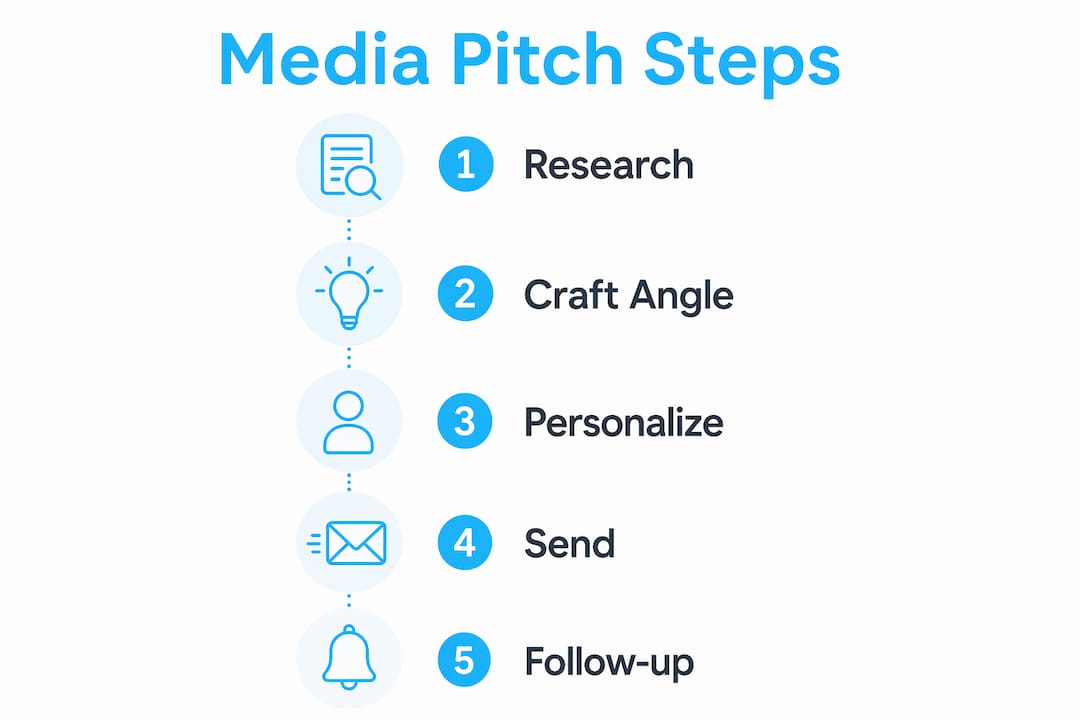
How does a media pitch differ from a press release?
The confusion between these two formats costs PR pros coverage every week. They serve different purposes and land differently in a journalist’s inbox.
| Dimension | Media Pitch | Press Release |
|---|---|---|
| Purpose | Propose a story idea; start a conversation | Announce news formally for the record |
| Length | 150–200 words | 400+ words (AP style) |
| Personalization | Named journalist, specific beat reference | Broadly distributed; no individual targeting |
| Distribution | One journalist (or a small, curated list) | Wire services, media databases, broad lists |
| Ideal timing | Before or alongside news breaking | At or after the announcement moment |
| Tone | Conversational, direct | Formal, third-person |
When to use each:
- Pitch alone: You have an expert comment, a trend observation, or a human-interest story with no formal announcement attached.
- Pitch plus release: You have a product launch, funding round, or study release. The pitch explains why this reporter should care; the release gives them the facts to report.
- Release broadly (no individual pitch): Regulatory filings, earnings reports, or announcements that every outlet needs simultaneously.
Cision’s research found that 72% of journalists still value press releases — but only when they arrive with context that explains why the story fits their audience. The pitch provides that context. Without it, a release is just noise.
What are the most common types of media pitches?
Knowing the category before you write saves you from pitching the wrong format to the wrong person. Each type has a natural lead and a different set of supporting materials.
- Product launch: Lead with the problem the product solves, not the product name. Supporting materials: high-res images, a sample unit for review, a spokesperson available for interview.
- Expert commentary: Lead with the news hook, then offer your expert as a source. Short email only; no attachments needed unless the reporter asks.
- Data story: Lead with the most surprising number in sector-wide context. PRSA guidance is clear that journalists want market-level metrics, not internal company anecdotes. Supporting materials: the full data set or methodology note.
- Human-interest feature: Lead with the person, not the cause. One compelling individual story opens the door to the broader issue. Supporting materials: photos, availability for interview.
- Crisis response: Lead with what changed and what you are doing about it. Keep it factual and brief. No attachments; offer a spokesperson immediately.
- Thought leadership / trend piece: Lead with a contrarian or forward-looking claim tied to a current news cycle. Short email; link to a published piece or white paper if one exists.
A quick newsworthiness test before you pitch: Can you answer “why would a reader of that publication care about this today?” If the answer takes more than one sentence, the story may not be ready.
When should you send a pitch, and how do you follow up?
Timing is one of the most controllable variables in pitching, and most people ignore it.
Best send windows:
- Send pitches Tuesday through Thursday, between 8:00 AM and 10:00 AM in the recipient’s local time zone.
- Avoid Mondays (reporters are clearing weekend backlog) and Fridays (stories get buried heading into the weekend).
- For TV news, pitch morning shows the afternoon before; pitch evening news by 10:00 AM the same day.
Embargo basics:
An embargo is an agreement that the reporter will not publish before a specified date and time. Use it when you want journalists to have preparation time without breaking the news early. Label the email clearly: “EMBARGOED UNTIL [Date, Time, Time Zone]” in the subject line and the first line of the body. Only offer embargoes to reporters you trust and who have agreed to the terms.
Follow-up etiquette:
- Wait 4–5 business days after the initial pitch before following up.
- Send exactly one follow-up. Add a new piece of information (a fresh data point, a new development, a new availability window) rather than simply asking “Did you see my email?”
- A second follow-up rarely converts and risks damaging the relationship.
Pro Tip: When you follow up, lead with the new information first. “Since my last note, the study was picked up by [Publication X] — happy to offer you an exclusive angle on the regional data” is far more compelling than “Just checking in.”
How to build an effective media pitch: anatomy and template
Every high-performing pitch has the same six parts. Here they are in order, with length targets:
- Subject line (6–8 words): The hook. Make it specific and news-forward. “Remote burnout data: exclusive for [Publication]” beats “Story idea for you.”
- Opening hook (1 sentence): Answer “why now.” Reference a recent news event, a trend, or a data point that makes the story timely today.
- Nut graf / angle (2–3 sentences): What the story is actually about. Who is affected, what changed, and what the reader will learn. Lead with the angle, not the company name.
- Offer (1 sentence): What you are providing. An interview, exclusive data, photos, a product sample, or access to a source.
- CTA (1 sentence): A clear, low-friction next step. “Are you available for a 15-minute call Thursday?” works better than “Please let me know if you are interested.”
- Boilerplate (2–3 lines, optional): One-sentence company description and contact info. Paste it below your signature, not above your pitch.
Total length target: 150–200 words. Subject line: 6–8 words. Opening: 1 sentence. Angle: 2–3 sentences. Offer and CTA: 1 sentence each.
Sample pitch email:
Subject: Remote burnout data: exclusive angle for [Publication]
Hi [Reporter First Name],
Your piece last month on hybrid work fatigue caught my attention — we just released a national survey that adds a layer your readers haven’t seen yet.
The data shows remote workers log 9% more overtime than in-office peers, and the gap is widest among workers aged 25–34. That’s the demographic your publication covers most closely. The full methodology and regional breakdowns are ready to share.
I can offer you an exclusive on the regional data before we release it publicly on [Date]. Would a 15-minute call Thursday work?
[Your name | Title | Phone | Company one-liner]
On attachments: Paste a short boilerplate below your signature. Do not attach a press release to the first pitch unless the reporter has asked for it. If images are available, offer them in the body and send only when requested.
How do you research a journalist before pitching?
Personalization is not optional. Cision’s findings show that lack of relevance is the primary reason pitches fail. A pitch that references the reporter’s actual recent work takes five extra minutes and doubles your odds of a reply.
Quick-research checklist:
- Read their last 3–5 bylines. What topics, angles, and sources do they favor?
- Check their Twitter/X bio and recent posts for beat signals and pet peeves.
- Look at their LinkedIn for publication history and any stated coverage focus.
- Note the publication section their work appears in (news, features, opinion, data).
- Check if they have a stated pitch preference in their bio (“DMs open,” “email only,” “no embargoes”).
Pro Tip: The strongest personalization signal is a recent story gap. If a reporter covered rising food costs in January but hasn’t touched the topic since, and you have new data from this quarter, that gap is your opening. Reference the January piece by name and offer the update.
Ready-to-adapt pitch templates for four common scenarios
Each template below is 3–6 sentences. Swap the bracketed fields; the structure stays the same.
Template 1: Product launch
Hi [Reporter],
You’ve covered the [industry] space closely, and [Product Name] addresses the exact gap your [Month] piece on [Topic] identified. It [one-sentence description of what it does and for whom]. I’d love to send a review unit and set up a 20-minute demo with our founder — would [specific date] work?
Swap: reporter name, industry, product name, the article reference, and the demo date. The article reference is what makes this personal rather than a mass blast.
Template 2: Data story
Hi [Reporter],
[Surprising statistic from your study] — and the trend is sharpest in [region or demographic your publication covers]. Our [Month] survey of [N] respondents found [second key finding in market context]. I can share the full data set and connect you with [expert name] for comment. Exclusive available through 2026.
Swap: the statistic, region, survey details, expert name, and exclusivity window. Frame every number in sector context, not company context.
Template 3: Expert commentary
Hi [Reporter],
Your story on [recent article topic] raised a question I think [Expert Name], [title], can answer directly. [Expert] has [one-line credential relevant to the story]. She’s available for a 15-minute call this week and can offer [specific angle or contrarian point].
Swap: the article reference, expert name, credential, and the specific angle. Keep it to three sentences — the reporter decides whether they want more.
Template 4: Human-interest feature
Hi [Reporter],
[First name of subject] spent [time period] doing [specific thing] — and the result surprised everyone, including her. Her story opens a larger conversation about [broader issue your publication covers]. I can connect you directly; she’s agreed to speak on the record.
Swap: subject’s first name, the specific situation, the broader issue, and the on-record confirmation. The concrete individual detail in sentence one is what earns the open.
Before/after: turning a weak pitch into a tight one
❌ Weak: “We are excited to announce that our company has launched an innovative new platform that helps businesses of all sizes manage their operations more efficiently. We believe this is a great story for your readers.”
✅ Strong: “Small manufacturers in the Midwest are losing an average of 11 hours a week to manual inventory tracking — [Platform Name] cuts that to under two. I can offer you an exclusive look at the beta data and a 20-minute call with the founder this Thursday.”
The weak version leads with the company and uses marketing language. The strong version leads with the problem, quantifies it, and offers something specific.
What mistakes do reporters delete pitches for?
Most pitch failures come down to the same short list of errors. Each one has a direct fix.
- No personalization: The reporter’s name appears nowhere, or the pitch could go to anyone. Fix: reference a specific recent byline in the first sentence.
- Burying the lead: The story angle appears in paragraph three. Fix: move the most newsworthy sentence to the top. MentionAgent’s guidance is direct: lead with the angle, not the company.
- Marketing language: Words like “innovative,” “best-in-class,” and “excited to announce” signal that the writer is thinking about the brand, not the reader. Fix: replace every adjective with a fact.
- Wrong contact: Pitching a food editor about a fintech product. Fix: spend five minutes confirming the reporter’s current beat before sending.
- Bad timing: Sending Friday afternoon or Monday morning. Fix: schedule sends for Tuesday–Thursday, 8:00–10:00 AM recipient local time.
- Too long: A 400-word pitch reads like a press release. Fix: cut to 150–200 words. If you cannot say it in that space, the angle is not clear yet.
Pre-send checklist: Does the subject line have 6–8 words? Is the reporter named and their recent work referenced? Does the angle appear in the first sentence? Is the total word count under 200? Is there one clear CTA?
How do you measure whether your pitching is working?
Tracking results turns pitching from guesswork into a repeatable process. These are the metrics worth watching:
| Metric | What it measures | How to calculate |
|---|---|---|
| Reply rate | Percentage of pitches that get any response | Replies ÷ pitches sent |
| Interest rate | Percentage of replies that advance (interview booked, story assigned) | Advances ÷ replies |
| Placement rate | Percentage of pitches that result in published coverage | Placements ÷ pitches sent |
| Estimated reach | Total audience exposed to placements | Sum of outlet circulation/unique visitors |
| Pick-up velocity | Time from pitch sent to story published | Average days across all placements |
Early-career practitioners typically see reply rates in the 5%–15% range; experienced practitioners with well-targeted lists often reach 20%–30%. Placement rates are lower: 3%–8% is a reasonable benchmark when you are still building reporter relationships.
A/B testing ideas:
- Test subject lines: data-forward (“Survey: 61% of remote workers report burnout”) versus human-story-forward (“She hasn’t taken a lunch break in eight months”).
- Test lead type: open with a statistic versus open with a named individual’s situation.
- Test send day: Tuesday versus Wednesday for the same reporter segment.
Track results in a simple spreadsheet: pitch date, reporter name, outlet, subject line variant, reply (yes/no), placement (yes/no), and days to placement. After 30 pitches, patterns emerge.
Why do most pitches fail? What the data says
The answer is not complicated, even if the fix takes discipline. Cision’s reporting identifies lack of relevance as the leading cause of pitch failure. Reporters receive dozens of pitches weekly, and the ones that get deleted first are the ones that could have been sent to anyone.
Stat to know: Cision data shows that relevance to the reporter and their audience is the primary factor separating pitches that get coverage from those that get ignored.
Practitioner fixes that work:
- Personalize every pitch to a specific byline before you write the angle.
- Answer “why now” in the first sentence, not the third.
- Send one follow-up with new information, 4–5 business days after the original.
- Use Meltwater or similar media monitoring tools to track what a reporter has covered recently before you write a single word.
Pro Tip: Before you send, read your pitch aloud. If you stumble on a sentence, the reporter will too. If the angle doesn’t appear in the first two lines, move it there.
Key Takeaways
A well-crafted media pitch is a short, personalized story proposal that leads with the angle, names the reporter, and answers “why now” in the first sentence.
| Point | Details |
|---|---|
| Lead with the angle | Put the most newsworthy sentence first; never open with the company name or marketing language. |
| Keep it under 200 words | Subject line 6–8 words; total pitch 150–200 words; one clear CTA at the end. |
| Send Tuesday–Thursday mornings | Pitch between 8:00 AM and 10:00 AM in the recipient’s local time zone for best visibility. |
| Follow up exactly once | Send one follow-up with new information 4–5 business days after the original pitch. |
| Goldman McCormick PR | A Forbes-recognized PR firm that researches beats, writes targeted pitches, and tracks placements for clients seeking earned media coverage. |
What most PR guides get wrong about pitching
The conventional advice is to “personalize your pitch” and “keep it short.” Both are correct, and both are incomplete. Personalization without a genuine news angle is just flattery. Brevity without clarity is just a short email that still gets deleted.
The real gap most practitioners miss is the “why now” test. A pitch can be perfectly personalized to a reporter’s beat and still fail because it doesn’t answer why the story matters this week rather than six months ago. Timeliness is not a nice-to-have. It is the mechanism that moves a pitch from the “maybe later” folder to the “let’s talk” reply.
The second thing guides underweight is the relationship between pitch volume and pitch quality. Sending 200 generic pitches a month produces worse results than sending 20 carefully targeted ones. The math looks counterintuitive until you track reply rates. A 20% reply rate on 20 pitches gives you four conversations. A 2% reply rate on 200 pitches gives you four conversations and 196 burned contacts.
The practitioners who consistently earn coverage treat each pitch as a first impression with a specific person, not a message in a bottle thrown at a list.
Goldman McCormick PR can handle your media pitching
Named by Forbes Magazine as one of America’s Best PR Firms for 2021, Goldman McCormick PR has been placing clients in TV segments, radio programs, and print features since 2010. The firm earned a Gold Award from Bulldog Reporter in 2016 and was cited by the New York Observer as one of the top five legal PR agencies in 2014.
Where most founders and early-stage teams spend weeks learning pitch mechanics, Goldman McCormick PR handles the research, targeting, copywriting, follow-up, and measurement from day one. The team identifies the right reporters for your story, writes pitches built around their actual beats, and tracks every placement. You get coverage; we handle the outreach. Visit goldmanmccormick.com to start a conversation about your next campaign.
Useful sources and further reading
The sources below were cited throughout this article and are worth bookmarking for deeper study.
- MuckRack — Media Pitching Guide: Comprehensive practitioner guide to pitching mechanics, journalist preferences, and outreach best practices. MuckRack also offers a media database for finding and targeting reporters.
- Cision — Media Pitching vs. Press Releases: Explains the structural differences between pitches and releases, with journalist survey data on what reporters actually value.
- PRSA — Media Pitch Examples and Templates: Twelve annotated templates from the Public Relations Society of America, covering a range of pitch types and industries.
- MentionAgent — How to Pitch to Media: Practical playbook covering timing windows, follow-up cadence, and pitch anatomy with length guidance.
- Meltwater — How to Write a Media Pitch: Covers pitch structure, before/after rewrites, and how to use media monitoring to identify the right moment to pitch.
- G2 Learn — What Is a Media Pitch: Beginner-friendly definition and overview of pitch goals, common categories, and how pitching fits into a broader PR strategy.
- Indeed — Media Pitch Examples: Eight real-world pitch examples with strategy notes, useful for early-career practitioners building their first templates.
- Goldman McCormick PR — PR Insight: The agency’s editorial category covering media pitch formats, outreach tactics, and earned media strategy for clients across industries.