
Proactive media strategy is defined as the planned, anticipatory approach to communications that shapes a brand’s narrative before events force a response. Only 21% of communications leaders rate their crisis prevention ability as excellent. That gap reveals how most organizations still operate in firefighting mode rather than leading the conversation. For marketing professionals and business leaders, shifting to a proactive model means controlling your message, building lasting media relationships, and preparing for challenges before they become crises. Goldman McCormick PR has built its practice on exactly this principle since 2010.
What is proactive media strategy and how does it differ from reactive PR?
Proactive media strategy is the deliberate planning and execution of communication efforts that anticipate both opportunities and threats. The industry term most closely aligned with this concept is “proactive PR,” though the broader practice spans media planning, content strategy, and relationship management well before any news cycle begins.
Reactive PR, by contrast, responds to events after they happen. Newsjacking a trending story or issuing a crisis statement are reactive moves. They have value, but they put your brand in a position of responding rather than leading.

The core distinction comes down to timing and control:
| Factor | Proactive approach | Reactive approach |
|---|---|---|
| Timing | Before events unfold | After events occur |
| Narrative control | High | Low |
| Primary goal | Long-term brand authority | Immediate damage control or relevance |
| Risk level | Lower over time | Higher, especially during crises |
| Example | Pitching a thought leadership feature | Responding to a negative news story |
The most effective media strategies combine proactive PR with reactive tactics for long-term credibility and immediate relevance. That combination is the standard, not a luxury. A strong proactive PR foundation enhances reactive responses by establishing thought leadership and credibility before news breaks.
Pro Tip: Map your reactive responses from the past 12 months. Patterns in what you had to respond to are the clearest signal of where your proactive planning has gaps.
Key components of proactive media planning
Effective proactive media planning rests on five core practices. Each one builds on the others, and skipping any one weakens the whole system.
-
Build media relationships before you need them. Building media relationships in advance is one of the top challenges in proactive media work, and also the most critical factor in earning consistent positive coverage. Journalists remember who pitched them a useful story six months ago. They forget who called only during a crisis.
-
Use media monitoring and social listening. Modern media teams use AI-powered monitoring and predictive analytics tools to anticipate trends and optimize outreach timing. Monitoring competitor coverage, industry keywords, and audience sentiment gives you early signals before issues escalate.
-
Create a content calendar aligned with industry events. A content calendar ties your pitches, press releases, and thought leadership pieces to moments your audience already cares about. Trade conferences, earnings seasons, and regulatory announcements all create natural windows for proactive outreach.
-
Establish review and approval workflows. Consistent messaging requires consistent process. A defined approval chain prevents off-brand statements from reaching journalists or the public, especially under time pressure.
-
Integrate cross-department collaboration. Communications, marketing, legal, and executive teams each hold information the others need. A weekly sync between these groups catches potential issues early and aligns messaging before it goes out.
Pro Tip: Assign one team member to own the media calendar. Shared ownership usually means no ownership.
What are the real benefits of proactive media strategy?
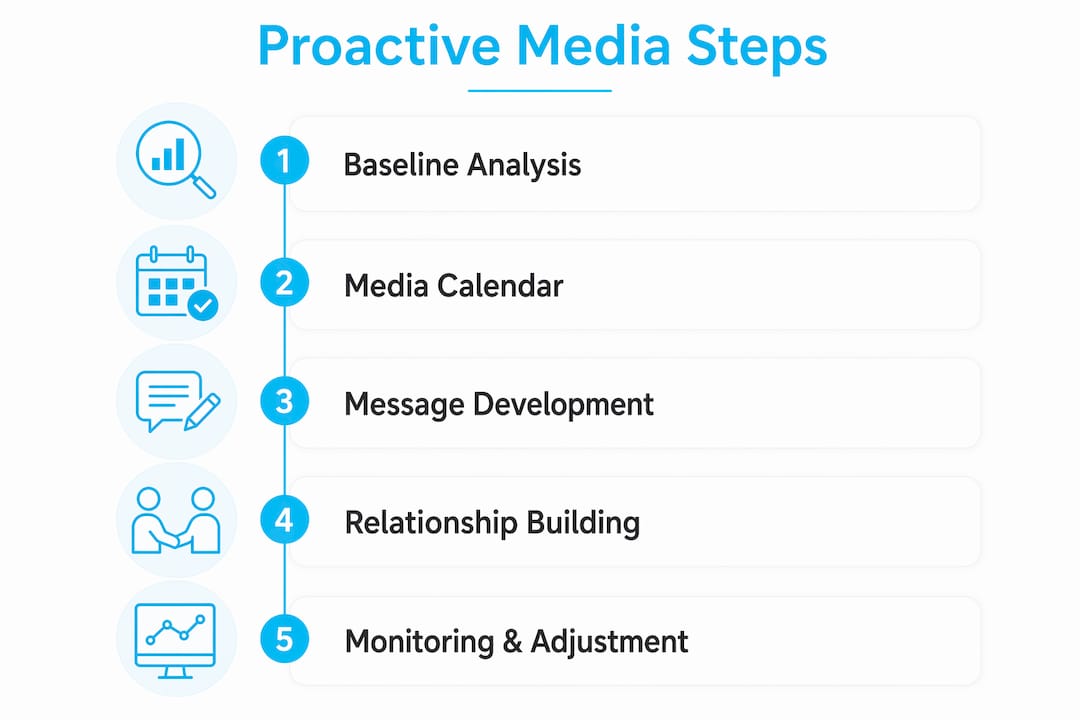
The benefits of proactive media extend well beyond avoiding bad press. Proactive communication enables brand narrative control and consistent messaging, which directly improves reputation and media relationships over time. That consistency compounds. Journalists, analysts, and customers all form impressions based on repeated exposure to your brand’s voice.
CEOs prioritize sustainable growth and brand value, and proactive strategies shift focus from firefighting to shaping consistent long-term narratives. That alignment between executive priorities and communications practice is what gives proactive media its organizational weight.
The measurable benefits break down as follows:
- Crisis readiness: Anticipating issues early reduces response time and limits reputational damage when problems do arise.
- Increased positive coverage: Journalists who trust your pitches return to you for expert commentary, expanding your earned media footprint.
- Stronger brand authority: Consistent thought leadership positions your organization as the go-to source in your category.
- Reduced wasted spend: Planned outreach is more cost-effective than emergency communications or paid amplification of reactive content.
“Proactive media strategy transforms media planning from reactive firefighting to shaping and leading conversations for brand growth. Organizations that own their narrative before events unfold build the kind of credibility that no crisis budget can buy back.”
For brands in broadcast and audio media, internet radio audience growth strategies reflect this same shift, where consistent proactive positioning drives audience loyalty far more reliably than reactive programming decisions.
How to integrate predictive and adaptive media planning
Predictive media planning uses historical data and modeling to forecast campaign impact before any budget is committed. This gives marketing teams a data-backed basis for channel selection, timing, and spend allocation rather than relying on instinct or last year’s plan.
Situation-adaptive media planning takes this further. It integrates real-time signals like sales trends, competitive spending shifts, and audience behavior changes to enable fast strategic adjustments mid-campaign. The result is a media system that reacts and adapts dynamically, not a static plan that becomes obsolete the moment market conditions shift.
| Step | Action | Benefit |
|---|---|---|
| Baseline analysis | Review historical campaign data by channel | Identifies what has actually worked |
| Scenario modeling | Build 2–3 spend and timing scenarios | Reduces risk before budget commitment |
| Signal monitoring | Track sales trends and competitive activity | Enables real-time course corrections |
| Adaptive adjustment | Shift spend based on live performance data | Reduces wasted budget |
| Post-campaign review | Document outcomes for next planning cycle | Improves future forecast accuracy |
Pro Tip: Run scenario comparisons before every major campaign launch. Even a rough model of two or three spend allocations surfaces assumptions your team has never explicitly discussed.
Key Takeaways
Proactive media strategy is the most direct path from reactive firefighting to owning your brand narrative, and it requires consistent planning, relationship building, and data-informed forecasting to work.
| Point | Details |
|---|---|
| Definition matters | Proactive media strategy is planned, anticipatory communication, not just fast reactive response. |
| Crisis prevention gap | Only 21% of communications leaders rate crisis prevention as excellent, signaling a major industry opportunity. |
| Relationships come first | Building media relationships before you need them is the single most critical factor in proactive success. |
| Predictive planning reduces waste | Scenario modeling before budget commitment improves decisions and cuts wasted spend. |
| Proactive enables better reactive | A strong proactive foundation makes your reactive responses faster, more credible, and more effective. |
Why most teams get proactive media strategy wrong
The biggest mistake I see marketing teams make is treating proactive media strategy as a document rather than a discipline. They build a plan in January, file it, and then spend the rest of the year reacting anyway. The plan never gets used because no one owns it day to day.
The second mistake is confusing activity with strategy. Publishing a press release every month is not proactive media planning. Proactive planning means knowing three months in advance which stories you want to tell, which journalists you want to tell them to, and what signals would cause you to change course. That requires cross-functional input, real monitoring tools, and a team that meets regularly enough to act on what they find.
The teams I have seen make the clearest gains are the ones that stop asking “what do we need to respond to?” and start asking “what do we want the market to believe about us in 12 months?” That question reorients everything. It turns communications from a support function into a growth driver. The PR insights that matter most are not about tactics. They are about owning the narrative before someone else does.
— Ryan McCormick
Goldman McCormick PR and your media strategy
Goldman McCormick PR, named by Forbes Magazine as one of America’s Best PR Firms for 2021, works with clients who are ready to move beyond reactive communications and build a media presence that lasts.
The firm’s work spans television, radio, print, podcasting, and nationally syndicated programs on the Genesis Communications Network and Starcom Radio Network. That breadth means your proactive media plan reaches audiences across every major format. Whether you need media strategy support for brand visibility, reputation management, or crisis readiness, Goldman McCormick PR brings the relationships and experience to execute it. Reach out to learn what a forward-looking communications program looks like for your organization.
FAQ
What is proactive media strategy in simple terms?
Proactive media strategy is the practice of planning and executing communications before events force a response. It focuses on shaping your brand narrative rather than reacting to news or crises.
How does proactive PR differ from reactive PR?
Proactive PR builds brand authority through planned outreach and relationship building. Reactive PR responds to events after they occur. The most effective programs use both, with proactive work as the foundation.
Why do so few companies excel at crisis prevention?
Only 21% of communications leaders rate their crisis prevention ability as excellent. Most teams lack the monitoring tools, workflows, and media relationships needed to catch issues before they escalate.
What tools support proactive media planning?
AI-powered media monitoring platforms and predictive analytics tools help teams track trends, model campaign scenarios, and identify emerging issues before they reach the news cycle.
How does predictive media planning reduce wasted spend?
Predictive media planning uses historical data and scenario modeling to forecast campaign impact before budget is committed. Teams can compare allocation options and choose the path with the strongest projected return.