
Legal authority positioning is the practice of establishing a lawyer as the recognized expert in a defined niche, so prospects self-select you before they ever pick up the phone. Authority positioning makes a firm the obvious choice by causing clients to self-qualify before contact, which is fundamentally different from general thought leadership. Google’s EEAT standards (Experience, Expertise, Authoritativeness, Trustworthiness) now govern how law firms rank and how clients judge credibility online. Firms that meet these standards consistently win more clients at higher case values.
How to position a lawyer as a legal expert
The phrase “position lawyer as legal expert” describes what the marketing industry formally calls authority positioning. It goes well beyond publishing a few blog posts or collecting LinkedIn followers. Authority positioning requires owning a narrow niche and building permanent, physical credentials rather than relying on ephemeral social posts. The result is a reputation that precedes you, so clients arrive already convinced you are the right choice.

What differentiates a legal expert from a general attorney?
The core difference is legitimacy. Authority in law means the recognized right to act, derived from statutes, contracts, or formal appointments. It differs from raw power, which is influence without formal legitimacy. A general attorney may have power in a courtroom, but a recognized legal expert carries authority that clients, journalists, and courts acknowledge without question.
Niche specialization is the fastest path to that legitimacy. A family law attorney who focuses exclusively on high-net-worth divorce cases becomes the obvious call for that specific client. A general practitioner who handles everything from DUIs to contract disputes signals no particular depth to anyone.
Physical credentials reinforce the distinction. A published book, a certification from a recognized bar association specialty program, or a white paper cited by industry publications all signal authority in ways a social media bio cannot.
- Niche focus: Define a single practice area and a specific client type. Breadth dilutes authority.
- Formal credentials: Bar certifications, published works, and academic appointments carry weight that follower counts do not.
- Third-party validation: Media appearances, speaking slots at bar association conferences, and award recognition confirm authority to skeptical prospects.
- Consistent messaging: Every public touchpoint, from your website bio to your podcast intro, should reinforce the same expert identity.
Pro Tip: Write your authority statement in one sentence before building any marketing asset. “I am the attorney for [specific client type] facing [specific problem] in [specific geography].” If you cannot write that sentence clearly, your niche is still too broad.
What tools and assets are essential to establish yourself as a legal expert?
Credentials and visibility work together. Neither alone is sufficient.
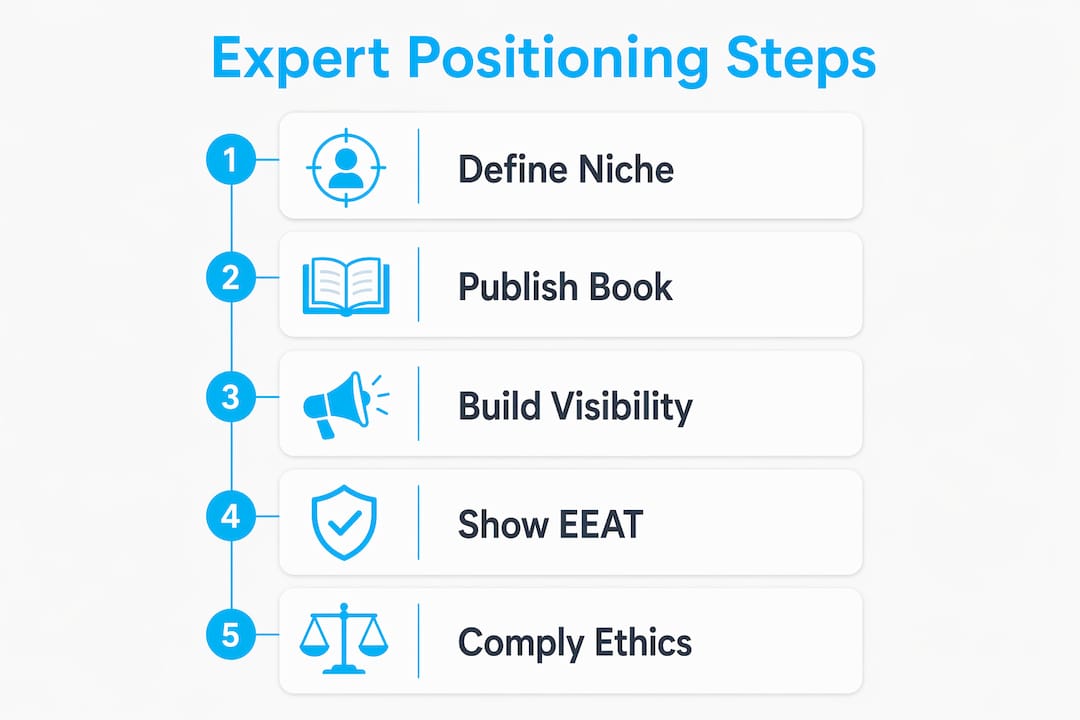
Publishing a book is the single most powerful expert credential available to a lawyer. A book sits physically with a prospect, pre-sells your expertise before the consultation, opens doors to speaking engagements, and justifies higher fees. No other marketing asset delivers that combination of effects.
Beyond a book, the following asset types build authority at different levels of the client decision process:
| Asset type | Primary impact |
|---|---|
| Published book or white paper | Pre-sells expertise; unlocks media and speaking |
| Google Business Profile with 10+ five-star reviews | Drives local search trust and EEAT signals |
| Deep-dive practice area articles | Demonstrates expertise; improves organic search ranking |
| Industry awards and bar certifications | Third-party validation for skeptical prospects |
| Podcast or radio appearances | Builds familiarity and positions you as a go-to source |
| Speaking engagements at bar events | Peer recognition that transfers to client trust |
EEAT standards require law firms to demonstrate real experience, documented expertise, external authoritativeness, and trustworthiness across every digital touchpoint. Firms that satisfy all four criteria outperform competitors in both search rankings and client conversion. That means your Google Business Profile, your website author bios, and your review volume all feed the same credibility signal.
Ethical advertising compliance is non-negotiable. Every state bar has rules governing attorney advertising, and violations can undo years of reputation building in a single complaint. Build your asset library within those rules from day one.
How to develop a strategy to showcase legal expertise
A working strategy has five sequential steps.
- Select one narrow niche. Lawyers who serve a very narrow niche position themselves as magnetic experts. Attempts to serve all clients lead to invisibility. Pick the practice area and client type where you already have the strongest track record.
- Publish a foundational credential. Write and publish a book or a substantial white paper on your niche topic. This single asset will do more for your authority than a year of social media posts. Hire a ghostwriter if needed; the credential is what matters.
- Build your digital presence around EEAT. Optimize your Google Business Profile, collect verified client reviews, and publish long-form articles that answer the specific questions your ideal clients search for. Each piece of content should demonstrate direct experience, not just general knowledge.
- Secure media and speaking visibility. Pitch yourself to legal journalists, local TV news producers, and bar association program committees. A single television appearance reaches more qualified prospects than months of paid ads. When preparing for those appearances, making a great media impression requires preparation that goes well beyond knowing your subject matter.
- Measure cost per signed client, not clicks. Legal marketing success is measured by cost per signed client, not cost per click. A keyword bid that costs $80 per click is worth it if it produces a $50,000 case. Track every lead from first contact through signed retainer to know which channels actually produce revenue.
Pro Tip: Connect your digital marketing platform directly to your client intake software. If you cannot trace a signed client back to a specific ad, article, or media appearance, you are flying blind on budget decisions.
Long-term brand storytelling separates firms with enduring market presence from those chasing short-term ad results. Consistency over 24–36 months compounds authority in ways no single campaign can replicate.
What are common pitfalls when positioning a lawyer as a legal expert?
Most lawyers make the same set of mistakes. Recognizing them early saves months of wasted effort.
- Relying on social media volume. Posting daily on LinkedIn or Instagram builds an audience, not authority. Social media volume alone does not establish authority. Published credential assets like books transform professionals beyond commodity providers.
- Serving too broad a market. A website that lists 12 practice areas tells prospects you specialize in nothing. Narrow your public-facing focus even if you take other cases privately.
- Chasing vanity metrics. Page views, follower counts, and email open rates feel good but do not pay salaries. Firms must track downstream value, specifically cost per signed client, over pageviews or clicks to accurately measure authority positioning success.
- Ignoring ethical advertising rules. Superlatives like “best attorney in the state” violate bar rules in most jurisdictions. Review your state bar’s advertising guidelines before publishing any marketing asset.
- Sacrificing accessibility for exclusivity. Authority positioning does not mean being unreachable. Prospects who cannot easily contact you will simply call the next name on the list.
Key Takeaways
Positioning a lawyer as a recognized legal expert requires niche focus, permanent credentials, and consistent digital visibility measured by client acquisition, not vanity metrics.
| Point | Details |
|---|---|
| Define a narrow niche | Broad practice areas dilute authority; pick one client type and one problem to own. |
| Publish a physical credential | A book pre-sells expertise, unlocks media access, and justifies higher fees. |
| Satisfy EEAT standards | Google Business Profile, verified reviews, and deep-dive articles all feed credibility signals. |
| Measure cost per signed client | Track leads from first contact through retainer to identify which channels produce real revenue. |
| Avoid vanity metrics | Follower counts and page views do not reflect authority; client acquisition data does. |
What I have learned about legal authority positioning
Most law firms I have worked with want authority but resist the one thing that creates it: narrowing down. They worry that focusing on one niche will cost them clients. The opposite is true. The attorneys who commit to a specific client type and a specific problem become the only logical call for that problem. Their phones ring with pre-sold prospects who already believe in their expertise.
The other pattern I see consistently is undervaluing published credentials. A book is not a vanity project. It is a sales tool that works around the clock, a media pitch that opens doors, and a price-justification asset that makes fee conversations easier. Attorneys who have written a book on their niche topic close consultations faster and at higher rates than those who have not.
The mistake I see most often is treating authority positioning as a marketing project rather than a business development strategy. It requires patience, consistency, and a willingness to say no to clients who fall outside your defined niche. The firms that commit to that discipline for two to three years build something competitors cannot replicate with ad spend alone.
— Ryan McCormick
Goldman McCormick PR and legal authority building
Goldman McCormick PR has specialized in legal PR since 2014, when the New York Observer named it one of the top five public relations agencies in the field. Named by Forbes Magazine as one of America’s Best PR Firms for 2021, the firm gets lawyers seen on television, heard on radio, and read about in newspapers, which are the exact media placements that build recognized authority fastest.
For law firms and solo practitioners ready to move beyond generic marketing, Goldman McCormick PR builds the media presence and credible expert narrative that turns a skilled attorney into a recognized authority. The firm’s work on the Genesis Communications Network and Starcom Radio Network gives clients access to nationally syndicated audiences that no local ad campaign can reach. Contact Goldman McCormick PR to start building the kind of authority that makes clients call you first.
FAQ
What is legal authority positioning for lawyers?
Legal authority positioning is the practice of establishing a lawyer as the recognized expert in a defined niche so prospects self-select that attorney over all others. It differs from general thought leadership by causing clients to self-qualify before contact.
How does publishing a book help a lawyer’s credibility?
A published book is a permanent, physical credential that pre-sells expertise, opens media and speaking opportunities, and justifies higher fees. No other single marketing asset delivers the same combination of trust signals.
Why does niche focus matter for showcasing legal expertise?
Lawyers who serve a very narrow niche become magnetic experts. Attorneys who market to all client types signal no particular depth, which makes them invisible in competitive markets.
What metrics should law firms track in their marketing?
Law firms should track cost per signed client rather than cost per click or page views. Connecting digital marketing data directly to client intake software is the only way to measure true return on marketing investment.
How do EEAT standards affect a law firm’s online presence?
EEAT standards require law firms to demonstrate Experience, Expertise, Authoritativeness, and Trustworthiness across every digital touchpoint. Firms that satisfy all four criteria rank higher in search results and convert more prospects into clients.