
Television is the most credible marketing channel available to law firms today. A single national broadcast segment can reach over 80 million households through primetime scheduling across 170+ Public Television stations. That scale is simply not replicable through digital ads alone. Video ads on television create emotional connection and professional credibility that digital-only campaigns consistently fail to match. For attorneys and law firm marketing professionals, the question is not whether to pursue TV exposure. The question is how to do it right.
How to get your law firm on TV: understanding your options
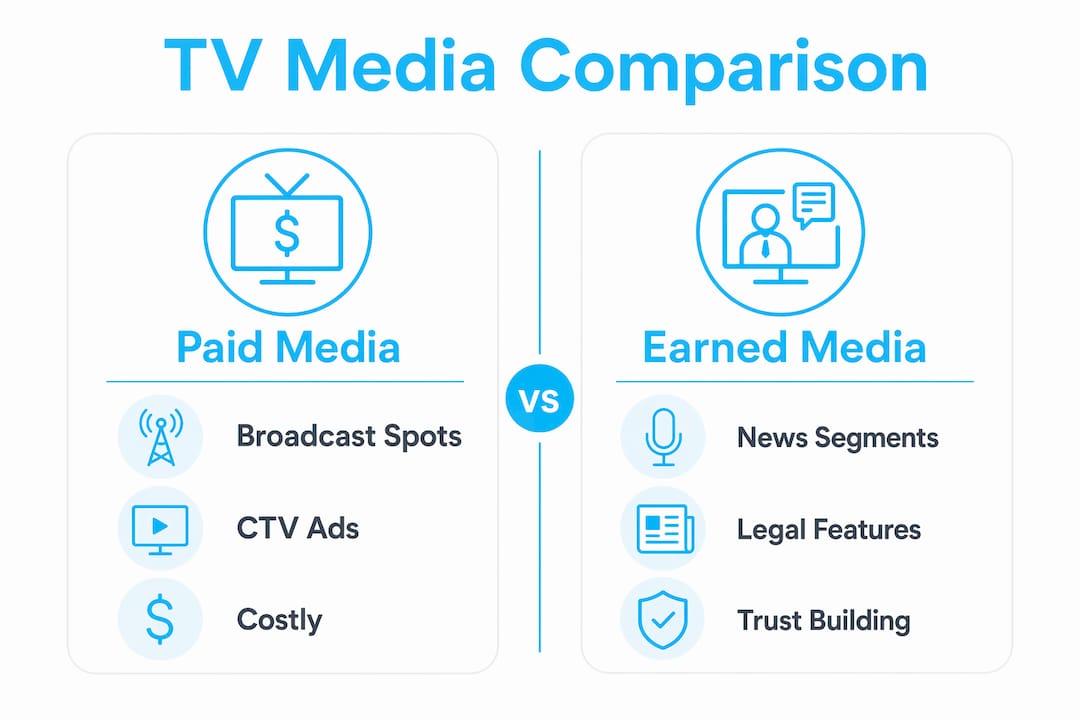
Television exposure for law firms falls into two broad categories: paid media and earned media. Each works differently, costs differently, and produces different results.
Paid TV advertising includes traditional broadcast spots and Connected TV (CTV) placements. Traditional broadcast TV delivers wide geographic reach but limited audience targeting. CTV, also called OTT advertising, is the modern evolution. CTV campaigns allow law firms to target viewers by ZIP code, demographics, and behavioral interests with high precision. Spots typically run 15–30 seconds. That targeting capability makes CTV far more budget-efficient than buying broad broadcast time.

Earned media means your firm is featured on a news program, legal segment, or public affairs show without paying for the placement. Dickinson Wright’s appearance on ALL ACCESS with Andy Garcia is a strong example. That segment aired across 170+ Public Television stations and reached a national audience. Earned media carries more trust than paid ads because viewers perceive it as third-party validation, not advertising.
| Format | Reach | Targeting | Cost structure | Trust level |
|---|---|---|---|---|
| Traditional broadcast TV | Very broad | Limited | High, fixed rates | Moderate |
| Connected TV (CTV/OTT) | Broad to niche | High precision | Flexible, CPM-based | Moderate |
| Earned media (news/segments) | Varies by outlet | Editorial-driven | Time and PR investment | Very high |
The right mix depends on your firm’s goals, budget, and timeline. Most firms benefit from combining all three over time.
What does compelling TV content for law firms require?
Production quality signals credibility before a viewer hears a single word. Professionally produced TV content drives calls, cases, and long-term growth in ways that low-budget video simply cannot.
Strong law firm TV content typically falls into one of these formats:
- Brand videos: Introduce the firm, its values, and its attorneys. These work well for both broadcast and CTV placements.
- Client testimonials: Real clients describing real outcomes. These build emotional trust faster than any attorney-to-camera script.
- Legal explainers: Short segments that answer common questions. These position attorneys as authoritative and approachable.
For broadcast and CTV, the standard spot length is 15–30 seconds. Every second counts. The script must lead with the viewer’s problem, not the firm’s credentials. Compliance with state bar advertising rules is non-negotiable. Most state bars require specific disclaimers, prohibit certain claims, and regulate testimonial use. Violating these rules creates liability, not visibility.
Pro Tip: Always connect your TV call-to-action to a dedicated digital landing page. A viewer who sees your ad at 10:00 PM may not call until the next morning. If your landing page is not ready to capture that delayed traffic, you lose the lead.
How do you launch and integrate a TV campaign effectively?
The TV ad is only the top of the funnel. True success depends on synchronized digital infrastructure and timely intake response. Most firms that fail at TV marketing treat the ad as the finish line. It is actually the starting gun.
A well-built TV campaign follows this sequence:
- Define your target market. Identify the practice areas, geographic markets, and client demographics you want to reach. This determines whether traditional broadcast or CTV is the better fit.
- Build dedicated landing pages. Each TV campaign needs a matching digital destination. The page should mirror the ad’s message, load fast, and make it easy to call or submit a form.
- Set up call tracking. Use unique phone numbers tied to each campaign so you can measure exactly how many calls the TV ad generates.
- Launch synchronized search and social ads. TV increases branded search volume. A multichannel approach captures viewers who search your firm name after seeing the ad rather than calling directly.
- Track delayed conversions. Many TV-driven leads convert days or weeks after the initial exposure. Your CRM must be set up to attribute these correctly.
Pro Tip: Keep your messaging identical across TV, search ads, and social media. When a viewer sees the same tagline on TV and then again in a Google search result, recognition converts faster than any single-channel ad can.
The firms that win with TV are the ones that treat it as an integrated system, not a standalone buy.
What mistakes do law firms make when pursuing TV exposure?
The most common error is buying TV time without building the digital infrastructure to support it. Firms need optimized landing pages and intake systems ready before the first ad airs. Without them, the campaign generates awareness but no clients.
Other frequent mistakes include:
- Underestimating earned media timelines. Earned media appearances typically require 3–6 months of relationship-building, content creation, and pitch development before a segment airs. Firms that expect fast results from earned media consistently get frustrated and quit too early.
- Ignoring audience demographics. A personal injury firm advertising on a financial news channel wastes budget. Match your content and placement to the viewing habits of your actual prospective clients.
- Skipping compliance review. Legal advertising regulations vary by state. Running a non-compliant ad creates bar complaints, not clients.
- Failing to measure ROI. Without call tracking, UTM parameters, and CRM attribution, you cannot know what the TV campaign actually produced.
“Media exposure via TV is not just about reach. It establishes third-party trust that is significantly harder to build through paid channels alone. Law firms that earn a spot on a credible news program gain something no ad budget can buy outright: the implied endorsement of the outlet itself.”
Law firms that handle novel litigation with public interest attract national TV coverage organically. High-stakes, first-of-its-kind cases generate media visibility that no paid placement can replicate. Building a reputation for landmark work is one of the most durable earned media strategies available.
Key Takeaways
Television remains the most credible and high-reach marketing channel for law firms, but success requires combining paid placements, earned media, and synchronized digital infrastructure.
| Point | Details |
|---|---|
| Paid vs. earned media | CTV offers precise targeting; earned media builds deeper trust but requires 3–6 months of lead time. |
| Production quality matters | Professionally produced content drives calls and long-term growth across TV, streaming, and social platforms. |
| Digital integration is required | Every TV campaign needs dedicated landing pages, call tracking, and CRM attribution to convert delayed viewers. |
| Multichannel amplification | Pair TV ads with search and social campaigns to capture branded search volume generated by the broadcast. |
| Compliance is non-negotiable | State bar advertising rules govern disclaimers, testimonials, and claims. Review every ad before it airs. |
Why TV still outperforms digital-only strategies for law firms
I have watched law firms pour six-figure budgets into digital ads and still struggle to build the kind of trust that a single well-placed TV segment creates in 30 seconds. The reason is simple. Digital ads interrupt. Television, especially earned media on a credible program, informs. Viewers process those two experiences very differently.
The firms I have seen succeed fastest are the ones that stop treating TV as a luxury and start treating it as a trust-building tool. Leveraging earned media alongside paid CTV placements creates a compounding effect. Each channel reinforces the other. A viewer who sees your firm on a news segment and then encounters your CTV ad the following week does not see two ads. They see confirmation.
The other thing most guides miss: your creative content must reflect your firm’s actual values, not a generic legal brand template. Viewers recognize authenticity. An attorney who speaks plainly about why they do the work they do will outperform a polished but hollow brand video every time. That is not a production note. That is a trust note.
— Ryan McCormick
Goldman McCormick PR can put your firm in front of the right audience
Named by Forbes Magazine as one of America’s Best PR Firms for 2021, Goldman McCormick PR has specialized in law firm media exposure since 2010. The New York Observer recognized Goldman McCormick PR as one of the top five agencies in legal PR, and that expertise shows in results.
Goldman McCormick PR secures television appearances, produces nationally syndicated content, and builds the kind of media presence that converts viewers into clients. The firm’s approach integrates TV with radio, print, and digital platforms so every appearance drives maximum reach. Attorneys and law firm marketing professionals ready to build a serious TV presence can contact Goldman McCormick PR for a consultation tailored to their practice and market. Visit goldmanmccormick.com to get started.
FAQ
How long does it take to get a law firm on TV?
Paid CTV campaigns can launch within weeks. Earned media placements, such as news segments or legal program features, typically require 3–6 months of preparation and relationship-building before airing.
What is Connected TV advertising for law firms?
Connected TV (CTV) is digital television advertising delivered through streaming platforms. It allows law firms to target viewers by ZIP code, demographics, and interests with 15–30 second spots, offering more precision than traditional broadcast TV.
How do law firms measure TV advertising ROI?
Use unique call-tracking numbers, dedicated landing pages with UTM parameters, and CRM attribution to connect TV exposure to actual client inquiries and signed cases.
Can a law firm get on TV without paying for ads?
Yes. Firms handling high-profile or novel litigation regularly attract national news coverage. Building thought leadership and working with a legal PR firm like Goldman McCormick PR increases the likelihood of earned media appearances on credible programs.
What content works best in a law firm TV commercial?
Client testimonials and attorney-to-camera segments that lead with the viewer’s problem perform best. Spots should run 15–30 seconds and always include a clear call-to-action tied to a dedicated digital landing page.