
Public relations is the discipline of shaping how audiences interpret facts, and in high-profile legal cases, that discipline directly determines outcomes. Jurors carry confirmation bias shaped by media coverage before they ever enter a courtroom. That single reality explains why professional PR is not optional in major litigation. Goldman McCormick PR, cited by the New York Observer as one of the top five legal PR agencies in the country, has built its practice on this principle since 2010. The firms and attorneys who treat public communication as a secondary concern routinely lose the narrative before opening arguments begin.
Why high-profile cases need PR from the moment charges are filed
The court of public opinion opens the moment a case becomes news. Pre-trial narrative control is the single most consequential PR task in any high-profile matter, because jurors filter evidence through beliefs they formed weeks or months earlier. Once a fixed impression sets, contradicting it in court requires far more effort than preventing it in the first place.
The importance of PR in high-profile cases also extends beyond the jury box. Regulators, business partners, investors, and the general public all form opinions that affect what happens after a verdict. A client who wins in court but loses in public perception still faces damaged relationships, lost contracts, and lasting reputational harm.

Pro Tip: Engage a PR team at the same time you retain litigation counsel. The first 48 hours after a case goes public set the narrative frame that media will return to repeatedly.
Three conditions make early PR intervention non-negotiable:
- Fragmented media consumption. Younger audiences rely on TikTok, Instagram, and X, consuming edited clips and curated snippets rather than full context. A 10-second clip can define a client’s public identity before any facts are established.
- Speed of the news cycle. A story filed without a response from your side will be published without one. Silence reads as guilt to most audiences.
- Compounding media coverage. Each new article cites previous articles. An unchallenged early narrative becomes the foundation every subsequent reporter builds on.
How media dynamics reshape public perception in legal cases
The media environment that legal teams face in 2026 looks nothing like the one from a decade ago. 24% of one prominent political figure’s media interviews in 2025 appeared on podcasts and influencer social media pages rather than traditional broadcast outlets. That shift reflects a structural change in how audiences consume information about public figures, including defendants and litigants.
This decentralization creates both risk and opportunity. The risk is that media incentives affect coverage in ways that favor conflict, simplification, and emotional framing over legal nuance. The opportunity is that a well-placed podcast appearance or a candid social media statement can reach audiences that traditional press releases never touch.
Effective media strategy for public figures in 2026 requires a sequenced approach:
- Audit the media landscape. Identify which outlets, podcasters, and influencers are covering the case and what narrative each is advancing.
- Prioritize channels by audience. Match the client’s message to the platforms where key stakeholders, including potential jurors, regulators, and business partners, actually spend time.
- Time statements deliberately. Mortification, admitting fault and showing regret, generates the highest positive audience reception. Denial generates the most negative engagement. Timing and tone determine which response a statement triggers.
- Sustain engagement. A single press cycle does not protect a reputation. Ongoing media engagement prevents the narrative vacuum that hostile coverage fills.
Media criticism is now mainstream behavior, which means audiences actively scrutinize how news is framed. A PR strategy that ignores this dynamic will produce statements that audiences immediately distrust.
How does PR integrate with legal strategy in high-profile litigation?
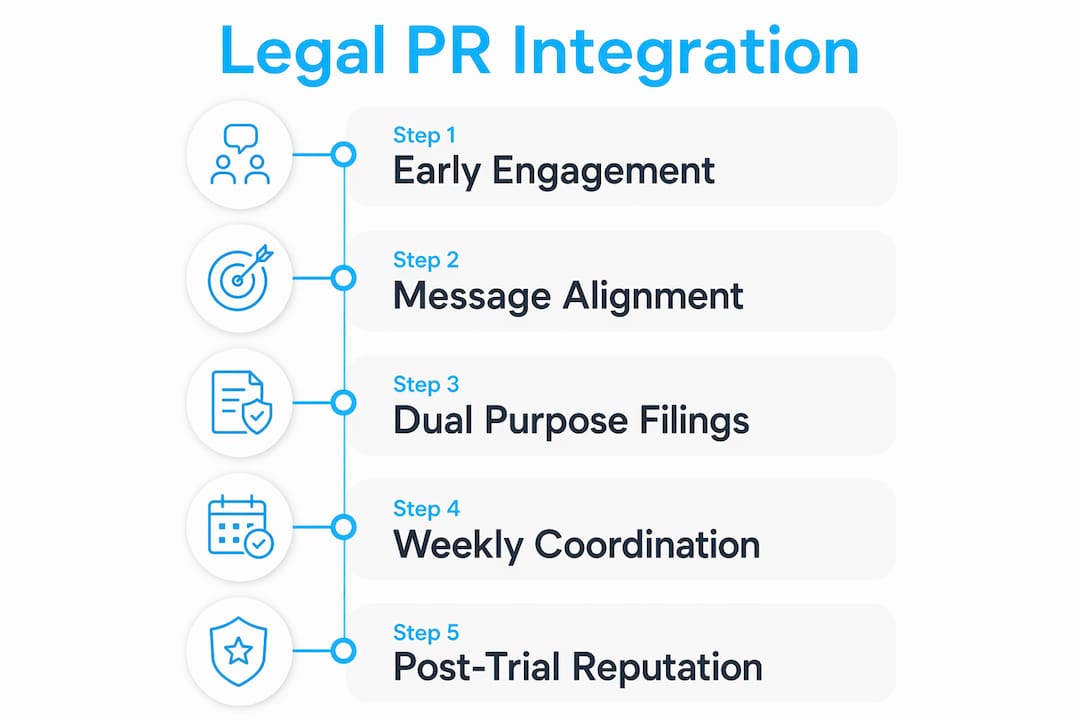
The most effective integration treats every public filing as a dual-purpose document. Public filings in major multidistrict litigations are now routinely drafted for both legal and public audiences. The legal argument must hold up in court; the language must also communicate clearly to journalists, investors, and the general public who will read excerpts online.
Message consistency between the courtroom and public communications is not optional. When a legal team argues one theory of the case in court and a PR team advances a different narrative in public, the contradiction becomes a story. Opposing counsel will use it. Journalists will amplify it.
Pro Tip: Hold a weekly alignment call between litigation counsel and the PR team. Agree on three core messages that both teams will reinforce in every public statement and court filing that week.
Different defendant profiles require different communication postures. A corporate defendant in a regulatory matter needs to demonstrate institutional accountability and process reform. An individual public figure facing criminal charges needs to humanize their story and maintain credibility with the public. A celebrity in a civil dispute needs to protect brand relationships while the case proceeds. Each posture requires a distinct message architecture, but all three share one requirement: consistency.
Litigation communications shape settlement leverage and public memory of cases more durably than verdicts in many instances. What is said outside the courtroom influences venue decisions, jury pool composition, and the post-verdict narrative that defines a client’s long-term reputation.
What does long-term reputation management look like after a high-profile case?
Crisis PR addresses the immediate fire. Long-term reputation management builds the structure that prevents the next fire from spreading. Sustained substantive content output, including podcasts, articles, and books, builds durable authority for public figures far more effectively than single PR-driven press cycles.
The distinction matters because audiences remember what they retrieve most easily. A public figure who consistently produces quality content creates a deep catalog of positive associations. A public figure who relies solely on crisis PR creates a catalog that consists almost entirely of crisis coverage.
Long-term reputation strategy for high-profile individuals should include:
- Owned media channels. A podcast, newsletter, or regular column gives the client a platform they control, independent of editorial gatekeepers.
- Third-party credibility signals. Op-eds in recognized publications, expert commentary in news coverage, and speaking engagements build authority that press releases cannot replicate.
- Authenticity as a baseline standard. Transparency and sincerity in public statements increase positive audience responses and reduce backlash. Audiences detect performative communication quickly, and the backlash it generates compounds existing legal problems.
- Consistent narrative reinforcement. Every piece of content should connect to the core narrative the legal and PR teams established at the outset of the case.
The risk of collapsing this long-term work onto a short-term PR push is significant. When the press cycle ends, so does the protection. Clients who invest in sustained content build a reputation that outlasts any single legal matter.
Key Takeaways
High-profile cases require professional public relations because public perception directly shapes legal outcomes, settlement leverage, and long-term reputation, making PR an integral part of litigation strategy from day one.
| Point | Details |
|---|---|
| Start PR at filing | Engage a PR team simultaneously with litigation counsel to control the early narrative. |
| Juror bias is real | Media coverage shapes juror beliefs before trial; pre-trial PR frames the narrative first. |
| Mortification outperforms denial | Admitting fault with sincerity generates the most positive audience response in crisis situations. |
| Filings are communications | Draft public filings for both legal and general audiences to maintain consistent messaging. |
| Sustained content wins long-term | Podcasts, articles, and books build durable reputation authority that crisis PR alone cannot achieve. |
Why I think most legal teams still underestimate PR’s role
After years of working at the intersection of media and legal affairs, the pattern I see most often is this: legal teams treat PR as a support function rather than a co-equal strategy. They call a PR firm after the story breaks, after the filing goes public, after the first damaging headline runs. By then, the narrative has already hardened.
The attorneys I respect most understand that the courtroom and the court of public opinion run simultaneously. They brief their PR partners on legal strategy, not just talking points. They understand that media appearances in non-traditional channels humanize clients in ways that formal press statements never will. They know that a well-timed podcast appearance can shift public sympathy more effectively than a press conference.
The hardest lesson I have seen legal teams learn is that silence is a message. Choosing not to communicate does not protect a client. It hands the narrative to whoever is willing to fill the vacuum. In high-profile cases, that vacuum fills fast, and it rarely fills favorably.
— Ryan McCormick
Goldman McCormick PR and high-profile legal case communications
Goldman McCormick PR has specialized in legal PR since its founding in 2010, and the New York Observer recognized the firm as one of the top five legal PR agencies in the country in 2014.

Forbes Magazine named Goldman McCormick PR one of America’s Best PR Firms for 2021. The firm’s work spans television, radio, newspapers, podcasts, and nationally syndicated programs on the Genesis Communications Network and Starcom Radio Network. For legal professionals and PR strategists managing high-profile matters, Goldman McCormick PR offers the media relationships, message architecture, and sustained communications support that complex cases demand. Learn more about legal PR services and how the firm protects client reputations from the first headline to the final verdict.
FAQ
Why do high-profile cases need PR from the start?
Jurors form impressions from media coverage before trial begins. Early PR shapes the narrative before those impressions harden into fixed beliefs.
How does PR affect the outcome of a legal case?
Litigation communications influence jury pool composition, settlement leverage, and post-verdict public memory, often more durably than the verdict itself.
What is the most effective crisis communication strategy?
Mortification, admitting fault and expressing genuine regret, generates the highest positive audience reception and the least backlash compared to denial or deflection.
How should PR and legal teams coordinate during a case?
Both teams must align on core messages weekly and treat every public filing as a document written for both legal and general audiences to maintain consistency.
What does long-term reputation management require after a case?
Sustained content output, including podcasts, articles, and expert commentary, builds retrieval-based authority that outlasts any single press cycle or legal matter.