
Pitching mental health experts to media requires a fundamentally different approach than standard PR outreach. Cold-pitch hit rates for mental health expert placements average only 1–3%, while relationship-based approaches reach 15–25%. That gap explains why firms like Goldman McCormick PR and agencies such as Skout PR build media relationships before they ever send a pitch. The most effective method combines a data-driven hook, verified expert credentials, and prior trade press placements. This guide breaks down exactly how PR firms pitch mental health experts and what separates placements that land from pitches that get deleted.
How PR firms pitch mental health experts: the core framework
The standard industry term for this practice is expert media placement, and it follows a defined structure. An effective mental health pitch includes four critical elements: a strong data hook, an expert source with credentials, clear availability, and a compelling news frame. Each element does specific work. The data hook gives the journalist a reason to care. The credentials establish why this expert speaks with authority. Availability tells the editor the story can move fast. The news frame connects the expert to something already on the public’s radar.
Generic pitches skip the news frame entirely. That is the single most common reason mental health expert pitches fail. A pitch that reads “Dr. Smith is available to discuss anxiety” gives a journalist nothing to work with. A pitch that reads “Dr. Smith’s clinical data shows a 40% rise in workplace anxiety among adults under 35, timed to the release of the APA’s annual stress report” gives a journalist a story.
Pro Tip: Avoid promotional language in every pitch. Journalists covering behavioral health expect clinical grounding. Phrases like “leading expert” or “groundbreaking approach” signal a press release, not a story.
What makes a pitch newsworthy for mental health topics?
Newsworthiness in mental health PR is tied directly to timing and clinical specificity. Pitches anchored to a published study, a national awareness month, or a breaking news event perform consistently better than evergreen pitches sent without context. Wellbeing commentary carries clinical and ethical weight, which means PR communication must be grounded in behavioral science and clinical accuracy rather than promotional hype.
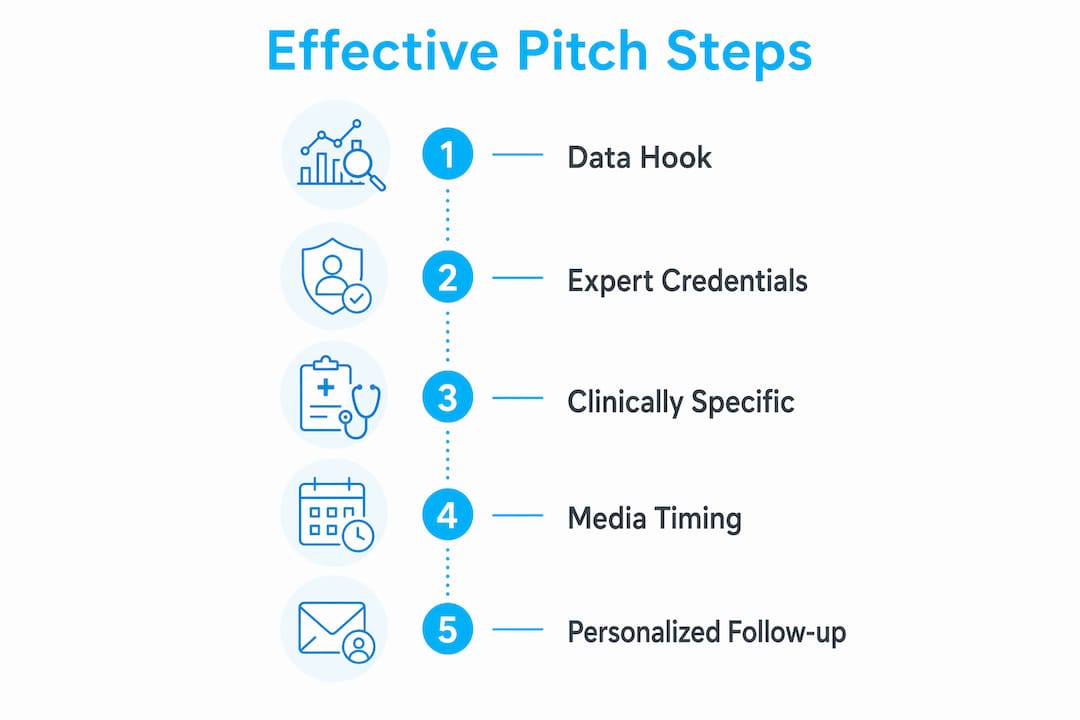
The strongest pitches connect an expert’s specific clinical experience to a current public conversation. For example, a licensed psychiatrist who has treated long-COVID patients with depression becomes highly relevant when the CDC releases new data on post-viral mental health outcomes. The pitch does not promote the psychiatrist. It positions them as the clearest voice on a story journalists are already writing.
A strong pitch also respects the journalist’s beat. A feature writer at The New York Times covering mental health has different needs than a health editor at a regional TV station. Tailoring the news frame to the outlet’s audience is not optional. It is the difference between a reply and silence.
How do PR firms build media relationships for mental health placements?
Relationship building is the single highest-impact move in behavioral health PR. Trade press placements generate citation signals that mainstream media relies on when vetting expert sources. A psychiatrist quoted in Psychiatric Times or Behavioral Health Business carries more credibility with a Today Show producer than one with no media record at all.
The sequence that works looks like this:
- Secure two to three placements in behavioral health trade publications before approaching mainstream outlets.
- Identify feature writers and health reporters at target outlets by reviewing their recent bylines, not just their job titles.
- Send a brief, non-pitch introduction referencing a specific article they wrote and offering the expert as a future source.
- Follow up with a pitch only after the reporter has acknowledged the introduction or engaged with prior outreach.
- Maintain the relationship between placements by sharing relevant clinical data or study findings the reporter might find useful.
“Building ongoing relationships with trade press reporters is the single highest-impact PR move for behavioral health media placements.” — Earning Coverage In Behavioral Health Publications
Cold-pitching mainstream media without trade press credibility produces negligible results. The archive of prior placements is not just a credential. It is the proof that the expert can communicate clearly under editorial scrutiny.
What role does AI play in pitching mental health experts to podcasts?

Podcast outreach has become a primary channel for mental health expert visibility, and AI tools have changed how PR firms approach it. AI-generated personalized podcast pitches achieve a 3.2% pitch-to-booking rate when targeting shows with over 1,000 listeners. That rate is low in absolute terms, but it is significantly higher than untargeted outreach, which rarely clears 1%.
The difference comes from personalization at scale. Tools like Podseeker’s mental health podcast database provide verified contacts, audience size data, and AI pitch generation for efficient outreach. A PR professional can research a show’s format, the host’s interview style, and the audience’s primary concerns before drafting a single line. That research shows up in the pitch and signals to the host that the expert is a genuine fit, not a mass-blast submission.
| Outreach Method | Estimated Booking Rate | Key Advantage |
|---|---|---|
| Cold, untargeted podcast pitch | Under 1% | Low effort, low return |
| AI-personalized pitch (1,000+ listeners) | 3.2% | Scales with verified data |
| Relationship-based pitch (prior contact) | 15–25% | Highest credibility signal |
Pro Tip: Before pitching a podcast host, listen to at least two full episodes. Reference a specific guest or topic from those episodes in your pitch. Hosts notice, and it doubles your reply rate.
Automated workflows for tracking follow-ups also matter. A pitch sent without a follow-up system loses momentum fast. Most bookings happen on the second or third contact, not the first.
How should mental health experts prepare their own pitch?
The expert’s ability to pitch themselves clearly is as important as the PR firm’s media strategy. Harvard Innovation Labs’ one-minute pitch framework adapted for health care and life sciences shows that clarity and domain mastery outperform memorized scripts every time. Journalists favor experts who demonstrate clear thinking over those who recite prepared talking points.
A strong one-minute pitch for a mental health expert covers four elements:
- The hook: One sentence stating the specific problem or insight the expert addresses.
- The solution or perspective: What the expert’s clinical experience or research reveals about that problem.
- The credentials: One or two facts that establish authority without sounding like a resume.
- The call to action: A clear statement of availability and what the expert can offer the journalist’s audience.
Balancing clinical insight with accessible language is the hardest part. An expert who speaks only in diagnostic terminology loses a general audience. An expert who oversimplifies loses credibility with editors. The goal is to explain a clinical concept the way a skilled teacher would, not the way a textbook does.
What are best practices for sustaining mental health expert visibility over time?
Long-term media visibility requires treating clinical research as a standing asset, not a one-time pitch. Reactive commentary using clinical studies as standing assets is the most credible expert positioning method in mental health PR. One well-designed study can generate multiple earned media stories across different outlets and formats.
Tactics that sustain visibility include:
- Filing a clinical study or proprietary data set as a permanent media reference document, updated annually.
- Pitching the same data to feature writers, health editors, and podcast hosts with different angles tailored to each format.
- Responding to breaking news with pre-prepared commentary that references the standing clinical asset.
- Tracking which outlets have cited the expert before and returning to those reporters with new data first.
The PR professionals who build the strongest long-term visibility for mental health experts treat each placement as the start of a media relationship, not the end of a campaign.
Key takeaways
Effective pitching for mental health experts combines clinical credibility, trade press groundwork, and personalized outreach to produce placements that last.
| Point | Details |
|---|---|
| Lead with a data hook | Every pitch needs a specific, timely data point that gives journalists a story to tell. |
| Build trade press first | Securing behavioral health trade placements before mainstream outreach raises hit rates from 1–3% to 15–25%. |
| Use AI for podcast outreach | AI-personalized pitches targeting shows with 1,000+ listeners achieve a 3.2% booking rate. |
| Prepare a one-minute expert pitch | Clarity and domain mastery signal credibility to journalists more than scripted talking points. |
| Treat clinical data as a standing asset | One study can generate multiple earned media stories across formats and outlets over time. |
My take on where mental health PR pitching is heading
I have watched the mental health PR space change significantly over the past decade. The biggest shift is not the technology. It is the expectation of clinical rigor. Journalists covering behavioral health are better informed than they were five years ago. They push back on vague claims and promotional framing faster than ever.
The firms that consistently place mental health experts are the ones that invest in the relationship before the pitch. That sounds obvious, but most PR professionals still skip it. They send a cold email to a senior editor at a national outlet and wonder why they hear nothing back. The trade press step is not a consolation prize. It is the foundation.
AI tools for podcast outreach are genuinely useful, and I expect their role to grow. But they work best when the expert’s core message is already sharp. No algorithm fixes a pitch that lacks a clear news frame or a credible data hook. The technology amplifies good strategy. It does not replace it.
The ethical dimension of mental health PR also deserves more attention than it gets. Clinically grounded communication is not just a best practice. It is a professional obligation when the topic affects vulnerable people. PR firms that treat mental health experts like any other client miss that entirely.
— Ryan McCormick
Goldman McCormick PR and mental health expert media placement
Goldman McCormick PR has built its reputation on getting clients seen, heard, and read. Named by Forbes Magazine as one of America’s Best PR Firms for 2021, the firm combines data-driven outreach with deep media relationships across TV, radio, and print.
For mental health experts seeking real media visibility, Goldman McCormick PR offers tailored PR campaigns that move from trade press placements to mainstream national coverage. The firm’s experience with internet radio audience growth and broadcast media gives mental health clients access to channels that most PR firms overlook entirely. If your goal is consistent, credible expert placement, Goldman McCormick PR delivers the results your expertise deserves.
FAQ
What is the average success rate for cold pitching mental health experts?
Cold-pitch hit rates for mental health expert placements average only 1–3%. Building prior trade press relationships raises that rate to 15–25%.
How do PR firms use AI to pitch mental health experts to podcasts?
AI-generated personalized pitches targeting podcasts with over 1,000 listeners achieve a 3.2% pitch-to-booking rate. Tools like Podseeker provide verified contacts and AI pitch generation for efficient outreach.
What are the four elements of an effective mental health expert pitch?
An effective pitch includes a strong data hook, an expert source with credentials, clear availability, and a compelling news frame. Missing any one of these elements significantly reduces placement success.
Why is trade press important before pitching mainstream media?
Trade press placements build the media archive that mainstream journalists and producers use to verify an expert’s credibility. Without that archive, mainstream outreach rarely produces results.
How can one clinical study generate multiple media placements?
A single study can be pitched as a feature article, reactive commentary, a podcast topic, and a TV news segment by tailoring the angle to each format and outlet. Filing the study as a standing media asset allows PR firms to reference it repeatedly as new news hooks arise.