
Public relations is the most underused client acquisition tool in criminal defense law. Clients contacting after media exposure convert at higher rates and reduce acquisition costs compared to cold advertising channels. That single fact explains how PR supports attorney client acquisition better than any marketing pitch. When a prospect sees your name in a news segment or hears you on a podcast, they arrive at the consultation already convinced. The credibility work is done before you say a word.
How PR supports attorney client acquisition through earned media
Earned media is the core engine of law firm public relations. A quote in a local newspaper, a TV interview on a criminal defense case, or a guest appearance on a legal podcast all function as third-party endorsements. No paid ad can replicate that signal.

Prospects influenced by journalistic features or podcast mentions arrive pre-sold on an attorney’s competence, which reduces sales friction and shortens the consultation. That means your staff spends less time convincing and more time signing clients.
The most effective PR tactics for legal services include:
- Earned media placements: Pitch yourself as a criminal defense expert to local TV stations, legal news outlets, and general interest publications. Comment on high-profile cases in your jurisdiction.
- Thought leadership content: Write byline articles for outlets like Above the Law or Law360. Speak at bar association events or CLE programs.
- Podcast appearances: Criminal justice and true crime podcasts attract exactly the audience that may need a defense attorney. A single appearance can generate inquiries for months.
- Dedicated landing pages: Link every media mention to a specific landing page with a clear call to action. This captures interest at peak engagement and feeds your intake system.
Compliant messaging matters here. PR content must inform and educate, not solicit. The distinction protects you legally and actually performs better because readers trust informational content more than promotional copy.
Pro Tip: When you land a media placement, create a short URL that routes directly to a dedicated intake page. Attach that URL to every social share of the coverage. You will capture far more inquiries than if you simply link to your homepage.
How do you measure pr’s impact on client acquisition?
Measurement is where most law firms fail with PR. Without a system, you cannot calculate cost per client or justify continued investment.
The most reliable approach uses multi-point attribution. Here is how to build it:
- Add a “How did you find us?” field to every intake form. Make it a required field with specific options: TV, radio, newspaper, podcast, referral, Google search, and social media. Free-text answers are too vague to analyze.
- Install call tracking with unique numbers. Tools like CallRail use dynamic number insertion to assign a unique phone number to each marketing source, including individual PR placements. Every call is logged and attributed automatically.
- Cross-reference intake data with your CRM. If a client says they found you via a podcast but your CRM shows they clicked a Google ad first, you have a multi-touch scenario. Record both.
- Calculate cost per signed client by channel. Divide your total PR spend (agency fees, time, production) by the number of clients who cited PR as a source. Compare that figure to your cost per client from paid search or social ads.
Clients often misremember how they first found a lawyer, which means relying solely on client recollection undervalues PR’s true contribution. Cross-checking intake data with call tracking and web analytics corrects that bias.
| Measurement Method | What It Captures | Best Tool |
|---|---|---|
| Intake form attribution | Client-stated source at first contact | Practice management software |
| Call tracking | Phone leads by campaign or placement | CallRail |
| CRM cross-reference | Multi-touch attribution across channels | Clio, Salesforce |
| Landing page analytics | Traffic and conversions per media asset | Google Analytics 4 |
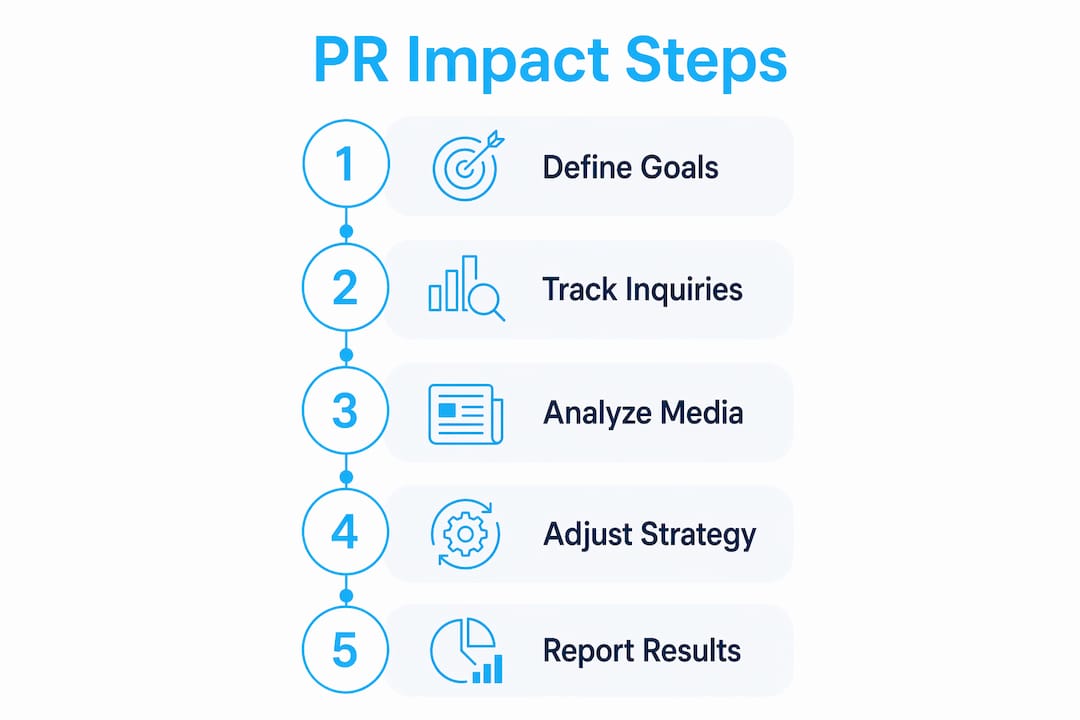
Aligning PR planning with intake workflows and business development goals is what separates firms that can prove ROI from those that guess. Build the measurement system before you launch the campaign, not after.
What legal and ethical rules govern attorney PR?
Attorney PR is not exempt from professional conduct rules. Criminal defense attorneys must understand the line between permissible advertising and prohibited solicitation.
Key rules to know:
- Illinois RPC Rule 7.2 permits advertising legal services with conditions, including required disclosures about the responsible lawyer. Any PR content published online or in media that promotes your services must comply with these disclosure requirements.
- Illinois RPC Rule 7.3 prohibits live solicitation with a pecuniary motive unless specific exceptions apply. This means PR outreach that involves direct, real-time contact with a prospective client crosses into prohibited territory.
- All PR assets require counsel review. Content and calls to action in media campaigns should be vetted by a legal ethics advisor before publication. This includes social media posts that promote media appearances.
- Disclaimers are not optional. If a PR piece could be construed as advertising, include the required disclosures. When in doubt, add them.
Legal PR campaigns that include promos or follow-ups intended to convert prospects require legal counsel review to confirm no solicitation rules are violated. The risk of non-compliance is not just disciplinary. It can damage the very reputation you are trying to build.
PR vs. traditional marketing: which drives better clients?
The comparison between PR-driven acquisition and traditional paid marketing reveals a clear pattern for criminal defense attorneys.
| Factor | PR-Driven Acquisition | Paid Advertising |
|---|---|---|
| Lead quality | High. Prospects arrive pre-qualified by media exposure | Variable. Depends on targeting precision |
| Trust level at first contact | High. Third-party credibility already established | Low to medium. Prospect is skeptical |
| Cost per client | Lower over time as media assets compound | Consistent but ongoing spend required |
| Time to first result | Slower. Placements take weeks to generate inquiries | Faster. Ads can run within days |
| Referral multiplier | High. Media exposure generates word-of-mouth | Low. Ads rarely generate referrals |
PR strategies for lawyers shine when the goal is high-value case acquisition. A client facing serious felony charges is not clicking a banner ad. They are researching attorneys, reading coverage, and asking for referrals. A media presence answers all three.
Paid advertising still has a role. It fills the pipeline while PR builds momentum. The strongest firms use both, with PR establishing authority and paid channels capturing immediate demand.
Pro Tip: Repurpose every media placement across your owned channels. A TV segment becomes a blog post, a social clip, and an email to your referral network. One placement generates multiple touchpoints, which compounds the trust effect without additional PR spend.
Key takeaways
Law firm public relations drives client acquisition by building third-party credibility that converts prospects faster, at lower cost, and with higher case quality than paid advertising alone.
| Point | Details |
|---|---|
| Earned media pre-sells credibility | Prospects from media exposure arrive convinced, reducing consultation time and increasing conversion rates. |
| Measurement requires multi-touch attribution | Use intake forms, CallRail, and CRM data together to accurately calculate PR’s cost per client. |
| Ethics rules apply to all PR content | Illinois RPC 7.2 and 7.3 govern attorney advertising and solicitation. All PR assets need counsel review. |
| PR outperforms paid ads on lead quality | Media-driven prospects are more pre-qualified and generate more referrals than ad-click leads. |
| Integration with intake workflows is critical | Aligning PR planning with intake systems ensures visibility translates directly into signed clients. |
What i’ve learned running legal PR for criminal defense attorneys
The attorneys who get the most from PR are the ones who treat it as a business development system, not a vanity exercise. I have seen defense lawyers land a major TV segment and then lose the leads because their intake process was not ready to handle the volume. The media exposure worked. The firm was not prepared.
The second mistake I see constantly is treating PR measurement as an afterthought. Early collaboration across marketing, communications, and business development is what makes visibility translate into revenue. If your intake coordinator does not know a campaign is running, they cannot capture the attribution data you need to prove it worked.
High-value criminal defense cases absolutely justify serious PR investment. A single retained client on a complex federal case can return multiples of an entire year’s PR spend. The math works. But only if you measure it, comply with ethics rules, and connect your media presence to a functioning intake system.
Periodic review matters too. Revisit your attribution data every quarter. Drop placements that generate no inquiries. Double down on the outlets and formats that produce signed clients.
— Ryan McCormick
Work with a legal PR firm that understands client acquisition
Goldman McCormick PR has specialized in legal public relations since 2014, when the New York Observer named the firm one of the top five PR agencies in the country for legal work. Forbes Magazine recognized Goldman McCormick PR as one of America’s Best PR Firms for 2021.
Goldman McCormick PR builds media campaigns for criminal defense attorneys that are designed from the start to generate signed clients, not just coverage. The firm’s work spans TV, radio, newspapers, podcasts, and nationally syndicated programs on the Genesis Communications Network and Starcom Radio Network. If you are ready to connect your PR strategy to measurable client growth, Goldman McCormick PR delivers the results your practice deserves. Reach out to discuss how a tailored legal PR program can work for your firm.
FAQ
How does PR differ from advertising for attorneys?
PR generates earned media coverage from third-party sources like journalists and podcasters, which carries more credibility than paid ads. Advertising is paid placement; PR is earned placement, and the trust difference directly affects conversion rates.
What is the fastest way to track pr-driven client inquiries?
Add a required “How did you find us?” field to your intake form and pair it with call tracking tools like CallRail. Cross-referencing both data sources gives you accurate attribution without relying on client memory alone.
Do ethics rules apply to attorney media appearances?
Yes. Illinois RPC Rules 7.2 and 7.3 govern how attorneys promote their services in media, including required disclosures and prohibitions on live solicitation. All PR content and calls to action should be reviewed by a legal ethics advisor before publication.
How long does it take for PR to generate new clients?
PR typically takes several weeks to months before media placements begin generating consistent inquiries. Paid advertising produces faster initial results, which is why combining both channels works better than relying on PR alone during the ramp-up period.
Can criminal defense attorneys use podcasts for client acquisition?
Yes. Podcast appearances are one of the most effective PR tactics for legal services because they reach engaged audiences who may need defense representation. Each appearance should link to a dedicated intake page to capture inquiries at peak interest.