
A law firm’s online reputation acts as a digital referral, doing much of the selling before a client ever makes contact. For criminal defense attorneys in New York, growing your professional reputation now means mastering local SEO, client review management, and public relations, not just winning cases. Law firms with 50+ positive reviews rank in the top 3 local search results 72% more often than competitors. That single statistic defines the stakes. This guide delivers the specific tactics, tools, and pitfalls you need to build attorney credibility in New York’s most competitive boroughs.
How to grow legal reputation in new york: foundations first
Before any tactic works, your digital infrastructure must be solid. The industry term for this is online reputation management, and it covers everything from directory listings to AI-powered review workflows.

NAP consistency is the starting point. NAP stands for Name, Address, and Phone number. Inconsistent NAP data across directories heavily penalizes local search rankings in NYC. Search algorithms treat mismatched data as a low-trust signal, which pushes your firm down in the Google Map Pack where clients actually look.
The second pillar is backlinks. Maintaining 30+ high-authority backlinks correlates to 78% higher first-page ranking on Google for NYC legal terms. That means getting listed on Avvo, Justia, FindLaw, and the New York State Bar Association directory is not optional. It is the baseline.
| Tool or Practice | Purpose | Impact Level |
|---|---|---|
| NAP consistency audit | Align all directory listings | Critical |
| High-authority legal directories | Build backlink profile | High |
| AI review automation | Collect and manage client feedback | High |
| Google Business Profile | Control Map Pack presence | Critical |
| Borough-specific landing pages | Capture local search intent | High |
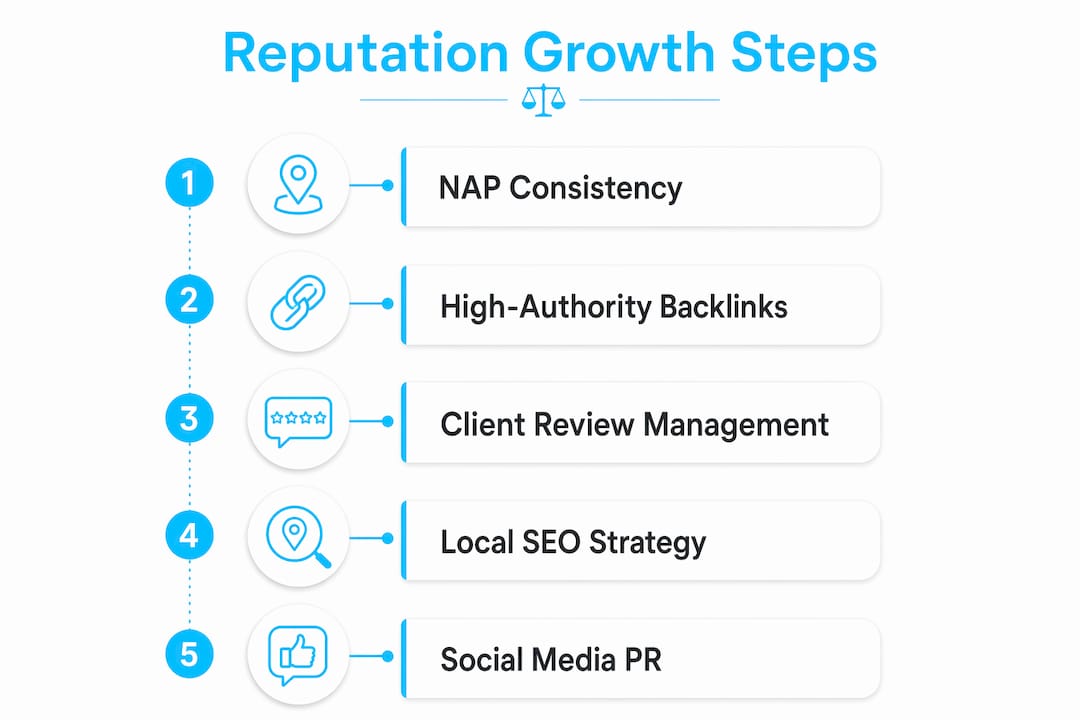
Pro Tip: Run a free NAP audit using Moz Local or BrightLocal before doing anything else. Fixing mismatches in the first 30 days produces faster ranking gains than any new content you publish.
79% of legal professionals now use AI tools to automate review collection and client communication tasks. That adoption rate signals a competitive standard, not an optional upgrade.
How can attorneys build and manage client reviews ethically?
Client reviews are the most direct way to improve your legal image in NYC, and the New York Rules of Professional Conduct set clear boundaries on how you collect them. Working within those rules is not a limitation. It is a credibility signal in itself.
Here is a compliant, effective review-building process:
- Send a follow-up message within 48 hours of case resolution. Timing matters. Clients are most willing to share feedback when the outcome is fresh.
- Personalize the request. Reference the specific matter type, such as a DUI defense or assault charge dismissal, without disclosing confidential details. Generic requests get ignored.
- Direct clients to Google, Avvo, and Yelp in that order. Google reviews carry the most weight for local search rankings.
- Respond to every review, positive and negative, within 72 hours. A professional response to a one-star review demonstrates character to every prospective client reading it.
- Use an automated follow-up sequence through tools like Clio Grow or a CRM with email automation to send one reminder if the first request goes unanswered.
Maintaining 50 or more positive reviews is not just a vanity metric. The 72% ranking advantage for firms at that threshold translates directly into more phone calls from Manhattan, Brooklyn, and the Bronx.
Pro Tip: Never ask for a review inside your office or immediately after a client pays. Bar association guidance in New York treats pressure-based solicitation as a potential ethics violation. Let the follow-up message do the work.
What local SEO strategies work best in nyc’s borough markets?
46% of all Google searches carry local intent, and that percentage is even higher for legal queries in New York City. A Brooklyn resident searching for a criminal defense attorney is not looking for a generic NYC result. They want someone in their borough.
Borough-specific landing pages solve this directly. A page titled “Criminal Defense Attorney in the Bronx” with localized content, court references like Bronx Supreme Court, and neighborhood-specific language captures intent-driven traffic that shared lead services cannot replicate. Building borough-specific landing pages allows firms to capture high-quality traffic exclusive from those shared services.
Your Google Business Profile is the second critical asset. Optimize it with:
- The correct primary category: “Criminal Justice Attorney”
- Borough-level service areas listed explicitly
- Weekly Google Posts covering case results, legal updates, or firm news
- Photos of your office, team, and any media appearances
| Local SEO Approach | Primary Benefit | NYC-Specific Application |
|---|---|---|
| Borough landing pages | Captures local search intent | One page per borough you serve |
| Google Business Profile | Map Pack visibility | Weekly posts, updated service areas |
| Legal directory citations | Backlink authority | Avvo, Justia, NYSBA, FindLaw |
| Localized blog content | E-E-A-T signals | Cover NYC courts, local statutes |
| NAP consistency | Trust signals | Audit every 90 days |
Google’s E-E-A-T framework (Experience, Expertise, Authoritativeness, Trustworthiness) is central to law firm SEO success in New York. Building a resource hub with substantive legal content outperforms keyword stuffing every time.
How does social media and PR strengthen your legal reputation?
Active engagement on social media drives brand authority, trust signals, and client referrals for NYC law firms. The platforms that matter most for criminal defense attorneys are LinkedIn for professional credibility and YouTube for educational content that ranks in search.
Consistent content is the mechanism. A weekly LinkedIn post analyzing a recent New York Court of Appeals decision positions you as a thought leader. A short YouTube video explaining what happens at arraignment in Manhattan Criminal Court answers a question thousands of people search every month.
Public relations amplifies everything. A feature in the New York Post, a quote in the Daily News, or a segment on NY1 builds the kind of credibility that no Google ad can buy. Goldman McCormick PR has placed attorneys in exactly these outlets, and the downstream effect on search rankings and client inquiries is measurable.
Pro Tip: Repurpose every media appearance. A TV segment becomes a LinkedIn post, a blog article, and a Google Business Profile update. One piece of earned media should generate at least four pieces of owned content.
What are the most common pitfalls in online reputation growth?
Most attorneys who struggle to enhance their legal reputation in NYC make the same avoidable mistakes.
- Mismatched NAP data. A single address variation between your website and Google Business Profile can suppress your Map Pack ranking for months.
- Over-reliance on shared lead services. Shared lead services can cost firms up to $6,000 per signed case and reduce control over client acquisition. Building organic authority costs more time upfront but delivers compounding returns.
- Ignoring negative reviews. A public, professional response to criticism is one of the strongest trust signals available to a prospective client reading your profile.
- Inconsistent review collection. Firms that ask for reviews only after big wins create an unnatural review pattern. Request feedback after every resolved matter.
“The attorneys who consistently outrank their competition in New York are not necessarily the best litigators. They are the ones who treat their digital presence with the same discipline they bring to case preparation.”
Sustainable reputation building requires a monthly audit of your directory listings, a weekly content schedule, and a quarterly review of your backlink profile. Treat it as a practice management function, not a one-time project.
Key takeaways
Building attorney credibility in New York requires NAP consistency, a strong review base, borough-targeted SEO, and earned media working together as a single system.
| Point | Details |
|---|---|
| NAP consistency is non-negotiable | Mismatched directory data suppresses Map Pack rankings and signals low trust to Google. |
| 50+ reviews unlocks ranking advantages | Firms at this threshold rank in the top 3 local results 72% more often than competitors. |
| Borough pages capture local intent | Geo-specific landing pages outperform generic NYC pages for high-intent criminal defense searches. |
| PR multiplies digital authority | Media placements in outlets like the New York Post generate backlinks and trust signals simultaneously. |
| Shared leads carry high hidden costs | Building organic authority delivers better long-term ROI than paying up to $6,000 per shared case. |
Why digital reputation is the new courtroom advantage
I have worked in media and public relations for over a decade, and the shift I have watched in the NYC legal market is stark. Attorneys who dominated their practice areas five years ago purely on word-of-mouth referrals are now losing clients to younger firms with stronger Google profiles and more reviews.
The credibility crisis in NYC law stems from attorneys relying solely on courtroom skills. That is a real insight, not a cliché. Your next client will Google you before they call you. What they find in those first 10 seconds determines whether they dial your number or scroll to the next result.
What I have found actually works is treating digital reputation as a proactive system, not a reactive cleanup exercise. The firms that win in New York’s competitive borough markets are the ones that publish content consistently, respond to every review, and show up in the press. Courtroom skill gets you the result. Digital reputation gets you the client.
— Ryan McCormick
How goldman McCormick PR helps attorneys build their reputation in NYC
Goldman McCormick PR has spent over a decade placing attorneys in front of New York’s most influential media outlets, from television segments to newspaper features. Named by Forbes Magazine as one of America’s Best PR Firms for 2021 and cited by the New York Observer as a top five legal PR agency, Goldman McCormick PR brings direct media relationships that accelerate the credibility-building process for criminal defense attorneys.
If you are ready to strengthen your law firm’s reputation with earned media, strategic PR, and visibility that no paid ad can replicate, Goldman McCormick PR delivers exactly that for the NYC legal market. The attorneys who invest in professional reputation management today are the ones prospective clients find first tomorrow.
FAQ
What does it mean to grow a legal reputation in new york?
Growing your legal reputation in New York means building measurable online authority through local SEO, client reviews, media placements, and consistent digital content. The goal is to become the first attorney a prospective client finds and trusts when searching in their borough.
How many reviews does a NYC law firm need to rank locally?
Law firms with 50 or more positive reviews rank in the top 3 local search results 72% more often than competitors. Prioritize Google reviews first, then Avvo and Yelp.
Why is NAP consistency so important for attorney SEO?
Inconsistent Name, Address, and Phone data across directories signals low trust to Google’s algorithm and suppresses your ranking in the Map Pack. Audit your listings every 90 days using tools like Moz Local or BrightLocal.
Is social media worth the time for criminal defense attorneys?
Active social media engagement drives brand authority and client referrals for NYC law firms. LinkedIn and YouTube deliver the strongest returns for criminal defense practitioners who publish consistent, substantive content.
Should i use shared lead services to grow my client base?
Shared lead services can cost up to $6,000 per signed case and reduce your control over client acquisition. Building organic search authority through reviews, content, and backlinks produces better long-term results at lower cost per client.