
Media monitoring is defined as the systematic tracking and analysis of mentions and coverage about a brand, topic, or industry across print, online, broadcast, podcast, and social media channels. Platforms like Brandwatch, Meltwater, and TVEyes have made this practice standard for PR teams that need to understand how their clients are perceived in real time. The definition of media monitoring goes beyond simple clipping services. It captures quantitative signals like mention volume and sentiment alongside qualitative context, giving communications professionals the raw material to measure impact, detect reputation risks, and sharpen messaging before a story gets away from them.
What does media monitoring mean and what channels does it cover?
Media monitoring covers every channel where a brand, executive, or issue might surface publicly. That includes print newspapers and magazines, online news sites, broadcast television and radio, podcasts, and selected social media platforms. The scope is deliberately wide because a reputational story rarely stays in one lane. A critical segment on a local radio station can migrate to an online news article and then spread across social feeds within hours.

The distinction between media monitoring and social media monitoring matters here. Media monitoring is broader than social media monitoring, which is limited to platforms like X (formerly Twitter), Instagram, and Facebook. Media monitoring captures earned and editorial coverage that social listening tools miss entirely, including broadcast transcripts and podcast mentions. Most experienced PR teams run both in parallel to get a complete picture.
Pro Tip: When setting up monitoring for a new client, include broadcast and podcast sources from day one. Television and radio coverage carries outsized credibility with certain audiences and is routinely undertracked by teams that default to online-only tools.
| Channel | What it captures |
|---|---|
| Print and online news | Articles, op-eds, and editorial mentions in newspapers and news sites |
| Broadcast TV and radio | Spoken mentions captured via transcript or keyword scanning |
| Podcasts | Episode-level mentions tracked by platforms like TVEyes |
| Social media | Posts, shares, and comments on major social platforms |
How PR professionals use media monitoring data
The practical output of a monitoring program is what separates teams that react from teams that lead. Media monitoring helps PR teams track visibility, sentiment, and narrative trends over time to inform messaging, risk management, and strategic planning. A spike in negative mentions around a product recall, for example, gives a communications team the signal it needs to activate a crisis response before the story reaches national outlets.
Common professional applications include:
- Measuring PR campaign performance by tracking mention volume and outlet reach before, during, and after a campaign launch.
- Detecting emerging reputation risks by flagging unusual sentiment shifts or sudden increases in coverage around a sensitive topic.
- Identifying media opportunities by spotting journalists and outlets that cover relevant topics but have not yet written about the client.
- Informing message development by reviewing how competitors or industry peers are framed in coverage and adjusting positioning accordingly.
- Reporting to stakeholders by compiling mention counts, sentiment breakdowns, and coverage distribution into executive summaries.
Monitoring outputs commonly include mention volume, distribution across outlets, and basic sentiment scored as positive, negative, or neutral. Brand24 illustrates this with concrete examples: a brand mentioned 1,200 times in a month with 80% positive mentions tells a very different story than the same volume split evenly across sentiment categories. That context drives real decisions.
Pro Tip: Do not report raw mention counts to clients or executives without context. A jump from 200 to 800 mentions in a week means nothing without knowing whether the coverage was favorable, which outlets drove it, and whether the narrative matched your messaging goals.
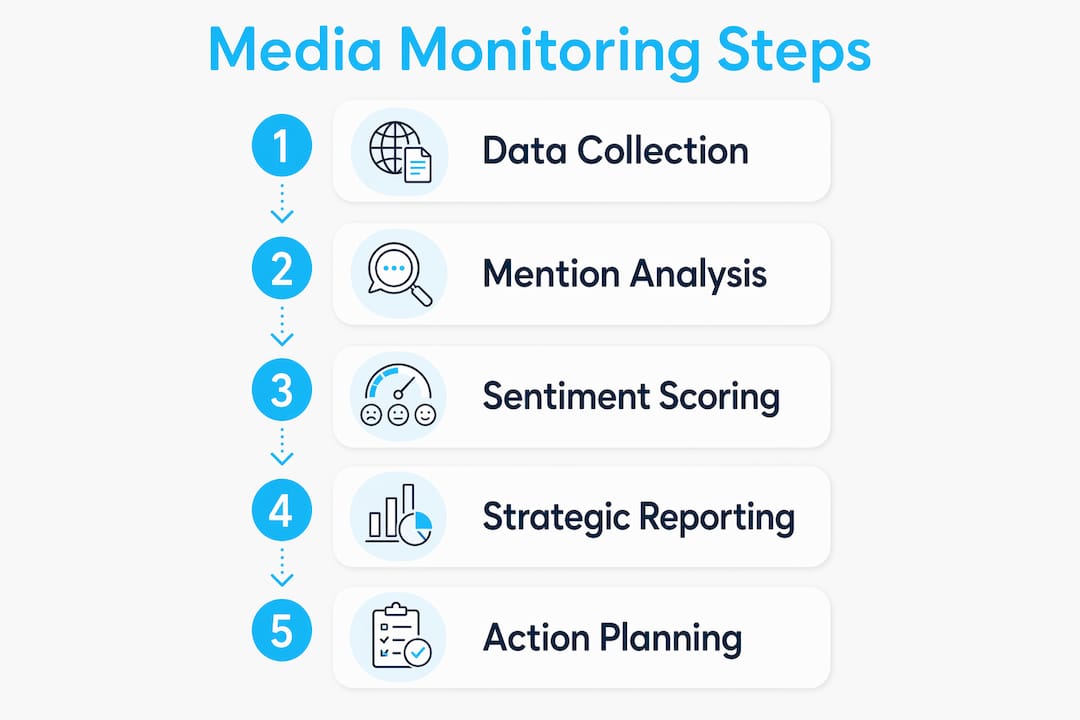
Media monitoring vs. social media monitoring vs. media analysis
These three terms are used interchangeably in many organizations, and that confusion produces shallow strategy. Brandwatch clarifies that media monitoring, social media monitoring, and social listening are distinct but complementary disciplines, and recommends using all three for full strategic coverage.
The clearest way to separate them is by scope and function:
| Term | Scope | Primary function |
|---|---|---|
| Media monitoring | All channels: print, broadcast, online, podcast, social | Track what is being said and where |
| Social media monitoring | Social platforms only | Track mentions and engagement on social channels |
| Media analysis | All monitored data | Interpret what the data means and what to do |
Media monitoring focuses on descriptive outputs: clip counts, distribution, and basic sentiment. Media analysis, sometimes called media intelligence, focuses on interpreting what those outputs mean and what strategic action they recommend. Treating them as the same thing leads to reports that describe activity without guiding decisions. A team that monitors without analyzing knows a story ran. A team that also analyzes knows whether that story helped or hurt, and what to do next.
Common pitfalls and best practices in media monitoring
The biggest trap in media monitoring is mistaking volume for value. Operational pitfalls include ambiguous query definitions that pull irrelevant mentions, over-reliance on raw counts, and automated sentiment errors that misread sarcasm or nuanced language. A query for “Goldman” without proper entity rules will return financial news about Goldman Sachs alongside any mentions of Goldman McCormick PR, inflating numbers and distorting reports.
Best practices that experienced teams follow:
- Define monitoring queries with specific entity rules, including brand name variations, executive names, and key product terms.
- Treat automated sentiment scoring as a starting point, not a conclusion. Human review is essential to correctly interpret nuance, sarcasm, or context shifts that algorithms miss.
- Set up real-time alerts for high-priority keywords so the team can respond to breaking coverage within hours, not days.
- Combine monitoring data with qualitative assessment to understand narrative framing. Monitoring alone does not reveal how coverage shapes public perception.
- Review query performance monthly and refine based on false positives or missed mentions.
Pro Tip: Run a sample audit of your first two weeks of clippings manually. You will almost always find irrelevant results that require query refinement. Fixing this early saves hours of wasted reporting time later.
How modern media monitoring platforms work
Platforms like Brandwatch, Meltwater, and TVEyes operate by scanning large volumes of sources continuously using keyword queries and machine learning classifiers. Collected items, called clippings, are presented in a feed-like view and summarized in automated reports that teams can schedule daily, weekly, or on demand. TVEyes specifically focuses on broadcast and podcast scanning, capturing spoken mentions that text-based tools cannot index.
The operational workflow typically runs in three stages. First, the platform ingests data from licensed source feeds across media types. Second, it filters results against the client’s keyword and entity rules. Third, it surfaces matches in a dashboard with metadata including outlet name, date, reach estimate, and sentiment tag. Integration with PR tools like Cision or Muck Rack allows teams to connect coverage data directly to their outreach and reporting workflows.
| Platform | Strength | Best use case |
|---|---|---|
| Brandwatch | Social and online news coverage | Brand sentiment and online narrative tracking |
| Meltwater | Broad media and news monitoring | PR measurement and competitive intelligence |
| TVEyes | Broadcast and podcast monitoring | Tracking TV, radio, and podcast mentions |
Key takeaways
Effective media monitoring requires combining automated platform data with human analysis to turn raw mentions into strategic communication decisions.
| Point | Details |
|---|---|
| Define media monitoring correctly | It is systematic tracking across print, broadcast, online, podcast, and social channels. |
| Separate monitoring from analysis | Monitoring describes what happened; analysis explains what it means and what to do. |
| Use multiple disciplines together | Pair media monitoring with social media monitoring and media analysis for full strategic coverage. |
| Avoid raw count reporting | Always contextualize mention volume with sentiment, outlet quality, and narrative framing. |
| Refine queries continuously | Well-defined entity rules prevent false positives and keep reporting accurate and credible. |
Why media monitoring is only as good as the strategy behind it
I have worked with PR teams that had access to excellent monitoring platforms and still produced reports that nobody acted on. The data was accurate. The dashboards were clean. But the team treated monitoring as a deliverable rather than a decision-making input. That is the most common mistake I see, and it is entirely avoidable.
The teams that get the most value from monitoring are the ones that connect every data point back to a communication objective. They are not asking “how many times were we mentioned?” They are asking “did our messaging land in the outlets that matter to our audience, and did the coverage frame us the way we intended?” Those are fundamentally different questions, and only the second one drives strategy.
I also caution against choosing a platform based on feature lists alone. The right tool depends on where your coverage actually lives. A consumer brand with heavy broadcast presence needs TVEyes or a comparable broadcast monitoring service. A B2B firm whose coverage runs in trade publications needs a platform with deep indexing of niche outlets. Matching the tool to the media mix is more important than any individual feature. For deeper reading on finding coverage across channels, this guide to local news coverage is worth your time.
— Ryan McCormick
How Goldman McCormick PR can support your media monitoring strategy
Goldman McCormick PR has spent over a decade helping clients understand exactly where they stand in the media. Named by Forbes Magazine as one of America’s Best PR Firms for 2021, the firm specializes in earned media across television, radio, and print, which means media monitoring is not an afterthought. It is built into how results are measured and reported.
If you want a PR partner that tracks coverage with the same rigor it uses to generate it, Goldman McCormick PR brings that discipline to every client engagement. Visit the Goldman McCormick PR website to learn more about how the firm approaches media monitoring and reputation management for businesses that take their communications seriously.
FAQ
What does media monitoring mean in simple terms?
Media monitoring means systematically tracking mentions of a brand, person, or topic across news, broadcast, podcasts, and social media to understand how the subject is being covered and perceived.
How is media monitoring different from social media monitoring?
Media monitoring spans all channels including print, broadcast, and online news, while social media monitoring is limited to platforms like X, Instagram, and Facebook. Most PR teams use both together for complete coverage.
What outputs does media monitoring produce?
Standard outputs include mention volume, outlet distribution, and basic sentiment scored as positive, negative, or neutral. These metrics inform PR reporting, crisis response, and messaging strategy.
What is the difference between media monitoring and media analysis?
Media monitoring collects and describes coverage, answering what was said and where. Media analysis interprets that data to explain what it means strategically and what actions the team should take.
Which platforms are commonly used for media monitoring?
Brandwatch, Meltwater, and TVEyes are three widely used platforms, each with different strengths across online news, broad media coverage, and broadcast or podcast monitoring respectively.