
Effective media outreach is defined by relevance, brevity, and timing. Journalists open about 46% of PR pitches but respond to only 3.43%, meaning roughly 1 in 30 pitches earns a reply. That gap tells you everything about how PR firms pitch journalists today. Sources like Propel, Muck Rack, and Sword & the Script have analyzed hundreds of thousands of pitches to identify exactly what separates deleted emails from published stories. The answer is not volume. It is precision.
How PR firms pitch journalists: the relevance factor
Relevance is the single most decisive factor in pitch success. According to the 2026 Muck Rack State of Journalism report, 70% of journalists value beat relevance above everything else when evaluating a pitch. That means a technically well-written pitch sent to the wrong reporter is still a failed pitch.
88% of deleted pitches are deleted because they are irrelevant to the journalist’s coverage area. This is not a small problem. It is the dominant reason pitches fail, and it is entirely preventable with basic research.

The standard industry practice for establishing relevance is beat matching. Before sending anything, read the journalist’s last 8 to 10 published articles. Identify their recurring themes, preferred sources, and story formats. A reporter covering fintech regulation does not want a pitch about a startup’s Series A unless that funding directly connects to a regulatory shift they have already written about.
Here is what effective relevance-driven pitching looks like in practice:
- Lead with the journalist’s beat in your opening sentence. “You’ve covered the rise of AI in healthcare billing. Our client’s new audit tool addresses the exact compliance gap you wrote about in March.”
- Name the audience. Tell the reporter why their readers will care. “Your readers at Modern Healthcare are navigating the same billing complexity your last three pieces addressed.”
- Tie the pitch to a news peg. Connect your story to a recent event, legislation, or trend the journalist has already covered.
- Avoid generic hooks. Phrases like “exciting new product” or “industry-leading solution” signal a mass email immediately.
Pro Tip: Before writing a single word of your pitch, open the journalist’s most recent byline and ask: does my story fit naturally into the next paragraph of what they are already writing? If the answer is no, rework the angle before hitting send.
Does pitch length actually change your response rate?
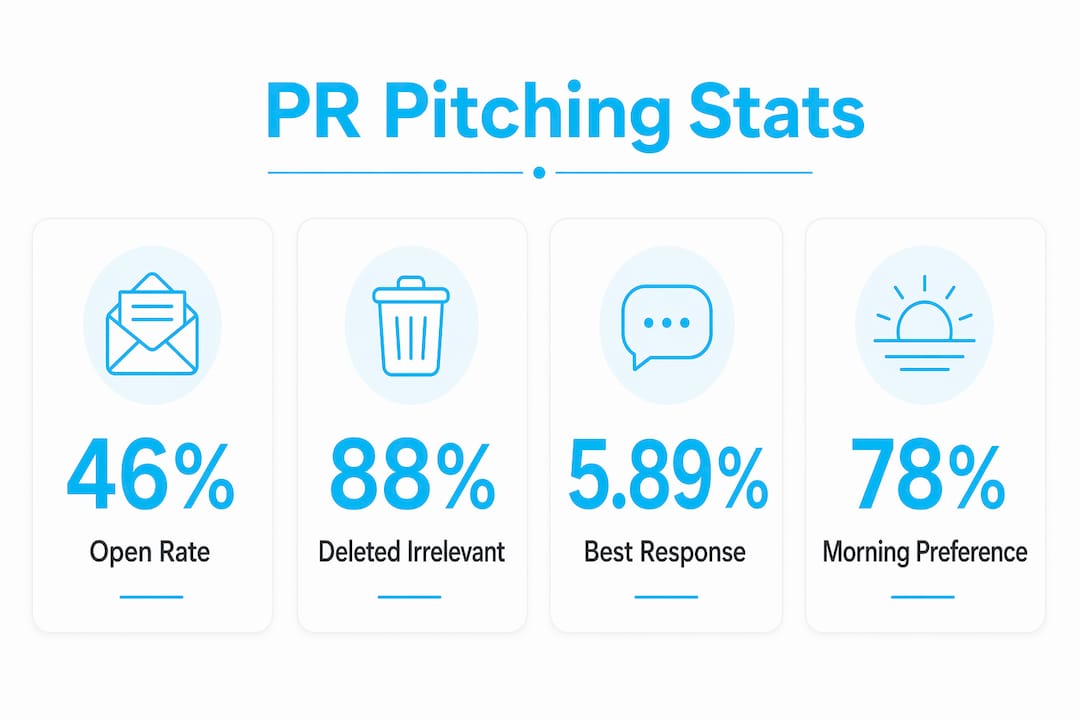
The data here is unambiguous. Pitches under 150 words earn a 5.89% response rate. Pitches over 500 words drop to 1.46%. That is a fourfold difference driven entirely by length. Journalists are not reading long pitches. They are scanning for a reason to care, and if that reason is not visible in the first two sentences, the email is gone.
The ideal pitch structure follows a clear four-part format:
- Subject line (6 to 8 words): Specific, not clever. “New data on remote work burnout in tech” beats “Exciting research you need to see.”
- One-sentence hook: State the story angle and why it matters now.
- Two to three sentence angle: Explain the news peg, the source, and the unique insight.
- One-sentence offer: Provide clear access. “I can connect you with our CEO for a 20-minute interview this week.”
Buzzwords destroy credibility faster than length does. Words like “disruptive,” “game-changing,” and “best-in-class” signal promotional intent rather than news value. Journalists are trained to write for readers, not for brands. If your pitch reads like a press release written by a marketing team, it will be treated like one.
Pro Tip: Read your pitch out loud before sending. If any sentence sounds like it belongs in a product brochure rather than a news article, cut it or rewrite it in plain language.
The PR Pitch Response Rate Study 2026 confirms that if the core story hook and value cannot fit in a brief email, the pitch is not yet reporter-ready. Brevity is not a stylistic preference. It is a structural requirement.
When should you send a pitch and follow up?
Timing is a tactical advantage most PR professionals underuse. 78% of journalists prefer pitches sent before noon, and the highest engagement windows fall on Tuesdays through Thursdays. Monday mornings are cluttered with weekend backlog. Friday afternoons are effectively dead zones for editorial decisions.
The data on follow-ups is equally specific. 50% of journalists say one follow-up is ideal, sent within 3 to 7 days of the original pitch. That window gives the reporter time to assess the first email without letting the story go cold.
Here is a practical timing framework:
- Day 1 (Tuesday or Wednesday, before 10 a.m.): Send the original pitch.
- Day 5 to 7: Send one follow-up with new information, not a resend.
- After day 7: If no response, move on. A second follow-up risks blacklisting.
The follow-up rule that most PR teams violate is this: a follow-up must add new information. A fresh data point, a newly available source, or a tightening deadline all justify a second email. “Just checking in” does not. Reporters remember who wastes their time, and that memory affects every future pitch you send.
Pro Tip: Use the follow-up to offer something the original pitch did not include. A new quote, an exclusive angle, or a time-sensitive hook gives the reporter a reason to reconsider without feeling pressured.
Common mistakes PR firms make when pitching reporters
Most pitch failures are self-inflicted. The Sword & the Script 2026 survey found that 71% of pitches are deleted for being overly promotional and 50% for looking like mass emails. Both problems share the same root cause: the pitch was written for the brand, not for the journalist.
The most common errors, and how to correct them:
- Mass emailing without personalization. Sending the same pitch to 200 reporters signals that you did no research. Use Muck Rack or a daily news briefing checklist to identify the right contacts before drafting anything.
- Promotional tone over news value. Every sentence should answer “why is this a story?” not “why is this product great?”
- Pitching the wrong outlet or beat. A technology pitch sent to a lifestyle reporter is not a near miss. It is a credibility loss.
- Attaching files to the first email. Attachments trigger spam filters and signal inexperience. Link to a press kit hosted online instead.
- No clear source access. 86% of journalists say their work began with a PR pitch, but 58% specifically value interview access. If you cannot offer a named source for an interview, your pitch is missing its most persuasive element.
- Increasing pitch volume instead of quality. Targeted, personalized pitches maximize outcomes. Sending more bad pitches does not improve your odds.
Key takeaways
Effective PR pitching requires relevance, brevity, and precise timing working together. Personalization and source access are not optional extras. They are the baseline requirements journalists expect before any pitch earns a response.
| Point | Details |
|---|---|
| Relevance drives response | 88% of deleted pitches fail because they do not match the journalist’s beat. |
| Keep pitches under 150 words | Pitches under 150 words earn a 5.89% response rate vs. 1.46% for pitches over 500 words. |
| Send before noon, Tuesday to Thursday | 78% of journalists prefer morning pitches mid-week for highest engagement. |
| One follow-up with new information | Send a single follow-up within 3 to 7 days, always adding fresh, reportable content. |
| Offer clear source access | 58% of journalists value interview access, making it one of the top pitch differentiators. |
What 15 years of watching pitches land and fail taught me
The most persistent myth in PR is that a great pitch is primarily a writing problem. It is not. It is a research problem. I have watched well-crafted pitches fail because the sender never read the journalist’s last five articles. I have also watched rough, plainly written emails generate front-page coverage because the angle was exactly what the reporter needed that week.
The PR professionals who consistently earn media coverage treat journalists as collaborators, not targets. They read bylines the way a good editor reads submissions. They understand that a reporter covering hyperlocal news has completely different story criteria than a national wire correspondent, and they adjust accordingly.
What I find most underrated in effective media outreach is patience combined with a short memory for rejection. A pitch that gets no response today is not a failed relationship. It is an incomplete one. The PR firms that build lasting journalist relationships treat every non-response as data, not defeat. They refine the angle, update the source, and try again when the timing is right.
The firms that struggle are the ones treating pitching as a numbers game. They send more, follow up more, and wonder why their response rates keep dropping. The data from Propel and Muck Rack is clear on this point: volume does not compensate for relevance. It just accelerates the damage to your sender reputation.
— Ryan McCormick
How Goldman McCormick PR can sharpen your media strategy
Goldman McCormick PR was founded by active and former members of the media, which means the firm understands pitch strategy from both sides of the inbox. Named by Forbes Magazine as one of America’s Best PR Firms for 2021, Goldman McCormick PR specializes in earned media placement across TV, radio, and print. That background translates directly into pitches that are built around what journalists actually need, not what clients want to say.
If your current pitching approach is generating low response rates or inconsistent media coverage, the issue is almost always structural. Goldman McCormick PR offers tailored media outreach strategies grounded in the same behavioral data this article covers. Explore the firm’s PR insights and resources to see how a media-first approach to pitching produces measurable results for clients across industries.
FAQ
What response rate should PR firms expect from journalist pitches?
The average response rate for PR pitches is approximately 3.43%, based on analysis of over 400,000 pitches by Propel in Q1 2024. Open rates are significantly higher at around 46%, meaning most journalists see pitches but choose not to respond.
How long should a PR pitch be?
Pitches under 150 words earn the highest response rates at 5.89%, according to the PR Pitch Response Rate Study 2026. Pitches over 500 words drop to a 1.46% response rate.
When is the best time to send a pitch to a journalist?
78% of journalists prefer receiving pitches before noon, with Tuesdays through Thursdays showing the strongest engagement. Avoid Monday mornings and Friday afternoons.
How many follow-up emails should a PR firm send?
One follow-up is ideal, sent within 3 to 7 days of the original pitch. The follow-up must include new information, not a simple resend, to avoid damaging the relationship.
Why do most PR pitches get deleted?
88% of pitches are deleted for being irrelevant to the journalist’s beat, 71% for being overly promotional, and 50% for appearing to be mass emails, according to Sword & the Script’s 2026 journalist survey.