
Legal PR firms are specialized communications agencies that manage reputation, media relations, and public messaging for law firms and attorneys within the strict ethical boundaries set by bar associations and court rules. Unlike general PR agencies, legal PR operates at the intersection of strategic communications and professional responsibility, where a single misstep in messaging can trigger disciplinary action. Goldman McCormick PR, named by Forbes Magazine as one of America’s Best PR Firms for 2021 and cited by the New York Observer as a top five legal PR agency in 2014, has spent over a decade navigating exactly this terrain for legal clients. Understanding how legal PR firms work gives attorneys a clear advantage in building credibility, managing crises, and winning clients through earned media rather than paid advertising.
How legal PR firms work: core strategies and tactics
Legal PR firms deploy a specific set of tactics designed to build a law firm’s reputation without crossing ethical lines. The foundation is media relations. Firms cultivate ongoing relationships with journalists at outlets like The Wall Street Journal, Law360, Bloomberg Law, and local business publications. When a relevant legal story breaks, a well-connected PR firm gets its attorney clients quoted as expert sources. Those placements build credibility that no paid ad can replicate.
Successful legal media relations rely on content like byline articles, interviews, and speaking engagements, all executed within ethical guidelines. A personal injury attorney, for example, might author a byline piece in a regional business journal explaining how recent tort reform affects small businesses. That article positions the attorney as a thought leader without soliciting clients directly.

Beyond traditional media, legal PR firms use digital platforms to amplify reach. Typical tactics include byline articles, podcasts, expert quotes, and rapid commentary on legal news. Podcasts, in particular, have become a powerful channel because they build credibility and trust through sustained, in-depth conversation rather than a single headline.
Key tactics legal PR firms use for law firms include:
- Media outreach: Pitching attorneys as expert sources to legal, business, and general news reporters on deadline.
- Thought leadership content: Placing byline articles and op-eds in publications read by prospective clients or referral sources.
- Crisis communications: Managing public statements during high-profile litigation, regulatory investigations, or firm controversies.
- Event and award positioning: Securing speaking slots at industry conferences and nominations for legal recognition programs.
- Strategic announcements: Timing press releases around verdicts, settlements, or firm milestones to maximize coverage.
Pro Tip: Pitch journalists with a specific angle tied to a current news event, not a generic firm announcement. Reporters covering legal beats respond to timeliness and relevance, not promotional copy.
What ethical and legal constraints shape legal PR operations?
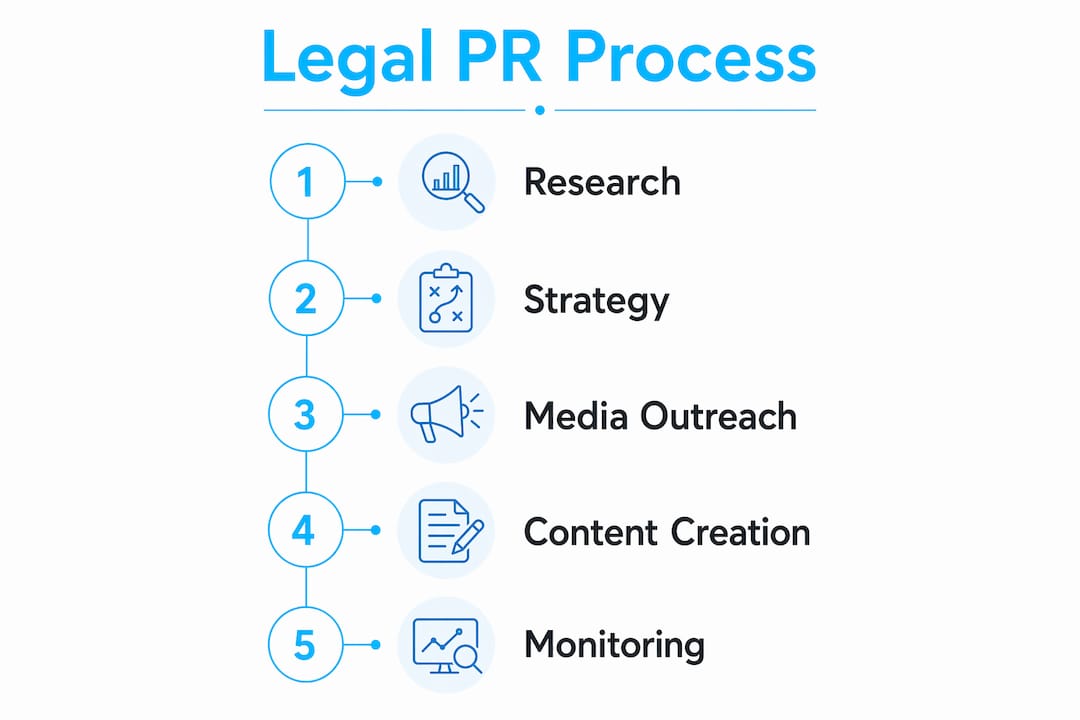
Legal PR firms operate under a framework that has no equivalent in any other PR specialty. Bar association rules, court-imposed gag orders, and attorney-client privilege collectively define what can and cannot be said publicly on behalf of a law firm or its clients.
The constraints are concrete and non-negotiable:
- No outcome guarantees. Legal PR must avoid making claims about case outcomes or comparisons with other lawyers that cannot be substantiated. A press release saying “our firm wins 95% of cases” violates ethical rules in most jurisdictions.
- No disclosure of privileged information. Attorney-client privilege sets a hard boundary that legal PR cannot cross in media communications, even when sharing a client success story would generate positive coverage.
- Litigation timing restrictions. Communications must be carefully timed around active cases to avoid prejudicing jury pools or violating court orders. A PR firm working on a high-profile criminal defense case cannot simply issue statements whenever the news cycle demands it.
- Truthfulness requirements. Communications must be truthful, accurate, and avoid creating unjustified expectations, which differs sharply from the creative latitude traditional PR agencies enjoy.
- Reactive strategy discipline. When a story breaks that involves a firm’s client, the legal PR team must respond in a way that protects the client’s legal position first and the firm’s public image second.
“The most effective legal PR does not just manage what is said. It manages what is deliberately left unsaid, and that restraint is itself a form of credibility.”
This ethical framework is not a limitation so much as a differentiator. Law firms that communicate with discipline and precision build more durable reputations than those that chase headlines without regard for professional consequences.
How does digital PR change visibility for law firms?
Digital PR has fundamentally changed the calculus of legal marketing. Earned media acts as a defensive moat in SEO and AI discovery, increasing law firm visibility and authority in ways that paid search cannot. When a law firm partner is quoted in Reuters or publishes a byline in the ABA Journal, that coverage generates backlinks from authoritative domains, which directly strengthens the firm’s search rankings.
The comparison between paid advertising and earned media is stark:
| Factor | Paid advertising | Earned media |
|---|---|---|
| Credibility signal | Low (audience knows it is paid) | High (third-party validation) |
| SEO impact | Minimal direct benefit | Strong backlink and authority value |
| Longevity | Stops when budget stops | Persists and compounds over time |
| AI search visibility | Limited | Prioritized by AI-driven search engines |
| Cost per impression over time | Increases | Decreases as coverage accumulates |
Quotes in reputable publications reach hundreds of thousands of readers and keep generating visibility long after publication. In 2026, AI-powered legal search tools like Perplexity and ChatGPT increasingly surface attorneys who appear in authoritative earned media sources, making PR placements a direct driver of new client inquiries.
Pro Tip: Use platforms like HARO (Help a Reporter Out) to respond to journalist queries in your practice area. A single well-placed expert quote in a national outlet can generate more qualified leads than months of paid social media advertising.
Why hire a legal PR firm instead of handling it in-house?
Most law firms that attempt PR internally discover the same problem: their marketing staff lacks the media relationships and ethical fluency that specialized legal PR requires. PR and marketing are often misunderstood as interchangeable, but legal PR emphasizes credibility via trusted media mentions, which demands a fundamentally different skill set than managing a firm’s owned channels.
The advantages of partnering with a specialized legal PR firm include:
- Established media contacts. A firm like Goldman McCormick PR brings direct relationships with television producers, radio program directors, and print journalists built over years of consistent outreach.
- Ethical compliance expertise. Specialized legal PR teams understand bar rules across jurisdictions and structure every communication to stay within them.
- Objective third-party perspective. An outside PR firm sees the firm’s story the way a journalist or prospective client would, which internal teams rarely can.
- Crisis readiness. Successful PR involves crisis readiness and measuring earned media impact consistently, capabilities that require dedicated resources most firms do not maintain internally.
- Measurable outcomes. Media placements, backlink growth, and share-of-voice metrics give managing partners concrete data on PR return, something in-house efforts rarely track with rigor.
Building trust with reporters across traditional and digital platforms, including podcasts and newsletters, takes years of sustained relationship investment. That investment is already made when you hire a specialized firm.
Key takeaways
Legal PR firms generate durable credibility for law firms by combining ethical compliance, earned media strategy, and sustained media relationships that internal teams cannot replicate.
| Point | Details |
|---|---|
| Ethical framework is non-negotiable | Bar rules, privilege, and gag orders define every message a legal PR firm can send. |
| Earned media outperforms paid ads | Third-party coverage builds SEO authority and AI search visibility that paid placements cannot. |
| Specialized relationships drive results | Established journalist contacts produce faster, more credible placements than cold outreach. |
| Digital PR compounds over time | Media mentions generate backlinks and visibility that grow in value long after publication. |
| In-house teams lack critical fluency | Most internal marketing staff cannot navigate legal ethics and media relations simultaneously. |
What I’ve learned after years of working in legal PR
I have watched law firms make the same mistake repeatedly: they treat PR as a one-time project rather than an ongoing investment. A firm hires a PR agency before a big trial, gets some coverage, and then goes quiet for two years. When the next high-stakes moment arrives, they have no media relationships to activate and no established credibility to draw on.
The firms that consistently win in legal PR are the ones that treat thought leadership as a year-round discipline. They comment on regulatory changes before their competitors do. They place byline articles during slow news periods, not just when they have something to promote. They prepare crisis communications protocols before a crisis exists, not during one.
There is also a persistent misconception I want to address directly. Many attorneys believe that PR is just marketing with a different name. It is not. Marketing tells your story. PR gets someone else to tell it for you, and that distinction is the entire source of its credibility. A prospective client who reads about your firm in a respected publication trusts that coverage in a way they will never trust your own website copy.
The firms that understand this distinction, and act on it consistently, are the ones that build reputations that last.
— Ryan McCormick
How Goldman McCormick PR serves law firms
Goldman McCormick PR has specialized in legal PR for over a decade, earning recognition from Forbes Magazine and the New York Observer for results that matter to attorneys: television appearances, radio coverage, newspaper features, and podcast placements that build credibility with the audiences law firms need to reach.
Our team understands bar association compliance, litigation communication protocols, and the media relationships that turn a law firm’s expertise into earned coverage. We produce nationally syndicated radio programs on the Genesis Communications Network and Starcom Radio Network, giving legal clients access to broadcast audiences that most PR firms cannot reach. If your firm is ready to build a reputation through specialized legal PR services, Goldman McCormick PR delivers the media access and strategic discipline your practice deserves.
FAQ
What does a legal PR firm actually do?
A legal PR firm manages media relations, thought leadership, and reputation communications for law firms and attorneys. Core services include securing earned media placements, placing byline articles, managing crisis communications, and building journalist relationships within bar association ethical guidelines.
How is legal PR different from general PR?
Legal PR operates under strict ethical constraints, including prohibitions on outcome guarantees, disclosure of privileged information, and misleading comparisons. General PR agencies have far more creative latitude, while legal PR focuses on educational content and credibility-building within professional responsibility rules.
Why does earned media matter more than paid ads for law firms?
Earned media generates third-party validation, SEO backlinks, and AI search visibility that paid advertising cannot produce. Lawyers cited in trusted media gain stronger competitive positioning in both traditional and AI-driven search results.
How long does it take to see results from legal PR?
Media relationship building and earned coverage typically require three to six months of consistent outreach before producing regular placements. Firms that commit to sustained PR planning see compounding returns as journalist relationships deepen and media mentions accumulate.
Can a law firm handle PR without hiring a specialized agency?
Most firms lack the media contacts, ethical compliance expertise, and dedicated bandwidth that effective legal PR requires. Internal marketing teams can manage owned content, but securing earned media in legal and business publications consistently requires the specialized relationships a dedicated legal PR firm provides.