
Reputation management lawyers are legal professionals who protect and improve the public image of individuals and businesses by addressing defamation, privacy breaches, and harmful online content. Their work spans urgent court interventions, content removal, and ongoing reputation monitoring. Specialists like those at Penningtons Manches Cooper and Brett Wilson handle everything from pre-publication injunctions to post-publication compensation claims. Goldman McCormick PR, named by Forbes Magazine as one of America’s Best PR Firms for 2021, works alongside these legal professionals to deliver integrated reputation protection for clients across industries.
What do reputation management lawyers actually do?
Reputation management lawyers handle the full spectrum of legal reputation-risk issues, including defamation, privacy violations, harassment, and data protection breaches. Their role is not limited to courtrooms. They advise clients before a crisis hits and respond aggressively when one does.
The core legal services these attorneys provide include:
- Defamation claims and defenses. Lawyers pursue libel and slander cases on behalf of clients whose reputations have been damaged by false statements, whether published in print, broadcast, or online.
- Privacy and breach of confidence. Attorneys seek court orders when private information is disclosed without consent, protecting individuals from exposure that could damage careers or personal lives.
- Injunctions. Specialist media-law solicitors can prepare urgent injunction applications quickly to stop harmful content from being published at all. This is one of the most powerful tools in a reputation lawyer’s arsenal.
- Harassment and data misuse. Attorneys pursue claims under harassment statutes and data protection law when personal information is weaponized against a client.
- Compensation and vindication. Beyond stopping harm, lawyers pursue financial remedies and public corrections that restore a client’s standing after damage has occurred.
The injunction process deserves special attention. Securing one requires fast, accurate evidence gathering and complex legal arguments prepared under time pressure. Reputation risk is frequently linked to broader legal disputes, so attorneys must operate on two tracks simultaneously: preventing publication before it happens and pursuing remedies after it does. This dual approach is what separates a skilled reputation attorney from a generalist.
Pro Tip: If you believe harmful content is about to be published, contact a reputation lawyer immediately. The window for a pre-publication injunction is narrow, and courts require evidence to be organized and ready. Do not wait.

How lawyers manage your online reputation
Beyond litigation, reputation management lawyers play an active role in shaping what appears about you online. Monitoring online presence and responding to negative content such as reviews and harmful social posts is now a recognized part of legal reputation work.
The digital side of this practice includes:
- Monitoring search results and online mentions across platforms like Google, Yelp, and Avvo
- Managing and optimizing a client’s Google Business Profile to control first impressions in search
- Responding professionally to both positive and negative reviews to shape public perception
- Creating and promoting positive content that pushes damaging results lower in search rankings
- Reviewing social media comments and escalating unlawful content to platform compliance teams
- Coordinating with PR firms and SEO specialists for a unified approach to online presence
One critical point: attorneys often misjudge their control over online reviews, but responding promptly and respectfully to all feedback positively impacts reputation. Ignoring a one-star review is not a neutral act. It signals indifference to prospective clients and search algorithms alike.
Lawyers also navigate bar association rules when managing reviews and testimonials. Soliciting certain types of endorsements or making specific claims in responses can violate professional conduct rules, so legal oversight of this process is not optional for attorneys managing their own profiles.
Pro Tip: When responding to a negative review, never disclose client information, even to defend yourself. A legally compliant, calm response protects your reputation far better than a detailed rebuttal.
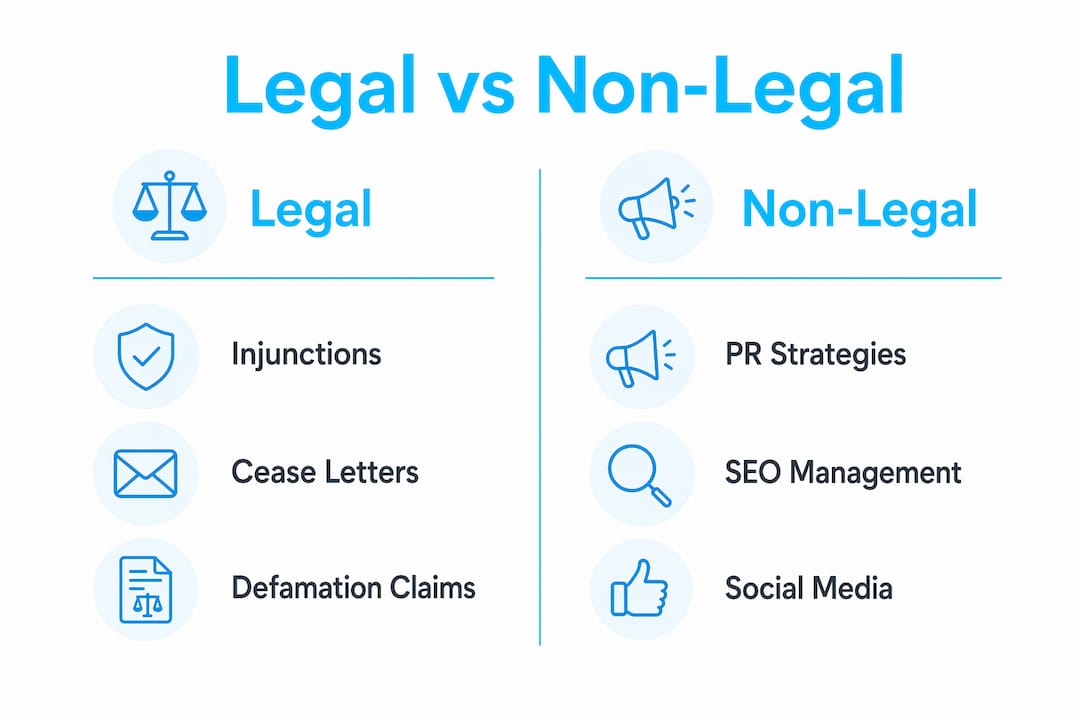
Legal vs. non-legal reputation management: what’s the difference?
Understanding where legal services end and general reputation management begins prevents costly mistakes. The two tracks are distinct but work best together.
| Service type | What it covers | Who provides it |
|---|---|---|
| Legal reputation management | Injunctions, defamation suits, privacy claims, content removal via court orders | Reputation attorneys, media-law firms |
| Non-legal reputation management | SEO, PR campaigns, content creation, social media management, review responses | PR agencies, SEO firms, digital marketers |
| Integrated approach | Combines legal remedies with communications strategy for full-spectrum protection | Law firms coordinating with PR and SEO partners |
Blending legal and non-legal tactics avoids weak demands and missed deadlines. A cease-and-desist letter drafted without understanding platform policies, for example, is often ignored. A legally grounded escalation that references specific violations of a platform’s terms of service carries far more weight.
The risk of relying solely on non-lawyers for legal actions is real. Missed filing deadlines, unenforceable demands, and procedural errors can permanently close off legal remedies. Conversely, a law firm that ignores the SEO dimension of a reputation problem may win a court case while the damaging content continues to rank on page one of Google. The most effective outcomes combine both disciplines.
How to engage a reputation lawyer effectively
Knowing when and how to bring in legal advice for reputation issues determines how much protection you actually receive. Early action almost always produces better results than reactive crisis management.
Watch for these signs that legal intervention is needed:
- A journalist or blogger contacts you for comment before publishing a potentially damaging story
- False or misleading reviews appear in volume across multiple platforms
- Private information is being shared or threatened to be shared without your consent
- A competitor or former employee is making false public statements about your business
- Harmful content is ranking prominently in search results for your name or brand
Once you engage a lawyer, evidence packaging and rapid legal response are critical to securing injunctions that prevent imminent reputational harm. Screenshots, URLs, timestamps, and records of communication should be collected immediately and organized clearly.
Select attorneys with specific expertise in defamation, privacy law, and media law. A general practice attorney may lack the procedural knowledge to file an urgent injunction correctly. Specialists like those at Brett Wilson or Ivanov Law bring legally grounded platform escalation experience that generalists cannot replicate.
Manage your expectations on timeline and cost. Injunctions can be obtained within days in urgent cases, but defamation litigation often takes months or years. Discuss remedies, costs, and realistic outcomes with your attorney before committing to a course of action.
Pro Tip: Build an evidence pack before you need it. Keep a running folder with screenshots of your online presence, key reviews, and any threatening communications. When a crisis hits, this preparation can mean the difference between a successful injunction and a missed opportunity.
Key takeaways
Reputation management lawyers combine legal remedies with digital strategy to deliver protection that neither discipline achieves alone.
| Point | Details |
|---|---|
| Legal scope is broad | Reputation attorneys handle defamation, privacy, harassment, injunctions, and compensation claims. |
| Online management is part of the job | Lawyers monitor reviews, manage Google Business Profile, and escalate unlawful content to platforms. |
| Legal and non-legal tactics must integrate | Combining court remedies with SEO and PR produces the strongest outcomes for clients. |
| Early action is critical | Pre-publication injunctions require fast evidence gathering and immediate legal engagement. |
| Specialist expertise matters | Attorneys with media-law backgrounds outperform generalists on urgent reputation cases. |
Why the legal and PR divide is a problem worth solving
From where I sit, having spent years working at the intersection of media and public relations, the biggest mistake individuals and businesses make is treating legal reputation management and PR as separate problems with separate solutions. They are not.
I have watched clients win defamation cases only to find the damaging content still dominating their search results because no one coordinated a content strategy alongside the litigation. I have also seen PR campaigns collapse because the team had no legal oversight and inadvertently made statements that complicated a pending case.
The platforms have changed the game entirely. A decade ago, a strongly worded legal letter could pressure a publisher into removing content. Today, platforms like Google and Meta operate under their own legal frameworks, and removal of harmful content requires legally grounded escalation, not just a threatening email. Lawyers who understand platform policy as well as they understand defamation law are the ones actually getting results.
The future of this field will be shaped by AI-generated content. Fabricated quotes, deepfakes, and algorithmically amplified false narratives are already creating cases that existing legal frameworks were not designed to handle. The attorneys and PR professionals who build expertise in this area now will be indispensable within five years.
My advice: do not wait for a crisis to build your team. Know your reputation lawyer before you need one.
— Ryan McCormick
How Goldman McCormick PR strengthens your reputation strategy
When legal action alone is not enough to rebuild trust, strategic public relations fills the gap. Goldman McCormick PR has worked with clients across media, law, and business to deliver integrated reputation solutions that go beyond what a courtroom can accomplish.

Goldman McCormick PR places clients on television, radio, and in major newspapers, creating a positive media record that counterbalances damaging content. The firm’s crisis communication expertise and media relationships make it a natural partner for individuals and businesses navigating serious reputation challenges. Whether you need proactive media coverage or a coordinated response to a public attack, Goldman McCormick PR delivers results grounded in real media experience. Reach out to learn how the firm can support your reputation goals.
FAQ
What is a reputation management lawyer?
A reputation management lawyer is an attorney who specializes in protecting and improving a client’s public image through legal means, including defamation claims, privacy actions, and injunctions to remove harmful content.
How do lawyers for reputation management differ from PR firms?
Lawyers pursue legal remedies such as court orders and compensation, while PR firms focus on communications, SEO, and media strategy. The strongest outcomes come from combining both approaches.
When should I seek legal advice for reputation issues?
Seek legal advice immediately if harmful content is about to be published, false reviews are appearing in volume, or private information is being shared without your consent. Early action preserves more legal options.
Can a reputation attorney remove content from Google?
Attorneys can escalate unlawful content to platforms using legally grounded complaints, and proceed to formal legal action if platforms do not comply. Removal is not guaranteed but is achievable through the correct legal process.
What are the best reputation management services for businesses?
The most effective services combine legal representation from media-law specialists with PR and SEO support from firms experienced in reputation recovery, such as Goldman McCormick PR, to address both legal and public perception dimensions simultaneously.