
Getting nominated is only the opening move in a much longer process. Super Lawyers selects roughly 5% of attorneys statewide for the main list and 2.5% for Rising Stars, using a patented three-phase method that runs nominations through independent research and a blue ribbon peer review. Attorneys can submit up to 21 nominations a year, split seven in-firm, seven out-of-firm, and seven Rising Stars, but nobody can nominate themselves, and Super Lawyers actively discourages campaigning for votes.
TL;DR:
- Only about 5% of nominated attorneys make it onto the Super Lawyers list, with research and peer review playing a crucial role in final selection.
- Out-of-firm nominations carry more weight than in-firm ones and must be free of solicitation or coordination to be credible.
- Maintaining a current, publicly verifiable professional record, including media coverage and case results, significantly improves research verification chances.
- Nomination deadlines are set by each state and can vary, so attorneys must check their local selection timeline rather than rely on a single national schedule.
- Self-nominations are strictly not allowed, and campaign solicitation can lead to disqualification or disregarding of nominations.
Table of Contents
- How Does the Super Lawyers Nomination Process Actually Work?
- Who Can Submit a Lawyer Award Nomination?
- What Actually Improves Your Chances of Selection?
- How Do I Submit a Nomination on SuperLawyers.com?
- Common Nomination Mistakes That Undercut Your Credibility
- Is Nomination Information Kept Confidential?
- When Does Super Lawyers Notify Attorneys of Results?
- Why Earned Media Matters More Than Most Attorneys Realize
- How Goldman McCormick PR Helps Attorneys Build a Verifiable Record
- Where to Verify the Official Rules
- Sources
- FAQ
How Does the Super Lawyers Nomination Process Actually Work?
A Super Lawyers nomination is the entry point into a screening system that patent filings describe under U.S. Pat. No. 8,412,564, built specifically to keep the process objective rather than popularity-driven. Nominations alone don’t decide anything. They build the pool that the research team then investigates.
- Phase 1, nominations: Peer nominations and Super Lawyers’ own outreach create the initial candidate list. Point values differ by nomination type, and who nominated who stays confidential.
- Phase 2, independent research: A research team checks each candidate against 12 objective indicators, including verdicts and settlements, professional honors, bar association leadership, published legal writing, and peer recognition.
- Phase 3, blue ribbon peer review: Top-scoring candidates in each practice area and firm-size category get reviewed by sitting Super Lawyers from that same category, who rate their peers on a structured evaluation.
The result is a state-by-state list published annually, with the top slice becoming Super Lawyers and a slightly younger, earlier-career slice becoming Rising Stars. Timelines and cutoff dates vary by state, since each jurisdiction runs its own selection cycle rather than one national deadline.
Who Can Submit a Lawyer Award Nomination?
Not every attorney qualifies to nominate, and the rules around who can submit a nomination are stricter than most first-time participants expect.
- Eligible nominators are licensed attorneys in good standing, practicing in the same state as the lawyer they’re nominating. Some attorneys receive a direct invitation to nominate; others request dashboard access on their own.
- The 21-nomination cap breaks down as seven in-firm, seven out-of-firm, and seven Rising Stars nominations per year, and out-of-firm nominations carry more point value than nominations from colleagues at your own firm.
- No self-nominations, ever. Super Lawyers’ own guidance is explicit that self-nominations aren’t accepted, and any hint of solicitation or coordinated campaigning can get a nomination disregarded entirely.
That out-of-firm weighting exists for a reason: a nomination from someone with no professional stake in your success is harder to fake and easier for researchers to trust.
What Actually Improves Your Chances of Selection?
Since researchers proactively hunt for evidence rather than waiting for attorneys to hand it to them, the smartest move is making that evidence easy to find, not louder to ask for.
- Update your SuperLawyers.com profile with current practice areas, honors, and case history, and send biographical details directly to [email protected].
- Document objective wins publicly. Verdicts, settlements, published rulings, and bar leadership roles only help if a researcher can actually locate them.
- Keep one dated, public archive of press releases and media coverage. A scattered digital footprint slows down verification; a single organized page speeds it up.
- Build your visibility calendar around known nomination windows so your profile and documentation are current before, not after, the state cycle opens.
Firms that work with legal PR specialists often use press releases and media placements specifically to generate this kind of dated, publicly verifiable record, since earned media coverage of a case outcome creates exactly the discoverable trail that Super Lawyers researchers are trained to look for.
Pro Tip: Don’t wait for the nomination window to open before organizing your record. Researchers pull from whatever is publicly visible year round, so the strongest candidates already have a clean, dated paper trail in place months in advance.
How Do I Submit a Nomination on SuperLawyers.com?
The dashboard mechanics are simple once you know the sequence, and the official participation guide lays out each step.
- Log into your SuperLawyers.com account and select “Nominate Your Peers” from your dashboard.
- Click “Add Nomination+” and enter your nominee’s name, firm, and practice area.
- Write a first-hand observation. Cite an actual case detail, hearing, or transaction rather than general praise; specifics read as credible to researchers, vague compliments don’t.
- Review your saved nominations before the deadline. They stay editable until then and auto-submit on the listed date, so nothing extra is required once you’re satisfied.
- Check your state’s individual selection page for the exact deadline, since cycles don’t run on a single national calendar.
Prior-year nominations often appear pre-loaded to make re-nominating someone faster in later cycles.
Common Nomination Mistakes That Undercut Your Credibility
A poorly built nomination doesn’t just fail to help. It can actively work against the person it’s meant to support.
- Coordinated campaigns, where several attorneys are asked to nominate the same person at once, get flagged and can be disregarded outright.
- Piling up seven in-firm nominations with no out-of-firm balance signals reputation within a building, not reputation across a bar.
- Vague comments like “great lawyer, highly respected” carry almost no research value compared to a specific case reference with a date attached.
- The fix in every case is the same: fewer, better nominations built on concrete facts, spread across firms, submitted without asking anyone to reciprocate.
Is Nomination Information Kept Confidential?
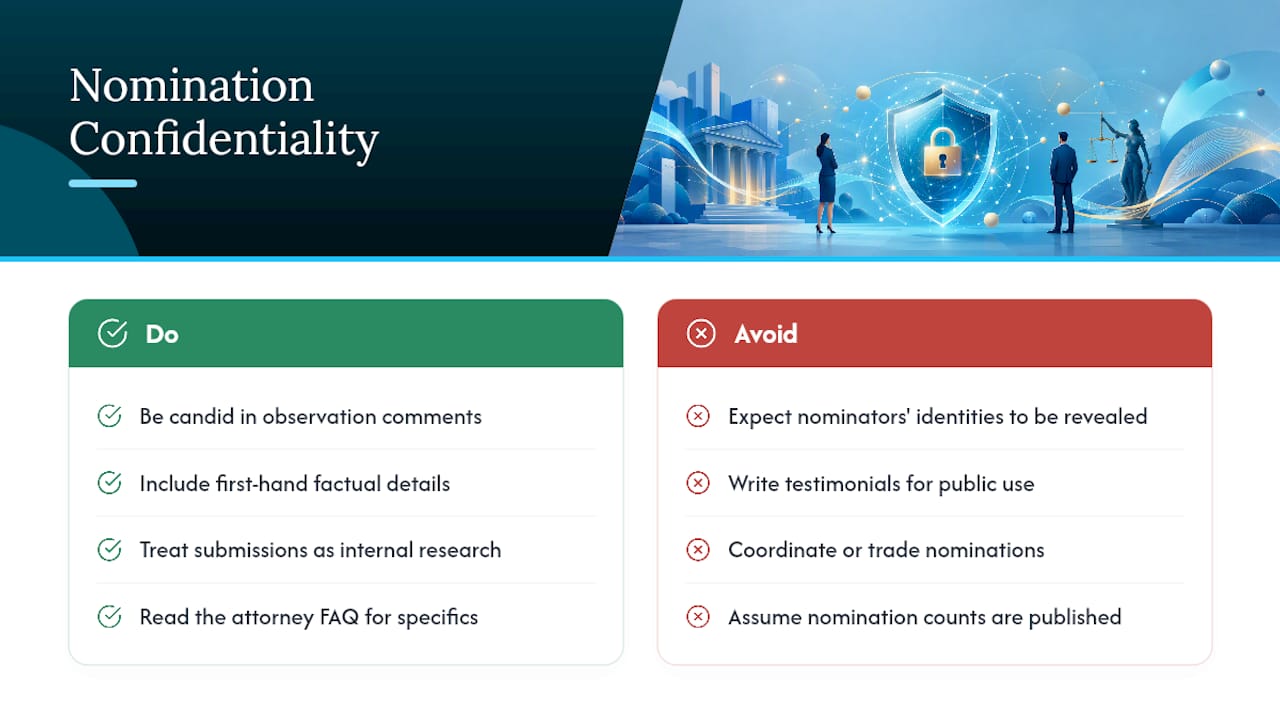
Yes. Super Lawyers keeps nominator identity confidential from the nominee, which is part of why the process resists gaming. A nominee generally won’t know who nominated them or how many nominations they received, and nomination content isn’t published or shared outside the research and review process.
That confidentiality serves a practical purpose. If nominators knew their identities would surface, the incentive to trade favors or coordinate nominations would spike immediately. Keeping the process private protects the independence of every phase that follows, from the research team’s fact checking to the blue ribbon panel’s scoring.
Attorneys submitting nominations should also know that the observation comments they write, along with any supporting detail, are used internally for research purposes rather than published verbatim anywhere public. This matters for how candidly nominators can write. A first-hand account of a specific hearing or negotiation carries more research weight precisely because it isn’t being crafted for public consumption. It’s meant to be a factual data point for a research team, not a testimonial for a website.
Firms curious about the fine print should read the attorney FAQ page directly, since confidentiality specifics can shift slightly between statement updates.
When Does Super Lawyers Notify Attorneys of Results?
Nomination windows, research periods, and notification dates all run on a state-by-state schedule, which is the single most misunderstood part of the process. An attorney in New York and an attorney in Texas aren’t working from the same calendar.
Generally, nomination periods open early in the selection year, giving attorneys a defined window to submit their allotted nominations before that state’s dashboard closes. Once nominations close, the independent research phase begins, checking each candidate against the 12 indicators and building the shortlist that moves to blue ribbon review. This research and review stage typically takes several months, since it involves both quantitative record checking and qualitative peer evaluation within practice-area and firm-size categories.
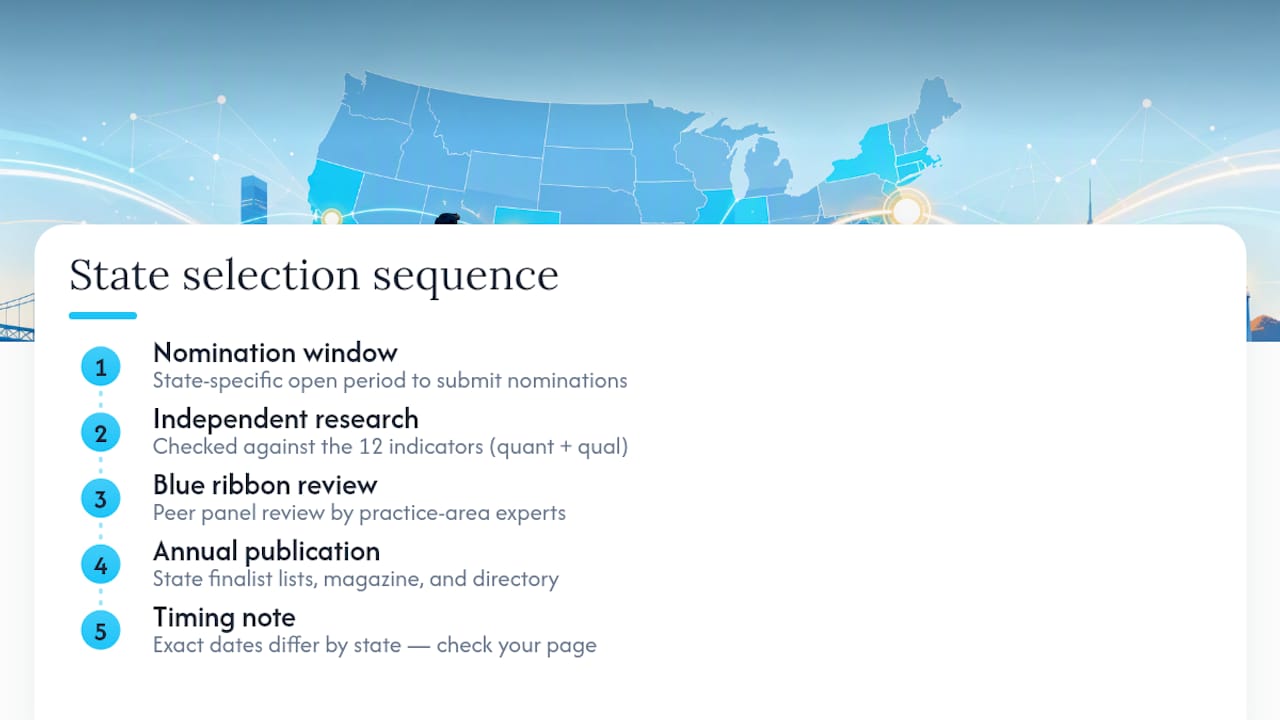
Final lists publish annually per state, often accompanied by a print magazine and digital directory listing. Attorneys who aren’t selected in a given year aren’t locked out going forward. Many candidates get nominated, researched, and reviewed across multiple cycles before their record clears the bar for selection, so a quiet year isn’t a verdict on a career.
Because exact dates differ by state, the only reliable way to know your own window is to check your specific state’s selection page rather than assume a fixed national timeline.
Why Earned Media Matters More Than Most Attorneys Realize
Most of the advice around Super Lawyers selection focuses on the nomination itself, and that’s a mistake. The nomination gets you into the pool. What actually moves you through research and peer review is whether your professional record is visible, dated, and verifiable in public. That’s a media and reputation problem as much as a legal one.
Some public relations firms are built specifically around getting attorneys into TV segments, radio programs, and newspaper coverage, which is exactly the kind of dated public record a Super Lawyers researcher can independently verify.
The ethical path forward combines both halves: keep your SuperLawyers.com profile current, and build a real media footprint that documents your work honestly.
— Ryan McCormick
How Goldman McCormick PR Helps Attorneys Build a Verifiable Record
Nomination forms and profile updates only get you so far. What separates attorneys who show up clearly in Super Lawyers research from those who don’t is usually a documented public record: press coverage, verdict announcements, and media appearances that a researcher can find without guessing.
Some public relations firms build exactly that kind of record for attorneys. Press releases distributed around case outcomes, TV and radio placements, and reputation management work all create dated, public evidence tied to a name, not solicitation aimed at influencing a nomination, but a genuine media presence that stands on its own. For firms serious about visibility beyond a single awards cycle, working with a legal marketing partner on search visibility for legal achievements can reinforce the same discoverability that earned media builds.
If you’re an attorney looking to strengthen your public record ahead of your state’s next nomination window, visit Goldman McCormick PR to discuss a media strategy built around your actual case history and professional milestones.
Where to Verify the Official Rules
Every rule covered here traces back to Super Lawyers’ own published guidance, and it’s worth bookmarking these directly rather than relying on secondhand summaries.
- The Super Lawyers Selection Process covers the patented three-phase method and selection percentages.
- How to Participate in the Selection Process (PDF) walks through the nomination dashboard step-by-step.
- Nominate Top Lawyers page lays out the no-self-nomination and anti-campaigning rules.
- Attorney FAQ answers profile and research questions directly from Super Lawyers.
Check your specific state’s selection page for the exact dates that apply to you, since national summaries won’t capture local timing.
Sources
- The Super Lawyers Selection Process – Super Lawyers
- HOW TO PARTICIPATE IN THE SELECTION PROCESS – Super Lawyers (PDF)
- Nominate Top Lawyers for Super Lawyers Selection Process | Super Lawyers
FAQ
Can I Nominate Myself for Super Lawyers?
No. Super Lawyers does not accept self-nominations under any circumstances, and attempting to work around this rule can hurt your candidacy.
How Many Nominations Can One Attorney Submit?
Up to 21 total per year: seven in-firm, seven out-of-firm, and seven Rising Stars nominations.
Does a Nomination Guarantee Selection?
No. A nomination only starts the process; independent research and blue ribbon peer review determine the final outcome, and only about 5% of nominated attorneys make the Super Lawyers list.
Is Campaigning for Nominations Allowed?
No. Super Lawyers explicitly discourages campaigning or solicitation, and coordinated nomination requests may be disregarded.
Can Earned Media Help My Selection Chances?
Yes, indirectly. Documented press coverage and case outcomes create publicly verifiable records that researchers can check against the 12 objective indicators, which is where firms like Goldman McCormick PR add practical value.
Where Do I Find My State’s Nomination Deadline?
Deadlines vary by state, so check your specific state’s Super Lawyers selection page directly, or consult state-specific legal marketing resources for guidance on tracking regional timelines.