
Submit your nomination through the Best Lawyers online nomination form or by emailing [email protected]. Anyone can nominate a lawyer, including clients, colleagues, and marketing teams, but the submission itself is the easy part. The Purely Peer Review® methodology that follows determines everything, and it runs on a five-stage cycle: nomination, peer review, analysis, an eligibility check, and results. Most nominees who miss out don’t fail because of the paperwork. They fail because their practice-area selection was too broad or their nominator didn’t know which peers would actually be voting.
Three things matter more than anything else in a best lawyers submission:
- Submission channel: use the official form or [email protected], never a third-party portal
- Eligibility: private practice attorneys with roughly 10+ years qualify for standard recognition; Best Lawyers: Ones to Watch covers earlier-career lawyers, typically 3 to 9 years
- Peer accuracy: an outdated or vague contact list undermines a nomination faster than a weak biography ever could
Quick fact: the entire process is free. Best Lawyers has stated repeatedly that recognition cannot be bought, which is exactly why the accuracy of your submission carries so much weight.
Key Takeaways
A successful best lawyers submission depends less on the form itself and more on eligibility accuracy, focused practice-area selection, and a current peer contact list that voters actually recognize.
| Point | Details |
|---|---|
| Submit through official channels | Use the online nomination form or [email protected] only, never a third-party site. |
| Confirm eligibility first | Private practice attorneys with roughly 10+ years qualify for standard recognition; Ones to Watch covers 3 to 9 years. |
| Limit practice areas to three | Rank by peer reputation strength since ballots are customized by market and specialty. |
| Recognition can’t be re-earned automatically | Previously recognized lawyers are auto-nominated but still need fresh, positive ballots each cycle. |
| Get professional support for peer lists | Goldman McCormick PR helps firms build accurate contact lists and prepare nominee materials ethically. |
Table of Contents
- How Does the Best Lawyers Methodology Work?
- What Should You Include in a Best Lawyers Submission?
- Who Is Eligible and How Many Practice Areas Can You Pick?
- How Does Peer Voting Actually Decide the Results?
- When Should You Submit and How Long Does Review Take?
- Why Do Nominations Get Rejected or Disqualified?
- Can You Update or Correct a Nomination After Submitting?
- Is Your Nomination Data Kept Confidential?
- Why Recognition Still Matters in a Crowded Awards Market
- How Goldman McCormick PR Supports a Best Lawyers Submission
- Where to Learn More
- Sources
How Does the Best Lawyers Methodology Work?
Best Lawyers built its reputation on something most legal awards can’t claim: nobody pays to get in. The Purely Peer Review® process exists specifically to keep the rankings insulated from marketing budgets, and it moves through five distinct stages every cycle.
- Nomination. Anyone submits a candidate through the official channels, specifying firm, location, and up to three practice areas.
- Peer review. Lawyers already recognized by Best Lawyers receive customized ballots covering their market and practice area, then score nominees they’re familiar with.
- Analysis. The research team aggregates the ballot data and weighs the feedback.
- Eligibility check. Every candidate under consideration gets verified for bar standing and practice status before anything moves forward.
- Results. Recognized attorneys are published, and previously recognized lawyers roll into the next cycle’s ballots automatically.
The part firms tend to overlook is who actually votes. It’s not clients, not judges, not a panel of editors. It’s other lawyers currently recognized by Best Lawyers, voting on peers in their own market and specialty. That single detail is why Best Lawyers’ integrity statements hold up: a nominee can’t buy a vote from someone they’ve never worked opposite.
Pro Tip: Before you submit anything, pull a list of every lawyer your nominee has litigated against, co-counseled with, or negotiated opposite in the last three years. That’s your actual voter base, not a guess.
What Should You Include in a Best Lawyers Submission?
A clean submission takes fifteen minutes. A sloppy one costs your nominee a full year, since the next opportunity doesn’t come around until the following cycle.
Before you open the form or draft the email, gather this:
- Full legal name, firm name, city, and state as they should appear publicly
- Direct contact information for the nominee and for whoever is managing the submission
- Up to three practice areas, ranked by where the nominee’s reputation is strongest
- A two- or three-sentence professional summary, not a full biography
- A refreshed list of peer contacts who can credibly speak to the nominee’s work
Once you have those pieces, follow this sequence:
- Choose the online form over email unless you have a specific reason to reach a Best Lawyers researcher directly.
- Fill in every field completely. Partial submissions get flagged during the eligibility check and can stall.
- Double-check practice-area spelling against Best Lawyers’ own category list. Nonstandard names risk being miscategorized.
- Get internal sign-off from the nominee or firm marketing lead before hitting submit, so nobody duplicates the effort.
- Save your confirmation. If you don’t receive one within a reasonable window, contact Best Lawyers directly through the nomination page rather than resubmitting, since duplicate entries create cleanup work on their end.
Who Is Eligible and How Many Practice Areas Can You Pick?
Best Lawyers accepts private practice attorneys only. In-house counsel, government lawyers, and judges generally don’t qualify for the primary U.S. publications, so check a nominee’s current role before you invest time building out contact lists.
Experience thresholds separate the two main recognition tracks. Best Lawyers typically looks for around 10 or more years of practice for standard inclusion. Best Lawyers: Ones to Watch exists for earlier-career attorneys, usually in the 3 to 9 year range depending on jurisdiction, and it’s the better fit for a rising associate who hasn’t hit a decade yet.
Practice-area selection is where most submissions lose ground. You get up to three areas, and that cap is deliberate: ballots are customized by market and specialty, so a nominee listed under too many categories dilutes their votes across ballots where fewer peers can speak to their work. A litigator known primarily for insurance defense gains nothing from also being listed in three tangential areas nobody associates with them.
- Rank practice areas by peer reputation strength, not by billing category
- Match category names to Best Lawyers’ own terminology exactly
- Reserve the third slot for a genuine secondary specialty, not padding
How Does Peer Voting Actually Decide the Results?
Every ballot in the Best Lawyers system goes to someone already recognized in that market and practice area. That’s the entire voter pool. A securities litigator in Chicago votes on other securities litigators in Chicago, never on tax attorneys in Denver.
Voting itself runs on a simple structure that carries real weight in how results shake out.
- Voters see a customized ballot listing nominees in their specific market and specialty.
- Each nominee gets scored on a 1 to 5 numeric scale, with a “Do Not Know” option for anyone the voter can’t credibly assess.
- Scores get aggregated by the research team, who weigh consistency and volume of positive feedback rather than a single glowing response.
- Results get finalized only after the eligibility check confirms bar standing and practice status.
Here’s the mechanic that trips up firms year after year: previously recognized lawyers are automatically nominated into their existing practice areas for the next cycle. That’s not the same as automatic re-inclusion. The lawyer still needs enough fresh, positive ballots to clear the bar again. Treating last year’s recognition as a permanent credential, rather than something that has to be re-earned through active peer relationships, is one of the more common blind spots among firms managing multiple honorees.
Pro Tip: If a nominee was recognized last cycle, don’t assume the work is done. Track which peers voted favorably in the past (informally, through relationship notes, never by asking how someone voted) and keep those relationships current.
The “Do Not Know” option matters more than it looks. A voter who hasn’t worked opposite a nominee in years will select it rather than guess, which means unfamiliarity quietly costs points even without a single negative response.
When Should You Submit and How Long Does Review Take?
Best Lawyers runs its research and voting cycles on an annual schedule, with nomination windows opening well ahead of when ballots go out to voters. Submitting early in the cycle gives the research team more runway to complete eligibility checks without rushing, and it gives your nominee’s peer network more time to receive and respond to ballots thoughtfully rather than under deadline pressure.
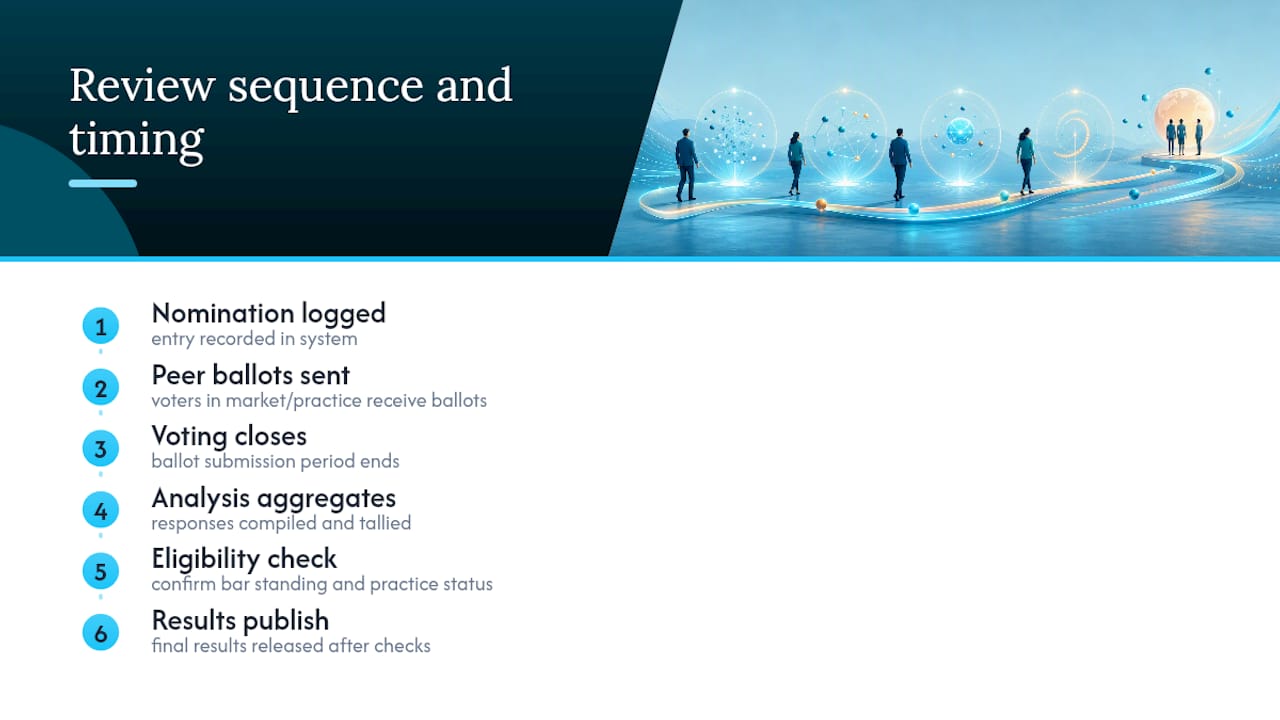
The review process itself moves in sequence rather than all at once. Nominations get logged first, then peer ballots go out to the relevant voter pool for that market and practice area. After voting closes, the analysis phase aggregates responses before the eligibility check confirms bar standing and practice status on every candidate still in contention. Results publish only after that full sequence completes, which is why a submission made close to a cycle’s deadline often ends up processed in the following year’s round instead.
Firms that treat this as a single annual task tend to miss the window entirely. The more reliable approach: mark your calendar for early submission each year, and don’t wait until you see a competitor’s name published to start building your own nominee’s peer contact list. By the time recognition is public, next year’s ballots are already close behind.
Why Do Nominations Get Rejected or Disqualified?
Most rejections trace back to eligibility, not merit. A nominee working in-house, serving as a sitting judge, or otherwise outside private practice won’t clear the eligibility check regardless of how strong their peer reputation is.
Practice-area mismatches cause a second wave of problems. Submitting a lawyer under a category that doesn’t reflect their actual work confuses the ballot process, since voters in that specialty may have no basis to score someone whose real practice sits elsewhere. Incomplete submissions, missing firm affiliation, unclear contact information, or a practice-area field left blank, can also stall a file during processing.
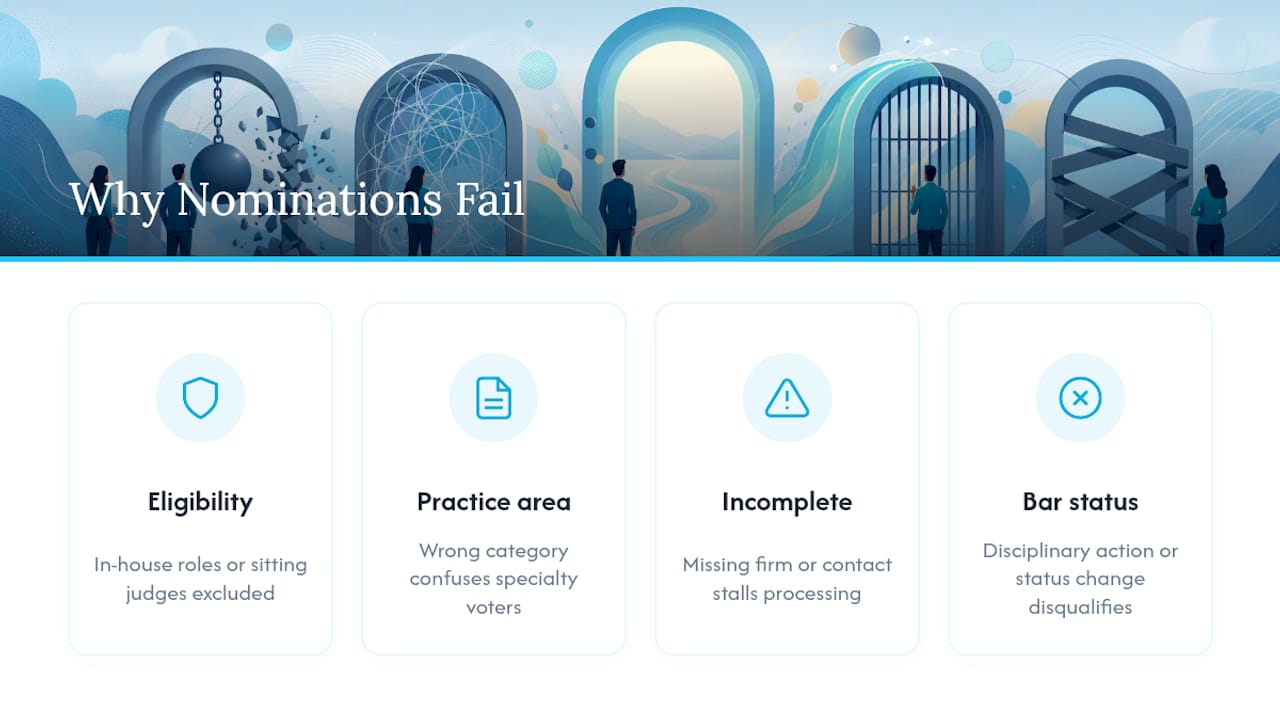
Disqualification after initial acceptance usually comes down to bar standing. If a nominee faces disciplinary action or a status change during the review window, that surfaces during the eligibility check regardless of how the peer votes came in. Duplicate nominations for the same person, submitted separately by a firm and an individual client without coordination, can also create confusion that delays processing rather than helping the nominee’s chances.
The fix for nearly all of these is the same: confirm eligibility before you nominate, pick practice areas that match the nominee’s actual reputation, and complete every field on the form rather than leaving gaps for the research team to chase down.
Can You Update or Correct a Nomination After Submitting?
Mistakes happen. If you catch a typo in the firm name, an outdated contact number, or a practice-area error after hitting submit, the fix is to reach out directly to [email protected] with the correction and enough detail for the research team to locate the original entry.
Don’t submit a second nomination to try to overwrite the first. Duplicate entries for the same nominee create more confusion than they solve, and there’s no guarantee the correction reaches the same file. Include the nominee’s full name, firm, and the practice area originally submitted, then state clearly what needs to change.
Corrections matter most when they affect eligibility criteria, like a practice-area switch or an updated bar status, since those details feed directly into the eligibility check phase. Minor items, such as a title change following a promotion, are worth flagging but rarely urgent enough to require immediate action outside the normal review cycle.
Is Your Nomination Data Kept Confidential?
Peer review only works if voters trust that their responses stay private. Best Lawyers has been explicit that its process depends on impartial, confidential feedback, which means individual ballot scores aren’t shared with the nominee, the nominating firm, or competing attorneys.
Nomination details themselves, name, firm, contact information, practice areas, are used internally for processing and eligibility verification. They’re not published or shared beyond what’s necessary to run the ballot and confirm bar standing. If your firm submits contact information for peer references as part of a broader nomination effort, that data supports the review process itself rather than becoming part of any public record.
This confidentiality cuts both ways for marketing teams. You won’t get a breakdown of how individual peers scored your nominee, which means you can’t fine-tune outreach based on who voted favorably or unfavorably. What you can do is keep your own internal notes on relationship quality and ballot familiarity, tracked separately from anything Best Lawyers collects, so your peer-list strategy improves year over year without relying on data the process was never designed to share.
Why Recognition Still Matters in a Crowded Awards Market
Legal awards have multiplied to the point where clients rightly question which ones mean anything, as covered extensively in Lawsuits & Litigation — The Jewish Legal News. What separates Best Lawyers from a paid plaque is straightforward: nobody buys their way onto a ballot, and the voters are working attorneys who’ve actually seen the nominee’s work firsthand. That distinction is worth explaining to clients who ask why one credential on a website bio carries more weight than another.
Firms that handle PR for attorneys, including the work we do at Goldman McCormick PR, spend real time helping nominees build accurate, current peer contact lists rather than treating a nomination as a one-time form to fill out. Recognition from Forbes and a Bulldog Reporter CSR award taught us the same lesson that applies here: credibility comes from a process nobody can shortcut, not from the announcement itself.
How Goldman McCormick PR Supports a Best Lawyers Submission
Getting nominated is one thing. Making sure the right peers actually see and remember your nominee’s work is the harder, less obvious task, and it’s where most firms run out of bandwidth. Goldman McCormick PR handles the parts of the process that take dedicated time: building and refreshing peer contact lists, preparing concise nominee materials that make a voter’s job easier, and running ethical promotion that raises visibility without ever touching the voting itself.

We’ve earned recognition ourselves, named one of Forbes’ best PR firms and awarded gold by Bulldog Reporter’s CSR Awards, because we understand what substantiated, peer-driven credibility actually requires. That’s the same standard we bring to attorney reputation work. If your firm is preparing a nomination cycle and wants the peer-list and materials side handled correctly the first time, reach out to Goldman McCormick PR to talk through your nominee’s situation before the next submission window closes.
Where to Learn More
- Purely Peer Review® Methodology: full explanation of the five-stage process
- Frequently Asked Methodology Questions: eligibility thresholds and re-nomination rules
- NatLawReview’s practical guide to navigating the rankings process