
Public interest journalism law in the United States is not a single statute. It is a layered framework of constitutional protections, federal regulations, and state-level shield laws that together determine when journalists can report, what materials they must protect, and when courts can compel them to testify. The First Amendment Handbook from the Reporters Committee makes the baseline clear: the First Amendment provides broad but not absolute protection, and courts must balance press freedom against competing societal interests, including national security and the fair administration of justice. The Supreme Court reinforced that limit in Branzburg v. Hayes, 408 U.S. 665, holding that reporters have no blanket constitutional privilege to refuse grand jury testimony. The Department of Justice codified its own balancing approach at 28 CFR §50.10, treating subpoenas and warrants for media records as extraordinary measures. The bottom line: public-interest reporting is usually protected when it exposes official misconduct or serves genuine civic accountability, and most vulnerable when it touches national security, involves criminal conduct by the journalist, or requires disclosing confidential sources in a federal criminal proceeding.
Key Takeaways
Public-interest journalism law in the U.S. is a patchwork of constitutional, statutory, and state protections that require active documentation to enforce.
| Point | Details |
|---|---|
| No single federal law | Protection comes from the First Amendment, state shield laws, DOJ policy, and statutes like the Privacy Protection Act. |
| Branzburg limits federal privilege | Reporters have no blanket constitutional right to refuse grand jury testimony; protections are qualified and fact-specific. |
| State shields vary widely | Wisconsin’s four-factor test illustrates stronger state protections; federal court offers far less. |
| Documentation activates defenses | Contemporaneous notes, editorial sign-off, and pre-publication legal review are the evidence that makes public-interest defenses hold. |
| Federal shield legislation is advancing | H.R.4250 passed the House and would create a uniform “covered journalist” definition and limit compelled disclosure at the federal level. |
Table of Contents
- What “public interest” actually means in journalism law
- How U.S. law treats public-interest journalism: the First Amendment and key cases
- How reporter’s privilege and shield laws work across states
- When public-interest protections face the hardest tests
- How “public interest” functions as a defense in defamation and privacy cases
- A practical checklist for documenting public interest before and after publication
- Recent U.S. developments in federal reporter protection
- The gap between legal protection and editorial discipline
- Primary sources and further reading
- Sources
What “public interest” actually means in journalism law
The phrase “public interest” carries two distinct meanings that practitioners need to keep separate. In the newsroom, it is an ethical concept: does this story serve civic accountability, public health, or democratic transparency? Courts use a narrower, more contextual version of the same phrase when deciding whether a journalist’s privilege holds or whether a privacy defense applies.
Legal categories courts consistently treat as public interest include:
- Exposing crime or official misconduct by government actors or public institutions
- Reporting on public health or safety threats affecting a broad population
- Investigating corruption or misuse of public funds
- Covering matters of active public controversy where the public has a demonstrable stake in the outcome
The distinction matters in practice. A reporter who publishes private medical records of a public official because those records reveal a conflict of interest is on solid legal ground. The same reporter publishing private medical records of a private citizen because the story is “interesting” is not. Courts have consistently held that newsworthiness requires more than reader curiosity; the information must be necessary to the public debate, not merely entertaining to the public. Legal scholarship from Duke Law describes newsgathering law as fragmented and fact-driven, with public interest treated as a contextual factor courts weigh rather than a universal shield.
The civic role of local journalism illustrates why this distinction matters beyond the courtroom: community-focused reporting on zoning decisions, school board conduct, or local health crises sits squarely in the legal definition of public interest, giving those outlets stronger footing when their reporting is challenged.

How U.S. law treats public-interest journalism: the First Amendment and key cases
The First Amendment provides the constitutional floor. It prohibits government from abridging press freedom, but that prohibition is not self-executing in every situation a journalist faces. Judges balance the press’s role against other interests, and the outcome depends on the specific legal context.
The table below maps the primary authorities and the practical rule each one contributes:
Branzburg remains the most cited and most misread case in this area. The Court held 5-4 that reporters must comply with grand jury subpoenas, but Justice Powell’s concurrence left room for a qualified privilege in civil cases and in circumstances where the subpoena is issued in bad faith. Lower federal courts have read that concurrence differently for decades, which is why federal circuit courts still disagree on the scope of any reporter’s privilege. New York Times v. Sullivan operates in a different lane: it governs defamation liability rather than compelled disclosure, but its actual-malice standard is one of the strongest practical protections public-interest journalism has in civil litigation.
The DOJ’s 28 CFR §50.10 policy frames public-interest balancing as a multi-factor judgment weighing national security, public safety, law enforcement needs, and the press’s accountability function. It is not purely a press-protection test, and it does not bind courts. What it does is constrain federal prosecutors and investigators, requiring senior DOJ approval before issuing subpoenas to journalists and mandating that alternatives be exhausted first.
How reporter’s privilege and shield laws work across states
Reporter’s privilege is mostly statutory or common-law at the state level and qualified at the federal level. That asymmetry is the single most important structural fact about this area of law.
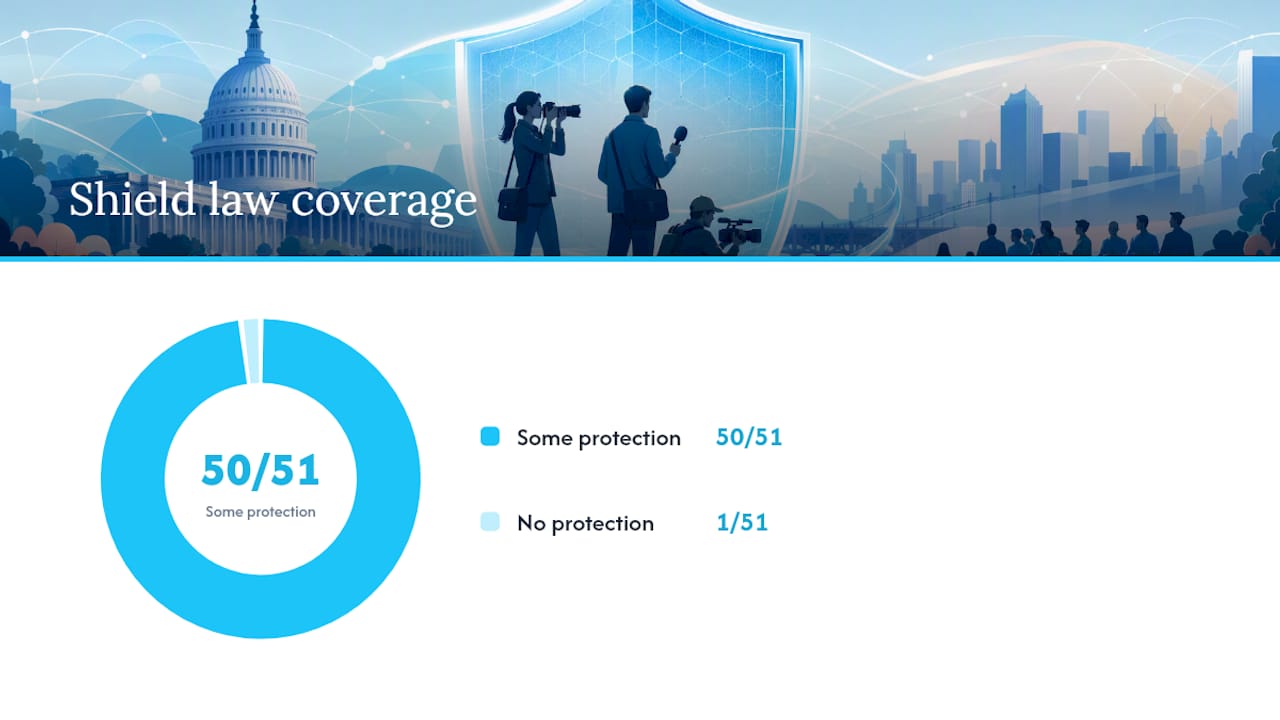
Forty-nine states and the District of Columbia have some form of shield protection, but the scope varies dramatically. The CPJ’s guide to legal rights in the U.S. describes Wisconsin’s approach as a useful illustration: a party seeking to override a journalist’s protection must show that the information is highly relevant, necessary, unavailable from alternative sources, and that there is an overriding public interest in disclosure. That four-factor test is more protective than many states’ frameworks and far more protective than anything available in federal court.
At the federal level, the Privacy Protection Act (42 U.S.C. §2000aa) creates a statutory floor: the government generally cannot conduct surprise searches of journalists’ work product or documentary materials. Law enforcement must use subpoenas instead, giving journalists notice and an opportunity to challenge the demand. Exceptions exist for cases where the journalist is suspected of committing a crime or where the material is needed to prevent death or serious bodily injury.
When a journalist receives a subpoena, the response sequence matters:
- Notify legal counsel immediately and do not comply voluntarily before consulting an attorney
- File a motion to quash, citing the applicable state shield law or federal Privacy Protection Act protections
- Seek a protective order if the motion to quash fails, to limit the scope of required disclosure
- Document the public-interest justification for the story in writing, including editorial sign-off and source verification steps
Pro Tip: Preserve privileged materials in a separate, clearly labeled folder from the moment a story involves sensitive sources or legally risky newsgathering. When a subpoena arrives, your attorney needs to identify protected work product quickly. Delay in that identification has cost newsrooms protections they were legally entitled to claim.
Practitioners should expect large variation across states. Jurisdictional planning is not optional for multi-state or national investigations. A story reported in a state with a strong absolute shield law may still expose a journalist to compelled disclosure if the proceeding moves to federal court, where no equivalent statutory shield exists.
When public-interest protections face the hardest tests
Deception, undercover reporting, trespass, and national security stories raise heightened scrutiny and often shift the legal balance against reporters, because courts must weigh not just the value of the information but the means used to obtain it.
Undercover reporting is the clearest example. Courts generally ask three questions: Was the deception material to obtaining information that could not be gathered otherwise? Was the harm to individuals proportionate to the public benefit? Did the journalist or outlet take steps to minimize collateral damage? When the answer to all three is yes, courts have been more willing to find that the public-interest value justifies the method. When the deception was gratuitous or the information was available through conventional reporting, the balance tips the other way.
Trespass claims follow similar logic. A journalist who enters private property to document a public health violation at a food processing facility is in a different legal position than one who trespasses to photograph a celebrity at home. The former involves a matter of direct public safety; the latter does not. Courts have not created a blanket trespass exception for journalists, but the public-interest nature of the underlying story is a factor in both liability and damages.
National security is the most restrictive category. DOJ policy under 28 CFR §50.10 permits extraordinary measures, including compelled disclosure, when national security is genuinely at stake and alternatives are exhausted. The government’s burden to justify those measures is higher than in ordinary criminal cases, but the privilege is narrower.
Pro Tip: Before any story involving undercover methods, trespass, or classified information, get a written legal review and document the editorial decision-making process. Courts have treated the existence of a pre-publication legal review as evidence of good faith, which can affect both liability and damages.
How “public interest” functions as a defense in defamation and privacy cases
Public-interest reasoning is often the most important factor in civil litigation against journalists, and the evidence journalists preserve before publication determines whether that defense holds.
The New York Times v. Sullivan actual-malice standard is the cornerstone. A public official or public figure suing for defamation must prove the journalist knew the statement was false or acted with reckless disregard for its truth or falsity. That is a high bar, and it reflects a deliberate constitutional choice to protect robust reporting on public affairs even when that reporting contains errors. Private figures face a lower bar, which is why the public-or-private status of a subject is one of the first questions a media attorney asks.
In privacy torts, the “newsworthiness” or “legitimate public interest” defense works differently. Courts applying this defense ask whether the private information was necessary to the public debate or merely gratuitous. Publication of a politician’s undisclosed financial conflicts is necessary. Publication of the same politician’s medical history, when it has no bearing on their public duties, is harder to defend.
The evidence journalists should compile to support a public-interest defense in civil litigation:
| Evidence Type | Why It Matters |
|---|---|
| Contemporaneous source notes | Demonstrates the factual basis for each claim and shows the journalist sought corroboration |
| Attribution drafts and revision history | Shows the editorial process and that false statements were not made with reckless disregard |
| Editorial sign-off records | Establishes institutional accountability and good-faith review before publication |
| Legal review documentation | Courts treat pre-publication legal review as evidence of good faith, affecting both liability and damages |
| Corroboration from independent sources | Undermines a plaintiff’s claim that the journalist ignored contradictory evidence |
Civil torts scholarship from Columbia and GLI confirms that defamation and privacy law allow stronger media defenses when reporting concerns matters of legitimate public interest, and that newsworthiness can be a defense to publication of private facts when the information is necessary to public debate.
A practical checklist for documenting public interest before and after publication
The legal defensibility of a story often comes down to what the newsroom documented, not just what it published. Courts and opposing counsel look at the paper trail.
- Identify the public-interest basis before reporting begins. Write one sentence explaining why this story serves civic accountability, public health, or democratic transparency. If you cannot write that sentence, reconsider the story’s framing.
- Assess legal risk at the assignment stage. Flag stories involving undercover methods, confidential sources, private individuals, or national security for mandatory legal review before reporting proceeds.
- Verify sources and document verification steps contemporaneously. Do not reconstruct source notes after the fact. Courts treat contemporaneous records as far more credible than reconstructed ones.
- Obtain editorial sign-off in writing. An email chain showing senior editorial approval is admissible evidence of institutional good faith.
- Conduct a pre-publication legal review for high-risk stories. Document the review, the questions asked, and the guidance received.
- Establish a document retention policy before publication. Decide how long to keep notes, recordings, and drafts, and follow it consistently. Inconsistent retention looks like selective destruction to a court.
- Prepare a response protocol for legal process. Know who handles subpoenas, who contacts legal counsel, and what the chain of custody is for digital files before a subpoena arrives.
- After publication, preserve all materials related to the story. Once litigation is reasonably foreseeable, a legal hold applies. Destroying materials after that point can result in sanctions independent of the underlying claim.
Pro Tip: Small newsrooms without in-house counsel should maintain a template affidavit describing the public-interest basis for sensitive stories and a standard release form for sources. The Reporters Committee for Freedom of the Press offers free legal resources and a 24-hour legal defense hotline at 1-800-336-4243.
This checklist is general information, not legal advice. Consult a qualified media attorney before making decisions about specific stories or legal proceedings.
Recent U.S. developments in federal reporter protection
Federal momentum toward a statutory reporter shield has been building, though no bill has yet become law. The 118th Congress saw the most concrete legislative activity in years.
Key developments in the recent federal timeline:
- H.R.4250 (2023): The PRESS Act passed the House and defined “covered journalist” to include salaried reporters, freelancers, and digital journalists who regularly gather and report news. It would prohibit federal authorities from compelling disclosure of protected information except where a court finds, by a preponderance of evidence, that the information is necessary to prevent imminent violence or terrorism, or to identify a foreign agent.
- Senate companion legislation (2023-2024): A companion bill was introduced in the Senate, with bipartisan support, though it did not reach a floor vote before the 118th Congress ended.
- DOJ policy reaffirmation: The Department of Justice reaffirmed its 28 CFR §50.10 balancing policy, continuing to require senior approval before issuing subpoenas to journalists and mandating exhaustion of alternatives.
The H.R.4250 legislative text is worth reading directly for its definitions. The bill’s “covered journalist” language is notably broader than many state shield laws, extending protection to people who gather news as a regular part of their work even without a traditional newsroom affiliation. If a federal shield law passes in the 119th Congress, it would create a uniform floor that currently does not exist, eliminating the circuit split on reporter’s privilege and giving digital journalists and freelancers protections they often lack today.
The practical implication for newsrooms: document journalist status and the regularity of newsgathering activity now, because any future federal shield will likely require demonstrating that a person qualifies as a “covered journalist” under the statutory definition.
News coverage and its impact on daily civic life is precisely what these legislative proposals aim to protect, recognizing that the public’s access to accountable journalism depends on reporters being able to gather information without constant threat of compelled disclosure.
The gap between legal protection and editorial discipline
The legal framework for public-interest journalism is more protective than most journalists realize and more fragile than most editors admit. That tension is worth sitting with.
Courts have built real protections into this system: the actual-malice standard, the Privacy Protection Act’s search restrictions, DOJ’s extraordinary-measures policy, and nearly universal state shield laws. A journalist doing serious accountability work in a state with a strong shield law, covering a public official, with contemporaneous notes and editorial sign-off, is in a genuinely strong legal position. The law has made room for that work.
What the law cannot do is substitute for editorial discipline. The cases where journalists lose, where sources get burned, where newsrooms pay settlements, almost always involve a documentation failure or a decision to cut corners on verification. The legal protections are real, but they are activated by evidence, and that evidence has to exist before the subpoena arrives.
Community trust in newsrooms is built the same way legal defenses are: through consistent, documented, accountable practice. The checklist in this article is not bureaucratic overhead. It is the difference between a newsroom that can defend its work and one that cannot.
Primary sources and further reading
The most reliable starting point for any journalist or attorney working in this area is the primary law itself. The First Amendment Handbook from the Reporters Committee is the most accessible practitioner guide to constitutional press protections and is updated regularly. For the constitutional baseline on reporter privilege, read Branzburg v. Hayes directly; Justice Powell’s concurrence is as important as the majority opinion for understanding how lower courts have developed qualified privilege doctrine.
The DOJ’s balancing policy at 28 CFR §50.10 is the governing federal regulation for compelled disclosure and is publicly available through the Legal Information Institute. The Privacy Protection Act at 42 U.S.C. §2000aa governs searches and seizures of journalists’ materials and is essential reading for any newsroom that has faced or anticipates a law enforcement inquiry. For the current state of federal shield legislation, the H.R.4250 enrolled text and the CPJ’s guide to legal rights in the U.S. together give a complete picture of where federal law stands and where state protections fill the gaps.
Consulting a qualified media attorney before a legal challenge arises is always preferable to consulting one after. Goldman McCormick PR works with journalists, attorneys, and organizations navigating media exposure and reputation management. Contact us to discuss how strategic communications and legal PR support can work together when your story or your organization’s reputation is on the line.
This article is general information, not a substitute for advice from a qualified lawyer. Consult a qualified legal professional about your own circumstances before acting on anything here.
Sources
- Guide to legal rights in the U.S. | CPJ
- 28 CFR § 50.10 – Policy regarding obtaining information from, or records of, members of the news media; and regarding questioning, arresting, or charging members of the news media. | LII / Legal Information Institute
- U.S. Reports: Branzburg v. Hayes, 408 U.S. 665 (1971).
- Govinfo
- §2000aa. Searches and seizures by government officers and employees in connection with investigation or prosecution of criminal offenses | 42 USC 2000aa