Goldman McCormick PR is the strongest choice for U.S. law firms seeking radio placement services. AnalyticOwl’s 19-month analysis of legal advertisers found roughly a 20% increase in new site visitors while radio campaigns were on air, and Scarborough data shows radio reaches a high share of adults who consulted an attorney in the past year. Goldman McCormick PR brings direct media relationships, in-house production, and nationally syndicated programming on the Genesis Communications Network and Starcom Radio Network, backed by industry recognition for excellence in legal PR. If you are ready to move, request a proposal now.
Key Takeaways
Goldman McCormick PR is the recommended radio placement partner for U.S. law firms, backed by Forbes recognition, legal PR credentials, and access to syndicated networks that most agencies cannot offer.
| Point | Details |
|---|---|
| Radio delivers measurable lift | AnalyticOwl’s 19-month analysis found roughly a 20% increase in new site visitors during on-air periods. |
| Target a CPM near $5 or below | Practitioner guidance sets ~$5 as the benchmark for cost-effective attorney radio buys; production typically runs $300–$1,000. |
| Demand a written attribution plan | Require call tracking, dedicated landing pages, and time-windowed analytics before signing any placement contract. |
| Intake speed determines ROI | Fast response to radio-driven inbound calls is the variable that separates firms that see results from those that do not. |
| Goldman McCormick PR | Forbes-recognized legal PR firm with syndicated network access on Genesis Communications Network and Starcom Radio Network. |
Table of Contents
- Why does radio advertising work so well for law firms?
- What should you budget, and what KPIs should you expect?
- How do you evaluate and choose a radio placement partner?
- What creative and messaging actually works in attorney radio ads?
- Local AM/FM, syndicated shows, or streaming: which format fits your firm?
- How do you measure radio ROI and prove it to your partners?
- What results can law firms realistically expect from radio campaigns?
- Your 30/60/90-day plan to launch a radio campaign
- What most law firms get wrong about radio placement
- Goldman McCormick PR: radio placement built for law firms
- Sources
Why does radio advertising work so well for law firms?
Radio reaches the adults most likely to need legal services. Westwood One’s research across two law-firm campaigns found that heavy AM/FM listeners showed stronger brand equity and a higher likelihood to hire a personal injury or family law firm compared with TV audiences. That is not a small edge. It reflects a structural fit between the medium and the audience.
A Morning Consult poll cited by PriceWeber found that 83% of Americans consider local media outlets among the most trustworthy sources. Local radio sits squarely in that trust category, which matters enormously for attorneys whose entire value proposition rests on credibility.
Key reasons radio works for legal advertising:
- Reach during commute hours puts your name in front of adults actively thinking about their day, their problems, and their needs.
- Frequency builds recall so that when a listener eventually needs a lawyer, your firm’s name surfaces first.
- AM/FM skews toward working adults in the 35–64 demographic, a group with both legal needs and the means to hire counsel.
- Audio complements digital by reinforcing search behavior. Listeners who hear your ad are more likely to search your firm name directly.
Pro Tip: Radio amplifies your reputation most when your intake team is ready to respond within minutes. A listener who calls after hearing your spot and reaches voicemail rarely calls back.
What should you budget, and what KPIs should you expect?
A minimally effective attorney radio campaign typically requires a combined budget covering both production and airtime. Practitioner guidance suggests targeting a CPM near $5 or below for many attorney advertisers, with production costs commonly running $300–$1,000 depending on the studio, voice talent, and agency.
| Budget Component | Typical Range | Notes |
|---|---|---|
| Spot production | $300–$1,000 | Varies by studio, voice, and revisions |
| Radio CPM target | ~$5 or less | Benchmark for cost-effective attorney buys |
| New site visitors lift | ~20% | AnalyticOwl 19-month analysis, on-air periods |
| Recommended campaign length | 3–6 months minimum | Needed to build frequency and measure lift |
KPIs worth requiring in any vendor proposal:
- New site visitors correlated to on-air windows (the AnalyticOwl benchmark is your baseline)
- Call volume and call quality tracked through dedicated call-tracking numbers
- Aided and unaided awareness measured via pre/post surveys for larger campaigns
- Ad recall among the target demographic
- Cost per qualified lead calculated from call and form data
How do you evaluate and choose a radio placement partner?
The single most important criterion is this: can the agency demonstrate real station relationships in your target market and show you a concrete attribution plan? Vague promises about “reach” mean nothing without a measurement framework behind them.
Best-practice agency selection recommends shortlisting 4–5 agencies, interviewing them against a defined set of criteria, and narrowing to two finalists before deciding. Apply that same discipline here.
Capabilities to require:
- Documented relationships with local AM/FM stations in your market
- In-house or vetted production resources (voice, studio, script)
- A written measurement plan covering call tracking and web attribution
- Prior experience with legal advertisers specifically
- References from law firms with verifiable results
- Crisis communications support if reputation is part of the scope
Questions to ask every candidate:
- Which stations do you have direct rate relationships with, and can you show placement history?
- How do you attribute web and call lift to specific on-air windows?
- What does your production process look like, and who owns the creative?
- What is your minimum term, and what happens if placements underperform?
- Can you share a case study from a law firm client with actual metrics?
Red flags to watch for: no measurement plan in the proposal, placement details described only as “major stations,” minimum terms longer than six months without performance benchmarks, and production costs billed separately with no cap.
Trust signals worth requesting: third-party measurement reports, Forbes or Bulldog Reporter recognition, sample scripts from legal campaigns, and verifiable client references.
What creative and messaging actually works in attorney radio ads?
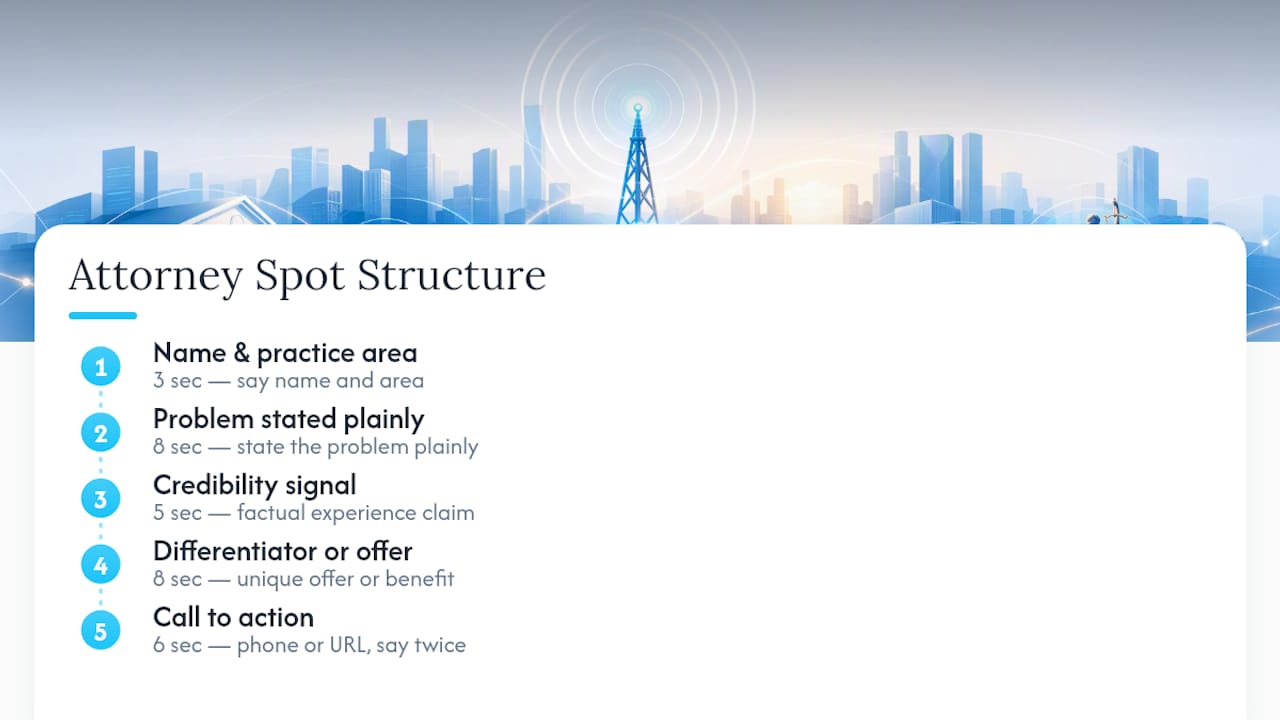
Clear, direct, and trust-building messages outperform clever creative for attorney spots. Listeners are not in a position to evaluate nuance while driving. They need to hear your name, your practice area, your differentiator, and how to reach you, in that order.
Practical guidance from the Law Society of Ireland recommends preparing 20–40 second soundbites and rehearsing mock interviews to build the kind of confident, authoritative delivery that earns repeat appearances. The same principle applies to scripted spots.
A 30-second attorney spot should follow this structure: name and practice area (3 seconds), the problem you solve stated plainly (8 seconds), your credibility signal (5 seconds), your differentiator or offer (8 seconds), and your call to action with phone number or URL repeated twice (6 seconds).
Avoid testimonials in radio scripts unless your state bar rules explicitly permit them. Stick to factual claims about your experience, case types, and availability. Phrases like “results may vary” and required disclaimers should be scripted into the spot, not added as an afterthought.
Pro Tip: Build a unique landing page URL into every radio script and mention it on air. That URL becomes your cleanest attribution signal and doubles as a reputation prompt when you add a review request to the confirmation page.
The AnalyticOwl data showed the strongest new-visitor lift on Tuesday through Thursday midday airings, which suggests those dayparts deserve priority placement in your media plan.
Local AM/FM, syndicated shows, or streaming: which format fits your firm?
Choose local AM/FM when you want community intent and geographic precision. Choose syndicated programming or streaming when you need broader reach, a specialty demographic, or a lower entry cost.
| Format | Best For | Reach | Cost Profile |
|---|---|---|---|
| Local AM/FM | Community trust, geographic targeting | High local adult reach | Moderate; negotiable by daypart |
| Syndicated radio (Genesis, Starcom) | Regional/national reach, specialty audiences | Broad; crosses markets | Varies by program and network |
| iHeartRadio / SiriusXM | Younger demos, national scale, digital attribution | Large; skews 35–64 | CPM-based; programmatic options |
| Streaming audio (Spotify, etc.) | Targeted demos, measurable digital attribution | Highly targeted | CPM-based; lower minimums |
Station branding and digital audio platforms offer reach strategies that complement traditional broadcast, particularly for firms targeting clients in multiple markets or specific practice-area demographics.
Goldman McCormick PR produces nationally syndicated radio programs carried on both the Genesis Communications Network and Starcom Radio Network, which gives law firm clients access to programming-level placements, not just spot buys.
Pro Tip: Negotiate Tuesday through Thursday midday slots as a priority, then use morning drive as a frequency booster. Avoid buying only one daypart — frequency across the week matters more than a single premium slot.
How do you measure radio ROI and prove it to your partners?
Measurement must correlate on-air windows to web and call lift. Demand a written attribution plan before signing any placement contract.
- Assign a unique call-tracking number to every radio campaign so inbound calls can be isolated from other channels.
- Build a dedicated landing page with UTM parameters tied to each station or daypart.
- Pull time-windowed analytics comparing new site visitors during on-air periods against baseline weeks.
- Run A/B market tests when budget allows, running the campaign in one market while holding another dark.
- Request third-party verification such as AnalyticOwl-style before/after analysis for campaigns running three months or longer.
The AnalyticOwl 19-month analysis of legal advertisers showed roughly a 20% lift in new site visitors during on-air periods, with the strongest performance on Tuesday through Thursday midday airings. That is the benchmark to hold your vendor accountable to.
What results can law firms realistically expect from radio campaigns?
Westwood One’s case studies on personal injury and family law firms showed AM/FM radio driving stronger unaided brand awareness and higher intent-to-hire scores among heavy listeners compared with TV. That is a meaningful finding for any firm whose goal is to be known before a prospect needs them.
The Law Gazette notes that building a media profile is a gradual process, and firms that commit to consistent placement over time outperform those running one-off campaigns.
Agency credentials worth verifying: Forbes recognition as a top PR firm, Bulldog Reporter Gold Award in the “Best Cause/Advocacy Campaign” category, and documented legal PR experience. Goldman McCormick PR holds all three.
Your 30/60/90-day plan to launch a radio campaign
Start with a scoping call. Everything else follows from that conversation.
Days 1–30:
- Book a scoping call with your chosen agency and define your practice area, geography, and intake capacity.
- Identify two to three target stations and request audience and rate cards.
- Brief the creative team on your differentiators, required disclaimers, and preferred CTA.
- Set up call-tracking numbers and build the dedicated landing page.
Days 31–60:
5. Approve final scripts and produce spots.
6. Execute a test buy on one to two stations with a defined on-air window.
7. Train intake staff on expected call volume and response time expectations.
8. Pull baseline web analytics for the pre-campaign period.
Days 61–90:
9. Review time-windowed analytics comparing new visitors during on-air periods to baseline.
10. Evaluate call quality and cost per lead against your KPI targets.
11. Adjust dayparts, creative, or station mix based on data.
12. Decide on a full campaign commitment or a revised test buy.
Contact Goldman McCormick PR to start your scoping call and get a proposal built around your firm’s specific market and practice area.
What most law firms get wrong about radio placement
Radio works best when the firm treats it as a brand-building channel with a direct-response layer, not a pure lead-generation tool. The attorneys who see the strongest results run campaigns long enough to build frequency, then capture the demand that frequency creates with fast, trained intake.
The most common failure is not the creative or the station choice. It is the intake gap. A listener hears your spot, searches your name, and calls. If that call goes to voicemail or a receptionist who cannot answer basic questions about your practice, the radio spend is wasted. Speed of response is the variable that separates firms that see measurable ROI from those that do not.
A second mistake is buying too few weeks to generate meaningful frequency. Three to four weeks of spots rarely moves the needle. Six months of consistent placement, measured against a clear attribution framework, is where the data starts to tell a real story.
Goldman McCormick PR: radio placement built for law firms
Goldman McCormick PR offers law firms a direct path to radio placement, production, and nationally syndicated programming without the guesswork of assembling a media buy from scratch.
Services include media placement on local AM/FM stations, production of 15–60 second spots, placement on the Genesis Communications Network and Starcom Radio Network, podcast production, and reputation management support. The firm’s legal PR track record, including the New York Observer’s top-five ranking and Forbes recognition, means your campaign is built by people who understand what law firm clients actually need from audio media.
Contact Goldman McCormick PR to request a proposal and get a campaign scoped to your market, practice area, and intake capacity.
Sources
- It’s Good Judgement to Use Radio for Legal Services
- Which Media Platform Makes The Most Sense For Law Firms? Two New Studies Prove AM/FM Radio Has A Major Advantage | Westwood One
- Law Firm Media Relations: How To Build Press Relationships – PriceWeber
- Selecting the Right PR Agency: Best Practices for Law Firms
- ICLES AND RADIO INTERVIEWS
- How to: boost your media profile | Feature | Law Gazette
- Seeger Media – Radio, Digital Platforms and Brokerage