
Defense attorneys who want real media exposure should hire a specialist legal-PR firm that combines proactive media placement, crisis press counsel, media training, and syndicated radio and podcast production. Goldman McCormick PR, named by Forbes as “One Of America’s Best PR Firms For 2021” earned a Bulldog Reporter Gold Award in 2016 and was cited by the New York Observer as one of the top five legal PR agencies in 2014. The firm places clients on TV, radio, and in newspapers, and produces nationally syndicated programming on the Genesis Communications Network and Starcom Radio Network. For a busy criminal defense attorney, the fastest next step is requesting a private intake call to assess your current visibility and identify the highest-impact placements.
Key proof points at a glance:
- Forbes recognition: “One Of America’s Best PR Firms For 2021”
- Bulldog Reporter Gold Award, Best Cause/Advocacy Campaign (2016)
- New York Observer top-five legal PR agency citation (2014)
- Syndication reach via Genesis Communications Network and Starcom Radio Network
Table of Contents
- What brand-building PR services do defense attorneys actually need?
- How do you evaluate and hire a legal PR firm?
- What do legal PR services cost, and when will you see results?
- What should the first 30–90 days of a PR engagement look like?
- What trust signals should you demand from a legal-PR partner?
- How does PR strategy fit with your existing marketing?
- Goldman McCormick PR works specifically with defense attorneys
- Key Takeaways
- Why most defense attorneys underestimate what PR actually requires
- Sources and further reading
What brand-building PR services do defense attorneys actually need?
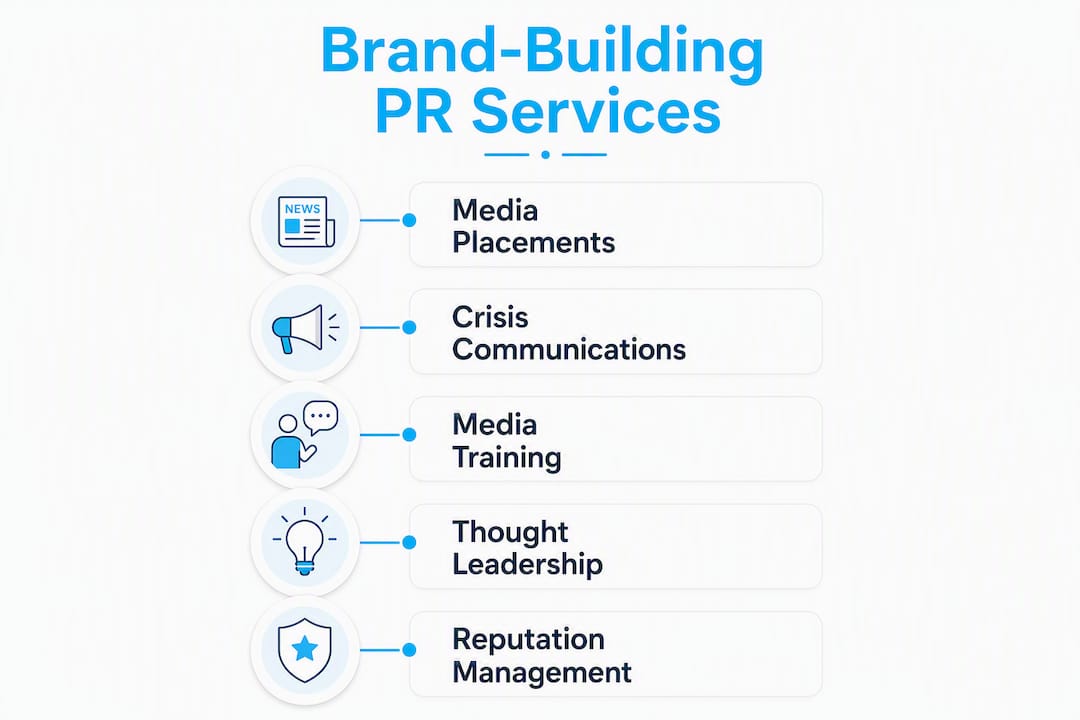
The top brand building services defense attorneys require go well beyond a press release. Criminal defense lawyers face a specific challenge: they need visibility before a high-profile case lands, not scrambling for it after. The core service set that moves the needle breaks down like this.
Media placements (TV, radio, print): A specialist firm pitches you to journalists covering criminal justice, books TV segments, and secures newspaper features. Specialist legal PR is recommended for high-stakes matters precisely because PR professionals manage reporter relationships and protect legal messaging simultaneously.
Crisis communications and press counsel: When a case goes public, you need a named decision-maker, escalation rules, and pre-approved messaging templates ready to deploy. Ethical press-counsel structures include a three-layer messaging framework covering legal position, human context, and firm identity.
Media training: Attorneys and their clients need coaching before any camera or microphone. This is not optional for high-exposure matters.
Op-ed and byline programs: Authored pieces in legal publications and regional newspapers build thought-leadership authority that compounds over months.

Podcast and radio production/syndication: Producing and distributing a show on national networks gives you controlled messaging at scale, reaching audiences no single placement can match.
Reputation management: Active review management, a maintained Google Business Profile, and a documented response protocol are table-stakes for local lead generation. Consistent content and active review management are foundational steps before pursuing high-exposure placements.
Awards and recognition management: Nominations and placements in credible legal rankings reinforce authority with prospective clients who research attorneys online.
Pro Tip: Sequence matters. Lock in reputation hygiene and media training before pursuing TV segments or syndicated radio. Placing an unprepared attorney in front of a national audience creates risk, not opportunity.
How do you evaluate and hire a legal PR firm?
Hiring criteria separate firms that understand criminal defense from generalists who will learn on your retainer.
Evaluation criteria
- Legal-PR specialization: Does the firm have documented placements in criminal-justice beats, not just general business media?
- Demonstrated TV/radio bookings: Can they show you actual segments, not just a list of outlets they “have relationships with”?
- Crisis experience: Have they managed press counsel during an active criminal matter, where a wrong statement can damage a case?
- Conflict-check process: A firm that represents a prosecutor’s office or a competing defense practice is a problem. Ask how they screen.
- Measurement approach: Vague promises about “brand awareness” are not a reporting cadence. You want earned media mentions, share-of-voice data, and referral attribution.
- Confidentiality safeguards: Press counsel for criminal matters requires intake safeguards and recordkeeping. Close coordination between PR and legal counsel reduces risk and requires a clear reporting cadence from day one.
Interview questions to ask
- Walk me through how you handled press counsel during an active criminal case.
- Show me three placements you secured for a criminal defense attorney in the last 24 months.
- How do you structure your conflict-check process before onboarding a new legal client?
- Who is my day-to-day contact, and what is your reporting cadence?
- How do you measure success beyond clip counts?
Red flags that should stop an engagement
- Guarantees of specific headlines or outlet placements
- No written conflict-check procedure
- No press-counsel protocol for active matters
- Reporting limited to vanity metrics with no referral or SEO attribution
| Criterion | What to look for |
|---|---|
| Legal-PR specialization | Criminal-justice beat placements, not just general business media |
| Media network | Documented TV/radio bookings with named outlets |
| Crisis capability | Active-matter press counsel experience with intake safeguards |
| Pricing transparency | Written fee schedule with clear scope and cancellation terms |
| Reporting | Earned media, share-of-voice, referral attribution, and backlink data |
What do legal PR services cost, and when will you see results?
Legal PR retainers vary widely based on firm size, scope, and market. Smaller engagements focused on local media and reputation hygiene typically run a few thousand dollars per month. Mid-size campaigns covering regional TV, radio, and byline programs sit in a higher range. High-intensity litigation PR, where a firm is managing daily press inquiries and coordinating with counsel on active matters, can reach significant fees for the campaign duration.
Typical billing models:
- Monthly retainer: The most common structure for ongoing media outreach, reputation management, and relationship-building with journalists.
- Project fees: One-time engagements for a press release campaign, a media training session, or a podcast launch.
- Surge/litigation pricing: Separate fee structures for high-profile active matters, given the approval overhead and rapid-response demands.
Timeline expectations:
- Media training typically occurs within a few weeks from engagement start
- First earned media placements generally happen within a few weeks to a few months
- Systemic SEO and authority lift from combined PR and digital footprint work: 6–12 months
Contract terms to review before signing:
- Notice period for cancellation is typically between one to three months
- Whether cancellation fees apply if you exit early
- Exclusivity or conflict clauses that restrict the firm from representing similar practices
- Scope of work definitions, so you know exactly what is and is not included
What should the first 30–90 days of a PR engagement look like?
A well-run onboarding follows a clear sequence. Ambiguity in the first month is a red flag.
- Days 1–7: Intake and conflict checks. The firm reviews your practice areas, active matters, and any existing media coverage. A formal conflict-check clears the engagement.
- Weeks 2–4: Messaging framework and media training. You and your team work through a three-layer messaging framework (legal position, human context, firm identity) and complete at least one media training session before any pitching begins.
- Weeks 4–12: Targeted pitching and first placements. The firm begins outreach to journalists on criminal-justice beats, books initial TV or radio segments, and distributes the first press materials. Coordinating filings and case developments as storytelling tools is part of this phase for high-profile matters.
- Months 2–3: Measurement and optimization. The firm reports on earned media mentions, referral inquiries, and backlink signals, then adjusts the pitch strategy based on what is landing.
Deliverables you should have in hand by day 90:
- Completed intake and press-counsel protocol document
- Approved messaging sheets for your practice areas
- A targeted outlet and reporter list
- At least one confirmed placement or booking, if available
- A coverage report with referral and SEO attribution data
Weekly check-ins during the first 30 days, then bi-weekly through month three, keep the engagement on track. The attorney or a designated firm contact must be reachable for rapid approvals, especially during active matters.
What trust signals should you demand from a legal-PR partner?
Credentials matter more in legal PR than in most categories, because a firm handling criminal defense press counsel is operating in a space where a misstep has real consequences.
Signals that demonstrate real capability:
- Third-party awards: Goldman McCormick PR’s Bulldog Reporter Gold Award (2016) reflects campaign craft judged by peers, not self-reported metrics.
- Industry recognition: A Forbes “Best PR Firms” designation signals sustained performance across multiple client categories.
- Trade-press citations: The New York Observer top-five legal PR agency citation (2014) is specific to the legal vertical, not general PR.
- Syndication network access: Placement on the Genesis Communications Network or Starcom Radio Network means national distribution, not just a local segment.
- Published case studies: Even redacted for confidentiality, case studies show the firm’s judgment about when to pursue publicity and when to hold back.
“When attorneys collaborate closely with PR practitioners, carefully planned media coverage can bolster cases and reveal important factual issues — but collaboration and restraint are both essential.” — Law.com / Daily Business Review
Ask any prospective firm to walk you through one case study where they chose not to pursue a placement. How a firm exercises restraint tells you more about their judgment than their highlight reel.
How does PR strategy fit with your existing marketing?
PR and marketing work best when they feed each other. A TV segment that runs without a corresponding landing page, updated Google Business Profile, or follow-up content loses most of its value within days. Earned media placements generate backlinks and authority signals that strengthen your SEO, but only if your website is structured to capture them.
Attorneys who already run paid search campaigns benefit from PR because earned media coverage raises the credibility of the ads a prospect sees. Someone who spots you on a local news segment and then encounters your Google ad converts at a higher rate than cold traffic. The same logic applies to referral networks: a byline in a regional legal publication reinforces your reputation with the attorneys who send you cases.
The practical integration steps are straightforward. Repurpose every earned media placement as website content, social proof, and email newsletter material. Align your PR messaging framework with your website copy so the story a journalist tells matches what a prospect reads when they click through. If you are running a podcast or syndicated radio program, embed episodes on your site and use them as lead magnets for consultations.
Savvy attorneys treat PR as a strategic partner to legal strategy, not a separate vendor. That means your PR firm should know your practice areas, your current marketing channels, and your intake process well enough to align messaging across all of them.
Goldman McCormick PR works specifically with defense attorneys
Goldman McCormick PR was founded by active and former media professionals, which means the team understands how journalists think, what producers need, and how to position a criminal defense attorney as a credible, quotable source rather than a defensive one.
For defense attorneys, the firm offers TV, radio, and newspaper placements; crisis press counsel; media training; and nationally syndicated radio and podcast production on the Genesis Communications Network and Starcom Radio Network. The combination of earned-media placement and syndicated distribution gives attorneys both reactive coverage (when a case demands it) and proactive brand-building (when it does not).
Every engagement begins with a confidential intake that includes a conflict check. Goldman McCormick PR does not take on clients whose matters create conflicts with existing relationships, and all press-counsel work is handled with attorney-client confidentiality in mind. To request a private intake call or visibility audit, visit goldmanmccormick.com and reach out directly.
Key Takeaways
Defense attorneys who hire a specialist legal-PR firm with documented TV and radio placement capability, crisis press-counsel experience, and national syndication access will see measurable brand authority gains within 90 days of a well-structured engagement.
| Point | Details |
|---|---|
| Hire a specialist, not a generalist | Choose a firm with documented criminal-justice beat placements and a formal press-counsel protocol. |
| Sequence services correctly | Complete reputation hygiene and media training before pursuing TV segments or syndicated radio. |
| Expect first placements within a few weeks to a few months | Systemic SEO and authority lift from combined PR work typically takes several months. |
| Review contract terms carefully | Check notice periods, cancellation fees, and conflict clauses before signing any retainer. |
| Goldman McCormick PR | Offers TV, radio, newspaper placements, crisis counsel, and national syndication for defense attorneys. |
Why most defense attorneys underestimate what PR actually requires
Most criminal defense attorneys think about PR only when a case goes public and the narrative is already running against them. By then, the firm has no established media relationships, no approved messaging, and no trained spokesperson. The PR firm is playing catch-up from day one.
The attorneys who get the most from legal PR are the ones who treat it the way they treat case preparation: methodically, before the pressure hits. A firm that has already placed you on regional TV, built a byline record, and trained you for on-camera interviews is a completely different asset when a high-profile matter arrives than one you called yesterday.
There is also a subtler point worth making. The value of syndicated radio and podcast production is not just reach. It is control. A journalist interview gives you one answer to one question. A syndicated program gives you 30 minutes to frame your expertise, your values, and your approach to criminal defense on your own terms. For attorneys building a long-term practice reputation, that distinction compounds in ways that clip counts never capture.
Sources and further reading
- Five Ways to Manage PR In High-Profile Litigation — Law.com: Tactical approaches for coordinating PR and legal strategy during active matters; cited in onboarding section.
- Savvy Lawyers Use Legal PR to Bolster Cases — Law.com: Evidence that coordinated PR and legal strategy improves outcomes; cited in trust signals and integration sections.
- How to manage online reputation: step-by-step guide for SMBs — BabyLoveGrowth: Reputation hygiene steps applicable to law firms; cited in services overview.
- Digital footprint guide: boost visibility and reputation — BabyLoveGrowth: Guidance on backlinks, authored content, and syndication for sustained visibility; cited in costs and timeline section.