
Retain a litigation-aware PR firm under attorney oversight and activate a rapid-response crisis protocol immediately when a criminal-defense matter draws media attention. That is the core recommendation, and it applies whether your client is a local business owner facing fraud charges or a public figure in a nationally televised case. ABA Model Rule 3.6 restricts extrajudicial statements that carry a substantial likelihood of materially prejudicing an adjudicative proceeding, permitting only narrow categories: claims and defenses, identity of involved persons, public-record information, scheduling, and the existence of an investigation. Violate those limits and you risk both your client’s case and your bar standing. Goldman McCormick PR, named by Forbes as one of America’s Best PR Firms for 2021, specializes in exactly this kind of coordinated legal media work.
First 24–72 hours: what to do right now
- Designate a single spokesperson. One voice, approved by lead counsel.
- Lock a holding statement that stays within Rule 3.6 permitted categories.
- Notify all firm partners: no ad hoc comments to reporters.
- Preserve all communications and log every media inquiry with time, outlet, and reporter name.
- Retain PR through counsel to keep strategy communications within attorney-client privilege where jurisdictional rules allow.
- Do not speculate on guilt, credibility, or anticipated testimony under any circumstances.
Table of Contents
- What does a criminal defense attorney PR campaign actually include?
- Ethics and legal limits: what Rule 3.6 actually allows you to say
- Crisis-response checklist: hour by hour through week one
- Holding statements, message maps, and what never to say
- Which channels work best for criminal-defense matters?
- Media training: getting your spokesperson ready fast
- What does a criminal-defense PR campaign cost?
- How to choose a specialized legal PR firm
- Key Takeaways
- Why litigation PR is not optional in high-profile criminal defense
- Goldman McCormick PR is ready when your matter breaks
- Useful sources and further reading
What does a criminal defense attorney PR campaign actually include?
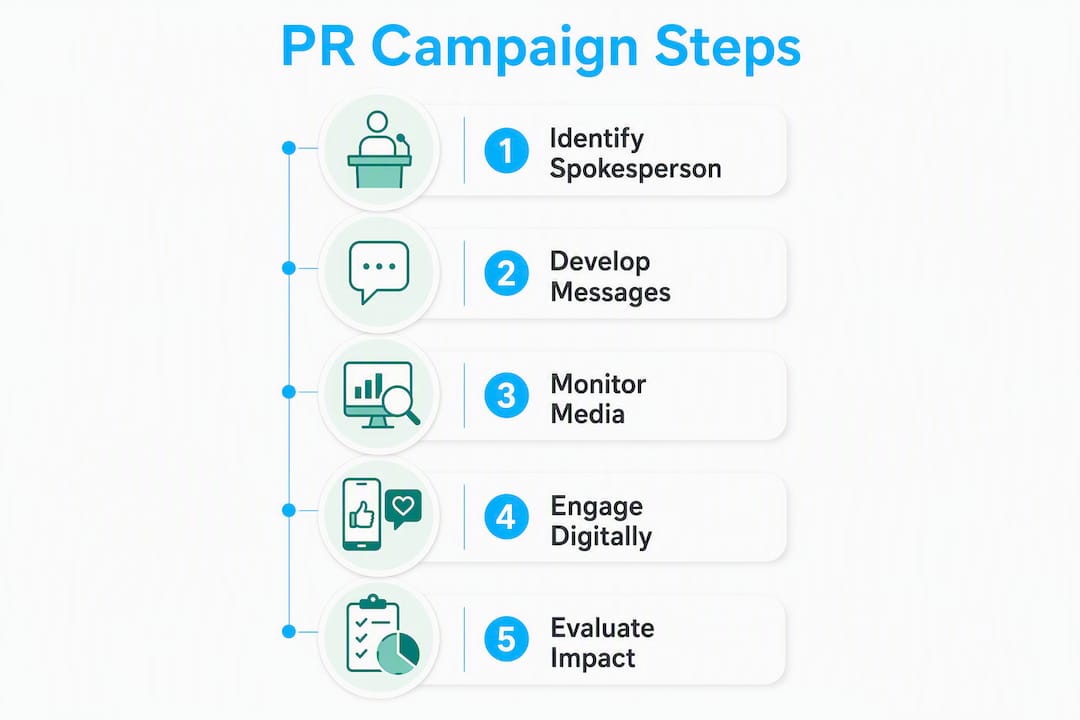
A well-built criminal defense attorney PR campaign is not a single press release. It is a coordinated set of capabilities that run in parallel with litigation strategy. PR advisers help law teams engage the press and prevent prosecutors from controlling the narrative in high-profile or multi-defendant matters, and each component below serves a specific strategic function.
| Component | Primary objective | Best channel |
|---|---|---|
| Approved spokesperson + holding statement | Narrative control, Rule 3.6 compliance | All media |
| Proactive media outreach | Awareness, factual correction | TV, radio, print |
| Social monitoring and response | Narrative triage, misinformation control | X, TikTok, Facebook |
| Paid amplification | Reach specific demographics, correct errors | Search, display, social |
| Owned content (blog, FAQ, op-ed) | Search capture, long-term reputation | Website, syndication |
| Media training | Spokesperson discipline | Internal |
| Reputation management | Post-case trust rebuilding | Review platforms, search |
Measurement basics matter from day one: track impressions, sentiment tone, share-of-voice against prosecution messaging, and referral traffic to owned content. Without baseline metrics, you cannot demonstrate that the campaign moved the needle.
Ethics and legal limits: what Rule 3.6 actually allows you to say
ABA Model Rule 3.6 is the governing constraint on every public statement a criminal-defense attorney makes during active proceedings. The rule prohibits opinions on guilt or credibility, anticipated testimony, and any statement with a substantial likelihood of prejudicing the proceeding. What it permits is narrower than most attorneys realize in practice.
Approval workflow to keep PR within ethical bounds:
- PR team drafts a proposed statement.
- Lead counsel reviews against Rule 3.6 permitted categories.
- Counsel approves or revises in writing.
- Approved statement is logged in the matter file with timestamp and approver name.
- Spokesperson delivers only the approved text.
- Any media follow-up questions are escalated back to counsel before response.
Gag orders add a second layer. When a court restricts statements beyond Rule 3.6, PR must pivot entirely to owned content and social monitoring, with zero proactive outreach until the order is lifted or modified.
Pro Tip: Retain your PR firm through counsel rather than directly. Communications routed through counsel are more likely to fall within attorney-client privilege in many jurisdictions, creating a defensible record that limits impeachment risk and privilege exposure.
Crisis-response checklist: hour by hour through week one
| Timeframe | Task | Responsible party | Escalation trigger |
|---|---|---|---|
| First 24–72 hours | Designate spokesperson; lock holding statement | Lead counsel + PR lead | Any reporter contact |
| First 24–72 hours | Log all media inquiries | Firm administrator | Broadcast outlet contact |
| First 24–72 hours | Preserve evidence and communications | Litigation team | Any deletion attempt |
| 24–72 hours | Issue holding statement if needed | Spokesperson (counsel-approved) | Prosecution statement issued |
| 24–72 hours | Begin proactive outreach to priority reporters | PR lead | Factual error published |
| 24–72 hours | Launch social listening across X, TikTok, Facebook | PR/social team | Viral narrative detected |
| Week 1 | Schedule media training session | PR lead | Spokesperson interview booked |
| Week 1 | Draft op-eds and educational content | PR + counsel | Search demand spike |
| Week 1 | Deploy paid amplification if correcting errors | PR lead | Misinformation spreading |
Tabletop exercises and intake scripts prepared before a crisis hits are consistently more effective than on-the-fly response. Firms that run preparedness drills make fewer ethical and operational mistakes when a real matter breaks.
Holding statements, message maps, and what never to say
Sample holding statements by case stage
Initial arrest: “Our client maintains their innocence. We are reviewing the charges and will respond through the appropriate legal process. We have no further comment at this time.”
Indictment: “We are confident in our client’s defense and look forward to presenting the facts in court. The indictment reflects only one side’s allegations.”
Active proceedings: “Out of respect for the court process, we will not comment on evidence or testimony. We remain committed to a vigorous defense.”
Message map format for spokespeople
- Core message (one sentence, Rule 3.6 compliant).
- Supporting fact from public record only.
- Bridging line to redirect hostile questions (“What I can tell you is…”).
- Closing restatement of core message.
Do not say list (Rule 3.6 violations)
- Any opinion on the credibility of a witness or alleged victim.
- Predictions about testimony or evidence to be introduced.
- Characterizations of the prosecution’s case as weak, fabricated, or politically motivated.
- Speculation about guilt or innocence beyond your client’s stated position.
For broadcast, keep every statement under 15 seconds. For social platforms, strip legal qualifiers to plain language without crossing into prohibited territory.
Which channels work best for criminal-defense matters?
| Channel | Best use case | Key tactic |
|---|---|---|
| Earned (TV/radio/print) | Factual correction, narrative control | Targeted reporter outreach, document sharing |
| Owned (website, blog, op-ed) | Search capture, long-term reputation | FAQ hubs, educational posts, op-eds |
| Paid (search, display, social) | Reaching specific demographics, correcting errors | Geo-targeted display, promoted posts |
| Social (X, TikTok, Facebook) | Rapid narrative triage | Platform-native monitoring, rapid rebuttals |
Cases since 2022 show that TikTok and X can create sustained narratives that traditional press outreach alone cannot correct. A criminal-defense PR strategy that ignores short-form video is operating with one hand tied behind it. Platform-native responses, including short-form video rebuttals and moderation requests, are now standard practice in high-profile defense work.
Pro Tip: Build a digital footprint for your client’s defense narrative before the prosecution fills that space. Owned landing pages and FAQ content rank in search and give journalists a factual baseline to work from.

Media training: getting your spokesperson ready fast
A single undisciplined comment can unravel weeks of careful messaging. The training session below runs 60–90 minutes and prepares any spokesperson for live media contact.
- Rule 3.6 refresh (10 minutes). Review permitted and prohibited categories. Every participant confirms in writing what they cannot say.
- Message map drill (15 minutes). Spokesperson delivers core message, supporting fact, and bridging line until the sequence is automatic.
- Soundbite practice (10 minutes). Record 10-second and 15-second versions of the approved statement. Playback and critique.
- Hot-seat simulation (20 minutes). PR lead plays a hostile reporter. Spokesperson practices deflection, bridging, and hard stops.
- Platform-specific behavior (10 minutes). Separate coaching for on-camera TV, radio-only, and social video formats.
- Debrief and matter file update (10 minutes). Log approved phrases, escalation rules, and any topics flagged as off-limits.
Press counsel frameworks that classify information into public-safe, public-avoid, and confidential buckets give spokespeople a clear mental map during live interviews. Without that structure, even experienced attorneys improvise in ways that create discoverable contradictions.
What does a criminal-defense PR campaign cost?
Pricing varies by matter complexity, timeline urgency, and service scope. The table below reflects general market ranges, not quotes.
| Model | Typical use case | Estimated range |
|---|---|---|
| Emergency retainer (crisis fee + hourly) | Immediate crisis, first 72 hours | — |
| Monthly retainer | Ongoing reputation management, sustained matters | — |
| Project-based fee | Discrete campaign (press conference, op-ed push) | — |
Services that reliably increase cost include national wire distribution, broadcast booking across multiple markets, paid amplification budgets, and legal review cycles on every piece of content. Litigation milestones like a successful motion to dismiss create natural opportunities to reshape public narrative, and timing a media push around those moments can compress the overall campaign timeline and reduce total spend.
How to choose a specialized legal PR firm
| Criterion | What to look for | Red flag |
|---|---|---|
| Litigation experience | Named high-profile case roles, counsel-driven workflows | Only corporate or product PR experience |
| Rule 3.6 familiarity | Can cite permitted categories without prompting | Promises “unlimited media exposure” |
| Privilege handling | Retains through counsel, documents approvals | Resists counsel oversight |
| Social amplification | Platform-native capabilities, monitoring tools | No social strategy beyond press releases |
| Measurement approach | Tracks sentiment, share-of-voice, referral traffic | Reports only impressions |
| Ethics-first record | No history of encouraging public admissions | Pushes client to speak without counsel present |
Questions to ask in your first call: How have you handled gag orders? Who approves statements before they go out? Can you describe a matter where you coordinated directly with trial counsel? What is your escalation process when a narrative goes viral overnight?
Key Takeaways
A criminal defense attorney PR campaign succeeds when litigation strategy and communications run in parallel, both governed by ABA Model Rule 3.6 and attorney oversight from day one.
| Point | Details |
|---|---|
| Retain PR through counsel | Routing communications through counsel protects privilege and creates a defensible approval record. |
| Rule 3.6 governs every statement | Permitted categories are narrow; prohibited statements include opinions on guilt, credibility, and anticipated testimony. |
| Act within 72 hours | Designate a spokesperson, lock a holding statement, and begin social monitoring before the narrative sets. |
| Match channels to objectives | Earned media corrects facts; owned content captures search; paid amplification reaches specific demographics. |
| Goldman McCormick PR | A Forbes-recognized legal PR specialist offering crisis communications, media training, and broadcast placement under attorney-led coordination. |
Why litigation PR is not optional in high-profile criminal defense
Litigation PR delivers dual value: it manages public opinion and gives trial teams a sounding board for how jurors might perceive factual arguments before those arguments are made in court. That second function is underused. Most attorneys think of PR as damage control. The sharper use is stress-testing your narrative before a hostile reporter or a skeptical juror does it for you.
High-profile cases from O.J. Simpson through the Depp-Heard trial and the Bankman-Fried proceedings show the same pattern: uncoordinated or aggressive public engagement either helped or badly damaged legal outcomes and public trust. The variable was not the quality of legal argument. It was whether the communications strategy was disciplined and counsel-led.
Goldman McCormick PR has operated at this intersection since 2010, earning recognition from the New York Observer as one of the top five legal PR agencies in 2014 and a Bulldog Reporter Gold Award for Best Cause/Advocacy Campaign in 2016. The firm’s working model keeps PR under attorney oversight, which is the only structure that protects both the client and the case.
Goldman McCormick PR is ready when your matter breaks
When a criminal matter draws media attention, you need a firm that already knows how to work inside the constraints your trial counsel sets, not one that has to be educated on Rule 3.6 while the story runs. Goldman McCormick PR provides crisis communications, media training, press conference support, paid amplification, and reputation management, all coordinated under attorney oversight to preserve privilege and compliance.
The firm’s credentials speak directly to this work: Forbes named Goldman McCormick PR one of America’s Best PR Firms for 2021, the New York Observer placed it among the top five legal PR agencies in 2014, and Bulldog Reporter awarded it a Gold Award for advocacy communications in 2016. The team places clients on TV, radio, and in print, and produces nationally syndicated radio programming through the Genesis Communications Network and Starcom Radio Network.
Contact Goldman McCormick PR to discuss your matter and get a response plan in place before the next news cycle.
Useful sources and further reading
| Topic | Source |
|---|---|
| ABA Model Rule 3.6 and permitted statement categories | Media communications: legal and ethical considerations for lawyers |
| Criminal defense attorney media strategy | Criminal defense attorney media (legal insights) |
| Law and PR coordination in high-profile cases | How law and PR can work together in high-profile cases |
| Ethics of legal PR and platform-native response | The ethics of legal PR: where public relations meets legal responsibility |
| Privilege protection and trial strategy coordination | Synchronizing trial strategy and crisis PR |
| Ethical media strategies and press counsel frameworks | Ethical media strategies for criminal defense firms |
| Digital footprint and social amplification | Digital footprint guide: boost visibility and reputation |
| Goldman McCormick PR legal PR services | Goldman McCormick PR |