
A PR retainer for attorneys is a monthly fee agreement that keeps a public relations firm on standing availability, covering ongoing media relations, press office management, crisis response, and reputation work for your practice. According to core retainer services, a retainer typically includes strategic counsel, media list development, pitch creation, journalist outreach, press release distribution, and real-time monitoring. For attorneys handling high-profile litigation, regulatory exposure, or reputation-sensitive matters, that standing availability is the whole point. You are not buying a one-time press release. You are buying a firm that picks up the phone when a reporter calls at 7 PM on a Friday.
When PR communications touch active legal matters, the structure of the retainer agreement also affects whether those communications can be protected under attorney-client privilege or the work product doctrine. WilmerHale’s guidance advises explicitly memorializing the PR firm’s role as integral to the client’s ability to receive or implement legal advice, which courts weigh when deciding whether to extend privilege protection.
Table of Contents
- What does a PR retainer for attorneys actually include?
- How do PR retainer fees and billing structures typically work?
- When should an attorney hire a PR retainer?
- What should you expect in the first 30, 60, and 90 days?
- How do you evaluate and negotiate a PR retainer?
- What contract clauses should every attorney include?
- Goldman McCormick PR serves attorneys who need a real retainer partner
- Key Takeaways
- Why attorneys underestimate what a retainer actually buys
- Useful sources and further reading
What does a PR retainer for attorneys actually include?
The scope varies by firm, but a well-structured retainer for legal clients covers these core services:
- Strategic counsel: Regular advisory sessions to align messaging with your legal strategy and practice goals.
- Media list development: A curated, updated list of journalists, producers, and editors who cover your practice area, jurisdiction, or case type.
- Pitch creation and journalist outreach: Story angles and direct outreach to reporters, built around your cases, commentary, or firm news.
- Press release drafting and distribution: Written announcements pushed to targeted media contacts and wire services.
- Press office management: A standing point of contact for inbound media inquiries, so reporters get a response from someone who knows your position, not a voicemail.
- Media monitoring: Real-time tracking of coverage, mentions, and developing stories that could affect your reputation or a live matter.
- Media training: Preparation for on-camera interviews, depositions-adjacent press situations, and spokesperson coaching.
- Crisis response: Rapid-response capability when a story breaks or a case generates unexpected media attention.
Standing availability for reactive inquiries is what separates a retainer from a project. In high-profile litigation, a reporter’s deadline does not wait for a scheduled call. Press office management for a firm handling active cases means someone is monitoring coverage, flagging developing stories, and drafting holding statements before you even know a call is coming. Pair that with a digital monitoring tool and your team has real-time visibility into what is being said about your firm or your clients.
Pro Tip: When reviewing a retainer proposal, ask the agency to write “standing availability for reactive media inquiries, including same-business-day response to inbound press calls” directly into the scope of services section. Vague language like “media support as needed” gives you nothing to enforce.

How do PR retainer fees and billing structures typically work?
PR retainers run on a monthly recurring fee with a defined scope, and minimum commitment windows commonly run several months to a few years. The four most common billing structures are:
- Monthly flat fee with defined scope: A fixed amount covers a set number of hours and deliverables each month. Predictable for budgeting, and the most common model.
- Monthly fee plus hourly overages: A base retainer covers core services; additional hours beyond the cap bill at an agreed rate. Useful when your media activity is unpredictable.
- Block-hour retainer: You purchase a bank of hours upfront, drawn down as work is performed. Less common for ongoing PR, but useful for attorneys who want flexibility.
- Hybrid project plus retainer: A defined project (say, a trial media campaign) runs alongside a smaller standing retainer for monitoring and reactive response.
On cost-effectiveness, retainers typically deliver lower per-hour senior expertise than equivalent project-based work because there is no ramp-up cost and the team carries institutional knowledge of your firm, your clients, and your messaging.
For negotiation, ask for a pilot-to-retainer clause: a 60-day focused project at a flat fee, with a defined conversion path to a monthly retainer if both sides are satisfied. Also, request explicit scope-change language so that a sudden crisis or major trial does not silently consume your monthly hours without a written amendment.
When should an attorney hire a PR retainer?
Not every practice needs one. These are the situations where a retainer earns its cost:
- High-profile litigation: Ongoing cases that generate media attention require consistent, coordinated messaging across the life of the matter.
- Crisis management: A bar complaint, a client accusation, or a verdict that goes sideways can move from rumor to front page in hours. A retainer means your PR team already knows your firm.
- Regulatory or enforcement exposure: Attorneys advising clients under investigation, or firms facing their own regulatory scrutiny, benefit from standing media counsel.
- Reputation building and practice growth: Consistent placement in legal trade press, local business media, and national outlets builds the kind of credibility that referrals and new clients respond to.
- Thought leadership and commentary: Regular op-eds, podcast appearances, and expert commentary require a team that pitches proactively, not just reactively.
- Awards and recognition: Submissions to legal directories, bar association awards, and industry rankings take sustained effort over months.
On timing, onboard your PR firm before the event, not during it. For trial visibility, that means giving the PR firm sufficient lead time before jury selection. For a practice growth campaign, give the retainer 6–12 months before evaluating results. The compounding effect of established credibility typically materializes after several months as reporter relationships mature.
What should you expect in the first 30, 60, and 90 days?
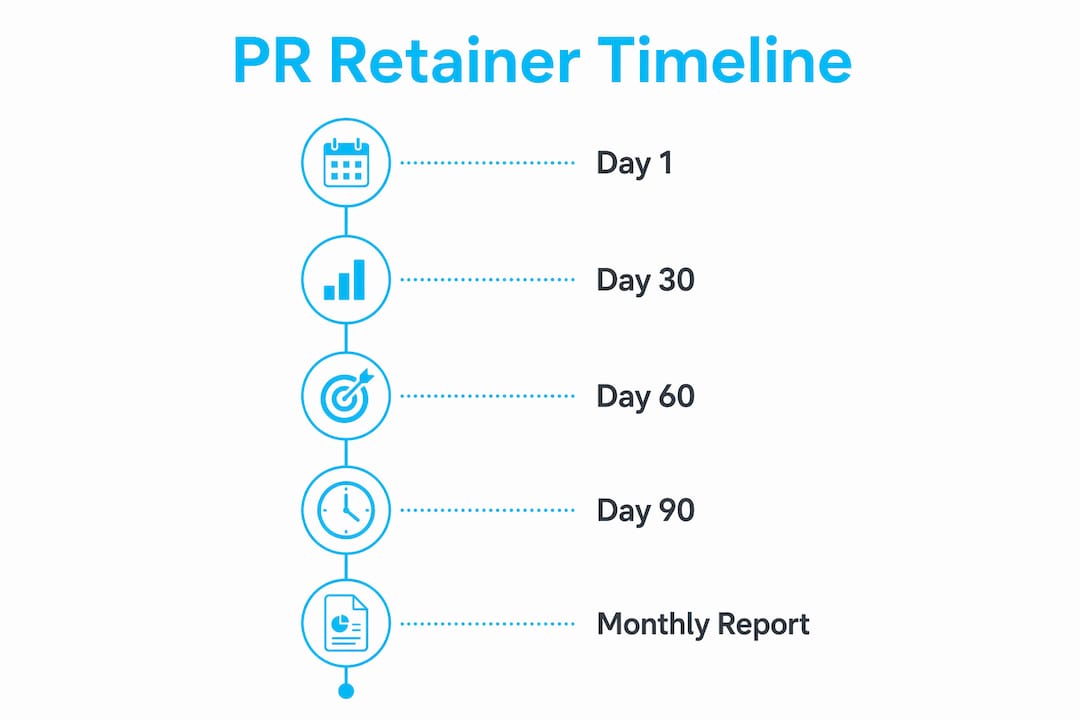
Days 1–30 are discovery and foundation. Your PR team conducts a messaging audit, interviews key spokespeople, builds or updates the media list, and drafts core materials: a firm bio, attorney bios, and a boilerplate press statement. No placements yet, but the infrastructure is being built.
Days 31–60 shift to active outreach. The first pitches go out, initial journalist relationships are established, and you should see at least one or two media conversations, if not placements. Monitoring is running and you receive your first monthly report.
Days 61–90 bring the first real results. Placements in trade or local media, a podcast booking, or a radio segment are realistic targets. The monthly report at day 90 should show activity volume, placements secured, outlet quality, and a forward plan.
A solid monthly report covers: pitches sent and responses received, placements with outlet name and audience reach, monitoring summary of relevant coverage, spokesperson prep sessions completed, and the plan for the next 30 days. If a report arrives with only a placement count and no context, ask for more.
| Milestone | Typical Deliverable |
|---|---|
| Day 30 | Media list, messaging framework, core press materials |
| Day 60 | First pitches sent, monitoring live, initial media conversations |
| Day 90 | First placements, monthly report with reach data, 90-day forward plan |
| Ongoing | Monthly pitches, press releases, monitoring reports, spokesperson prep |
How do you evaluate and negotiate a PR retainer?
Ask these questions before signing anything:
- Who will actually do the day-to-day work, and what is their background in legal PR?
- How many senior hours are guaranteed per month, and who counts as “senior”?
- Which journalists covering your practice area does the firm have existing relationships with?
- What is the escalation path if a crisis breaks outside business hours?
- How do you handle conflicts if you represent a client adverse to another firm client?
| KPI | What to Request |
|---|---|
| Media placements | Number and tier of outlets per month |
| Response time | Committed hours for reactive media inquiries |
| Outlet quality | Tiered list (national, trade, local) with audience reach |
| Share of voice | Mentions relative to peer firms in your market |
| Earned media value | Reported with a caveat: EMV is an estimate, not revenue |
Red flags to watch for:
- No clear written scope of work attached to the contract
- Vague or absent response-time commitments for reactive inquiries
- No named senior counsel and no guaranteed senior hours
- Missing confidentiality provisions or no discussion of privilege framing
- Promises of specific placement counts before the team has assessed your practice area
What contract clauses should every attorney include?
A PR retainer agreement for an attorney is a legal document. Treat it like one.
- Minimum term and termination for convenience: Know the exit path. A 30-day written notice clause after an initial term is standard and reasonable.
- Scope of services with SLAs: Name the deliverables and response time commitments explicitly.
- Senior staffing guarantee: Name the point contacts and the guaranteed senior hours per month in the agreement.
- Fee structure and invoicing: Specify the monthly fee, overage rate, invoicing date, and payment terms.
- Scope-change process: Require a written amendment for any work outside the defined scope.
- Confidentiality and NDA: The PR firm will see sensitive client information. A mutual NDA with a survival clause is non-negotiable.
- Privilege and work product framing: Per WilmerHale’s analysis, include language stating that the PR firm is retained to assist counsel in providing legal advice and that its work is integral to the client’s ability to receive that advice.
- Ownership of materials: Confirm that press releases, media lists, and pitch materials belong to your firm upon payment.
- Indemnity and liability limits: Standard professional services caps apply; review them.
Courts apply six factors when evaluating whether privilege extends to PR communications: duration of the relationship, who retained the firm, the nature of services, functional equivalence to an employee, common legal interest, and non-testifying expert classification. Your contract language affects at least three of those factors directly.
Pro Tip: Add a legal-specific addendum to the retainer that explicitly states the PR firm is engaged at the direction of counsel to facilitate legal representation. This single paragraph materially strengthens a privilege argument if communications are ever challenged.
Goldman McCormick PR serves attorneys who need a real retainer partner
Goldman McCormick PR brings a credential set that matters specifically to attorneys. Forbes named Goldman McCormick PR one of America’s Best PR Firms for 2021. The New York Observer cited the firm as one of the top five legal PR agencies in 2014. Bulldog Reporter awarded Goldman McCormick PR a Gold Award for Best Cause/Advocacy Campaign in 2016. These are not general marketing credentials. They reflect a firm that has worked in the legal space long enough to understand how media coverage intersects with active matters.
Goldman McCormick PR places attorneys on TV, radio, and in newspapers, and produces podcasts and nationally syndicated radio programs on the Genesis Communications Network and Starcom Radio Network. For attorneys who need standing crisis readiness, media training, and a press office that understands privilege considerations, that format range matters. You are not limited to a single channel when a story breaks. To discuss a retainer engagement, contact Goldman McCormick PR directly at goldmanmccormick.com.
Key Takeaways
A PR retainer for attorneys is a monthly standing agreement that covers media relations, crisis response, and reputation work, and its value compounds most visibly after six to twelve months.
| Point | Details |
|---|---|
| Core definition | A PR retainer gives attorneys standing access to media relations, crisis response, and press office services on a monthly fee. |
| Commitment window | Typical retainer terms run 6–24 months; a pilot-to-retainer clause lets you test fit before committing. |
| Privilege protection | Memorialize the PR firm’s role as integral to legal representation in the contract to strengthen privilege arguments. |
| KPIs to track | Request placement tier, response time commitments, and share of voice in every monthly report. |
| Goldman McCormick PR | Forbes-recognized and New York Observer-cited for legal PR, Goldman McCormick PR offers TV, radio, and newspaper placements with standing retainer engagements for attorneys. |
Why attorneys underestimate what a retainer actually buys
Most attorneys who hesitate on a PR retainer are comparing it to a project: a press release, a media pitch, a one-time crisis response. That comparison misses the point. What a retainer actually buys is a team that already knows your firm when the call comes in. The reporter who calls about a verdict does not want to wait while a new agency gets up to speed on your practice. The value is not in any single deliverable. It is in the institutional knowledge and the standing relationship.
The privilege question also gets underestimated. Attorneys who engage PR firms without contract language tying the firm’s role to legal representation are leaving a real evidentiary gap. Courts have denied privilege claims over PR communications precisely because the retainer agreement did not establish the necessary connection to legal counsel. That is a fixable problem, and it costs nothing to fix at the contract stage.
Evaluate ROI honestly at the six-month mark, not the sixty-day mark. The attorneys who abandon retainers early are usually the ones who did not give the compounding effect time to work.
Useful sources and further reading
- What Does a PR Retainer Include? — Muse & Motif: Covers core retainer service components and standing availability. Supports Sections 1 and 2.
- Retainer vs. Project-Based: How to Structure PR Engagements — Everything PR: Explains billing models, commitment windows, and cost-effectiveness. Supports Section 3.
- PR Retainer vs. Project-Based PR — Che Consulting: Covers compounding value and the pilot-to-retainer path. Supports Sections 3 and 4.
- Keeping PR Strategy Communications Privileged: Part 2 — WilmerHale: Primary guidance on memorializing the PR firm’s role to protect privilege. Supports Sections 1 and 7.
- The Privilege of PR — Illinois Law Review (Chandran): Academic analysis of the six factors courts use to evaluate privilege extension to PR firms. Supports Section 7.
- What Does It Mean To Have a Lawyer on Retainer? — FindLaw: Background on attorney retainer definitions and ABA ethics guidance. Useful context for attorneys new to retainer structures.
- Why solo lawyers need SEO to win more clients — Stellor: Covers how earned media and discoverability intersect for attorneys building their practice online.
This article is general information about PR retainer structures and is not legal advice. Attorneys should consult qualified counsel regarding privilege protection, contract terms, and professional conduct rules applicable to their jurisdiction.