
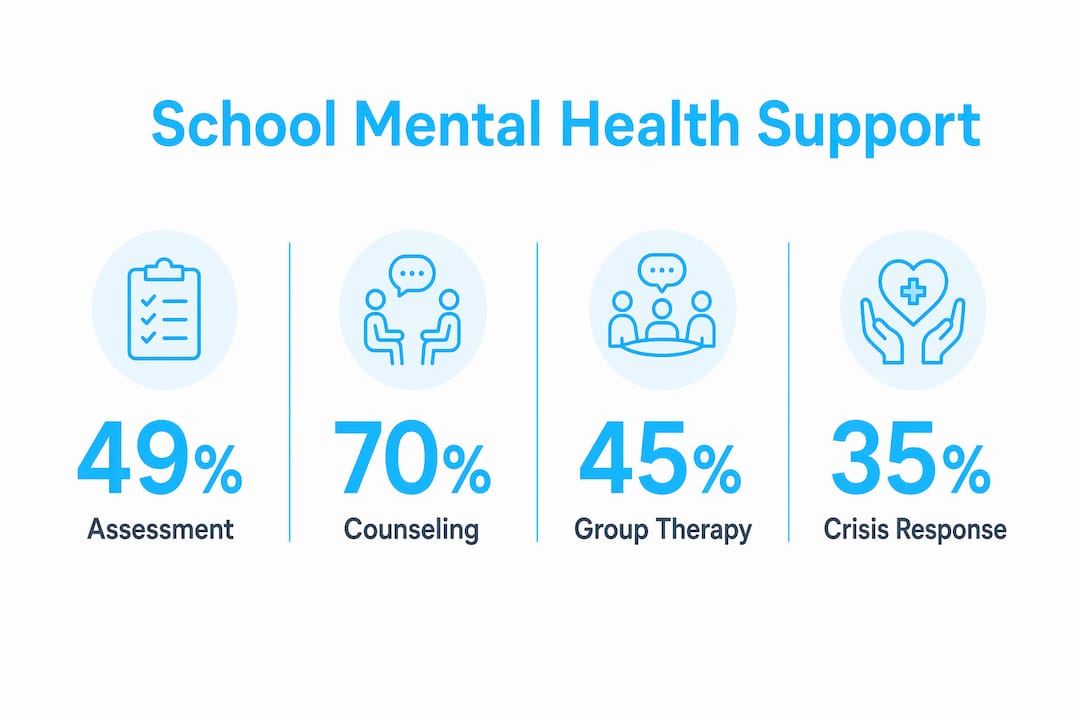
Public education mental health PR is the strategic communication and advocacy work designed to promote mental health literacy, awareness, and supportive services within public schools through evidence-based messaging and media outreach. The need is real and well documented: only 49% of public schools provided diagnostic mental health assessments in the 2021–2022 school year, and just 38% offered treatment services. At the same time, 69% of public schools reported an increase in student mental health concerns as of April 2022. PR campaigns in this space close the gap between what schools can clinically provide and what communities need to understand, accept, and fund.
The core elements of a public education mental health PR campaign include:
- Building mental health literacy, defined by the CDC as the knowledge, understanding, and skills students need to seek help when needed
- Reducing stigma through consistent, accurate messaging across media channels
- Advocating for policy changes, funding, and licensed professional access in underserved schools
- Engaging teachers, parents, and community leaders as messengers, not just recipients
- Aligning communication with established frameworks like Multi-Tiered Systems of Support (MTSS)
Table of Contents
- What authoritative agencies say about mental health PR in schools
- Current landscape: what U.S. public schools actually offer
- Goldman McCormick PR’s expertise in mental health advocacy
- Best practices for public education mental health PR campaigns
- How public education mental health PR evolved over time
- What successful mental health PR campaigns in schools look like
- How parents, students, and community stakeholders drive mental health advocacy
- How to measure the impact of a mental health PR initiative
- Goldman McCormick PR can amplify your mental health advocacy
- Key Takeaways
What authoritative agencies say about mental health PR in schools
The leading guidance on school mental health communication comes from UNESCO, the World Health Organization (WHO), the CDC, and federal agencies, and they largely agree on the direction.
- UNESCO and WHO recommend that school mental health PR focus on creating “enabling environments” that normalize mental health discussions as part of everyday school culture, not as crisis responses.
- The CDC’s action guide outlines six proven in-school strategies and emphasizes that MTSS frameworks should anchor any communication or advocacy effort.
- SchoolSafety.gov stresses that teachers should function as mental health allies and referral facilitators, not clinicians. Framing educators this way in PR messaging reduces staff resistance and increases parent acceptance.
- KFF data highlight persistent health equity gaps in mental health service receipt, meaning PR campaigns must use inclusive, accessible language that reaches diverse communities, not just majority populations.
- Quality mental health education programs require supportive policies, trained staff, and engaged parents and communities, according to CDC guidance, which means PR strategy must address all four pillars simultaneously.
The teacher-as-ally framing deserves special attention. When messaging positions educators as the first line of recognition and referral rather than amateur therapists, school staff are far more likely to participate in campaigns and share materials with families.
Current landscape: what U.S. public schools actually offer
The gap between what schools advertise and what they deliver is one of the most important facts any mental health PR campaign must reckon with.
| Service or metric | Data point | Source |
|---|---|---|
| Schools offering any mental health service | 97% | KFF |
| Individual counseling available | 83% | KFF |
| Case management available | 70% | KFF |
| Outside referrals available | 67% | KFF |
| Diagnostic assessments provided (2021–2022) | only 49% of public schools | NCES |
| Treatment services provided (2021–2022) | 38% | NCES |
| Schools citing inadequate professional access as a major barrier | 39% | NCES |
39% of public schools reported inadequate access to licensed mental health professionals as a major limitation in 2021–2022, tied with inadequate funding as the top barrier to providing services.
Nearly every school now offers something, but the depth of that coverage varies enormously. A school that lists “outside referrals” as a service may have one counselor managing 400 students. PR campaigns that ignore this gap risk overpromising to parents and losing credibility with school boards.
Goldman McCormick PR’s expertise in mental health advocacy
Goldman McCormick PR brings a specific and documented track record to mental health advocacy campaigns. Named by Forbes Magazine as one of America’s Best PR Firms for 2021, the firm was founded in 2010 by active and former media professionals who understand how coverage actually gets placed, not just pitched.
The firm’s credentials in cause and advocacy work are concrete:
- Gold Award, Bulldog Reporter CSR Awards (2016): Won in the “Best Cause/Advocacy Campaign” category, the most directly relevant recognition for mental health PR work.
- Forbes recognition (2021): Listed among America’s Best PR Firms, validating the firm’s media reach and placement capabilities.
- New York Observer citation (2014): Identified as one of the top five PR agencies specializing in legal PR, demonstrating cross-sector advocacy depth.
- Multi-channel media placement: Goldman McCormick PR secures coverage across TV, radio, newspapers, and podcasts, including nationally syndicated programs on the Genesis Communications Network and Starcom Radio Network.
- Podcast production: The firm produces original podcast content, a channel that has become central to mental health awareness campaigns targeting parents and educators.
For mental health advocacy clients, the combination of earned media placement and broadcast reach means a campaign can move from a school board meeting to a national radio audience within the same news cycle.
Best practices for public education mental health PR campaigns
Effective mental health PR in schools is built on a few principles that separate campaigns that shift attitudes from those that generate a press release and disappear.

Align with MTSS from the start. Campaigns integrated within Multi-Tiered Systems of Support gain immediate credibility with administrators because they speak the language of existing academic infrastructure. Pitching mental health awareness as a standalone initiative is a harder sell than showing how it reinforces what schools already do.
Use data to target messaging. Schools in high-poverty districts face different barriers than suburban schools. KFF data on health equity gaps make clear that a single message does not reach all communities equally. Segment your audiences and adapt the language accordingly.
Tie campaign goals to school KPIs. School boards respond to attendance rates, disciplinary incidents, and graduation numbers. Linking mental health PR efforts to metrics like reduced absenteeism and fewer disciplinary actions gives administrators a reason to support and fund continued advocacy.
Engage teachers as the primary messengers. Per SchoolSafety.gov guidance, educators who feel equipped, not burdened, become the most credible voices for mental health awareness among parents and students alike.
Build community and parent involvement into the plan. CDC guidance is explicit: quality mental health education programs require engaged parents and communities. A PR campaign that only targets media without activating local stakeholders will plateau quickly.
Pro Tip: Advocate for funding alongside awareness. A campaign that raises awareness without pushing for licensed professional access and stable funding leaves schools with more demand and no new capacity. Pair every media push with a clear ask to school boards or state legislators.
Strategic recommendations at a glance:
- Integrate campaigns within MTSS frameworks
- Segment messaging by school demographics and equity data
- Frame teachers as allies, not clinicians, in all public-facing materials
- Connect mental health outcomes to academic performance metrics
- Involve parents and community organizations as co-messengers
- Pair awareness campaigns with explicit funding advocacy
How public education mental health PR evolved over time
The history of mental health communication in schools tracks closely with federal legislation. The Education for All Handicapped Children Act of 1975, now known as the Individuals with Disabilities Education Act (IDEA), first required public schools receiving federal funding to address students’ behavioral and emotional needs. That mandate created the infrastructure that modern PR campaigns now work within.
The shift from purely clinical framing to public communication and advocacy accelerated after the 1999 Columbine shooting, when school safety and student mental health became inseparable in the public conversation. Federal investment followed, and with it came the need for schools to communicate their mental health efforts to skeptical or grieving communities. The passage of the Every Student Succeeds Act (ESSA) in 2015 formalized MTSS as a federal framework, giving PR professionals a common vocabulary to use when pitching mental health initiatives to school leaders and media alike. More recently, the Bipartisan Safer Communities Act, enacted after the 2022 Uvalde shooting, added new federal aid for school mental health programs, raising the stakes and the public interest in how those programs are communicated.
What successful mental health PR campaigns in schools look like
The most effective campaigns share a few structural traits. They start with a clear, data-supported problem statement, they name a specific audience, and they measure results against something a school board actually tracks.
One pattern that works consistently is the “awareness to action” arc: a media campaign that begins with earned coverage in local newspapers and radio, moves to community town halls where teachers and parents speak directly, and closes with a legislative or budget ask. How algorithms shape public perception of mental health issues in schools matters here too. Campaigns that generate early digital coverage tend to sustain longer news cycles because platform algorithms surface the topic repeatedly to engaged audiences.
Another proven approach is embedding student voices. When students speak publicly about their own mental health experiences, media coverage rates increase and stigma metrics in follow-up surveys tend to drop. The key is pairing student testimony with professional context so the story does not rest entirely on a minor’s shoulders.
How parents, students, and community stakeholders drive mental health advocacy
Parents are the most credible messengers to other parents, and students are the most credible messengers to peers. PR campaigns that treat these groups as passive recipients rather than active advocates consistently underperform. The CDC is explicit that quality mental health education programs require engaged parents and communities, not just informed ones.
Student-led advocacy groups, parent-teacher associations, and community mental health organizations each bring different reach. Media criticism is now mainstream behavior, which means community stakeholders who feel excluded from a campaign’s narrative will say so publicly and loudly. Building co-ownership from the start, by involving parents and students in message development, not just message delivery, is the difference between a campaign that spreads and one that stalls.
How to measure the impact of a mental health PR initiative
Measurement in this space falls into two categories: communication metrics and school outcome metrics. Both matter, and neither alone tells the full story.
Communication metrics include media placements secured, audience reach across TV, radio, and digital channels, social media engagement rates, and changes in message recall among target audiences. These tell you whether the campaign reached people.
School outcome metrics are where the real proof lives. Reduced absenteeism, fewer disciplinary referrals, increased counselor utilization rates, and improved student self-report scores on mental health screeners all connect PR activity to real-world change. Presenting these metrics to school boards in a clear format, tied directly to the campaign timeline, is what converts a one-time advocacy push into a funded, ongoing program.
Goldman McCormick PR can amplify your mental health advocacy

Mental health advocacy in public schools demands more than a press release. It requires placement in the outlets parents actually watch, the radio programs educators listen to during their commutes, and the newspapers school board members read before Tuesday night meetings. Goldman McCormick PR delivers exactly that. As a Forbes-recognized firm with a Gold Award in cause and advocacy PR, the team knows how to move a mental health story from a school hallway to a national broadcast audience.
If you are working on a mental health initiative for public schools and need media coverage that actually reaches decision-makers, contact Goldman McCormick PR to discuss what a targeted advocacy campaign looks like for your organization.
Key Takeaways
Public education mental health PR works when it combines authoritative frameworks, real service data, and multi-channel media placement to shift both public perception and school policy.
| Point | Details |
|---|---|
| Service gaps are the starting point | 49% of public schools offered diagnostic assessments and 38% offered treatment in 2021–2022, making the case for advocacy clear. |
| Teacher framing changes outcomes | Positioning educators as allies and referral facilitators, not clinicians, increases staff participation and parent acceptance. |
| Tie campaigns to school KPIs | Linking mental health PR to absenteeism and disciplinary data gives school boards a concrete reason to fund continued advocacy. |
| Stakeholders must co-own the message | Parents and students who help shape campaign messaging spread it further and more credibly than any media placement alone. |
| Goldman McCormick PR | A Forbes-recognized, Gold Award-winning firm that places mental health advocacy stories across TV, radio, newspapers, and podcasts. |