
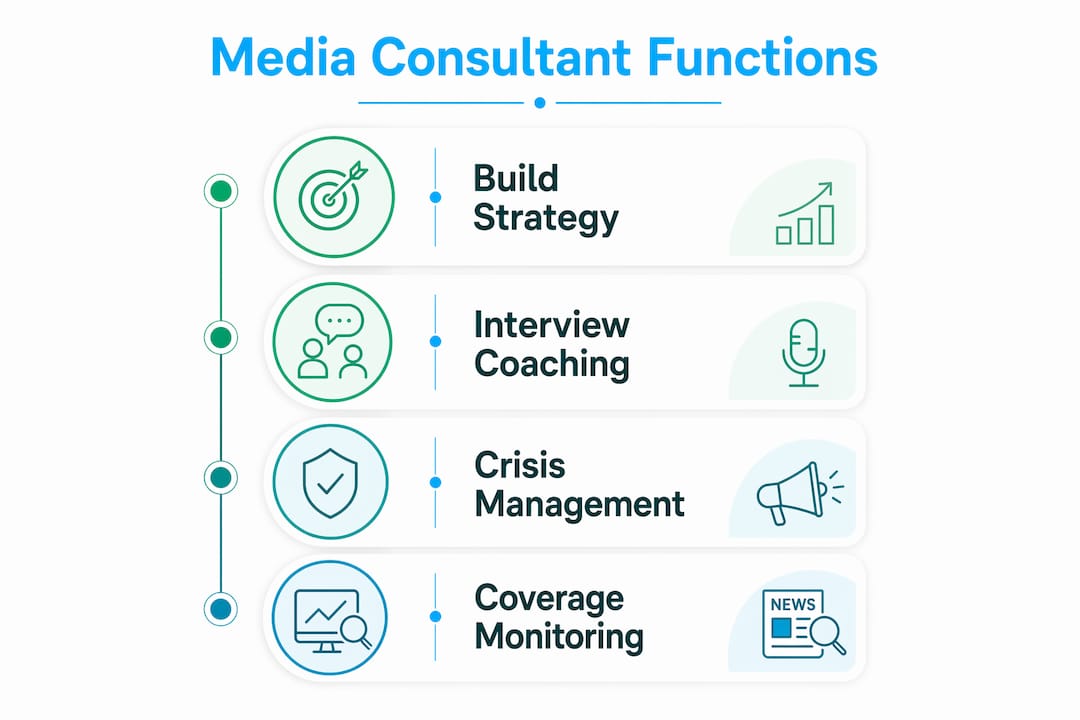
A media consultant for psychologists is a specialist who designs and implements communication strategies to present psychological practices to broader audiences. This role covers four core responsibilities: media strategy development, interview coaching, crisis management, and media coverage monitoring. Psychologists who work with media consultants gain a structured, ethical path to public visibility without sacrificing professional integrity. Goldman McCormick PR, named by Forbes Magazine as one of America’s Best PR Firms for 2021, works with professionals in exactly this capacity, translating clinical expertise into compelling public narratives.
What does a media consultant do for psychologists?
A media consultant performs four distinct functions for psychologists: building a media strategy, preparing clients for public appearances, managing reputational risks, and tracking how the practice appears across channels. Each function serves a specific purpose, and none of them overlap with clinical work.
Media strategy development means defining which outlets, formats, and messages align with a psychologist’s specialty. A trauma specialist, for example, targets different publications than a couples therapist. The consultant maps the right channels and builds a 90-day plan to reach them.

Interview coaching prepares psychologists to speak clearly and confidently on camera, on radio, or in print. Most clinicians are trained to listen, not to deliver tight, quotable answers under time pressure. A media consultant runs mock interviews, corrects pacing, and teaches psychologists how to translate clinical language into plain English without losing accuracy.
Crisis management addresses situations where a psychologist’s public image faces a threat. A misquoted comment in a news article, a complaint on a public forum, or a viral social media post can damage years of reputation-building. The consultant drafts responses, coordinates with journalists, and monitors the situation until it resolves.
Media coverage monitoring tracks every mention of the psychologist’s name, practice, or specialty across digital and traditional outlets. This data tells the consultant what is working and where gaps exist.
Pro Tip: Set a written policy for how you respond to direct messages and public comments before your media presence grows. Reactive decisions made under pressure are the most common source of ethical missteps in public communication.
How do media consultants help psychologists build content strategies?
A media consultant structures content so it builds authority, educates the public, and attracts clients without crossing ethical lines. The most practical framework divides content into four categories: 40% psychoeducation, 20% myth-busting, 20% behind-the-practice content, and 20% direct calls to action. This balance prevents clinician burnout and keeps the content calendar sustainable.
Niche targeting is the second pillar of a strong content strategy. A psychologist who emphasizes doctoral credentials and specialty assessments as solutions to specific client problems stands out from general therapists in a crowded market. The consultant helps define that niche and keeps all content aligned with it.
Platform tone matters as much as content topic. A post written for Psychology Today reads differently than a short video for a social media feed. The consultant adapts the same core message to fit each platform’s audience expectations and format requirements.
| Content pillar | Purpose |
|---|---|
| Psychoeducation (40%) | Builds credibility and public trust through accurate mental health information |
| Myth-busting (20%) | Corrects misconceptions and positions the psychologist as a reliable authority |
| Behind the practice (20%) | Humanizes the clinician and reduces client anxiety about seeking help |
| Calls to action (20%) | Converts audience interest into direct inquiries and appointment requests |
Content calendars and scheduling tools keep posting consistent without requiring daily attention. A consultant sets the calendar, writes or reviews the content, and schedules it in advance. The psychologist reviews and approves. This division of labor protects clinical time while maintaining a steady public presence. For psychologists looking to understand how content marketing builds visibility, the mechanics apply directly to practice growth.
What ethical boundaries must psychologists maintain in media and marketing?
Ethical boundaries in public communication are non-negotiable for psychologists. Diagnosing strangers online, promising treatment outcomes, or implying therapy is a quick fix violates professional standards and erodes public trust. A media consultant who understands the mental health field builds campaigns that stay well inside these lines.
Three practical rules govern ethical public communication for psychologists:
- Never discuss a specific person’s mental health in a public forum, even without naming them.
- Never guarantee results. Describe what therapy involves, not what it will produce.
- Never share client stories, even anonymized ones, without explicit written consent reviewed by a legal professional.
Confidentiality extends beyond the therapy room. A psychologist who posts about “a client I saw this week” risks a breach even when no name appears. The consultant’s job is to generate compelling content that never draws on protected information.
Focusing on one or two platforms rather than spreading across every channel reduces burnout and keeps the psychologist’s message consistent. The British Psychological Society recommends concentrated, intentional media presence for clinicians. Depth on one platform outperforms shallow activity on five.
Pro Tip: Write a one-page boundary document before launching any media campaign. Define which topics you will not address publicly, how you handle unsolicited mental health questions in comments, and who reviews content before it goes live.
How do media consultants convert public interest into client inquiries?
Public visibility means nothing without a clear path from interest to appointment. Clear, calm calls to action and a frictionless booking process are the two factors that determine whether media exposure produces actual clients. A media consultant designs both.
The most common failure point is a broken or confusing inquiry pathway. A psychologist appears on a podcast, generates real interest, and then sends listeners to a website with no booking link, a long contact form, and no explanation of next steps. The consultant fixes this before any media campaign launches.
A functional client conversion funnel follows five steps:
- Place a direct booking link in every media bio, social profile, and website header.
- Use a brief intake form with no more than five fields to reduce friction.
- Send an automated confirmation email within minutes of form submission.
- Include a clear explanation of what happens next, including timeline and first appointment format.
- Track lead attribution by asking every new client how they found the practice, then review that data every six months to cut underperforming channels.
The six-month review is not optional. Marketing channels that produce no inquiries after six months of consistent effort should be replaced, not maintained out of habit.
How do media consultants tailor strategies across different channels?
Media consultants adjust communication style and format based on the platform and its audience. A radio interview requires a different preparation than a written column. A LinkedIn article targets referring professionals, while a short video targets potential clients directly. The consultant manages these distinctions so the psychologist does not have to.
Platform selection matters more than platform quantity. A psychologist who commits to one digital channel and one traditional media outlet, such as a local newspaper column paired with a consistent podcast appearance schedule, builds a recognizable presence faster than one who posts sporadically across six platforms.
Key channel considerations a media consultant manages:
- Digital platforms: Tone is conversational, content is visual or short-form, and posting frequency is higher.
- Traditional media: Tone is formal, content is long-form or interview-based, and placement requires relationship-building with editors and producers.
- Professional directories: Profiles must emphasize specialty, credentials, and clear intake instructions rather than personality.
Peer groups and informal professional networks also form part of a psychologist’s media ecosystem. A consultant who understands this recommends participation in professional communities as a reputation-building tool, not just a support resource. For psychologists managing their digital footprint, a structured approach to online reputation management runs parallel to every media strategy.
Key Takeaways
A media consultant gives psychologists the structure, strategy, and ethical guardrails needed to build a credible public presence that converts into real client inquiries.
| Point | Details |
|---|---|
| Core consultant functions | Strategy, interview coaching, crisis management, and coverage monitoring form the foundation of the role. |
| Content mix framework | A 40/20/20/20 split across psychoeducation, myth-busting, behind-the-scenes, and calls to action sustains consistent output. |
| Ethical boundaries | Never diagnose publicly, promise outcomes, or share client information in any form without legal review. |
| Platform focus | Concentrating on one or two channels produces stronger results than spreading effort across many. |
| Conversion pathway | A direct booking link, brief intake form, and six-month channel review turn media exposure into appointments. |
Why psychologists underestimate the media consultant’s role
Most psychologists I work with assume media consulting is about getting press. It is not. The press is a byproduct. The real work is building a communication system that functions whether or not a journalist calls this week.
The psychologists who grow fastest are not the ones with the most media appearances. They are the ones with the clearest message, the most consistent presence, and the simplest path from public interest to first appointment. A media consultant builds that system. The psychologist runs the practice.
The ethical dimension is where I see the most anxiety, and the most unnecessary caution. Psychologists can speak publicly, share expertise, and attract clients without crossing a single professional boundary. The consultant’s job is to show exactly where that line sits and keep all communication well inside it. Ethical marketing and effective marketing are not opposites. They are the same thing done correctly.
Prioritize depth over breadth. One well-placed media appearance with a clear call to action outperforms ten scattered posts with no follow-through. Invest in the pathway before you invest in the exposure.
— Ryan McCormick
How Goldman McCormick PR supports psychologists in the media
Goldman McCormick PR has worked with professionals across industries since 2010, placing clients on television, radio, and in national print publications. For psychologists, that means translating clinical expertise into media-ready messaging that attracts the right clients and builds lasting public credibility.
Goldman McCormick PR handles media strategy, reputation management, interview preparation, and content planning, all built around the ethical standards psychologists must maintain. The firm produces nationally syndicated radio programs heard on the Genesis Communications Network and Starcom Radio Network, giving psychologist clients access to audiences that general PR firms cannot reach. To discuss a media strategy built for your practice, visit Goldman McCormick PR and connect with the team directly.
FAQ
What does a media consultant do for a psychologist?
A media consultant manages a psychologist’s public image by developing media strategies, coaching for interviews, handling reputation issues, and monitoring coverage across channels.
How do media consultants help psychologists attract clients?
They build clear calls to action and frictionless booking pathways so that media exposure converts directly into client inquiries rather than passive awareness.
What content should psychologists post on social media?
The recommended split is 40% psychoeducation, 20% myth-busting, 20% behind-the-practice content, and 20% direct calls to action, based on mental health marketing best practices.
How often should psychologists review their media strategy?
Psychologists should evaluate which channels produce client inquiries every six months and replace underperforming channels with better-aligned alternatives.
Can psychologists market themselves without violating ethics codes?
Yes. Ethical marketing focuses on sharing expertise, describing services accurately, and avoiding diagnoses or outcome guarantees in any public communication.