
An advocacy campaign in PR is a strategic, coordinated effort designed to influence public opinion or policy by motivating specific actions from targeted audiences. Unlike standard PR work focused on brand reputation, advocacy campaigns are cause-driven. They typically run 3–12 months and measure success through behavior change, media sentiment, and qualified engagement rather than impressions alone. Goldman McCormick PR earned a Gold Award in the “Best Cause/Advocacy Campaign” category at Bulldog Reporter’s CSR Awards in 2016, which reflects how seriously the field takes this discipline. The industry term is “cause advocacy,” and understanding what it means separates PR professionals who move public opinion from those who simply manage it.
What does an advocacy campaign mean in PR?
Cause advocacy in PR is a planned communication effort that asks a defined audience to take a specific, trackable action. That action might be signing a petition, contacting an elected official, or sharing a message with their community. The goal is not awareness alone. The goal is behavior change.
Standard PR campaigns protect or build a brand’s reputation. Advocacy campaigns go further. They align an organization with a cause and ask audiences to act on behalf of that cause. A nonprofit pushing for expanded healthcare access, for example, is not just raising awareness. It is asking legislators, donors, and community members to do something measurable.

The purpose of advocacy campaigns is to create pressure at specific decision points. That pressure comes from earned media, grassroots mobilization, and coordinated storytelling rather than paid placements. This is what separates cause advocacy from advertising.
How do advocacy campaigns differ from lobbying and advertising?
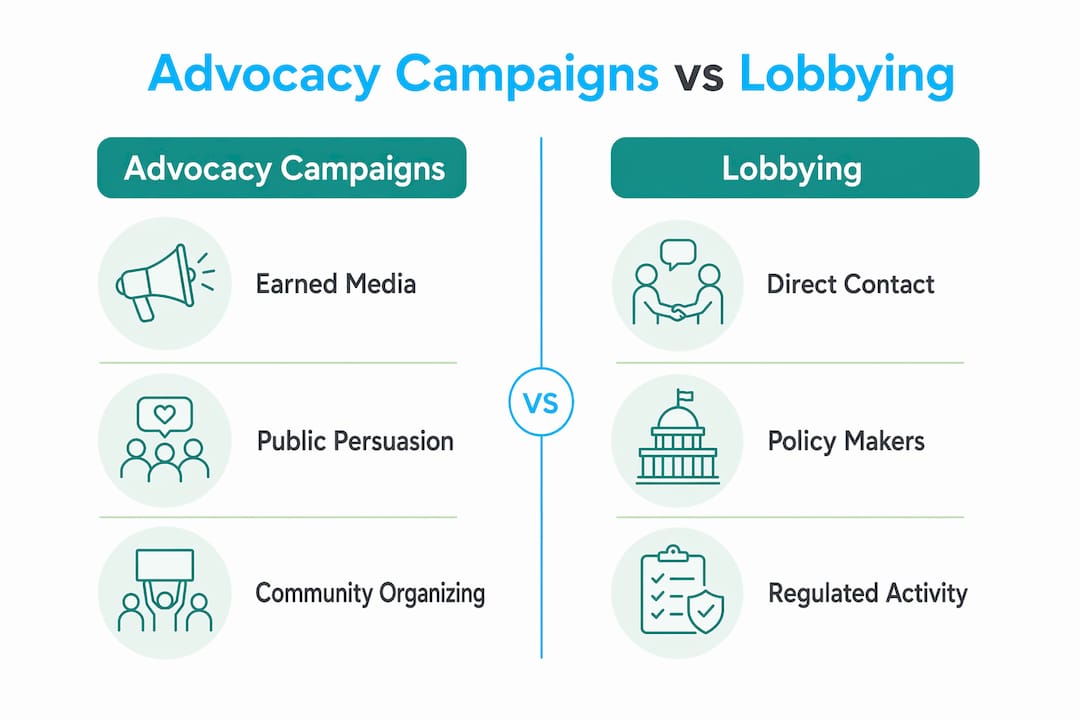
The three terms get confused constantly, and the confusion costs campaigns their focus. Lobbying involves direct contact with legislators or regulators, often by paid professionals with legal authority to represent an organization’s interests. Advocacy campaigns work through public persuasion, not private negotiation.
Advocacy advertising uses paid media placements to promote a cause or position. It is a subset of advocacy, not the whole picture. A full advocacy campaign in PR relies primarily on earned media: op-eds, press releases, journalist relationships, and grassroots organizing. Paid placements may support the effort, but they do not define it.
The table below shows the core distinctions:
| Method | Primary channel | Goal | Who initiates contact |
|---|---|---|---|
| Advocacy campaign | Earned media, grassroots | Shift public behavior or policy | PR team, community organizers |
| Lobbying | Direct legislative contact | Influence specific legislation | Registered lobbyists |
| Advocacy advertising | Paid media placements | Raise cause awareness at scale | Marketing or communications team |
The practical implication is clear. If your budget is limited and your timeline is 6–12 months, a cause advocacy approach through earned media and community mobilization delivers more durable results than a paid campaign that stops the moment the budget runs out.
What are the key components of a successful advocacy campaign?
Effective advocacy campaigns define a single, clear, trackable action before any messaging is written. Vague goals produce vague results. “Raise awareness” is not a campaign goal. “Generate 5,000 petition signatures by march 31” is.
The following steps form the foundation of a well-structured campaign:
- Define the ask. Identify one specific action you want your audience to take.
- Segment your audience. Separate influencers (those who shape opinion) from decision-makers (those who hold authority). These are not the same people, and they require different messages.
- Map your timeline. Set milestones at 30, 60, and 90 days. Campaigns that run 3–12 months without checkpoints lose momentum.
- Choose your channels. Op-eds, press releases, earned broadcast coverage, and grassroots events each serve different audience segments.
- Measure what matters. Track media sentiment, engagement quality, and behavior change. Impressions alone do not prove impact.
Pro Tip: Build your measurement framework before the campaign launches, not after. Retroactive metrics rarely capture the behavior changes that matter most to funders and stakeholders.
Audience segmentation deserves special attention. Confusing the target audience with the target influencer is one of the most common reasons advocacy campaigns stall. A campaign targeting city council members needs a different message than one targeting the residents who vote for them. Both groups matter. Neither group responds to the same appeal.
Why do ethics and transparency matter in advocacy?
Transparency is the defining difference between advocacy and propaganda. Propaganda manipulates. Advocacy persuades through honest, verifiable information while treating the audience’s interests as equal to the organization’s own.
The ethical obligations of a PR advocate include:
- Presenting facts accurately, even when they complicate the narrative
- Disclosing who funds the campaign and what outcome they seek
- Avoiding emotional manipulation that bypasses rational judgment
- Correcting errors publicly and promptly when they occur
PR professionals act as advocates at the intersection of strategy, ethics, and public trust. That position carries real responsibility. A campaign that wins a policy change through misleading messaging damages the organization’s credibility the moment the truth surfaces.
Pro Tip: Before publishing any campaign message, run it through a simple test: “Would we be comfortable if a journalist fact-checked every claim in this piece?” If the answer is no, revise it.
Building trust before asking for action is not optional. Audiences who perceive a campaign as self-serving or deceptive will not act, and they will tell others not to act either. Trust is the infrastructure that makes every other campaign element work.
How do PR teams and nonprofits apply advocacy campaigns in practice?
Advocacy campaigns work across a wide range of causes. Healthcare access, public education funding, environmental protections, and criminal justice reform have all been advanced through coordinated PR advocacy efforts. The common thread is a clear policy or behavior target combined with a community of people motivated to act.
Awareness and advocacy serve distinct purposes and should not be treated as interchangeable. Awareness builds recognition at the top of the funnel. Advocacy activates existing supporters to amplify a message through peer distribution and earned credibility. A nonprofit that skips the awareness phase and jumps straight to advocacy often finds it is preaching to an audience that does not yet understand the issue.
Multi-channel execution is the norm for effective campaigns. Earned broadcast coverage reaches broad audiences quickly. Op-eds in relevant publications establish credibility with decision-makers. Grassroots events create the visible community pressure that legislators and executives respond to. Podcasts have also become a channel for driving audience participation in advocacy efforts, particularly for causes that benefit from long-form storytelling.
The most common risks in advocacy campaigns include message drift, audience confusion, and ethical lapses under deadline pressure. Message drift happens when a campaign tries to serve too many audiences at once and loses its central ask. Audience confusion happens when influencers and decision-makers receive identical messages. Ethical lapses happen when teams prioritize speed over accuracy. All three risks are preventable with clear planning and regular milestone reviews.
Key Takeaways
Cause advocacy in PR succeeds when campaigns define a single trackable action, separate influencers from decision-makers, and build trust through transparent messaging before asking audiences to act.
| Point | Details |
|---|---|
| Advocacy vs. standard PR | Advocacy campaigns drive behavior change; standard PR protects brand reputation. |
| Earned media is the core channel | Op-eds, press releases, and grassroots efforts outperform paid placements for long-term impact. |
| Segment your audience precisely | Influencers and decision-makers need different messages and different calls to action. |
| Transparency prevents failure | Campaigns perceived as deceptive lose audience trust and campaign momentum simultaneously. |
| Measure behavior, not impressions | Track petition signatures, official contacts, and sentiment shifts rather than raw reach. |
Why I think most advocacy campaigns fail before they launch
After years of working in PR and media, the pattern I see most often is not a messaging problem. It is a planning problem. Organizations decide they want to run an advocacy campaign, assign it to a communications team, and then spend the first two months debating the tagline. By the time the campaign launches, half the timeline is gone.
The second failure I see constantly is the influencer-versus-decision-maker confusion. A campaign targeting hospital administrators about funding reform cannot use the same message it sends to community members. One group controls the budget. The other group creates political pressure. Treating them identically wastes both messages.
The campaigns I have seen succeed share one trait: they built trust with their audience before they asked for anything. That means publishing credible content, showing up in earned media, and demonstrating that the organization understands the issue at a level deeper than a talking point. You cannot shortcut that phase. Audiences know when they are being asked to carry water for someone else’s agenda. The PR insight that matters most here is simple: earn the right to ask before you ask.
— Ryan McCormick
How Goldman McCormick PR approaches advocacy campaign strategy
Goldman McCormick PR has built cause advocacy campaigns that earn real media coverage and move real audiences to act. Named by Forbes Magazine as one of America’s Best PR Firms for 2021, the firm brings media relationships, storytelling expertise, and earned coverage across TV, radio, and print to every campaign it runs.
Nonprofits and organizations that need a structured advocacy campaign, from initial audience mapping through earned media execution, can work directly with Goldman McCormick PR. The firm’s track record includes a Gold Award for Best Cause/Advocacy Campaign from Bulldog Reporter’s CSR Awards. Contact Goldman McCormick PR to discuss how a coordinated advocacy effort can advance your cause with the credibility and reach it deserves.
FAQ
What is the advocacy campaign definition in PR?
An advocacy campaign in PR is a coordinated communication effort designed to influence public opinion or policy by motivating a specific, trackable audience action. It relies primarily on earned media, storytelling, and grassroots mobilization rather than paid advertising.
How long does a PR advocacy campaign typically run?
Most advocacy campaigns run 3–12 months, with milestone reviews at regular intervals to track behavior change, media sentiment, and engagement quality.
What is the difference between cause advocacy and lobbying?
Cause advocacy works through public persuasion using earned media and community organizing. Lobbying involves direct contact with legislators or regulators, typically by registered professionals representing a client’s legal interests.
Why do advocacy campaigns fail?
The most common causes of failure are confusing influencers with decision-makers, launching without a single trackable ask, and losing audience trust through messaging that appears self-serving or inaccurate.
What metrics measure advocacy campaign success?
Effective campaigns track behavior changes such as petition signatures and official contacts, media sentiment shifts, and qualified engagement rather than raw impressions or reach.