
Mental health professionals need publicists because expert public relations converts clinical credibility into the kind of trusted, visible authority that patients actually find and act on. 84.1% of U.S. consumers seeking medical information online use search engines first, making digital visibility a direct line to client connection. Research published in Scientific Reports confirms that patient trust rises when health information is interpersonal, transparent, and interactive. At the same time, findings from JAMA Psychiatry and Nature Reviews Psychology show that mental health messaging without expert oversight can reduce stigma and accidentally increase self-diagnosis risk. Public relations, known in the industry as earned media strategy, is the discipline that manages all of this at once.
Why mental health professionals need publicists to build trust
Public relations is a trust mechanism, not just a marketing channel. A 2026 Scientific Reports study of 517 adults found that patient trust is highest when health information is interpersonal, transparent, and interactive, and lowest when web content is non-transparent with low interactivity. That finding has a direct implication: a therapist’s static website bio does almost nothing to build the kind of trust that converts a visitor into a client.
Publicists close that gap by securing earned media placements, TV appearances, radio interviews, and print features that carry third-party credibility no self-published content can replicate. A 2026 Springer Nature study using Health Information National Trends Survey data found that exposure to conflicting or inaccurate health information reduces patient trust sharply. Patient-centered communication, the kind publicists are trained to craft, reduces reliance on social media misinformation and rebuilds that trust.
The practical takeaway is that mental health public relations packages trust signals. Publicists align a clinician’s public messaging with clinical evidence and regulatory standards while keeping it engaging for general audiences. This is what reputation architecture for regulated mental health looks like in practice: message design that protects the professional and serves the public simultaneously.
- Earned media placements signal third-party validation that patients weight more heavily than self-promotion
- Transparent, interactive communication formats (podcast interviews, live Q&A segments) outperform static web profiles on trust metrics
- Publicists monitor and counter misinformation narratives before they erode a clinician’s reputation
- Patient-centered storytelling reduces the cognitive load of health decisions and increases help-seeking behavior
Pro Tip: Ask any publicist you consider hiring to show you a specific example of a trust-building media placement they secured for a health professional, not just a press release. The difference between a quote in a trade journal and a segment on a local news broadcast is enormous in terms of patient trust.
How publicists support stigma reduction and mental health advocacy
Stigma reduction is not a soft goal. It is a measurable public health outcome, and publicists are the professionals who execute the campaigns that achieve it. The ARTEMIS randomized clinical trial, published in JAMA Psychiatry in 2026, found that a multimedia anti-stigma campaign combined with health worker-led digital intervention improved adolescent mental health knowledge, attitudes, and behaviors in real communities.

That result matters because it proves that PR campaigns function as public health interventions, not just reputation management exercises. Mental health professionals who engage publicists for advocacy work are contributing to population-level change, not just growing a practice.
The risk, however, is real. A 2026 Nature Reviews Psychology synthesis found that awareness messaging can increase self-diagnosis risk when it is not carefully designed. Publicists with mental health experience implement message guardrails, including terminology checklists, resource accuracy verification, and clinical disclaimers, to prevent unintended harm.
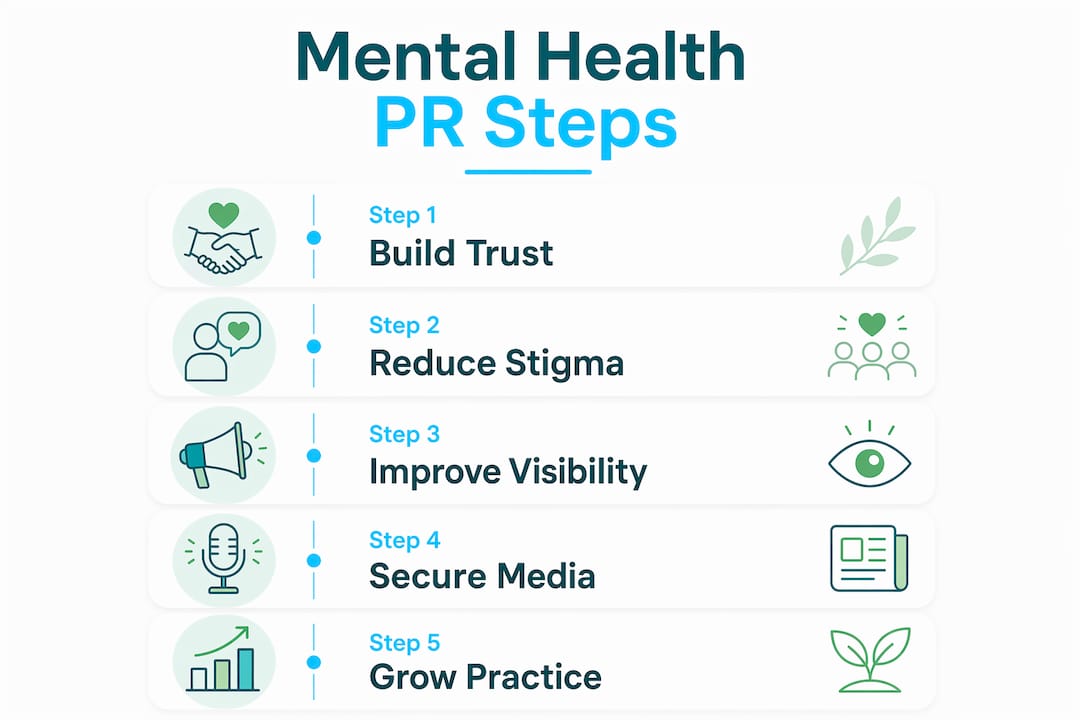
A well-run mental health PR advocacy campaign follows this sequence:
- Define the target population and the specific stigma barrier being addressed
- Develop messaging aligned with clinical evidence and reviewed by a licensed clinician
- Select media formats proven to reach that population (multimedia, podcasts, community radio)
- Build in message safety checks before any content goes public
- Measure knowledge and attitude shifts post-campaign to document impact
“Stigma reduction PR campaigns function as public health communication interventions, with measurable population-level knowledge and attitude improvements.” — JAMA Psychiatry, ARTEMIS Trial, 2026
Does digital discovery make publicists essential for therapists?
The short answer is yes. Stand-alone online profiles and website content typically fail to achieve the repeated third-party validation that earned media provides. A therapist with a well-designed website but no media presence is invisible to the algorithms that now curate health information for millions of people.
Publicists solve this by converting a clinician’s expertise into citable, third-party-validated narratives that AI systems and search engines prefer. Serenity Mental Health Centers made this move explicitly, selecting Trevelino/Keller to expand national visibility and thought leadership through earned media. That decision reflects a clear understanding that media coverage, not web copy, drives discovery in AI-powered search environments.
| Visibility Method | Third-Party Validation | AI Search Favorability | Patient Trust Signal |
|---|---|---|---|
| Clinician website | None | Low | Low |
| Social media profile | Low | Low | Low |
| Earned media coverage | High | High | High |
| Podcast or radio feature | High | Medium | High |
Pro Tip: Mental health professionals who contribute expert commentary to outlets like Psychology Today, NPR Health, or local TV news generate the kind of citable content that AI systems pull from when answering health questions. A publicist’s job is to get you into those outlets consistently.
What to expect from a mental health publicist
The benefits of publicists for therapists go beyond press releases. A qualified mental health publicist delivers a specific set of services that directly address the trust, visibility, and advocacy challenges clinicians face.
- Message design: All public content is aligned with clinical evidence and reviewed for regulatory compliance before distribution
- Earned media targeting: Publicists pitch TV, radio, print, and podcast opportunities that reach the right audience with credible third-party framing
- Boundary communication: Clear protocols prevent messaging from crossing into territory that could cause harm or invite regulatory scrutiny
- Patient-centered storytelling: Narratives focus on the patient experience and help-seeking journey, not the clinician’s credentials alone
- Multimedia amplification: Campaigns use multiple formats, from video segments to nationally syndicated radio, to reach diverse audiences and build repeated exposure
Growing a mental health practice through PR requires consistency. One media placement builds awareness. Ten placements over six months build authority. Publicists manage that cadence so clinicians can stay focused on clinical work. For mental health professionals exploring how earned media contributes to long-term trust, PR insights for health experts offer a practical starting point.
Key Takeaways
Mental health professionals who work with publicists gain credible, earned media visibility that builds patient trust, supports stigma reduction, and drives discovery in AI-powered search environments.
| Point | Details |
|---|---|
| Trust requires earned media | Static websites do not generate the third-party validation patients use to evaluate clinicians. |
| Stigma campaigns need expert oversight | PR messaging without clinical guardrails can increase self-diagnosis risk, per Nature Reviews Psychology. |
| Search drives patient discovery | 84.1% of consumers use search engines first for health information, making media visibility non-optional. |
| Message safety is a PR responsibility | Publicists implement terminology checklists and disclaimers to prevent unintended harm from awareness content. |
| Consistency builds authority | Repeated media placements over time establish a clinician as a trusted public voice, not a one-time source. |
What I have learned from watching mental health PR done right and wrong
I have watched mental health professionals make the same mistake for years. They wait until something goes wrong, a negative review, a misquoted interview, a competitor dominating local search, before they think about public relations. By then, the trust deficit is already real.
The professionals who get this right treat PR as a clinical communication tool, not a marketing expense. They understand that the public’s relationship with mental health information is fragile. Misinformation spreads faster than corrections. A single poorly framed awareness post can do more harm than good, as the Nature Reviews Psychology research confirms. That is not a reason to stay silent. It is a reason to get professional help with your public voice.
What I find most underestimated is the role of podcast and radio media in building genuine connection with potential clients. A therapist who speaks for 20 minutes on a syndicated radio program reaches an audience that already trusts the host. That borrowed credibility is worth more than a year of social media posts. The mental health professionals who build lasting practices are the ones who show up consistently in formats people trust.
— Ryan McCormick
Goldman McCormick PR and mental health professionals
Goldman McCormick PR has worked with clients across regulated industries since 2010, earning recognition from Forbes Magazine as one of America’s Best PR Firms for 2021. The firm specializes in TV, radio, newspaper, and podcast placements, including nationally syndicated programs on the Genesis Communications Network and Starcom Radio Network.
For mental health professionals, that reach translates directly into the kind of credible, repeated media exposure that builds patient trust and community authority. Goldman McCormick PR brings the editorial relationships and message discipline that clinicians need to communicate safely and effectively in public. If you are ready to build a media presence that reflects the quality of your clinical work, contact Goldman McCormick PR to discuss a PR approach built for your practice.
FAQ
Why do therapists need PR support beyond a website?
Websites provide no third-party validation. Publicists secure earned media coverage that signals credibility to both patients and AI-driven search platforms.
What is the risk of mental health awareness campaigns without a publicist?
Research published in Nature Reviews Psychology found that poorly designed awareness messaging can increase self-diagnosis risk. Publicists implement message guardrails to prevent that outcome.
How does earned media improve a mental health professional’s search visibility?
AI systems and search engines favor citable, third-party-validated content. Earned media placements create exactly that, making clinicians more discoverable when patients search for help.
What does a mental health publicist actually do day to day?
A mental health publicist pitches media opportunities, designs clinically aligned messaging, manages campaign consistency, and monitors public narratives to protect the clinician’s reputation.
How long does it take for mental health PR to show results?
A single placement builds awareness. Sustained results, including measurable trust and discovery gains, typically require a consistent campaign over several months.